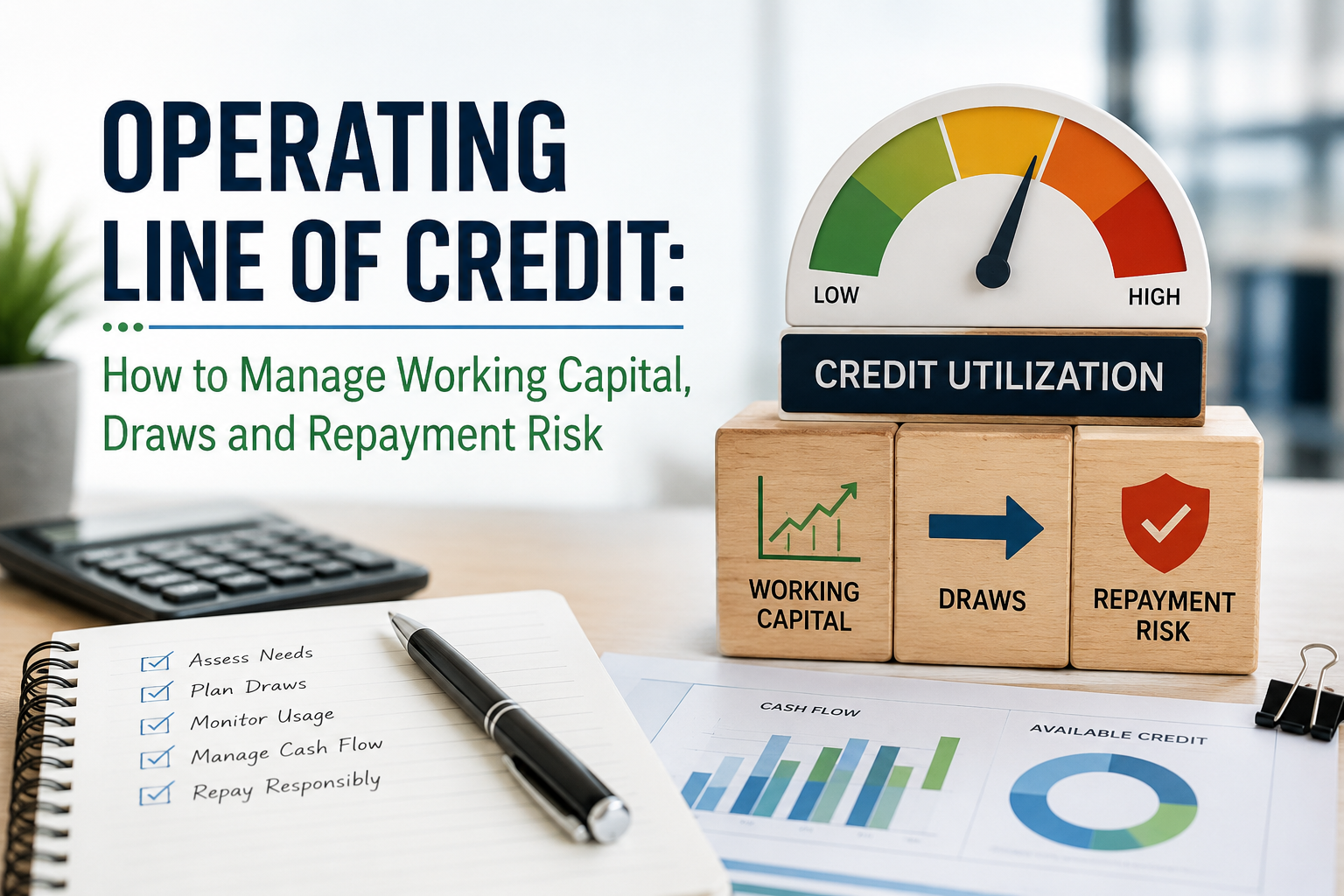
An operating line of credit can give a business flexible access to funding for short-term operating needs without requiring the company to borrow one large lump sum at the beginning.
It may help a business manage temporary gaps involving:
- inventory purchases
- payroll timing
- supplier payments
- materials
- accounts receivable
- seasonal expenses
- contract costs
- short-term working-capital requirements
The defining idea is revolving access.
A business may draw funds when permitted, repay some or all of the outstanding balance, and potentially reuse available credit while the facility remains open and subject to the lender’s terms.
That flexibility can be extremely useful.
But flexibility creates its own risk.
A business that continually draws from an operating line of credit without allowing the balance to fall may gradually convert a short-term cash-management tool into permanent debt.
The central question is therefore not:
How large a credit line can the business obtain?
It is:
Can the business draw for a legitimate operating need, convert that spending into incoming cash, repay the draw, and restore available credit before the next operating cycle?
For a broader explanation of revolving business credit, see Kevanzo’s business line of credit guide.
Educational note: Kevanzo.com provides general business-financing education only. Kevanzo is not a lender, broker, loan marketplace, financial adviser, attorney, accountant, or approval service. Interest rates, APRs, fees, credit limits, collateral requirements, guarantees, repayment structures, renewal terms, eligibility requirements, and available financing products vary by lender and borrower. Always review the complete agreement before accepting business financing.
What an Operating Line of Credit Means
An operating line of credit is generally a revolving business-credit facility intended to help finance recurring or temporary operating requirements.
Unlike a conventional term loan, the business does not necessarily receive the entire approved amount immediately.
Suppose a company has a:
$100,000 operating line of credit
but currently requires only:
$25,000
The business may be able to draw $25,000 rather than borrowing the entire $100,000, depending on the lender’s agreement.
If that $25,000 is later repaid, some or all of that borrowing capacity may become available again.
That creates a cycle:
available credit → draw → operating use → incoming business cash → repayment → restored available credit
The strength of an operating line of credit depends heavily on whether that cycle actually occurs.
Why Businesses Use Operating Lines of Credit
Businesses rarely receive and spend cash at perfectly matched times.
A company might need to pay suppliers on Monday while a major customer does not pay until the following Friday.
A contractor may need materials before receiving a progress payment.
A wholesaler may purchase inventory months before the busiest selling season.
A professional-services company may pay employees every two weeks while commercial customers pay invoices in 30, 45, or 60 days.
An operating line of credit can potentially bridge those timing differences.
That is very different from borrowing because the underlying business is consistently losing money.
The Kevanzo Operating-Cycle Map
Before using an operating line of credit, map the complete operating cycle.
Identify four points.
1. Cash Goes Out
What must be paid?
Examples:
- inventory
- materials
- payroll
- suppliers
- freight
- insurance
- operating expenses
2. Credit Is Drawn
How much additional cash does the business actually require?
3. Business Activity Generates Cash
What event should produce the money needed to repay the draw?
Examples:
- customer invoice payment
- seasonal sales
- completion of a contract
- inventory sale
4. The Draw Is Repaid
When should the borrowed amount return to the lender?
A healthy revolving-credit cycle should contain all four stages.
If Step 4 repeatedly fails to occur, the business should investigate why.
Temporary Cash Gap Versus Structural Cash Problem
This distinction is critical.
Temporary Cash Gap
The business is fundamentally profitable, but cash receipts and expenses occur at different times.
Example:
A distributor must buy $40,000 of inventory today.
Customers are expected to pay $65,000 over the next 45 days.
The timing is uncomfortable, but there is an identifiable source of repayment.
Structural Cash Problem
The company continually spends more than it generates.
Example:
The business loses $15,000 every month and uses its operating line of credit to fill the difference.
There is no clear operating event that restores the borrowed funds.
An operating line of credit may temporarily hide this problem, but it does not repair the economics of the business.
The Kevanzo Temporary-or-Structural Test
Ask:
If the credit line disappeared tomorrow, what specific cash-flow event would be missing?
If the answer is:
We would have enough cash overall, but customers pay after our supplier bills become due.
that suggests a timing problem.
If the answer is:
We simply do not generate enough money to pay normal expenses.
that indicates a deeper operating problem.
The financing decision should reflect the difference.
How an Operating Line of Credit May Work
A lender may approve a maximum credit limit.
The business can potentially draw up to the amount permitted under the facility.
For example:
Credit limit: $150,000
Current balance: $40,000
Potential unused availability: $110,000
If the business repays $20,000, the unused availability could potentially increase, subject to the lender’s terms.
This revolving structure is one reason an operating line of credit may suit businesses with repeat working-capital requirements.
Businesses with smaller recurring needs may also want to compare a small business line of credit.
Operating Line of Credit Versus a Term Loan
The fundamental difference is flexibility.
Operating Line of Credit
Typically:
- revolving
- draws made as needed
- available credit can potentially be reused
- designed mainly for shorter operating cycles
Term Loan
Typically:
- one lump-sum advance
- defined repayment schedule
- clearer payoff path
- may be suitable for a specific one-time expenditure
A business purchasing long-life equipment may prefer predictable term financing.
A company repeatedly financing 45-day inventory cycles may find revolving credit more closely matched to the need.
The Kevanzo Purpose-to-Structure Test
Match the financing structure to the economic life of the business need.
Very Short Need
Examples:
- 30-day customer-payment gap
- short supplier timing issue
Potential match:
operating line of credit
Recurring Short-Term Need
Examples:
- inventory cycles
- seasonal working capital
- repeat contract mobilization
Potential match:
operating line of credit or other working-capital facility
Longer-Term Need
Examples:
- major machinery
- expansion
- facility improvements
Potential match:
term financing or another longer-duration structure
Do not automatically finance a five-year asset through a facility designed around short operating cycles.
Draw Discipline
A credit line can feel less restrictive than a term loan because money remains available.
That psychological difference matters.
A company with $100,000 of available credit may begin treating the facility like additional revenue.
It is not revenue.
It is borrowed money.
Each draw creates a financial obligation.
The Kevanzo Draw-Purpose Rule
Before every draw, write down:
Amount needed
Exact business purpose
Expected cash source for repayment
Expected repayment date
Example:
Draw: $25,000
Purpose: seasonal inventory
Expected cash source: product sales
Expected repayment period: approximately 60 days
That is far stronger than:
We have credit available, so we might as well use it.
The Draw-to-Cash Match
The repayment source should connect logically to the reason the business borrowed.
For example:
Inventory Draw
Draw funds → purchase inventory → sell inventory → collect customer cash → repay draw.
Receivables Gap
Draw funds → meet operating expenses → customer pays outstanding receivable → repay draw.
Contract Mobilization
Draw funds → purchase materials/pay startup costs → perform contract → customer pays → repay draw.
This relationship is the draw-to-cash match.
The clearer the match, the easier it becomes to judge whether revolving credit is serving its intended purpose.
Operating Line of Credit for Working Capital
Working capital broadly involves resources needed to support normal business operations.
An operating line of credit can provide one form of working-capital flexibility.
Businesses should also compare working capital loans when deciding whether revolving access or a fixed advance is more appropriate.
An operating line can be particularly useful when working-capital requirements:
- repeat
- vary in size
- arise at different times
- can be repaid from normal cash conversion
A one-time working-capital loan may be easier to manage when the business knows precisely how much money it needs.
Operating Line of Credit Versus Working Capital Loans for Small Business
Working capital loans for small business may provide financing through several different structures.
The major question is whether the company needs:
one amount
or:
ongoing access.
Consider two businesses.
Business A
Needs $60,000 one time to build inventory for a known expansion.
A fixed funding structure may work.
Business B
Needs between $10,000 and $40,000 at different points throughout the year as receivables and inventory fluctuate.
Revolving access may fit better.
Operating Line of Credit Versus Cash Flow Loans
Cash flow loans for small business focus more broadly on financing supported by business cash generation and repayment ability.
An operating line of credit specifically emphasizes reusable access.
This distinction becomes important when the funding requirement repeatedly disappears and returns.
A business that needs funds only once may not need a revolving facility.
Operating Line of Credit Versus Invoice Financing
invoice financing for small business ties funding more directly to eligible unpaid invoices.
An operating line of credit may provide broader flexibility.
Suppose a business needs cash because $80,000 of customer invoices are still outstanding.
Invoice financing may match that exact problem.
Now suppose the business needs funding for:
- inventory
- payroll
- supplier deposits
- several operating expenses
A broader operating credit line may provide more flexibility.
Operating Line of Credit Versus Small Business Capital Loans
small business capital loans can support a much wider range of business requirements, including longer-term investments.
Operating credit is generally better viewed as liquidity infrastructure rather than permanent capital.
That distinction helps protect the business from financing long-lived investments with short-cycle debt.
Operating Line of Credit Versus a Short-Term Business Loan
A short-term business loan usually creates a defined advance and repayment obligation.
An operating line of credit usually provides reusable borrowing capacity.
If the business knows:
- exact amount required
- exact purpose
- exact repayment path
a short-term loan may be simpler.
If funding needs vary month to month, revolving access may have greater value.
Operating Line of Credit Versus Quick Business Loans
Businesses facing an urgent cash requirement may also compare quick business loans.
Do not let speed override structure.
A fast lump-sum loan and a revolving line solve different problems.
The better choice depends on:
- purpose
- duration
- cost
- repayment timing
- expected reuse
- cash-flow pressure
Secured Operating Lines of Credit
Some operating lines may be secured.
Potential security can involve:
- receivables
- inventory
- business equipment
- other business assets
The exact structure depends on the lender and agreement.
Security can reduce lender exposure, but it also matters to the borrower because default may place pledged assets at risk.
Asset-Based Revolving Credit
Some working-capital facilities calculate borrowing availability partly from eligible assets such as receivables and inventory.
This is often called a borrowing base.
A simplified example might look like:
Eligible receivables: $100,000
Eligible inventory: $50,000
The lender may apply its own advance rules and eligibility requirements to determine available borrowing capacity.
Not every dollar of receivables or inventory necessarily counts.
The agreement controls.
The Kevanzo Borrowing-Base Check
If a line relies on receivables or inventory, determine:
- Which assets are eligible?
- Which assets are excluded?
- How often must reporting be supplied?
- Can borrowing availability decline?
- What happens if receivables age?
- What happens if inventory value changes?
- Can the lender require repayment if availability falls?
Borrowing-base fluctuations can materially affect liquidity.
Current SBA Working-Capital Lines
The U.S. Small Business Administration currently operates the 7(a) Working Capital Pilot, which provides monitored lines of credit within the SBA 7(a) program. SBA says the program can support transaction-based or asset-based working-capital financing and may include advances connected to accounts receivable or inventory. Current SBA information lists WCP lines of credit of up to $5 million.
SBA’s current lender materials also describe revolving working-capital structures designed around recurring or short-term needs and repayment as short-term business assets convert back into cash.
That makes the cash-conversion principle especially important:
draw → operate → convert short-term assets into cash → repay
The SBA WCP program guide was updated effective January 26, 2026, so borrowers researching SBA-backed working-capital financing should always rely on current SBA materials rather than old summaries.
Unsecured Operating Lines of Credit
Some businesses may compare an operating line that does not require the same specifically pledged collateral structure.
An unsecured business line of credit may instead rely heavily on factors such as:
- cash flow
- revenue
- business credit
- personal credit
- time in business
- repayment history
- guarantees
“Unsecured” should not automatically be interpreted as:
- no personal guarantee
- no lender protections
- no default consequences
- no broader security provisions
Read the agreement.
Interest and Other Costs
An operating line of credit may involve several possible costs.
These can include:
- interest
- draw fees
- origination charges
- annual fees
- maintenance fees
- renewal fees
- late charges
- unused-line fees in some structures
- other contractual charges
Not every lender uses every fee.
The comparison should therefore go beyond the stated interest rate.
The Kevanzo True-Cost-of-Access Test
Divide costs into three groups.
Cost to Establish the Line
Possible examples:
- origination
- setup
- documentation
Cost to Keep the Line Available
Possible examples:
- annual fee
- maintenance fee
- renewal fee
Cost to Actually Use the Line
Possible examples:
- interest
- draw fee
- transaction charges
This reveals something important.
A credit line can cost money even when relatively little is borrowed.
Interest Only on Amount Used
Some revolving facilities charge interest primarily on the outstanding amount rather than the full approved limit.
SBA currently describes the Working Capital Pilot as a line-of-credit structure in which interest is charged while the loan is in use.
That can make revolving credit efficient when the business:
- draws selectively
- repays quickly
- avoids carrying unnecessary balances
But it does not mean the entire arrangement is free when unused.
Other fees may still apply depending on the agreement.
The Kevanzo Utilization Ratio
Track:
outstanding balance ÷ total available credit
Suppose:
Credit limit: $100,000
Outstanding balance: $20,000
Utilization:
20%
Now suppose:
Outstanding balance: $95,000
Utilization:
95%
High utilization is not automatically wrong.
A business may intentionally use most of its facility during peak season.
But continuously high utilization can signal that the line is no longer functioning as temporary liquidity.
The 30-60-90 Utilization Test
Review the operating line at three intervals.
Last 30 Days
What was average utilization?
Last 60 Days
Did the balance materially decline?
Last 90 Days
Did the facility complete at least one meaningful repayment cycle?
This gives management a better picture than looking only at today’s balance.
The Zero-Balance Test
A particularly useful question is:
Does the operating line ever return to zero—or close to zero?
It does not necessarily need to reach zero every month.
Seasonality can make that unrealistic.
But if the balance has grown continuously for:
- six months
- nine months
- twelve months
without a meaningful reduction, the business should investigate.
Possible causes include:
- insufficient margins
- weak collections
- excess inventory
- declining revenue
- rising costs
- excessive withdrawals
- too much existing debt
The Kevanzo Reset Test
Define a target period in which the operating line should materially reset.
Example:
Peak-season borrowing reaches: $80,000
Expected post-season balance: under $20,000
Actual post-season balance: $72,000
That is a warning.
The business expected the operating cycle to repay the line, but the reset did not happen.
Credit-Line Creep
Credit-line creep occurs when yesterday’s temporary borrowing becomes today’s permanent balance.
Example:
January balance: $20,000
March: $35,000
May: $50,000
July: $65,000
September: $80,000
The business may still make every required payment.
But the underlying balance keeps climbing.
That deserves attention before the facility reaches its limit.
The Kevanzo Credit-Line Creep Check
Compare:
current balance
with:
balance 90 days ago
and:
balance 180 days ago
Then ask:
- Is utilization rising?
- Is revenue rising equally?
- Are receivables rising?
- Is inventory rising?
- Are margins falling?
- Is debt replacing operating cash?
The trend matters more than a single snapshot.
Available Credit Is a Liquidity Buffer
Unused availability can have value.
Suppose a business has:
Credit limit: $150,000
Current balance: $40,000
Unused availability: $110,000
That unused capacity may help the business respond to an unexpected working-capital requirement.
Now imagine the balance is:
$145,000
Only $5,000 remains available.
The business has lost most of its financing flexibility.
The Kevanzo Available-Credit Buffer
Calculate:
credit limit − outstanding balance = available-credit buffer
Then ask:
Would this remaining buffer still protect the business during a realistic operating disruption?
If not, the facility may already be too heavily used.
Never Treat the Credit Limit as Cash
A $200,000 credit limit does not mean the business has $200,000 of additional wealth.
It means the lender may permit borrowing up to defined limits and subject to agreement conditions.
Credit availability can potentially change because of:
- lender review
- borrowing-base changes
- covenant violations
- business deterioration
- renewal decisions
- default
- agreement provisions
Businesses should maintain independent liquidity where possible rather than assuming credit will always remain available.
Renewal Risk
Some operating lines must periodically be reviewed or renewed.
That creates renewal risk.
A business that depends completely on a revolving line may face pressure if:
- the line is reduced
- terms change
- collateral requirements change
- renewal is declined
- lender appetite changes
The company should understand the facility’s maturity and renewal provisions well before the review date.
The Kevanzo Renewal-Dependence Test
Ask:
If this line were reduced by 25% at renewal, could the business continue operating?
Then test:
50% reduction
Finally:
complete non-renewal
This is not a prediction that the lender will reduce the facility.
It is a resilience test.
A business with no alternative liquidity may be excessively dependent on the line.
Fixed Versus Variable Interest
Some operating lines may have variable pricing.
A variable interest rate can change over time according to the agreement.
That means a facility affordable today could become more expensive if the applicable rate rises.
Businesses should model repayment using more than one rate scenario.
The Kevanzo Rate-Stress Test
Calculate the cost under:
Current Rate
Normal scenario.
Moderately Higher Rate
Stress scenario.
Significantly Higher Rate
Severe scenario.
Then ask:
Could normal operating cash still service the line comfortably?
The purpose is not to predict rates.
It is to understand financing resilience.
Payment Frequency Matters
Different business-credit products can require:
- monthly payments
- weekly payments
- other payment schedules
The frequency affects cash flow.
A business whose customers pay monthly may find very frequent repayment more difficult to manage.
Always compare the repayment schedule with the company’s actual cash-conversion cycle.
The Kevanzo Payment-to-Cash Match
Write down:
customer cash-arrival pattern
and:
credit repayment pattern
Example:
Customer collections: mainly monthly
Credit repayment: weekly
That mismatch deserves review.
A financing product should support the business cash cycle rather than continually run ahead of it.
Accounts Receivable and Operating Credit
Receivables can create a natural use case for operating credit.
Example:
A company completes $100,000 of work.
Customers pay in approximately 45 days.
Payroll and suppliers must be paid before then.
The company draws $30,000.
Customers pay.
The business repays $30,000.
This is a clean operating cycle.
If customers begin paying in 90 days instead of 45 days, the economics change.
The company may carry the balance for much longer than expected.
Inventory and Operating Credit
Inventory is another common working-capital use.
Consider a seasonal retailer.
August:
Buys inventory.
September:
Begins seasonal sales.
October:
Sales accelerate.
November:
Cash collections peak.
December:
Operating-line balance is repaid.
The financing duration roughly matches the inventory-conversion cycle.
But unsold inventory can disrupt that plan.
That is why inventory purchases financed with revolving credit still require conservative sales assumptions.
The Kevanzo Inventory Conversion Test
Before drawing for inventory, estimate:
- Purchase date
- Selling period
- Expected gross margin
- Expected cash-collection date
- Planned repayment date
- Slow-sales scenario
Do not base repayment entirely on the best sales forecast.
Payroll and Operating Credit
Payroll can create a legitimate temporary financing need.
For example:
employees must be paid Friday while customer receivables settle the following Tuesday.
A short draw may bridge the gap.
But persistent payroll borrowing deserves examination.
If the business must borrow every week simply to meet payroll, management should inspect:
- margins
- staffing cost
- revenue
- collections
- customer terms
- overhead
Temporary payroll timing is different from permanently financing payroll losses.
Seven Operating Line of Credit Scenarios
Scenario 1: Seasonal Retailer
A retailer needs $60,000 to purchase inventory before its peak season.
It expects the inventory to convert to cash over approximately three months.
An operating line of credit may fit if:
- demand assumptions are reasonable
- margins support the financing cost
- sales generate repayment
- the balance declines after the season
Scenario 2: Commercial Contractor
A contractor wins a new project.
It needs:
- materials
- subcontractor deposits
- payroll
before receiving the first progress payment.
The line could help mobilize the project.
The contractor should map repayment to contract receipts.
Scenario 3: Professional-Services Company
A firm bills commercial customers on Net 45 terms but pays employees every two weeks.
An operating line may help manage that mismatch.
If customers begin paying later, the firm should rerun its stress test.
Scenario 4: Wholesaler
A wholesaler continuously buys inventory and waits for retail customers to pay.
Recurring working-capital requirements may make a revolving facility more appropriate than repeated individual loans.
Scenario 5: Growing Business
Revenue increases rapidly.
So do:
- receivables
- inventory
- payroll
- supplier requirements
Growth itself can consume cash.
An operating line may help finance the expanding cash cycle if the business remains profitable and collections remain healthy.
Scenario 6: Declining Business
Revenue falls for six consecutive months.
The company uses its credit line to maintain previous spending.
This is more dangerous.
Credit may delay difficult decisions while debt rises.
Scenario 7: Permanently Maxed-Out Line
A business has a:
$100,000 limit
and carries:
$98,000
almost continuously.
It makes required payments but immediately redraws.
The facility is no longer providing much liquidity.
Management should determine why the line cannot reset.
Operating Line of Credit Red Flags
Investigate carefully if:
- the balance never declines
- utilization stays near 100%
- every repayment is immediately redrawn
- the line funds permanent losses
- the business cannot identify repayment sources
- payments rely on obtaining more debt
- customer collections are deteriorating
- inventory is accumulating
- margins are falling
- line fees are unclear
- collateral terms are unclear
- personal-guarantee terms are unclear
- renewal provisions are unclear
- the business assumes the facility cannot be reduced
- the business has no emergency liquidity without the line
One red flag does not automatically make financing inappropriate.
Several together deserve serious attention.
Common Mistakes to Avoid
Borrowing Because Credit Is Available
Availability is not a borrowing reason.
Using Revolving Credit for Permanent Losses
A timing facility cannot repair an unprofitable business model.
Maxing Out the Facility
Very high utilization removes liquidity flexibility.
Ignoring Renewal
A business can become dangerously dependent on a facility that requires periodic renewal.
Ignoring Fees
Interest is only one part of financing cost.
Ignoring Variable Rates
Payment cost can change.
Ignoring Collateral
Secured credit can place business assets at risk.
Ignoring Customer Timing
A 30-day receivable becoming a 90-day receivable can materially extend borrowing.
Using Short Credit for Long Assets
Financing duration should broadly match the useful economic life of the purpose.
Failing to Monitor the Trend
Today’s balance tells less than the six-month direction.
What Lenders May Review
Depending on the product and lender, underwriting may consider:
- business revenue
- business cash flow
- bank activity
- credit history
- business credit
- owner credit
- time in business
- industry
- existing debt
- receivables
- inventory
- repayment history
- collateral
- guarantees
- financial statements
- tax information
- intended use of funds
Requirements vary substantially.
SBA currently states that applicants for its 7(a) Working Capital Pilot may need timely financial statements, accounts-receivable and accounts-payable aging reports, and inventory reporting, illustrating how important financial visibility can be for monitored working-capital lines.
Information to Prepare Before Comparing Offers
Consider assembling:
- recent bank statements
- profit and loss statements
- balance sheet
- cash-flow information
- accounts-receivable aging
- accounts-payable aging
- inventory reports
- existing debt schedule
- revenue history
- business formation information
- owner information
- business tax records where requested
Then define exactly why the facility is needed.
The Kevanzo 10-Number Operating Line Comparison
For every offer, write down these ten numbers.
1. Credit Limit
Maximum potential availability.
2. Initial Draw
What the business expects to borrow first.
3. Interest Rate or Pricing
Understand how borrowing cost is calculated.
4. Estimated Interest Cost
Estimate using realistic utilization.
5. Establishment Fees
Include setup or origination charges where applicable.
6. Ongoing Fees
Annual, renewal or maintenance costs.
7. Draw Fees
Cost each time funds are accessed, if applicable.
8. Minimum Payment
Know the required payment structure.
9. Expected Repayment Period
How long should each operating cycle keep funds outstanding?
10. Remaining Available Buffer
How much credit remains after the planned draw?
Comparing these ten numbers can reveal major differences between apparently similar facilities.
The Kevanzo Three-Condition Operating-Line Stress Test
Before accepting an operating line of credit, model three conditions.
Condition 1: Normal
Sales, collections and costs occur approximately as expected.
Condition 2: Slow
Customers pay later and inventory sells more slowly.
Condition 3: Difficult
Revenue drops while collections slow and costs rise.
Under each condition ask:
- What is the likely outstanding balance?
- Can payments still be made?
- How much credit remains available?
- Does the facility reset?
- Is emergency liquidity still available?
A line should not be evaluated only under the best scenario.
The Kevanzo Revolving-Credit Independence Test
Ask:
Can the business function without drawing the line continuously?
A healthy business may use revolving credit strategically.
But it should ideally retain some independence from it.
If operating activity cannot continue for even a short period without new borrowing, that dependence deserves attention.
When an Operating Line of Credit May Be a Strong Fit
It may be worth comparing when:
- the business has recurring short-term working-capital needs
- cash gaps are predictable
- receivables are reliable
- inventory converts to cash predictably
- the business has a clear repayment source
- borrowing requirements fluctuate
- reusable access has genuine value
- margins comfortably absorb financing costs
When It May Be a Poor Fit
Reconsider it when:
- the company needs long-term capital
- operating losses are persistent
- repayment sources are unclear
- utilization will remain permanently high
- the line is being used to refinance every previous draw
- cash flow cannot support payments
- financing cost overwhelms margins
- the business would collapse if the line were not renewed
The Kevanzo 20-Point Operating Line of Credit Check
Before accepting an operating line of credit, complete this review.
1. Purpose
What exact operating requirement will be funded?
2. Duration
How long should each draw remain outstanding?
3. Credit Limit
How much access is being offered?
4. Actual Need
How much does the business realistically need?
5. Repayment Source
What cash event will repay each draw?
6. Repayment Date
When should that cash arrive?
7. Interest
How is interest calculated?
8. Fees
What establishment, draw, maintenance or renewal charges apply?
9. Payment Frequency
How often are payments required?
10. Utilization
How heavily will the facility normally be used?
11. Available Buffer
How much unused capacity remains?
12. Reset
When should the balance materially decline?
13. Collateral
Which assets, if any, support the line?
14. Guarantees
Are owner guarantees involved?
15. Borrowing Base
Does availability depend on receivables or inventory?
16. Renewal
When does the facility mature or require review?
17. Reduction Risk
What contractual circumstances could reduce availability?
18. Stress Case
Can the business manage slower sales or collections?
19. Alternatives
Would a term loan, invoice financing or another structure fit better?
20. Independence
Can the business avoid becoming permanently dependent on the facility?
If several answers remain unclear, the financing comparison is not finished.
Practical Next Steps
Start by identifying the operating cycle causing the cash gap.
Write down:
- when money leaves
- what the money buys
- when revenue is generated
- when cash is collected
- when the draw can be repaid
Then determine the maximum realistic shortfall.
Do not automatically seek the largest line available.
Next compare:
- credit limit
- interest
- fees
- payment frequency
- collateral
- guarantees
- borrowing-base requirements
- renewal terms
- available-credit buffer
Run the 30-60-90 utilization test.
Then run the three-condition stress test.
Finally, compare the proposed operating line against other forms of business financing before deciding whether revolving credit genuinely matches the business need.
Final Takeaway
An operating line of credit can be one of the most useful tools for managing working-capital timing because the business can potentially draw funds when necessary, repay them as operating cash returns, and reuse available credit.
But the real strength of the facility is not the credit limit.
It is the cycle.
A strong operating line of credit should generally help the business move through:
temporary cash requirement → productive operating use → incoming cash → repayment → restored availability
The warning sign is when that cycle stops.
If balances continually rise, utilization remains permanently high, repayment depends on additional borrowing, or the company cannot operate without the facility, the line may be masking a deeper financial problem.
The best operating line of credit is therefore not necessarily the largest one.
It is the facility whose cost, draw rules, repayment cycle, available-credit buffer and renewal structure match the real economics of the business.
Frequently Asked Questions About an Operating Line of Credit
What Is an Operating Line of Credit?
An operating line of credit is generally a revolving business-credit facility used for recurring or temporary operating expenses and working-capital needs.
The business may draw funds, repay balances, and potentially reuse available credit according to the lender’s agreement.
Is an Operating Line of Credit the Same as a Business Line of Credit?
They are closely related.
“Operating line of credit” generally emphasizes a business line being used specifically for operating and working-capital requirements rather than broader financing purposes.
What Can an Operating Line of Credit Be Used For?
Depending on lender terms, possible uses may include:
- inventory
- payroll timing
- supplier payments
- receivables gaps
- materials
- seasonal operating costs
Permitted uses depend on the agreement.
Is an Operating Line of Credit a Loan?
It is a form of business credit, but its revolving structure differs from a conventional lump-sum term loan.
Does the Business Pay Interest on the Entire Credit Limit?
That depends on the facility.
Some revolving structures assess interest primarily on the amount actually outstanding rather than the total approved limit, although other fees can apply.
Can an Operating Line of Credit Be Secured?
Yes.
Some facilities may involve receivables, inventory, equipment, or other business assets as security.
Can It Be Unsecured?
Some business lines may be offered without the same specifically pledged collateral structure.
The lender may still require guarantees or other protections.
What Is a Borrowing Base?
A borrowing base is a method of calculating borrowing availability using eligible assets such as qualifying receivables or inventory.
The exact calculation and eligibility rules depend on the lender.
What Happens When a Draw Is Repaid?
Depending on the agreement, repaid principal may restore some borrowing availability.
That ability to reuse credit is a defining feature of revolving financing.
What Is Credit-Line Utilization?
Utilization measures how much of the available credit limit is currently being used.
A business with a $100,000 limit and a $50,000 outstanding balance is using 50% of its line.
Is High Utilization Bad?
Not automatically.
A seasonal business may legitimately use much of its available line temporarily.
Persistently high utilization without meaningful repayment is more concerning.
Should an Operating Line Return to Zero?
Not necessarily on a fixed schedule.
But businesses should monitor whether the facility periodically resets or materially declines.
A balance that only increases over time deserves investigation.
What Is Renewal Risk?
Renewal risk is the possibility that the line may not continue on exactly the same terms when it reaches a review or maturity point.
Businesses should understand renewal provisions in advance.
What Is the Biggest Risk of an Operating Line of Credit?
A major risk is turning temporary revolving borrowing into permanent debt.
That can happen when repeated draws cover structural losses rather than temporary timing gaps.
How Should a Business Compare Operating Lines?
Compare at least:
- limit
- interest
- APR where relevant
- fees
- repayment structure
- payment frequency
- collateral
- guarantees
- borrowing-base rules
- renewal conditions
- draw restrictions
- total financing cost
When Might an Operating Line of Credit Be a Poor Fit?
It may be a poor fit when the business:
- needs long-term financing
- cannot identify a repayment source
- continually loses money
- expects to remain permanently near the credit limit
- cannot afford the financing costs
- needs certainty that a term structure would provide better
What Is the Most Important Question Before Opening One?
Ask:
What specific operating cash flow will repay every draw?
If that question cannot be answered clearly, additional analysis is warranted.
Helpful Authoritative Resources
- U.S. Small Business Administration 7(a) loans
- U.S. Small Business Administration lender information
- U.S. Small Business Administration Working Capital Pilot Program Guide
- Consumer Financial Protection Bureau small business lending resources
- Federal Trade Commission business guidance
- SCORE small business mentoring and education
Author Bio
Kevanzo Editorial Team
Kevanzo Editorial Team creates practical, plain-English educational resources for U.S. business owners comparing operating lines of credit, business lines of credit, working-capital financing, small business loans, cash-flow funding, borrowing costs, repayment structures, and responsible business-financing decisions.
Copyright Notice
© 2026 Kevanzo. All rights reserved.
This article about an operating line of credit is protected by copyright and may not be copied, scraped, spun, republished, or used commercially without prior written permission from Kevanzo. Brief quotations may be used with clear attribution and a link to the original article.
Unauthorized reuse, bulk scraping, content spinning, AI rewriting for republication, or commercial reproduction of this material is prohibited.
Educational Disclaimer
Kevanzo.com provides general educational information about business financing. Kevanzo is not a lender, broker, loan marketplace, financial adviser, attorney, accountant, or approval service.
Nothing in this article constitutes financial, legal, tax, accounting, investment, lending, or personalized business advice. Interest rates, APRs, fees, repayment structures, credit limits, collateral requirements, guarantees, borrowing-base requirements, renewal provisions, eligibility standards, and available financing products vary according to lender, borrower, business profile, industry, revenue, credit history, and market conditions.
Business owners should review current official information, read all financing documents carefully, and consider seeking advice from appropriately qualified professionals when necessary before making borrowing decisions.