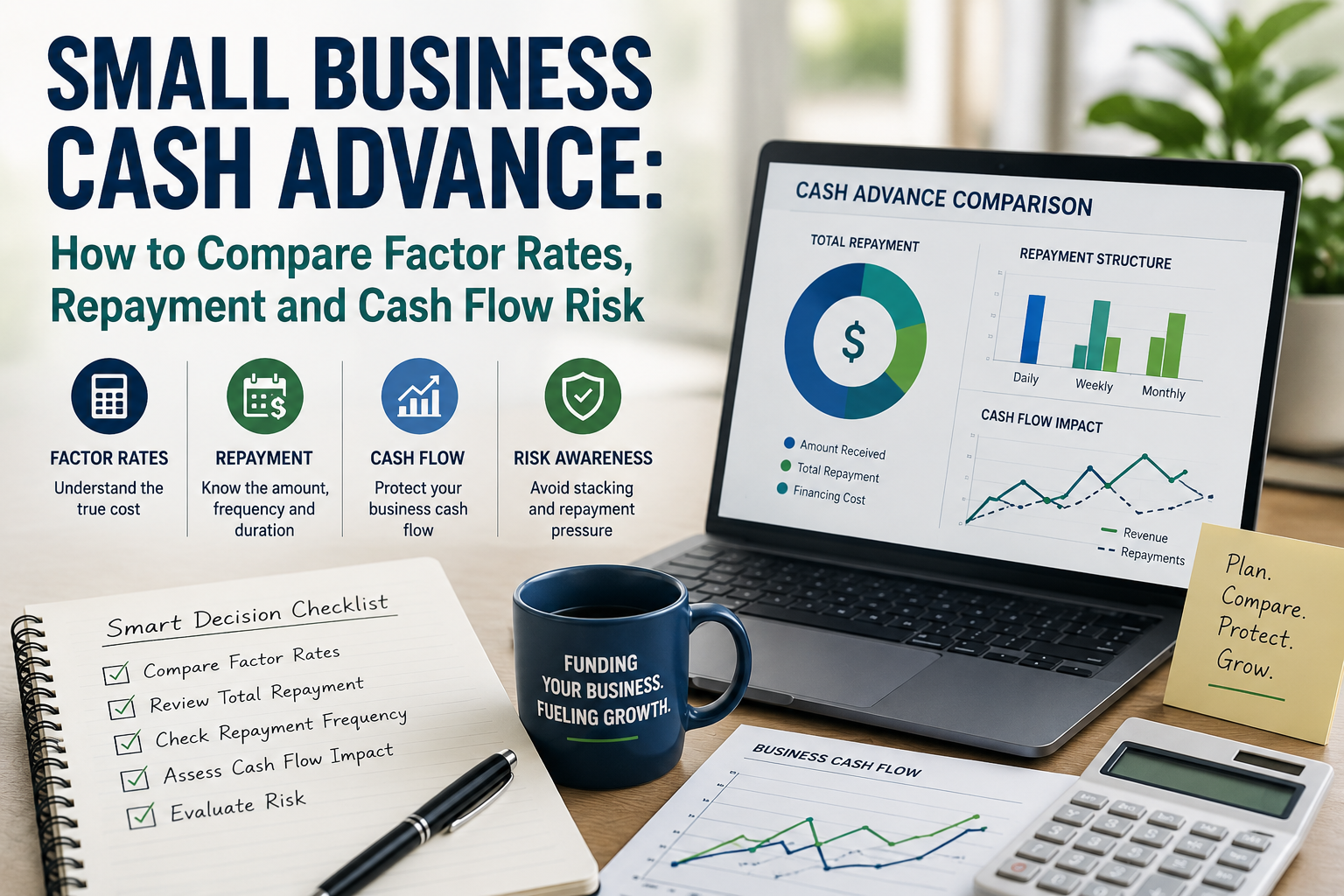
A small business cash advance can provide access to short-term business funding, but receiving money quickly is only one part of the decision.
The more important questions are:
- how much cash the business actually receives
- how much must ultimately be repaid
- how quickly repayment occurs
- how payments are collected
- how repayment affects everyday cash flow
- whether revenue can comfortably support the obligation
- what happens if sales fall
- whether another type of business financing fits better
This matters because some cash-advance structures use frequent daily or weekly withdrawals rather than the monthly payment schedule business owners may associate with a traditional term loan.
That difference can materially affect working capital.
A payment may appear manageable when viewed over an entire month but become uncomfortable when money leaves the business account every business day.
The central question should therefore not be:
How much can the business obtain?
It should be:
After the advance is received, can the business comfortably meet the repayment obligation while still paying payroll, suppliers, rent, taxes, inventory costs and other essential expenses?
Businesses comparing broader funding options can also review cash flow loans for small business to understand how different repayment structures may affect business cash flow.
Educational note: Kevanzo.com provides general business-financing education only. Kevanzo is not a lender, broker, loan marketplace, merchant cash advance provider, financial adviser, attorney, accountant or approval service. Funding amounts, factor rates, fees, repayment amounts, withdrawal frequency, revenue-based payment structures, guarantees, security arrangements, eligibility standards and other terms vary by provider and agreement. Always read the complete financing agreement before accepting business funding.
What Is a Small Business Cash Advance?
A small business cash advance is a form of business financing in which a company receives money upfront and agrees to provide repayment from future business revenue according to the financing agreement.
The structure can vary.
Repayment may involve:
- a percentage of sales
- a percentage of card receipts
- automatic withdrawals from a business bank account
- fixed daily payments
- fixed weekly payments
- another agreed revenue-based structure
A small business cash advance may therefore behave differently from a conventional business term loan.
The business may not be quoted a traditional interest rate in the same way.
Instead, some providers use a factor rate or predetermined repayment amount.
That makes understanding the true economics extremely important.
Small Business Cash Advance Versus Merchant Cash Advance
The terms small business cash advance and merchant cash advance are often used in closely related ways.
Merchant cash advances are generally associated with financing based on anticipated future business sales or revenue.
The Consumer Financial Protection Bureau describes merchant cash advances as arrangements in which a business receives an advance and repayment can be based on future revenue, including a percentage of card receipts or fixed withdrawals.
The exact legal and commercial structure still depends on the agreement.
A business owner should therefore not rely only on the product label.
Read what the contract actually requires.
Why Businesses Consider a Small Business Cash Advance
A business may look at this type of funding when money is required before enough operating cash is available.
Common situations can include:
- emergency equipment repair
- seasonal inventory
- temporary payroll pressure
- supplier payments
- materials for a new contract
- unexpected operating expenses
- a short delay in customer payments
- an immediate revenue-generating opportunity
None of those purposes automatically makes the financing good or bad.
The real question is whether the economic benefit created by the money is strong enough to justify the financing cost and repayment pressure.
The Kevanzo Cash-Advance Purpose Test
Before comparing offers, identify exactly why the business wants the money.
Use four questions.
1. What Is the Exact Funding Need?
Do not write:
Working capital.
Be more specific.
For example:
$18,000 to replace essential refrigeration equipment.
or:
$30,000 to purchase seasonal inventory before the November sales period.
2. Is the Need Temporary?
A temporary need has an identifiable beginning and end.
A permanent operating loss does not.
3. What Business Activity Will Produce Repayment Cash?
Examples include:
- additional product sales
- completed customer jobs
- collected receivables
- restored business operations after equipment repair
4. When Should That Cash Arrive?
The repayment schedule should broadly match the timing of expected business cash.
If the business cannot answer these four questions, accepting a small business cash advance deserves more caution.
Temporary Cash Gap Versus Permanent Cash Shortage
This is one of the most important distinctions in the article.
Temporary Gap
A profitable restaurant needs $15,000 immediately to replace essential equipment.
Normal customer revenue should continue after the repair.
The problem is temporary.
Permanent Shortage
A restaurant loses $15,000 every month and requires new financing just to remain open.
The problem is structural.
A small business cash advance may delay the consequences, but financing does not automatically repair:
- weak pricing
- poor margins
- excessive overhead
- falling sales
- excessive debt
- ineffective inventory management
Short-term financing works best when the underlying business economics remain healthy.
The Kevanzo Temporary-or-Structural Test
Ask:
If the business receives this money today, what changes that allows the advance to be repaid?
Strong answer:
The repaired equipment restores our normal production capacity and revenue.
Concerning answer:
We need money because we are short every month.
The second situation needs deeper investigation.
How a Small Business Cash Advance May Work
Consider a simplified hypothetical example.
Business receives:
$40,000
Contractual repayment amount:
$52,000
The business therefore receives $40,000 but must ultimately provide $52,000 under the agreement.
Difference:
$12,000
That difference is economically important regardless of the terminology used to describe it.
The next question is:
How quickly must the $52,000 be repaid?
Repaying it over a relatively short period creates very different cash-flow pressure from repaying it over several years.
Factor Rates
Some cash-advance products use a factor rate.
A simple hypothetical example:
Advance:
$50,000
Factor rate:
1.30
Total contractual repayment:
$65,000
Because:
$50,000 × 1.30 = $65,000
That produces:
$15,000 above the amount received
This does not mean the financing necessarily carries a 30% APR.
A factor rate and an annual percentage rate measure cost differently.
Time matters.
A $15,000 financing cost over several years is economically different from the same $15,000 cost paid over only several months.
The Kevanzo Factor-Rate Reality Check
Whenever a factor rate appears, write down four numbers.
Amount Received
Example:
$50,000
Factor Rate
Example:
1.30
Total Repayment
Example:
$65,000
Expected Repayment Period
Example:
8 months
Now the business has the basic information needed to compare the advance with other financing structures.
Never compare offers using the factor rate alone.
Why Repayment Speed Matters
Imagine two arrangements.
Both provide:
$50,000
Both require:
$65,000 total repayment
But:
Arrangement A
Expected repayment period:
18 months
Arrangement B
Expected repayment period:
6 months
The total repayment amount is identical.
The pressure on business cash flow is not.
Arrangement B requires the business to move substantially more cash toward financing over a shorter period.
That is why repayment duration deserves the same attention as total cost.
Daily Versus Weekly Versus Monthly Repayment
A small business cash advance may involve frequent withdrawals.
That creates a very different operating experience.
Suppose a business has a repayment obligation of approximately:
$10,000 per month
A business owner might think:
We can handle $10,000 each month.
But if withdrawals occur every business day, the business account experiences continuous reductions.
That can matter when:
- payroll is due
- suppliers debit the account
- taxes need to be paid
- rent becomes due
- revenue arrives unevenly
Repayment frequency is therefore a cash-flow issue, not merely an administrative detail.
The Kevanzo Payment-Frequency Test
Write down:
Normal Customer Cash Pattern
Does revenue arrive:
- daily?
- weekly?
- monthly?
- irregularly?
Financing Withdrawal Pattern
Does repayment occur:
- daily?
- weekly?
- monthly?
Then compare the two.
A business with highly irregular revenue may experience greater pressure from fixed daily withdrawals than a business with stable daily sales.
Fixed Withdrawal Versus Percentage-of-Revenue Repayment
Cash advances can have different repayment structures.
Fixed Withdrawal
The business pays a predetermined amount on a scheduled basis.
Potential advantage:
Predictability.
Potential risk:
The withdrawal may remain the same even during slower revenue periods.
Percentage-of-Revenue Structure
Repayment may vary with revenue according to the agreement.
Potential advantage:
Payments may move more closely with business activity.
Potential risk:
The owner still needs to understand:
- calculation method
- reporting requirements
- minimum amounts
- reconciliation provisions
- total repayment obligation
Neither structure is automatically superior.
The correct choice depends on the business’s actual revenue pattern.
The Kevanzo Revenue-Match Test
Compare three months of normal revenue with the proposed payment structure.
For each month write:
Revenue
minus
cash-advance payments
minus
essential operating expenses
equals
remaining operating cash
If the remaining amount becomes dangerously thin, the financing may create too much pressure.
Small Business Cash Advance and Cash Flow
Cash flow is where this financing structure succeeds or fails.
Suppose a business normally receives:
$100,000 monthly revenue
Essential operating expenses:
$82,000
Normal cash remaining before financing:
$18,000
Now add cash-advance repayments of:
$12,000 per month
Remaining cushion:
$6,000
The company has lost two-thirds of its previous operating cushion.
That may still work.
But the margin for error has become much smaller.
The Kevanzo Operating-Cushion Test
Calculate:
normal operating cash surplus
minus
new financing repayment
equals
remaining cash cushion
Then ask:
Is this enough to handle a realistic bad month?
A financing arrangement should not be evaluated only under ideal conditions.
Three-Condition Cash-Advance Stress Test
Test the financing under three revenue environments.
Condition 1: Normal Month
Revenue performs as expected.
Can all obligations be paid?
Condition 2: Slow Month
Revenue falls by a realistic amount.
Can the business still handle:
- repayments
- payroll
- suppliers
- rent
- taxes
- insurance?
Condition 3: Difficult Month
Revenue falls substantially or an unexpected cost occurs.
What happens?
If the small business cash advance becomes unaffordable immediately when revenue weakens, the business may have too little repayment cushion.
Small Business Cash Advance Versus Short-Term Business Loan
A short-term business loan can also provide financing for temporary business needs.
The structures may differ substantially.
A short-term business loan may use:
- stated interest
- a defined loan term
- scheduled payments
A cash advance may instead use:
- factor pricing
- revenue-based payments
- frequent automatic withdrawals
- a predetermined payback amount
Do not choose based only on which option produces cash faster.
Compare the complete economics.
Small Business Cash Advance Versus Business Line of Credit
A business line of credit offers revolving access rather than one advance that creates one repayment obligation.
A credit line may fit a business with recurring funding needs because money can potentially be:
drawn → repaid → reused
A small business cash advance may fit a more defined short-term requirement.
The comparison should include:
- total cost
- repayment frequency
- reusable credit
- draw flexibility
- fees
- available-credit requirements
Small Business Cash Advance Versus Small Business Line of Credit
A small business line of credit may be useful when financing requirements change throughout the year.
For example:
January need: $10,000
March need: $20,000
June need: $5,000
A reusable line may fit that pattern better than taking a new advance each time.
Repeatedly obtaining separate advances can create cumulative repayment pressure.
Small Business Cash Advance Versus Working Capital Loans
Working capital loans can fund operating requirements through structures that may differ from a cash advance.
The business should compare:
- amount received
- financing cost
- payment frequency
- term
- collateral
- guarantees
- speed
- repayment flexibility
Working capital is the purpose.
It does not dictate one specific financing product.
Small Business Cash Advance Versus Working Capital Loans for Small Business
Working capital loans for small business may provide a more traditional financing structure for operating requirements.
A business should determine whether it needs:
rapid short-duration funding
or:
a more predictable working-capital repayment structure.
The cheapest funding option is not automatically best.
But the fastest option is not automatically best either.
The correct decision matches cost, timing and cash-flow capacity.
Small Business Cash Advance Versus Invoice Financing
invoice financing for small business may make more sense when the company’s cash shortage is caused specifically by unpaid customer invoices.
Example:
A company has:
$120,000 of strong commercial invoices
but must wait 45 days for payment.
Financing tied to receivables may match that problem more directly than a general cash advance.
Always identify the cause of the cash gap before choosing the financing structure.
Small Business Cash Advance Versus Quick Business Loans
Quick business loans may also appeal to a company requiring money rapidly.
Speed is only one variable.
The stronger comparison includes:
- amount available
- amount actually received
- total repayment
- fees
- payment frequency
- repayment period
- cash-flow impact
- consequences of slower revenue
Fast money can become expensive money if the repayment structure does not fit the business.
Small Business Cash Advance Versus Unsecured Business Loans
unsecured business loans may not rely on specific pledged collateral in the same way as traditional secured financing.
A business owner should not assume a small business cash advance is financially low-risk simply because conventional collateral is not emphasized.
The agreement may still contain:
- personal guarantees
- ACH authorization
- security provisions
- default rights
- collection provisions
Read the full contract.
Small Business Cash Advance Versus Small Business Capital Loans
small business capital loans may support longer-term business investments such as:
- expansion
- major equipment
- new locations
- large capital projects
A cash advance is generally better considered a short-duration financing tool.
Using expensive short-term funding for a long-lived business investment can create a mismatch between:
how quickly the financing must be repaid
and:
how slowly the investment creates economic value.
Small Business Cash Advance Versus Small Business Loans
Small business loans can include many different financing structures.
Traditional loans may provide:
- longer terms
- monthly repayment
- stated interest rates
- amortization schedules
A small business cash advance can operate differently.
The goal should never be to force every financing need into one product category.
Choose the structure that best matches:
- purpose
- duration
- affordability
- repayment source
- cash-flow pattern
Total Repayment Matters More Than the Advance Amount
A common mistake is focusing on:
We can receive $75,000.
Instead ask:
What will receiving that $75,000 ultimately require the business to pay?
Consider:
Advance received:
$75,000
Total repayment:
$97,500
Difference:
$22,500
The company must determine whether receiving $75,000 now creates enough business value to justify giving up an additional $22,500 later.
The Kevanzo Net-Cash Test
Do not assume the advertised advance equals usable cash.
Record:
Gross Advance
Example:
$75,000
Upfront Fees or Deductions
Hypothetical:
$2,500
Net Cash Received
$72,500
Total Contractual Repayment
Hypothetical:
$97,500
Now the comparison is clearer.
The business receives:
$72,500 usable cash
but may ultimately need to provide:
$97,500
That economic difference deserves attention.
Cost as a Percentage of Usable Cash
A business should also understand how much financing cost exists relative to the money actually received.
Suppose:
Net cash received:
$72,500
Total repayment:
$97,500
Difference:
$25,000
The business should compare that cost with:
- expected profit generated by the funding
- other available financing
- cost of delaying the expenditure
- cost of not taking the opportunity
The Kevanzo Economic-Value Test
Ask:
What additional economic value should this financing create?
Example:
Cash advance cost:
$15,000
Expected additional gross profit from inventory financed:
$40,000
That may potentially justify further evaluation.
Now consider:
Cash advance cost:
$15,000
Expected additional gross profit:
$12,000
The financing appears to cost more than the expected gross profit it creates.
That deserves serious reconsideration.
Margin Compression
Funding inventory does not automatically make sense because the inventory will be sold.
Margins matter.
Example:
Inventory purchase:
$50,000
Expected sales:
$65,000
Expected gross profit:
$15,000
Financing cost:
$10,000
The financing consumes approximately two-thirds of the expected gross profit.
The business may generate sales while retaining surprisingly little economic benefit.
The Kevanzo Margin-Erosion Test
Calculate:
expected gross profit generated by financed activity
minus
financing cost
equals
remaining gross profit before other expenses
This prevents the owner from confusing:
more revenue
with:
more profit.
Automatic Withdrawals
Some small business cash advance arrangements may use automatic withdrawals from the business bank account.
That can make repayment operationally simple.
But it also means the business must understand:
- withdrawal amount
- withdrawal frequency
- withdrawal start date
- bank-account authorization
- reconciliation procedures
- what happens when funds are insufficient
- whether withdrawal amounts can change
Never sign an automatic-withdrawal authorization without understanding its scope.
Bank-Balance Pressure
A business can appear profitable but still experience problems if scheduled withdrawals occur before customer revenue arrives.
Example:
Monday account balance:
$18,000
Tuesday payroll:
$12,000
Tuesday cash-advance withdrawal:
$3,000
Supplier payment:
$5,000
The company suddenly has almost no remaining liquidity.
Timing matters.
The Kevanzo Bank-Balance Test
Review the proposed repayment schedule against actual daily cash balances from recent months.
Do not use monthly revenue totals alone.
Look at:
- lowest bank balance
- payroll dates
- supplier-payment dates
- tax dates
- rent date
- existing debt withdrawals
Then place the new financing payment into that timeline.
That gives a much more realistic picture.
Holdback Percentage
Some revenue-based financing structures use a percentage of qualifying sales or receipts.
For example:
Hypothetical holdback:
10% of qualifying revenue
If qualifying sales are:
$5,000
the associated payment could be:
$500
If sales fall to:
$2,000
the associated amount could potentially fall too, depending on the agreement.
Businesses should confirm exactly:
- which revenue counts
- how the percentage is calculated
- when money is withdrawn
- whether minimum payments apply
- how reconciliation works
Reconciliation
Some revenue-based arrangements may provide mechanisms to adjust payments when actual revenue differs from assumed revenue.
The details matter enormously.
Ask:
- Is reconciliation available?
- How is it requested?
- What documents are required?
- How often can it occur?
- How quickly is the adjustment processed?
- Does the provider have discretion?
Never assume payments automatically fall when sales fall unless the agreement specifically says so.
Personal Guarantees
Some financing agreements may require an owner guarantee.
A personal guarantee can increase the owner’s exposure if the business does not meet its contractual obligations.
Before signing, determine:
- whether a guarantee exists
- who signs it
- what obligations it covers
- when it can be enforced
“Unsecured” and “no personal risk” are not synonymous.
Security Interests
An agreement may also contain security provisions involving business property or receivables.
The business should understand whether the provider claims rights relating to:
- receivables
- bank accounts
- inventory
- other business assets
If any provision is unclear, professional legal review may be worthwhile.
Renewal Risk
A business may successfully repay one small business cash advance and then be offered another.
That can feel positive.
But repeated renewals create a major question:
Is the business using financing strategically, or has financing become part of its permanent operating budget?
The difference matters.
The Kevanzo Renewal-Dependency Test
Review the last 12 months.
Ask:
How Many Advances Were Taken?
One unusual need?
Or several consecutive advances?
Was Each Previous Advance Fully Repaid From Operations?
Or was new financing needed before the old obligation was finished?
Why Is Another Advance Needed?
New opportunity?
Or the same recurring shortage?
Repeated borrowing can be a warning that the business’s underlying cash cycle needs repair.
Cash-Advance Stacking
One of the biggest risks is stacking multiple financing obligations.
Consider a business already paying:
Advance A:
$600 daily
Advance B:
$450 daily
Equipment finance:
$2,000 monthly
Vehicle loan:
$1,100 monthly
Credit card minimums:
$1,500 monthly
Adding another advance does not replace those obligations.
It sits on top of them.
The Kevanzo Debt-Stack Test
Before accepting additional funding, list every required payment.
Include:
- business loans
- lines of credit
- cash advances
- equipment financing
- vehicle financing
- credit cards
- tax payment plans
- supplier arrangements
Then calculate the combined weekly and monthly debt burden.
The new financing must be evaluated against the entire stack.
Using New Advances to Repay Old Advances
This is particularly concerning.
If a business takes:
Advance 1
then:
Advance 2 to help repay Advance 1
then:
Advance 3 to manage the cash shortage created by Advances 1 and 2
the business may enter a financing spiral.
The owner should investigate the underlying economics immediately.
New funding should ideally create productive business value, not merely postpone existing repayment.
The Kevanzo Cash-Advance Independence Test
Ask:
Could the business operate for the next 90 days without obtaining another advance after this one?
If yes:
The financing may be addressing a defined temporary problem.
If no:
The company may already be dependent on repeated financing.
That deserves deeper review.
What Providers May Review
Requirements vary.
A financing provider may examine factors such as:
- monthly revenue
- bank deposits
- sales history
- card-processing activity
- cash flow
- time in business
- industry
- existing debt
- negative bank balances
- payment history
- business credit
- owner information
Different providers use different underwriting methods.
Approval alone does not prove affordability.
A provider’s willingness to advance money and a business’s ability to repay comfortably are two different questions.
The Kevanzo Qualification-versus-Affordability Rule
Always separate:
Can we qualify?
from:
Can we afford it?
The second question matters more.
A business might technically qualify for $100,000 but only be able to responsibly support $40,000.
Borrowing capacity is not the same as repayment capacity.
Seven Small Business Cash Advance Scenarios
Scenario 1: Emergency Equipment Repair
A restaurant’s essential refrigerator fails.
Repair and replacement cost:
$18,000
Without the equipment, revenue falls sharply.
A small business cash advance could have a legitimate productive purpose because the funding restores normal operations.
Still compare:
- cost
- repayment frequency
- equipment financing
- line-of-credit alternatives
Scenario 2: Seasonal Retail Inventory
A retailer expects a strong holiday sales period.
It requires:
$40,000
for inventory.
The owner should calculate:
- expected sales
- gross margin
- likely sell-through
- financing cost
- repayment timing
- downside if inventory sells slowly
Do not finance inventory based only on the most optimistic forecast.
Scenario 3: Contractor Mobilization
A contractor wins a profitable project but needs upfront materials and payroll.
Expected customer payments should provide the eventual repayment source.
The owner should test what happens if the project:
- starts late
- runs over budget
- encounters payment delays
Scenario 4: Café With Stable Card Sales
A café has relatively predictable daily revenue.
A revenue-based structure may fit the sales pattern more naturally than it would for a business with highly irregular receipts.
The café still needs sufficient margin after repayment.
Scenario 5: Business With Falling Revenue
Revenue has declined for six consecutive months.
The owner wants an advance to pay regular overhead.
This is higher risk.
The funding may temporarily postpone the shortage without correcting its cause.
Scenario 6: Business Already Carrying Several Advances
The company has multiple daily withdrawals.
Another advance may create serious debt-stack pressure.
The owner should calculate the combined obligation before proceeding.
Scenario 7: Profitable Growth Opportunity
A company can purchase discounted inventory that historically sells quickly and profitably.
The financing might create enough economic value to justify its cost.
The decision should still be based on conservative sales assumptions.
Common Small Business Cash Advance Mistakes
Comparing Only the Amount Offered
The repayment amount matters more.
Ignoring the Factor Rate
Understand what it does to total repayment.
Treating Factor Rate as APR
They are not the same measurement.
Ignoring Repayment Speed
Short repayment can create intense cash-flow pressure.
Ignoring Daily Withdrawals
Monthly revenue totals can hide daily bank-account problems.
Borrowing the Maximum Available
Use only what the business genuinely needs.
Ignoring Slow-Sales Scenarios
Always stress-test.
Ignoring Existing Debt
Every financing obligation competes for the same business cash.
Automatically Renewing
Repeated advances can create dependency.
Stacking Advances
Multiple frequent payments can become extremely difficult to manage.
Using Short-Term Funding for Long-Term Losses
Financing cannot permanently repair an unprofitable business model.
Ignoring Contract Terms
Read guarantees, withdrawals, default provisions and security terms.
Small Business Cash Advance Red Flags
Slow down when:
- total repayment is unclear
- factor-rate explanation is unclear
- payment frequency is unclear
- fees are difficult to identify
- the provider cannot explain reconciliation
- withdrawal rights appear unusually broad
- the business already has several financing obligations
- repayment requires optimistic revenue assumptions
- the business has persistent losses
- the advance is primarily being used to repay previous advances
- the owner cannot identify the repayment source
- most operating cash would be consumed by financing
- guarantees are not understood
- default provisions are unclear
- another financing option appears materially cheaper
Several red flags together deserve serious attention.
Questions to Ask Before Accepting an Offer
Ask the provider:
- How much money will the business receive?
- Are any fees deducted before funding?
- What is the total repayment amount?
- Is a factor rate used?
- How is the factor rate calculated?
- What is the expected repayment period?
- Are payments daily, weekly or otherwise?
- Are payments fixed or revenue-based?
- How is revenue measured?
- Is there a holdback percentage?
- Is reconciliation available?
- How does reconciliation work?
- Are there minimum payments?
- What happens if sales decline?
- What happens if the bank account has insufficient funds?
- Are late or returned-payment fees charged?
- Is a personal guarantee required?
- Is a security interest involved?
- Is ACH authorization required?
- What rights does that authorization provide?
- Can the business repay early?
- Does early repayment reduce the total cost?
- Are renewal incentives offered?
- Can another advance be taken before this one is repaid?
- What constitutes default?
- What collection rights apply?
- How can the agreement be terminated?
- Is any broker compensation included?
- What amount reaches the business after every deduction?
- What other funding structures should be compared?
If important answers remain unclear, the comparison is not complete.
Information to Prepare Before Comparing Offers
Gather:
- recent bank statements
- monthly revenue
- daily or weekly sales data
- card-processing statements where relevant
- accounts receivable
- existing debt schedule
- profit and loss information
- cash-flow information
- upcoming payroll
- supplier obligations
- tax obligations
- planned use of funds
Then determine the maximum affordable repayment, not merely the maximum available advance.
The Kevanzo 10-Number Cash-Advance Comparison
For every offer write down:
1. Gross Advance
The advertised funding amount.
2. Upfront Deductions
Fees removed before the business receives the money.
3. Net Cash Received
Actual usable cash.
4. Factor Rate
Where applicable.
5. Total Repayment
The complete amount contractually owed.
6. Financing Difference
Total repayment minus net cash received.
7. Payment Amount
Daily, weekly or other required amount.
8. Expected Repayment Period
How long the obligation is expected to remain.
9. Existing Debt Payments
What the business already pays.
10. Remaining Cash Cushion
How much operating cash should remain after financing.
These ten numbers create a far clearer comparison than focusing on the advance amount alone.
The Kevanzo Three-Month Cash-Flow Test
Before accepting a small business cash advance, model the next three months.
For each month include:
Expected Revenue
Use realistic rather than optimistic numbers.
Essential Expenses
Include:
- payroll
- rent
- suppliers
- tax
- insurance
- utilities
- inventory
Existing Debt
Include every current financing obligation.
New Cash-Advance Repayment
Add the proposed payment.
Remaining Cash
Determine the expected cushion.
Then rerun the model using lower revenue.
If the business becomes cash-negative quickly, the advance may be too aggressive.
The Kevanzo 20-Point Small Business Cash Advance Check
Before accepting a small business cash advance, complete this final review.
1. Funding Purpose
Exactly what will the money be used for?
2. Temporary Need
Is the problem genuinely short term?
3. Amount Required
How much is actually needed?
4. Net Cash Received
How much reaches the business after deductions?
5. Total Repayment
How much must ultimately be paid?
6. Factor Rate
Is one used and understood?
7. Repayment Period
How quickly is the obligation expected to be satisfied?
8. Payment Frequency
Daily, weekly or another schedule?
9. Payment Method
Fixed withdrawal or revenue-based?
10. Revenue Match
Does payment timing fit business revenue?
11. Operating Cushion
How much cash remains after repayment?
12. Slow-Month Test
Can the company survive weaker revenue?
13. Existing Debt
What obligations already exist?
14. Debt Stack
What is the combined repayment burden?
15. Guarantee
Is a personal guarantee required?
16. Security
Does the provider have rights involving business assets?
17. Reconciliation
Can payments adjust when revenue changes?
18. Alternatives
Would another financing type fit better?
19. Renewal Dependence
Is the business likely to require another advance?
20. Economic Value
Does receiving the money create more value than the financing costs?
If several answers are uncertain, more comparison is warranted.
Practical Next Steps
Start with the funding purpose.
Write down:
exact amount required
and:
exact reason for borrowing
Then identify the expected source of repayment.
Next calculate:
- net cash received
- total repayment
- repayment frequency
- expected repayment period
- financing cost
- remaining operating cushion
Run the slow-month test.
Then compare the small business cash advance with:
- a term loan
- short-term business financing
- line of credit
- working-capital financing
- invoice financing
- equipment financing where appropriate
Do not automatically choose the offer with the highest funding amount or fastest approval.
Choose the structure that best matches the business’s real cash cycle and repayment capacity.
Final Takeaway
A small business cash advance can provide fast access to business funding, but speed should never replace careful comparison.
The business needs to understand:
- net cash received
- total repayment
- factor-rate pricing
- repayment frequency
- fixed versus revenue-based payments
- automatic withdrawals
- operating cash-flow pressure
- guarantees and security provisions
- renewal risk
- existing debt
- cash-advance stacking
The strongest decision asks one simple question:
Will receiving this money improve the business enough to comfortably cover the financing cost without damaging normal operations?
If the answer depends entirely on unusually strong sales, another advance, or perfect cash flow, the financing may be too risky.
A strong small business cash advance decision therefore is not about obtaining the most money.
It is about obtaining only the funding genuinely required, understanding exactly what must be repaid, and preserving enough cash flow for the business to continue operating safely.
Frequently Asked Questions About a Small Business Cash Advance
What Is a Small Business Cash Advance?
A small business cash advance is a form of business financing that provides money upfront in exchange for repayment under an agreement that may be connected to future business revenue.
Is a Small Business Cash Advance the Same as a Loan?
Not necessarily.
Cash advances can be structured differently from traditional term loans and may use revenue-based repayment or factor-rate pricing.
The actual contract determines the structure.
What Is a Merchant Cash Advance?
A merchant cash advance is generally financing in which a business receives money upfront and repayment is linked to future business sales or revenue according to the agreement.
What Is a Factor Rate?
A factor rate is one method of calculating a predetermined repayment amount.
For example, an advance of $50,000 multiplied by a hypothetical factor rate of 1.30 produces $65,000 of total repayment.
Is a Factor Rate the Same as APR?
No.
They measure financing cost differently.
Time must be considered when comparing financing costs.
Can Payments Be Taken Daily?
Some agreements may involve daily automatic withdrawals.
Other arrangements may use weekly or revenue-based payments.
Review the actual contract.
Can Payments Change When Revenue Falls?
That depends entirely on the financing structure.
Some revenue-based arrangements may have adjustment or reconciliation provisions.
Fixed-payment structures may work differently.
What Is a Holdback Percentage?
A holdback percentage generally refers to a percentage of qualifying business revenue used toward repayment under certain revenue-based structures.
Can a Small Business Cash Advance Hurt Cash Flow?
Yes.
Frequent repayment can reduce the money available for payroll, suppliers, rent, taxes and other operating costs.
Is a Small Business Cash Advance Unsecured?
The structure varies.
An agreement may still contain personal guarantees, security provisions, ACH rights or other contractual protections.
What Is Cash-Advance Stacking?
Stacking occurs when a business carries multiple cash-advance obligations at the same time.
The combined repayment burden can create significant cash-flow pressure.
Is Taking Another Advance to Repay the First One Risky?
It can be.
Repeatedly using new financing to manage earlier financing obligations may indicate increasing dependency.
Can a Small Business Cash Advance Be Used for Inventory?
Potentially, depending on the provider and agreement.
The business should ensure the expected inventory profit and sales timing support repayment.
Can It Be Used for Emergency Repairs?
Potentially.
A repair that restores revenue-producing operations can represent a defined business purpose, but alternative financing should still be compared.
When Might a Small Business Cash Advance Be a Poor Fit?
It may deserve reconsideration when:
- revenue is falling
- margins are extremely thin
- repayments consume too much operating cash
- multiple advances already exist
- the company requires long-term capital
- the business expects to renew repeatedly
- another financing option offers materially better economics
What Should a Business Compare First?
Start with:
net cash received versus total repayment.
Then compare:
- repayment frequency
- expected duration
- cash-flow impact
- guarantees
- other financing alternatives
What Is the Most Important Question Before Accepting One?
Ask:
Can the business repay this advance from normal operating cash without needing another financing product to survive?
Helpful Authoritative Resources
- U.S. Small Business Administration 7(a) loans
- U.S. Small Business Administration lender information
- Consumer Financial Protection Bureau small business lending resources
- Consumer Financial Protection Bureau small business lending rule FAQs
- Federal Trade Commission business guidance
- SCORE small business mentoring and education
Author Bio
Kevanzo Editorial Team
Kevanzo Editorial Team creates practical, plain-English educational resources for U.S. business owners comparing small business cash advances, merchant cash advances, business loans, working-capital funding, lines of credit, cash-flow financing, factor rates, repayment structures and responsible business-financing decisions.
Copyright Notice
© 2026 Kevanzo. All rights reserved.
This article about a small business cash advance is protected by copyright and may not be copied, scraped, spun, republished or used commercially without prior written permission from Kevanzo. Brief quotations may be used with clear attribution and a link to the original article.
Unauthorized reuse, bulk scraping, content spinning, AI rewriting for republication or commercial reproduction of this material is prohibited.
Educational Disclaimer
Kevanzo.com provides general educational information about business financing. Kevanzo is not a lender, broker, loan marketplace, merchant cash advance provider, financial adviser, attorney, accountant or approval service.
Nothing in this article constitutes financial, legal, tax, accounting, investment, lending or personalized business advice. Financing costs, factor rates, repayment amounts, payment frequencies, guarantees, security provisions, revenue-based payment structures, eligibility requirements and available products vary according to provider, business profile, revenue, industry, credit history, market conditions and agreement terms.
Business owners should review current official information, read all financing documents carefully and consider seeking advice from appropriately qualified professionals when necessary before making financing decisions.