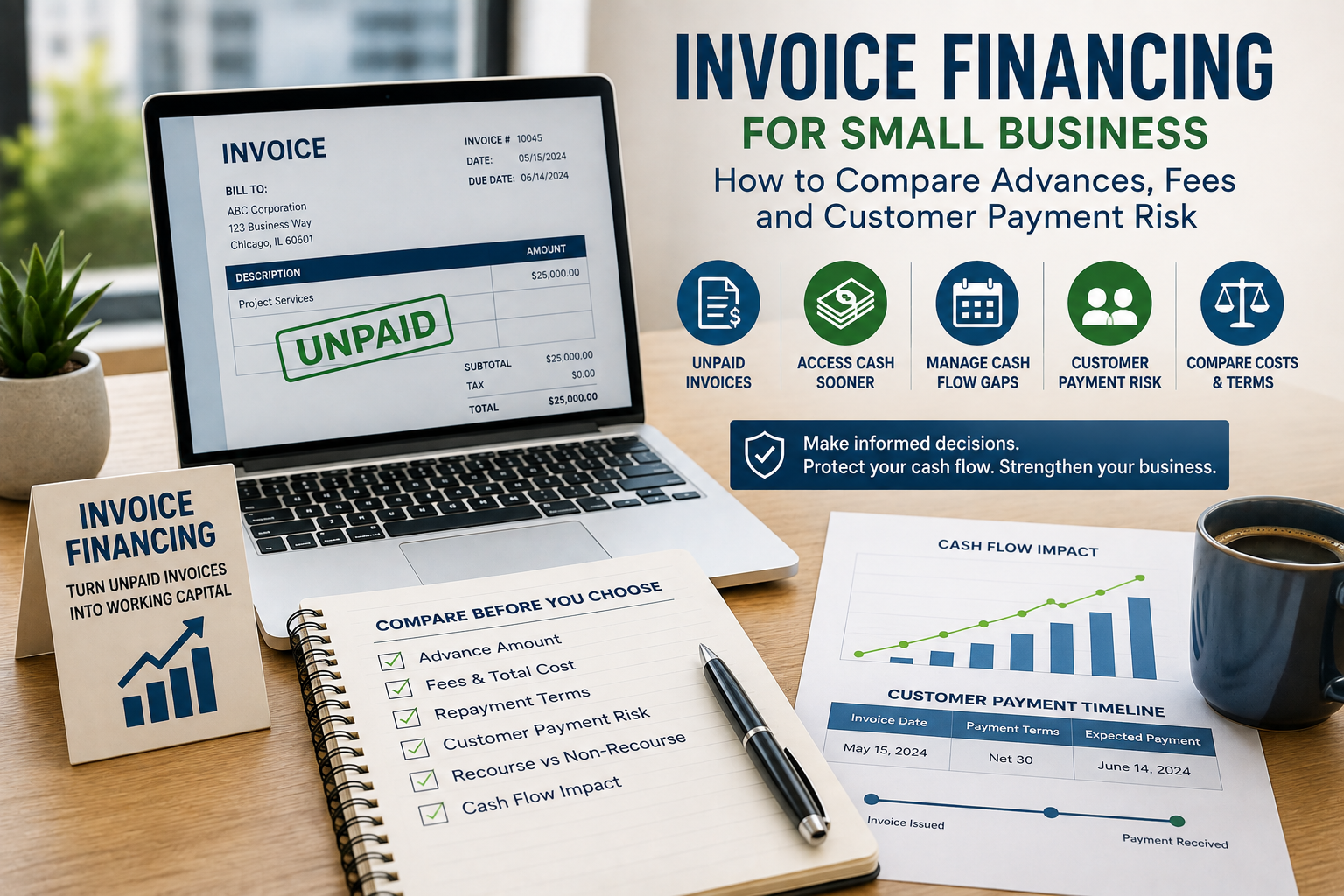
Invoice financing for small business can help a company access cash that is tied up in unpaid customer invoices rather than waiting weeks or months for those customers to pay.
For many businesses, the underlying problem is not lack of sales.
It is timing.
The business may have:
- completed the work
- delivered the goods
- issued the invoice
- earned the revenue
but still be waiting for the actual cash.
Meanwhile:
- payroll continues
- suppliers need payment
- rent becomes due
- fuel is required
- materials must be purchased
- insurance continues
- another customer project may already be starting
Invoice financing for small business can potentially shorten that cash-flow gap by providing financing linked to eligible accounts receivable.
But receiving cash earlier comes at a cost.
The strongest comparison therefore asks:
How much usable cash does the business receive, how much does the financing cost, what happens if the customer pays late, and how much profit remains after the financing is repaid?
For businesses comparing the wider funding landscape, Kevanzo’s small business financing guide explains how receivables funding fits beside loans, credit lines, and other financing structures.
Educational note: Kevanzo.com provides general business-financing education only. Kevanzo is not a lender, broker, loan marketplace, factoring company, financial adviser, attorney, accountant, or approval service. Rates, fees, advance amounts, repayment terms, recourse provisions, invoice eligibility, customer requirements, approval standards, and available products vary. Always review the complete financing agreement before accepting business funding.
What Invoice Financing for Small Business Means
Invoice financing for small business generally involves obtaining financing based partly on eligible unpaid customer invoices.
The invoices represent money customers owe the business.
Instead of waiting until those customers pay, the business may be able to access part of that value earlier.
A simplified cash cycle could look like this:
business completes work → customer invoice issued → invoice financing obtained → business receives cash earlier → customer later pays invoice → financing arrangement is settled according to the agreement
The exact structure varies.
That is important.
Invoice financing is not one standardized product with one universal:
- advance percentage
- fee
- repayment method
- customer-notification rule
- recourse provision
- collection process
Business owners must compare the actual agreement.
Why Businesses Use Invoice Financing
Imagine a commercial cleaning company.
It completes $80,000 of work during the month.
Customers pay on 45-day terms.
The company still needs cash immediately for:
- wages
- cleaning supplies
- fuel
- insurance
- equipment maintenance
- taxes
- new customer work
The business can be profitable on paper while still experiencing cash-flow pressure.
Invoice financing for small business may help convert part of the receivables balance into usable cash earlier.
The economic question is whether receiving that money early is worth the financing cost.
The Kevanzo Receivables-Gap Test
Before comparing invoice financing for small business, answer these five questions.
1. Has the Revenue Already Been Earned?
Has the business actually:
- completed the work
- delivered the goods
- issued a legitimate invoice?
Invoice financing is fundamentally different from borrowing against hoped-for future sales.
2. When Is the Customer Expected to Pay?
Record the contractual due date.
For example:
Invoice issued: June 1
Payment terms: Net 30
Expected payment: approximately July 1
3. When Does the Business Need Cash?
Perhaps payroll is due June 7.
The gap is therefore not simply “30 days.”
The business may need financing almost immediately.
4. How Much Will Earlier Access Cost?
Estimate:
- financing fees
- interest where applicable
- processing charges
- service charges
- additional fees if payment is delayed
5. What Happens If the Customer Pays Late?
This question is essential.
A 30-day invoice that becomes a 60-day invoice may create:
- additional fees
- repayment pressure
- eligibility problems
- recourse obligations
depending on the agreement.
Invoice Financing Versus Waiting for Customer Payment
Sometimes the cheapest option is simply waiting.
But waiting has an economic cost too.
Suppose:
Invoice: $50,000
Customer expected to pay in: 45 days
The company has enough reserves to operate comfortably.
Invoice financing may provide little value if the business does not need the cash.
Now consider another company with the same invoice.
Without earlier cash, it cannot purchase materials for a profitable customer project.
The decision changes.
The correct comparison is:
cost of waiting versus cost of obtaining the invoice cash earlier
The Kevanzo Early-Cash Value Test
Write down two numbers.
Cost of Financing the Invoice
Include all relevant fees and financing costs.
Economic Cost of Waiting
Potential examples:
- delayed customer project
- lost supplier discount
- overtime
- inability to purchase inventory
- missed growth opportunity
- operational disruption
Then compare them.
Invoice financing for small business is most useful when earlier access to cash creates enough legitimate business value to justify its cost.
Invoice Financing Versus Invoice Factoring
These terms are sometimes used loosely, but the structures can differ.
Invoice financing commonly involves borrowing or receiving an advance connected to eligible receivables while the business may retain more control of its sales ledger and customer collection process.
Invoice factoring traditionally involves selling or assigning receivables to a factor.
Current CFPB regulatory interpretation describes factoring as an accounts-receivable purchase transaction in which a legally enforceable claim for payment is purchased or transferred.
Business owners comparing small business factoring should therefore determine the actual legal arrangement rather than relying on the product name.
Ask:
- Is the invoice being financed or sold?
- Who owns the receivable?
- Who collects customer payment?
- Will the customer know?
- Who carries customer non-payment risk?
- What happens if the invoice becomes uncollectible?
Recourse Versus Non-Recourse
One of the most important invoice-financing concepts is recourse.
Recourse Arrangement
The business may remain responsible if the customer does not pay according to the agreement.
Depending on the contract, the business might have to:
- repay the provider
- replace the invoice
- buy the receivable back
- provide another eligible invoice
Non-Recourse Arrangement
Some arrangements may transfer specified customer non-payment risk to the finance provider.
But “non-recourse” should never automatically be interpreted as:
the business has no responsibility under any circumstance.
Coverage may apply only to defined events.
For example, commercial insolvency might be treated differently from:
- disputed work
- customer dissatisfaction
- billing errors
- fraud
- contractual disputes
The agreement controls.
The Kevanzo Recourse Check
Before accepting invoice financing for small business, answer:
- Who ultimately bears customer non-payment risk?
- What counts as non-payment?
- What happens if the invoice is disputed?
- Can the business substitute another invoice?
- Can the provider require repayment directly from the business?
- Are there circumstances excluded from non-recourse protection?
This section deserves careful reading in any agreement.
Eligible Invoices Matter
Not every invoice will necessarily qualify.
Providers may consider factors such as:
- customer quality
- invoice age
- payment terms
- customer location
- industry
- disputes
- concentration
- whether work has been completed
- whether goods were accepted
- liens or prior financing claims
- invoice documentation
An invoice owed by an established commercial customer may be viewed differently from an old disputed invoice.
Invoice quality matters because the receivable helps support the financing decision.
Customer Quality Can Matter More Than Expected
Traditional business lending often focuses heavily on the borrower.
Invoice financing may also place substantial emphasis on the customer that owes the invoice.
Consider:
Invoice A
Amount: $50,000
Customer: established company
Payment history: reliable
Invoice: undisputed
Invoice B
Amount: $50,000
Customer: new company
Payment history: unknown
Invoice: currently disputed
The amounts are identical.
The financing value may not be.
That is why businesses should understand both their own finances and their customer-payment quality.
The Kevanzo Invoice-Quality Test
Score each invoice using five questions.
1. Is the Invoice Legitimate and Complete?
Has the underlying work been completed or product delivered?
2. Is the Invoice Undisputed?
Customer disputes can dramatically change collectability.
3. Is the Customer Reliable?
Review actual payment history where available.
4. Is the Invoice Recent?
Older receivables may present different risks.
5. Is Payment Timing Predictable?
A customer consistently paying Net 30 invoices around Day 35 is easier to model than one paying unpredictably between Day 20 and Day 120.
The stronger the invoice, the easier the cash-flow timing may be to evaluate.
Advance Rates
Invoice financing for small business may provide only part of an eligible invoice’s face value upfront.
For example:
Eligible invoice: $50,000
Hypothetical advance: 80%
Initial cash:
$40,000
The remaining amount may be handled according to the financing agreement after customer payment and fees.
This example is educational only.
Actual advance structures vary.
The important point is:
invoice value is not necessarily the same as cash received.
The Kevanzo Net-Advance Test
For every invoice-financing quote, record:
Invoice Face Value
Example: $50,000
Initial Advance
Example: $40,000
Upfront Fees or Deductions
Example: hypothetical $1,000
Net Usable Cash
Example:
$39,000
That is the amount the business can actually use immediately.
Compare offers using net cash—not only the invoice value or advertised advance percentage.
Invoice Financing Costs
Costs may be structured in several ways depending on the provider and agreement.
Potential charges can include:
- financing fees
- service fees
- processing fees
- account fees
- wire or transaction fees
- due-diligence fees
- minimum charges
- additional time-based fees
- late-payment-related costs
- other contract charges
Not every provider charges every fee.
The business should identify all costs before comparing offers.
Why Time Can Increase Invoice Financing Cost
Some invoice-financing fees may depend partly on how long the receivable remains outstanding.
That makes customer-payment timing especially important.
Suppose two identical invoices are financed.
Invoice A
Customer pays after 25 days.
Invoice B
Customer pays after 70 days.
If the financing cost increases with time, Invoice B may become substantially more expensive.
A customer’s slow payment can therefore reduce the profit margin on the underlying work.
The Kevanzo Payment-Delay Stress Test
Model three customer-payment scenarios.
Scenario 1: On-Time Payment
Customer pays when expected.
What does financing cost?
Scenario 2: 30-Day Delay
Customer pays one month late.
What changes?
Scenario 3: Serious Delay
Customer payment is substantially late.
Ask:
- do fees keep increasing?
- does recourse apply?
- does the business need to repay?
- can another invoice substitute?
- does the customer relationship become involved?
An invoice-financing offer should be tested under all three scenarios.
Margin Matters More Than the Invoice Amount
A large invoice does not automatically make financing worthwhile.
Consider:
Invoice: $100,000
Gross profit associated with the work: $15,000
Hypothetical financing cost: $6,000
Financing has absorbed 40% of the gross profit.
Now compare another invoice:
Invoice: $100,000
Gross profit: $40,000
Same financing cost: $6,000
The economic impact is completely different.
This is why invoice financing for small business should be compared against margin, not only invoice value.
The Kevanzo Margin-Erosion Test
Calculate:
expected gross profit from financed invoice
minus
invoice-financing cost
equals
remaining gross profit before other business costs
Example:
Expected gross profit: $20,000
Financing cost: $4,000
Remaining:
$16,000
Now ask:
Does receiving the cash earlier justify giving up $4,000 of margin?
The answer depends on what earlier cash enables the business to do.
Invoice Financing Versus Small Business Loans
A traditional small business loan may provide a lump sum unrelated to specific invoices.
That may be more appropriate when the company needs money for:
- expansion
- equipment
- renovation
- broader capital requirements
Invoice financing for small business is narrower.
It primarily addresses cash tied up in receivables.
A company should avoid taking a large general-purpose loan if the real problem is a short receivables gap unless the loan structure genuinely offers a better solution.
Invoice Financing Versus a Business Line of Credit
A business line of credit can provide revolving access to business funding subject to lender terms.
Both structures can address cash-flow timing.
But they work differently.
Invoice Financing
Typically connected directly to eligible receivables.
Business Line of Credit
Generally provides borrowing capacity based on a broader underwriting structure.
A credit line may be useful when funding needs occur for reasons beyond invoices.
Invoice financing may be more targeted when receivables are clearly causing the cash gap.
Invoice Financing Versus Working Capital Loans
Working capital loans can provide capital for broader operating needs.
Examples include:
- payroll
- inventory
- suppliers
- rent timing
- seasonal expenses
- operating costs
Invoice financing for small business is specifically connected to receivables.
If the business’s cash shortage has nothing to do with unpaid invoices, invoice financing may not address the real problem.
Invoice Financing Versus Working Capital Loans for Small Business
Businesses comparing working capital loans for small business should ask whether the cash requirement is:
invoice-specific
or:
business-wide.
Suppose a company has $150,000 of reliable commercial invoices due within 45 days.
Receivables financing may fit the problem closely.
Now suppose the company has very few receivables but needs $75,000 for seasonal inventory.
A working-capital loan or line of credit may be more logical.
Invoice Financing Versus Cash Flow Loans
Cash flow loans for small business focus more broadly on the timing of business cash.
Invoice financing is one possible way to address cash-flow timing when the timing problem is specifically caused by outstanding receivables.
The distinction matters.
Every invoice-financing problem is related to cash flow.
Not every cash-flow problem is caused by invoices.
Invoice Financing Versus Small Business Capital Loans
Small business capital loans may fund much broader business requirements.
A business might need capital for:
- expansion
- equipment
- inventory
- infrastructure
- major projects
Invoice financing for small business generally has a shorter and more specific purpose:
turning eligible receivables into earlier liquidity.
Do not finance a multi-year capital project with a short receivables product simply because invoices are available.
Invoice Financing Versus Quick Business Loans
A company needing money quickly may compare quick business loans with invoice financing.
Speed alone should not determine the decision.
If the business already has strong invoices, invoice financing may connect the borrowing directly to identifiable incoming cash.
A quick term loan may provide broader flexibility.
Compare:
- total cost
- repayment timing
- customer involvement
- invoice eligibility
- guarantees
- fees
- business cash flow
Invoice Financing Versus Unsecured Business Loans
unsecured business loans may provide financing without one specifically pledged asset in the traditional secured-loan sense.
Invoice financing is different because receivables play a central role.
Business owners should understand whether:
- receivables secure the financing
- invoices are assigned
- invoices are purchased
- a broader lien applies
- personal guarantees apply
Do not assume receivables financing is unsecured simply because physical equipment or property is not pledged.
Customer Notification
Some invoice-financing structures may allow the business to continue handling customer payments normally.
Others may involve:
- notices of assignment
- lockbox arrangements
- changed payment instructions
- direct provider involvement
This matters because customer relationships can be commercially important.
A business owner should ask:
Will my customers know that their invoice has been financed?
And:
Who will communicate with the customer if payment is late?
The Kevanzo Customer-Relationship Test
Before accepting invoice financing for small business, evaluate:
Customer Visibility
Will customers know financing is involved?
Collection Control
Who follows up on late invoices?
Payment Destination
Where does the customer send money?
Communication Style
Who controls the tone and frequency of customer contact?
Relationship Risk
Could the financing arrangement affect an important commercial relationship?
Cost is not the only consideration.
Customer experience can matter too.
Concentration Risk
A business may have many invoices but still depend heavily on one customer.
Example:
Total receivables: $200,000
Customer A: $150,000
All other customers: $50,000
That means 75% of receivables depend on one customer.
If Customer A pays late, the business may have a substantial financing and cash-flow problem.
Providers may also consider customer concentration when deciding invoice eligibility.
The Kevanzo Customer-Concentration Check
Calculate:
largest customer’s outstanding receivables ÷ total receivables
Then ask:
- how dependent is the business on that customer?
- what happens if payment is delayed?
- does financing increase that dependence?
- would the provider finance all of those invoices?
Invoice financing should not hide concentration risk.
Disputed Invoices Are Different
An invoice can exist in accounting records and still be economically uncertain.
Possible disputes include:
- work quality
- delivery issues
- quantity disagreements
- pricing disagreements
- contract interpretation
- missing purchase orders
- administrative errors
A disputed $100,000 invoice is not financially equivalent to an undisputed $100,000 invoice from a reliable customer.
Resolve invoice-quality problems before assuming the receivable can support financing.
Invoice Aging
Businesses commonly track receivables by age.
For example:
- current
- 1–30 days
- 31–60 days
- 61–90 days
- more than 90 days
Older receivables may be less attractive or may face different provider treatment.
The exact rules vary.
Before requesting quotes, produce an accurate accounts-receivable aging report.
That helps both financing comparison and internal cash-flow management.
The Kevanzo Receivables Health Check
Before using invoice financing, calculate:
Total Outstanding Receivables
How much money is owed?
Average Collection Time
How long do customers typically take to pay?
Overdue Percentage
What proportion is past due?
Dispute Rate
How many invoices are currently disputed?
Customer Concentration
How dependent is the business on the largest customers?
A healthy receivables book makes the financing problem easier to understand.
Existing Debt Still Matters
Invoice financing for small business does not exist separately from the company’s other obligations.
Suppose the business already pays:
Term loan: $3,000 monthly
Equipment finance: $1,800 monthly
Vehicle finance: $900 monthly
Credit cards: $1,300 monthly
Invoice-financing costs must be added to the same business cash-flow picture.
The company must remain able to pay:
- payroll
- taxes
- suppliers
- rent
- insurance
- debt
- financing fees
after accessing the earlier invoice cash.
The Kevanzo Receivables Dependency Test
Invoice financing becomes more concerning when the business cannot operate without continually financing each new invoice.
Ask:
Is Financing Occasional?
Used during unusual timing gaps?
Or Continuous?
Does nearly every invoice need financing?
Continuous dependence may indicate:
- customer terms are too long
- margins are too thin
- expenses are too high
- working-capital reserves are inadequate
- collections are weak
- existing debt is excessive
Invoice financing can solve timing.
It should not prevent management from fixing the underlying cash cycle.
Seven Practical Invoice Financing Scenarios
Scenario 1: Commercial Service Business
A company completes $90,000 of work for established corporate customers.
Payment terms are Net 45.
Payroll is due every two weeks.
Invoice financing for small business may bridge the gap.
The owner should compare:
- advance amount
- customer payment history
- financing cost
- margin after financing
- late-payment scenario
Scenario 2: Wholesale Supplier
A wholesaler sells $70,000 of goods to established retailers.
Those retailers pay in 60 days.
The wholesaler needs cash now to purchase its next inventory order.
Receivables financing may allow the business to continue the inventory cycle.
The key question is whether the gross margin can comfortably absorb the financing cost.
Scenario 3: Contractor With Progress Invoices
A contractor completes a project milestone and issues a $120,000 invoice.
The next phase requires $35,000 in materials.
Invoice financing may link the capital need directly to the existing receivable.
But the contractor should test what happens if:
- approval of the milestone is delayed
- the invoice is disputed
- payment arrives late
Scenario 4: Business With Highly Reliable Customers
A company works mainly with large customers that historically pay on predictable terms.
The receivables are strong.
Invoice financing may be relatively easy to model because payment behavior is consistent.
The business still needs to compare cost.
Reliable invoices do not make financing free.
Scenario 5: Business With Disputed Invoices
A consulting company has $100,000 in outstanding invoices.
But $60,000 is disputed.
Invoice financing may be a poor fit because invoice collectability is uncertain.
The business should address the underlying commercial disputes first.
Scenario 6: Thin-Margin Business
A distributor operates on narrow margins.
Invoice financing may improve cash timing but absorb too much profit.
The margin-erosion test is critical.
Earlier cash is not useful if financing makes otherwise profitable sales uneconomic.
Scenario 7: Business Using Financing Continuously
A business finances every invoice to make payroll.
It then depends on new invoices to finance the next payroll cycle.
This deserves deeper review.
Management should examine:
- pricing
- customer terms
- margins
- overhead
- collections
- debt
- working-capital reserves
Invoice financing should not become an automatic substitute for healthy operating cash.
Common Invoice Financing Mistakes
Treating an Invoice as Guaranteed Cash
Customers can pay late or dispute charges.
Comparing Only the Advance Percentage
A larger advance may have substantially higher costs.
Ignoring Fees
Total financing cost matters.
Ignoring Payment Delay
Slow customers may increase financing cost or create recourse risk.
Ignoring Margin
Financing can consume too much of the profit from the work.
Financing Disputed Invoices
Invoice quality is central.
Ignoring Customer Communication
The financing structure may affect the customer relationship.
Using Financing Continuously Without Investigation
Repeated dependence may signal a deeper working-capital problem.
Comparing Invoice Financing Only With Factoring
A line of credit or working-capital loan may fit better.
Invoice Financing Red Flags
Slow down if:
- the provider cannot clearly explain fees
- total cost is difficult to calculate
- customer-payment responsibilities are unclear
- recourse provisions are unclear
- invoice ownership is unclear
- customer notification is unclear
- the provider’s collection process is unclear
- the invoice is disputed
- customer payment history is poor
- financing consumes a large percentage of gross margin
- the business is dependent on one customer
- the business finances almost every invoice
- another financing structure would cost materially less
- the business has persistent operating losses
Several red flags together deserve serious review.
Questions to Ask Before Accepting Invoice Financing
Ask:
- Which invoices are eligible?
- What percentage of an eligible invoice may be advanced?
- How much cash will the business actually receive?
- What fees apply?
- How are fees calculated?
- Does financing cost increase over time?
- What happens if the customer pays late?
- What happens if the invoice is disputed?
- Is the arrangement recourse or non-recourse?
- What exactly does non-recourse cover?
- Who owns the receivable?
- Who collects payment?
- Will customers be notified?
- Where will customers send payments?
- Does the provider contact customers directly?
- Is a personal guarantee required?
- Is a lien or security interest involved?
- Is there a minimum monthly volume?
- Are there minimum fees?
- Can the business choose individual invoices?
- Is every invoice required to be financed?
- What happens when the customer pays early?
- What happens when the customer pays very late?
- Can another invoice replace an ineligible receivable?
- How can the agreement be terminated?
If important answers remain unclear, the comparison is unfinished.
Documents Worth Preparing
Businesses comparing invoice financing for small business may benefit from preparing:
- accounts-receivable aging report
- eligible unpaid invoices
- customer payment history
- customer contracts
- purchase orders where relevant
- proof of completed work
- bank statements
- revenue records
- profit and loss information
- existing debt schedule
- business formation records
- ownership details
Requirements vary.
Good records also help the business determine whether financing is actually necessary.
The Kevanzo 20-Point Invoice Financing Check
Before accepting invoice financing for small business, complete this final review.
1. Cash Gap
Why does the business need money before the customer pays?
2. Invoice Quality
Is the invoice complete, legitimate and undisputed?
3. Customer Quality
How reliably does the customer pay?
4. Invoice Amount
What is the receivable worth?
5. Advance Amount
How much financing will be provided?
6. Net Cash
How much usable money reaches the business?
7. Fee Structure
How is financing cost calculated?
8. Total Cost
What should financing cost if the customer pays as expected?
9. Delay Cost
What happens if payment is late?
10. Margin Impact
How much profit remains after financing?
11. Recourse
Who bears non-payment risk?
12. Disputes
What happens if the customer challenges the invoice?
13. Customer Notification
Will the customer know?
14. Collection Control
Who communicates with the customer?
15. Payment Destination
Where does the customer send payment?
16. Customer Concentration
Is the business dependent on one major customer?
17. Existing Debt
What other obligations already consume cash?
18. Alternative Financing
Would a line of credit or working-capital loan fit better?
19. Dependency
Is invoice financing occasional or becoming permanent?
20. Economic Benefit
Does receiving the cash earlier create more value than the financing costs?
If several answers remain unclear, do more comparison before accepting an agreement.
Practical Next Steps
Start with the receivables.
Produce an accurate aging report showing:
- customer
- invoice amount
- invoice date
- due date
- payment history
- dispute status
Next, identify the actual cash requirement.
Do not automatically finance $100,000 of invoices if the business only needs $25,000.
Then calculate:
- likely advance
- net cash received
- fees
- margin impact
- customer-payment timing
Run three scenarios:
- customer pays on time
- customer pays 30 days late
- customer payment becomes seriously delayed
Then compare invoice financing with:
- a business line of credit
- working-capital financing
- term financing
- improved customer collection
- customer deposits
- revised payment terms
Finally, read the complete agreement.
Invoice financing for small business works best when it solves a specific temporary receivables timing problem at a cost the underlying invoice margin can comfortably support.
Final Takeaway
Invoice financing for small business can help companies turn eligible unpaid invoices into earlier operating cash, but the value of the financing depends on far more than the invoice amount.
Business owners should understand the advance structure, net cash received, fees, customer-payment timing, recourse provisions, invoice eligibility, collection rules, customer notification, and what happens if payment is delayed or disputed.
Most importantly, compare the financing cost with the profit margin on the invoice and the economic value created by receiving the cash earlier.
A strong invoice-financing decision converts timing into flexibility without converting too much of the business’s profit into financing cost.
Frequently Asked Questions About Invoice Financing for Small Business
What Is Invoice Financing for Small Business?
Invoice financing for small business generally involves obtaining financing based partly on eligible unpaid customer invoices.
It can allow a company to access cash before customers actually pay those invoices.
Is Invoice Financing the Same as Invoice Factoring?
Not necessarily.
Factoring traditionally involves the purchase or assignment of receivables, while invoice financing may involve an advance against receivables with the business retaining greater control of customer collections.
Terminology varies, so review the actual legal structure.
How Much of an Invoice Can a Business Receive?
There is no universal percentage.
Advance structures vary by provider, customer quality, invoice characteristics, business profile, and agreement.
Does the Business Receive the Full Invoice Amount Immediately?
Usually not necessarily.
The business may receive an advance representing part of an eligible invoice, with remaining amounts handled according to the agreement.
What Happens if the Customer Pays Late?
This depends on the financing structure.
Late payment may increase financing cost, trigger recourse provisions, require invoice replacement, or create other obligations.
What Does Recourse Mean?
Recourse generally means the business retains some responsibility if the customer fails to pay according to the agreement.
The exact obligation depends on contract terms.
Does Non-Recourse Mean the Business Has No Risk?
Not necessarily.
Non-recourse protection may apply only to specific circumstances.
Disputes, fraud, billing problems, or other events may still remain the business’s responsibility.
Will Customers Know Their Invoices Are Being Financed?
It depends on the financing structure.
Some arrangements may involve customer notification or changed payment instructions.
Others may be less visible.
Is Invoice Financing a Business Loan?
Not always.
The legal structure can differ from a conventional loan.
Review whether the arrangement involves credit, an advance, assignment, purchase of receivables, or another structure.
Can Invoice Financing Hurt Profit Margins?
Yes.
Financing fees reduce the profit retained from the underlying customer transaction.
The margin-erosion test is important.
What Types of Businesses May Consider Invoice Financing?
Businesses that sell goods or services on invoice and wait for customer payment may potentially consider it.
Suitability depends on invoice quality, customer payment reliability, cost, and the business’s cash-flow requirements.
Is Invoice Financing Suitable for Consumer Invoices?
Providers may have specific eligibility requirements and may focus on certain types of commercial receivables.
Businesses should confirm permitted invoice types directly.
Can a Business Finance Every Invoice?
This depends on the provider and agreement.
Some arrangements allow selective financing.
Others may have different requirements.
What Is the Biggest Risk?
One major risk is assuming the invoice will be paid exactly when expected.
Delayed or disputed customer payment can materially change financing economics.
When Might Invoice Financing Be a Poor Fit?
It may deserve reconsideration when:
- invoices are frequently disputed
- customers pay unpredictably
- margins are very thin
- financing fees are high
- customer concentration is extreme
- the business requires long-term capital
- the business is becoming permanently dependent on receivables financing
What Is the Most Important Question Before Using Invoice Financing?
Ask:
After financing cost and customer-payment risk are included, does receiving this invoice cash earlier genuinely improve the business’s position?
Helpful Authoritative Resources
- U.S. Small Business Administration loan programs
- U.S. Small Business Administration 7(a) working-capital resources
- Consumer Financial Protection Bureau small business lending resources
- Consumer Financial Protection Bureau Regulation B small business credit definitions
- Federal Trade Commission business guidance
- SCORE small business mentoring and education
Author Bio
Kevanzo Editorial Team
Kevanzo Editorial Team creates practical, plain-English educational resources for U.S. business owners comparing invoice financing for small business, accounts-receivable financing, small business loans, working-capital funding, cash-flow financing, borrowing costs, repayment structures, and responsible business-financing decisions.
Copyright Notice
© 2026 Kevanzo. All rights reserved.
This article about invoice financing for small business is protected by copyright and may not be copied, scraped, spun, republished, or used commercially without prior written permission from Kevanzo. Brief quotations may be used with clear attribution and a link to the original article.
Unauthorized reuse, bulk scraping, content spinning, AI rewriting for republication, or commercial reproduction of this material is prohibited.
Educational Disclaimer
Kevanzo.com provides general educational information about business financing. Kevanzo is not a lender, broker, loan marketplace, factoring company, financial adviser, attorney, accountant, or approval service.
Nothing in this article constitutes financial, legal, tax, accounting, investment, lending, or personalized business advice. Rates, fees, advance percentages, repayment terms, recourse provisions, customer requirements, invoice eligibility, security interests, approval requirements, and available financing products vary by provider, borrower, customer, invoice, industry, revenue, credit history, and market conditions.
Business owners should review current official information, read financing agreements carefully, and consider obtaining advice from appropriately qualified professionals when necessary before making financing decisions.