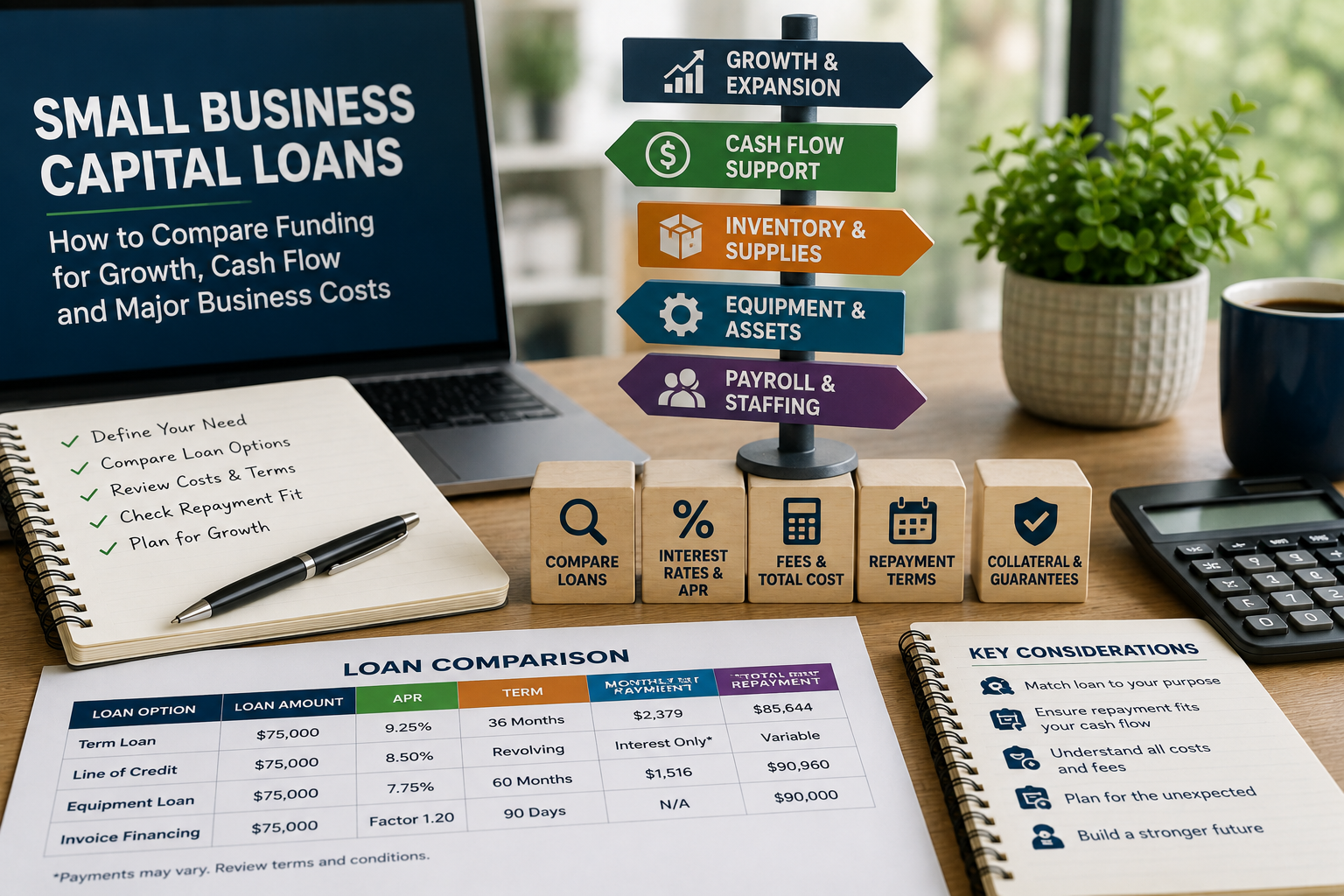
Small business capital loans can help a company fund growth, equipment, inventory, working-capital needs, expansion costs, repairs, hiring, or other substantial business expenses.
But the phrase small business capital loans does not describe one standardized financing product.
A business owner searching for capital may encounter:
- term loans
- working-capital loans
- business lines of credit
- equipment financing
- invoice financing
- secured business loans
- unsecured business loans
- SBA-backed financing
- other commercial funding structures
That means the first decision is not simply where to borrow.
It is:
What type of capital does the business actually need, how long will that need benefit the business, and what repayment structure best matches the cash the investment is expected to generate?
A company purchasing equipment expected to operate for eight years has a very different capital need from a retailer buying inventory that should sell within 90 days.
A contractor bridging a 30-day receivables gap has a different need again.
The strongest small business capital loans comparison therefore starts with the purpose of the money before examining the financing offer.
For the broader loan landscape, Kevanzo’s small business loans guide explains how different borrowing structures may fit different business needs.
Educational note: Kevanzo.com provides general business-financing education only. Kevanzo is not a lender, broker, loan marketplace, financial adviser, attorney, accountant, or approval service. Rates, APRs, fees, repayment terms, eligibility standards, collateral requirements, guarantees, funding amounts, approval requirements, and available products vary. Always review the complete financing agreement before accepting business funding.
What Small Business Capital Loans Mean
Small business capital loans generally refer to financing used to provide capital for a business purpose.
That purpose might be short-term.
It might be long-term.
It might involve an asset.
It might involve operating cash.
Common examples include:
- purchasing inventory
- covering temporary working-capital needs
- acquiring equipment
- preparing for seasonal demand
- funding a customer project
- hiring employees
- opening another location
- upgrading business systems
- repairing essential equipment
- refinancing certain existing business obligations
- supporting expansion
The word capital therefore describes what the business is trying to fund more than it describes one particular loan structure.
Business owners considering the wider range of business financing choices should concentrate on the actual agreement rather than the marketing label attached to the product.
The Most Important Question: What Is the Capital For?
Before comparing small business capital loans, define the funding purpose in one sentence.
Weak:
We need more money for the business.
Better:
We need $35,000 to purchase seasonal inventory expected to sell over the next four months.
Or:
We need $80,000 for production equipment expected to remain in service for seven years.
Or:
We need $22,000 to cover materials for a signed customer contract before the first progress payment arrives.
These examples may all involve business capital.
But they should not automatically use the same financing structure.
The Kevanzo Capital-Purpose Map
Divide the funding requirement into one of four broad categories.
1. Timing Capital
Money is needed because expenses and incoming cash occur at different times.
Examples:
- delayed invoices
- supplier timing
- payroll gaps
- project materials
2. Operating Capital
Money is needed to support ordinary short-term business activity.
Examples:
- inventory
- seasonal staffing
- marketing
- supplies
3. Asset Capital
Money is needed for something expected to benefit the business for a longer period.
Examples:
- equipment
- machinery
- vehicles
- certain technology systems
4. Expansion Capital
Money is needed for a larger strategic business investment.
Examples:
- another location
- major capacity increase
- substantial renovation
- long-term expansion program
This classification does not choose the financing automatically.
It gives the comparison a logical starting point.
The Kevanzo Benefit-Life Match
One of the strongest principles for comparing small business capital loans is:
Try to avoid repaying the financing long after the funded benefit has disappeared—or having to repay it far faster than the funded benefit can reasonably produce cash.
Consider three examples.
Inventory
Expected business benefit:
Approximately three months.
Very long-term financing may leave the business repaying inventory years after it has been sold.
Equipment
Expected useful life:
Eight years.
Extremely short-term financing may force repayment long before the equipment has generated enough value.
Receivables Gap
Expected duration:
30–60 days.
A revolving facility or another short-duration solution may deserve comparison.
The closer the financing structure matches the useful life and cash cycle of the business need, the easier the borrowing decision is to understand.
Why Business Owners Compare Small Business Capital Loans
Small businesses do not always have enough available cash to fund every opportunity or expense internally.
A business may be profitable but still need capital because:
- customer payments arrive later than expenses
- inventory must be purchased before sales
- equipment requires replacement
- growth requires spending before new revenue appears
- seasonal demand creates temporary funding requirements
- a larger customer project requires upfront materials
- expansion requires more capital than current reserves can comfortably supply
Financing can allow the business to spread or bridge those costs.
But capital is useful only if the economic benefit remains meaningful after financing cost is included.
The Kevanzo Capital-Value Question
Before borrowing, ask:
After interest, fees and repayment are included, is the funded activity still likely to strengthen the business?
Suppose a business borrows $40,000 for inventory.
The owner should not evaluate only:
Can I get the $40,000?
Instead evaluate:
- expected sales
- gross margin
- financing cost
- time required to sell inventory
- payment schedule
- downside scenario
Capital should ideally create more business value than the financing consumes.
Small Business Capital Loans Versus Small Business Loans
The term small business loans is broader.
Small business loans may cover almost any permitted business borrowing purpose.
Small business capital loans focus more specifically on obtaining capital to support:
- operations
- assets
- cash flow
- growth
- expansion
The categories overlap substantially.
This is why product names alone should not drive the decision.
Compare:
- purpose
- amount
- repayment term
- payment frequency
- total cost
- security
- guarantees
- cash-flow impact
Small Business Capital Loans Versus Business Financing
Business financing is broader still.
Business financing can include:
- loans
- revolving credit
- invoice-related financing
- equipment financing
- certain sales-based arrangements
- secured financing
- unsecured financing
A small business capital loan is therefore one possible way to obtain capital within a much wider financing landscape.
The useful question is:
Which structure solves this particular capital requirement most efficiently?
Working Capital Versus Long-Term Capital
This distinction is crucial.
Working Capital
Working capital generally supports shorter-term operating requirements.
Examples include:
- payroll timing
- inventory
- suppliers
- materials
- seasonal costs
- temporary cash gaps
Businesses considering working capital loans for small business should generally focus heavily on repayment timing.
Long-Term Capital
Longer-term capital may support investments whose benefits are expected to continue for years.
Examples may include:
- major equipment
- substantial expansion
- long-lived infrastructure
- certain property-related business investments
The financing period should make sense relative to the useful life of the investment.
The Kevanzo Short-Need/Long-Need Test
Ask one question:
Will this capital need disappear quickly, or will it continue benefiting the business for years?
If the need disappears quickly, shorter-duration or revolving financing may deserve comparison.
If the benefit continues for many years, a longer repayment structure may be more appropriate.
This prevents a common financing mistake:
using short-term money for a long-term business investment.
Small Business Capital Loans for Working Capital
Small business capital loans may be used for working-capital purposes depending on lender terms.
Examples may include:
- inventory
- payroll
- supplier payments
- temporary repairs
- seasonal preparation
- project costs
- marketing
The business should know what should repay the funding.
If $25,000 is borrowed to purchase inventory, expected inventory sales may represent the repayment source.
If $25,000 is borrowed because ordinary operating expenses continually exceed revenue, the repayment source may be much less clear.
That distinction matters.
Small Business Capital Loans Versus Working Capital Term Loans
A working capital term loan may suit a business that knows exactly how much operating capital it needs and wants a structured repayment path.
For example:
Required amount: $30,000
Purpose: seasonal inventory
Expected sales cycle: four months
A term structure may provide clarity.
However, a business with unpredictable working-capital requirements throughout the year may prefer to compare revolving credit.
Small Business Capital Loans Versus a Business Line of Credit
A business line of credit can provide flexible borrowing capacity rather than one mandatory lump sum.
That can be useful when:
- funding needs vary
- expenses are difficult to predict
- gaps occur repeatedly
- unused borrowing capacity has value
Consider:
January need: $8,000
May need: $15,000
September need: $6,000
Repeatedly arranging separate small business capital loans could be inefficient.
A revolving facility may deserve comparison.
But flexibility can also encourage unnecessary borrowing.
Every draw should have:
- a purpose
- an amount
- a repayment source
- an expected reduction date
Small Business Capital Loans Versus Cash Flow Loans
Businesses comparing cash flow loans for small business are primarily trying to solve a timing problem between incoming and outgoing money.
Suppose:
Materials paid: Day 1
Customer project completed: Day 25
Invoice paid: Day 55
The business must finance almost two months of activity before receiving customer cash.
Capital could bridge that period.
The important comparison becomes:
- when financing payments begin
- when customer cash arrives
- how much operating cash is available during the gap
A loan can be affordable overall but poorly timed.
The Kevanzo Cash-Generation Clock
For any small business capital loans used to fund a revenue-producing activity, write down four dates:
- when capital is received
- when the business spends it
- when the funded activity begins producing cash
- when financing repayment begins
Example:
Day 1 — funding received
Day 3 — inventory purchased
Day 25 — inventory sales begin
Day 40 — meaningful customer cash arrives
Day 10 — financing payments begin
The business must fund payments from Day 10 to Day 40 before the investment is producing meaningful cash.
That period should be part of the affordability calculation.
Small Business Capital Loans Versus Unsecured Business Loans
Unsecured business loans may allow financing without one specifically pledged asset in the same way as traditional secured borrowing.
That can be useful for general capital purposes.
But unsecured does not mean:
- no risk
- no personal guarantee
- no business lien
- inexpensive financing
- guaranteed approval
A lender may rely more heavily on:
- business cash flow
- credit
- revenue
- time in business
- existing debt
- repayment history
Compare the total structure.
Secured Small Business Capital Loans
Secured financing may involve collateral such as:
- equipment
- inventory
- receivables
- vehicles
- real property
- other qualifying business assets
Security can affect:
- lender risk
- available amount
- pricing
- repayment terms
- borrower consequences after default
A secured loan may be perfectly reasonable when financing an identifiable asset.
For example, equipment financing may naturally be connected to the equipment being purchased.
The important issue is understanding exactly what is pledged.
The Kevanzo Security Tradeoff
When comparing secured and unsecured small business capital loans, evaluate two types of pressure.
Asset Exposure
What collateral could be at risk?
Cash-Flow Pressure
How much cash must leave the business to service the financing?
Avoid assuming that the option with no specifically pledged asset is automatically the safer choice.
A substantially more expensive unsecured facility could create serious cash-flow pressure.
Small Business Capital Loans Versus Invoice Financing
Businesses waiting on customer payments may compare capital loans with invoice financing for small business.
Suppose a company has:
Eligible outstanding invoices: $120,000
Immediate funding requirement: $30,000
The underlying capital problem is closely connected to receivables.
Invoice financing may therefore deserve comparison with a general-purpose business loan.
Consider:
- invoice eligibility
- customer quality
- financing fees
- payment timing
- customer-payment risk
- collection structure
Financing should match the underlying problem.
Small Business Capital Loans Versus Quick Business Loans
Sometimes the issue is not only obtaining capital.
It is obtaining it quickly.
Businesses considering quick business loans may be facing:
- equipment failure
- supplier deadlines
- project timing
- seasonal inventory deadlines
- unexpected operating costs
Speed has value when waiting has measurable business consequences.
But a faster funding process should still be compared by:
- total cost
- repayment term
- payment frequency
- guarantees
- security
- cash-flow impact
Fast funding should not require fast judgment.
Small Business Capital Loans Versus Short-Term Business Loans
A short term business loan may make sense when the capital requirement is temporary and clearly defined.
But short repayment periods can create repayment compression.
Suppose:
Funding: $40,000
Term A: 24 months
Term B: 8 months
Even before comparing interest or fees, Term B requires the business to return the borrowed capital much faster.
That could be appropriate if the funded activity produces cash quickly.
It could be dangerous if the benefit takes years to appear.
SBA-Backed Capital Options
U.S. business owners may also compare SBA-backed financing with conventional small business capital loans.
The SBA currently identifies 7(a) as its primary business-loan program, with permitted uses that include short- and long-term working capital, machinery and equipment, supplies, debt refinancing, real estate and multiple-purpose loans. The SBA separately maintains 504 and Microloan programs.
These programs have their own eligibility, lender, use-of-proceeds and application requirements.
They should be evaluated based on the business’s actual financing purpose rather than simply because they carry the SBA name.
Capital for Equipment
Equipment is a classic example of why financing structure matters.
Imagine a business needs a $90,000 machine expected to operate for eight years.
If the business uses an extremely short-term loan, repayment may occur much faster than the equipment produces its economic benefit.
That could strain cash flow unnecessarily.
A financing structure aligned more closely with the asset’s useful life may deserve consideration.
The key principle is:
Long-lived benefit usually deserves a long-term financing comparison.
Capital for Inventory
Inventory behaves differently.
Suppose:
Inventory cost: $40,000
Expected selling period: 90 days
The business expects the inventory to convert back into cash relatively quickly.
A long multi-year financing commitment may not be necessary.
Instead, the owner could compare:
- working-capital financing
- revolving credit
- short-term financing
- supplier terms
Again, match the financing to the business cycle.
Capital for Expansion
Expansion creates one of the most complicated small business capital loans decisions.
A new location may require:
- renovations
- equipment
- inventory
- deposits
- hiring
- training
- advertising
- working-capital reserves
The business may spend substantial money months before the new operation becomes profitable.
That creates a longer capital cycle.
Before borrowing, estimate:
- total project cost
- expected opening date
- break-even period
- working-capital requirement
- projected operating margin
- debt payments
- downside scenario
Expansion should not depend on perfect forecasting.
The Kevanzo Capital-Layer Test
Large projects often contain more than one type of capital need.
Imagine a second retail location.
The business needs:
$120,000 equipment
$50,000 renovations
$35,000 inventory
$25,000 opening working capital
Total:
$230,000
These expenses do not all have the same economic life.
Instead of automatically funding everything through one product, compare whether different layers deserve different financing structures.
This can make repayment better aligned with how the business uses the money.
What Lenders May Review
Lenders considering small business capital loans may review:
- business revenue
- profitability
- cash flow
- bank activity
- existing debt
- credit history
- repayment history
- time in business
- industry
- ownership
- intended use of proceeds
- collateral
- guarantees
- requested amount
Requirements vary considerably.
A business should therefore prepare for more than a headline revenue check.
Revenue Is Not Repayment Capacity
Consider two fictional companies.
Business A
Monthly revenue: $180,000
Monthly operating expenses: $169,000
Operating room before new debt: $11,000
Business B
Monthly revenue: $110,000
Monthly operating expenses: $75,000
Operating room before new debt: $35,000
Business A produces much more revenue.
Business B has far more room before adding a new financing payment.
That is why small business capital loans should be evaluated against cash remaining after operations, not sales alone.
The Kevanzo Capital Repayment Cushion
Calculate:
operating cash available
minus
existing debt payments
minus
new financing payment
equals
remaining repayment cushion
Example:
Operating cash available: $27,000
Existing debt payments: $7,000
Proposed new capital-loan payment: $8,000
Remaining cushion:
$12,000
Now test a slower month.
Operating cash available: $18,000
Existing debt: $7,000
New financing: $8,000
Remaining cushion:
$3,000
That second result may substantially change the decision.
The Kevanzo Three-Condition Capital Stress Test
Test small business capital loans under three conditions.
Normal Conditions
Revenue and costs behave approximately as expected.
Can the business repay comfortably?
Slow Conditions
Revenue declines by a realistic amount.
Can the business still cover:
- payroll
- rent
- taxes
- suppliers
- insurance
- loan payments?
Disrupted Conditions
Revenue weakens while an unexpected expense occurs.
Would another loan immediately become necessary?
Financing that survives only the best scenario may be too aggressive.
Fixed Repayment Versus Flexible Access
Small business capital loans may use fixed repayment.
Fixed payments can provide:
- clarity
- budgeting simplicity
- a defined payoff path
But they also continue when revenue slows.
Revolving credit may provide:
- flexible draws
- the ability to borrow only what is required
- potential reuse of repaid credit
But flexible access can encourage repeated borrowing.
Neither structure is inherently superior.
The business should choose based on the capital requirement.
Interest Rate, APR and Total Cost
Small business capital loans should never be compared only by the advertised payment.
Review:
- interest rate
- APR where applicable
- fees
- repayment term
- payment frequency
- total repayment
- net funding received
APR may help compare certain financing products.
But different business-funding structures may use different pricing approaches.
The business should understand the actual dollars received and the actual dollars expected to be repaid.
Factor Rates
Some business-funding products use factor-rate pricing rather than a traditional interest rate.
For example:
Funding:
$50,000
Factor rate:
1.25
Simplified contractual repayment:
$62,500
That does not mean the product has a conventional 25% annual interest rate.
The duration and repayment structure matter.
When factor-rate products appear alongside small business capital loans, compare:
- amount received
- total repayment
- repayment period
- payment frequency
- other fees
Do not compare differently defined numbers as if they meant the same thing.
The Kevanzo Ten-Number Capital Loan Comparison
For every serious offer, record these ten numbers.
1. Capital Required
How much does the business actually need?
2. Gross Financing Amount
What amount appears in the agreement?
3. Net Cash Received
How much usable capital reaches the company?
4. Interest Rate
What rate applies where relevant?
5. APR
What APR is disclosed where applicable?
6. Fees
What origination or other charges apply?
7. Payment Amount
What must the business pay?
8. Payment Frequency
How often?
9. Repayment Term
How long?
10. Total Repayment
How much should be repaid altogether?
This turns small business capital loans into comparable financial structures instead of marketing headlines.
Net Capital Received Matters
Suppose the business needs exactly $75,000.
A financing agreement is presented as:
$75,000 loan
But fees are deducted before funds are released.
The business receives less than $75,000.
It may then still have insufficient capital for the project.
Compare:
gross financing
with:
net usable capital
before accepting.
Existing Debt Changes the Capital Decision
Never analyze small business capital loans in isolation.
Suppose a business already pays:
Equipment loan: $2,400 monthly
Vehicle financing: $1,100 monthly
Existing term loan: $3,000 monthly
Credit cards: $1,500 monthly
Proposed capital loan: $5,000 monthly
The new loan payment is $5,000.
But total debt-related cash outflow becomes:
$13,000 per month
That is the number the business must absorb.
The Kevanzo Debt-Stack Check
List every existing obligation.
For each include:
- balance
- payment
- frequency
- remaining term
- collateral
- guarantee
Then add the proposed small business capital loans payment.
Ask:
Does enough cash remain to operate normally after all debt payments are made?
If not, more capital may actually reduce financial flexibility.
Personal Guarantees
Some small business capital loans may require personal guarantees.
A guarantee can create personal repayment responsibility depending on the contract.
Review:
- who guarantees the financing
- what obligations are covered
- when the guarantee applies
- lender rights following default
Do not assume business borrowing always means business-only exposure.
Collateral and Liens
Financing may involve:
- specific collateral
- broader business security interests
- liens
- other lender protections
Read the agreement carefully.
Ask:
- what assets are affected?
- what happens after default?
- what happens after repayment?
- are there restrictions on selling secured assets?
Security provisions matter as much as the payment.
Nine Small Business Capital Loan Scenarios
Scenario 1: Seasonal Inventory
A retailer needs $45,000 in inventory.
Expected sales cycle:
Four months.
The owner should compare:
- expected margin
- repayment term
- sales timing
- slower-sales scenario
- total financing cost
The inventory should ideally produce cash before financing becomes burdensome.
Scenario 2: Equipment Purchase
A contractor needs a $70,000 machine expected to operate for seven years.
Short-term financing may create excessive repayment pressure.
Longer-term asset financing deserves comparison.
Scenario 3: Customer Project
A business wins a $150,000 project.
It needs $30,000 in materials immediately.
The first milestone payment is expected in 45 days.
Small business capital loans may bridge the project.
But the business should test what happens if payment is 30 days late.
Scenario 4: New Location
A successful company wants to open another location.
Capital requirement:
$250,000
Expected break-even:
15 months.
This is a longer-term capital need.
The financing structure should recognize that meaningful cash return may take time.
Scenario 5: Emergency Repair
Essential equipment breaks.
Repair cost:
$18,000
Every day of downtime costs significant revenue.
Here, obtaining capital quickly may create measurable economic value.
But cost and repayment still matter.
Scenario 6: Receivables Gap
A company has $100,000 of customer invoices outstanding but needs $20,000 today.
The business could compare:
- capital loans
- invoice financing
- revolving credit
- improved collection procedures
The receivable itself provides useful context for the funding problem.
Scenario 7: Marketing Investment
A business wants $50,000 for advertising.
Unlike confirmed invoices, the resulting revenue is uncertain.
The owner should model:
- acquisition cost
- expected conversions
- gross margin
- downside scenario
Do not treat forecast revenue as guaranteed repayment cash.
Scenario 8: Rapid Growth
A company is growing quickly.
It needs more:
- employees
- inventory
- systems
- working capital
Growth can consume cash even when revenue rises.
Small business capital loans should therefore be compared against profitable cash-generating growth, not simply higher sales.
Scenario 9: Persistent Operating Loss
A business repeatedly needs loans for:
- payroll
- suppliers
- rent
- previous debt payments
This is a serious warning pattern.
More capital may temporarily delay the problem while increasing future obligations.
Management should investigate:
- pricing
- margins
- overhead
- staffing
- inventory
- collections
- customer profitability
- existing debt
Capital cannot permanently repair an unsustainable operating model.
Common Small Business Capital Loan Mistakes
Borrowing Without a Specific Purpose
Capital should solve an identifiable problem or fund an identifiable opportunity.
Borrowing the Maximum Offered
Approval size is not a spending target.
Matching the Wrong Term to the Need
Short-lived expenses and long-lived assets require different thinking.
Comparing Only Monthly Payments
A smaller payment may come with a longer and more expensive obligation.
Ignoring Existing Debt
The business pays all obligations from the same cash flow.
Using Optimistic Revenue Forecasts
Stress-test weaker scenarios.
Ignoring Fees
Net capital and total repayment matter.
Ignoring Guarantees or Collateral
Understand lender protections before signing.
Using New Debt to Repay Old Debt Repeatedly
This can indicate escalating financial stress.
Small Business Capital Loan Red Flags
Slow down when:
- the funding purpose is vague
- the business does not know how much capital is actually required
- the financing period does not match the business need
- total repayment is unclear
- fees are difficult to identify
- payment frequency is unsuitable
- collateral requirements are unclear
- personal guarantee language is unclear
- repayment depends on very optimistic revenue
- existing debt is already heavy
- the business expects another loan will soon be required
- the financed activity may take years to generate value but repayment is heavily compressed
- financing is covering recurring operating losses
Several red flags together deserve serious review.
Questions to Ask Before Accepting Small Business Capital Loans
Ask:
- What exact business purpose will the capital fund?
- How much capital is actually required?
- How much money will the business receive after deductions?
- What interest rate applies?
- What APR is disclosed where applicable?
- What fees apply?
- What is the total repayment amount?
- What is each payment?
- How frequently are payments required?
- When does repayment begin?
- How long is the repayment term?
- Can the financing be repaid early?
- Are there prepayment costs?
- Is collateral required?
- Is a personal guarantee required?
- Is a lien involved?
- What constitutes default?
- What happens after a missed payment?
- Can rates or payments change?
- Does the repayment period match the funded asset or activity?
- What happens if revenue is delayed?
- How does this loan fit beside existing debt?
- What alternative financing structures could solve the same problem?
If these questions cannot be answered clearly, comparison is not complete.
Documents Worth Preparing
Businesses considering small business capital loans may benefit from organizing:
- business bank statements
- profit and loss statements
- balance-sheet information
- tax records where requested
- business debt schedules
- accounts receivable
- accounts payable
- ownership information
- business formation records
- identification
- collateral information
- project or equipment costs
- explanation of the funding purpose
Requirements vary by lender.
Preparation also allows the owner to evaluate the financing independently.
The Kevanzo 20-Point Capital Loan Check
Before accepting small business capital loans, complete this final review.
1. Purpose
What exactly will the money fund?
2. Need Type
Timing, operating, asset, or expansion capital?
3. Required Amount
How much is genuinely needed?
4. Net Capital
How much cash actually reaches the business?
5. Benefit Life
How long should the funded activity benefit the business?
6. Financing Term
Does repayment match that period?
7. Repayment Source
What cash should repay the loan?
8. Cash-Generation Timing
When does the financed activity begin producing money?
9. Interest Rate
What rate applies?
10. APR
What APR is disclosed where applicable?
11. Fees
What additional costs apply?
12. Total Repayment
How much should be paid altogether?
13. Payment Amount
What is each payment?
14. Payment Frequency
How often must the business pay?
15. Existing Debt
What other obligations already consume cash?
16. Repayment Cushion
How much operating cash remains?
17. Slow-Month Test
Can the business repay during weaker conditions?
18. Collateral and Guarantees
What lender protections apply?
19. Alternative Financing
Would another structure better match the capital need?
20. After-Debt Result
Should the business reasonably be stronger after the financing is completely repaid?
That last question is particularly important.
Capital should ideally leave the business with something valuable after the debt is gone.
Practical Next Steps
Start by defining the capital requirement.
Write down:
- what needs funding
- how much it costs
- how long the benefit should last
- when the activity should start generating cash
- what should repay the financing
Then classify the need:
- timing capital
- operating capital
- asset capital
- expansion capital
Next, compare financing structures.
A business may consider:
- a term loan
- working-capital financing
- a line of credit
- invoice financing
- asset-specific financing
- another suitable business-funding structure
For every serious offer, record:
- gross funding
- net funding
- interest
- APR where applicable
- fees
- payment
- payment frequency
- repayment term
- total repayment
- collateral
- guarantees
Then run:
- the benefit-life match
- the capital repayment cushion
- the three-condition stress test
- the debt-stack check
Finally, read the complete agreement.
Small business capital loans should not simply provide money.
They should provide capital whose useful business benefit has a realistic chance of exceeding its cost and whose repayment fits the business’s actual cash flow.
Final Takeaway
Small business capital loans can help fund inventory, working capital, equipment, customer projects, expansion, growth, and other legitimate business needs, but the phrase describes a broad financing purpose rather than one standardized loan product.
The strongest capital decision begins by defining:
what the business needs, how long the funded benefit should last, when the investment should begin producing cash, and what cash will repay the financing.
Before accepting small business capital loans, compare the net amount received, interest or APR where applicable, fees, payment amount, payment frequency, repayment term, total repayment, collateral, personal guarantees, existing debt, and cash-flow impact.
Most importantly, match the financing term to the economic life of the business need.
Good capital financing should leave the business stronger after the debt has been repaid—not simply richer in cash on the day the loan arrives.
Frequently Asked Questions About Small Business Capital Loans
What Are Small Business Capital Loans?
Small business capital loans generally refer to financing used to provide money for business operations, assets, working capital, growth, expansion, inventory, equipment, projects, or other business needs.
The exact financing structure varies.
Are Small Business Capital Loans One Specific Loan Product?
No.
The term may describe several forms of business financing.
Business owners should examine the actual product and agreement.
What Can Small Business Capital Loans Be Used For?
Depending on lender rules, potential uses may include:
- working capital
- inventory
- equipment
- payroll timing
- suppliers
- projects
- expansion
- repairs
- growth
Permitted uses vary.
Are Small Business Capital Loans the Same as Working Capital Loans?
Not necessarily.
Working-capital loans generally focus on operating requirements.
Small business capital loans may also fund longer-term assets or expansion.
Are Small Business Capital Loans the Same as a Business Line of Credit?
No.
A line of credit generally provides borrowing access up to an approved limit.
A capital term loan may provide one lump sum.
Can Small Business Capital Loans Be Unsecured?
Some may be.
Others may require collateral or another security interest.
The agreement determines the structure.
Are SBA Loans Small Business Capital Loans?
SBA-backed loan programs can provide financing for eligible small businesses and may fund various business capital needs depending on the particular program and lender requirements.
Should a Business Use Short-Term Financing for Equipment?
It depends on the specific circumstances.
A business should consider whether the repayment term reasonably matches the useful life and cash-generation period of the equipment.
What Is the Difference Between Interest Rate and APR?
Interest rate describes one component of borrowing cost.
APR, where applicable, may incorporate certain additional costs into an annualized measure.
Business owners should still review fees and total repayment.
What Is a Factor Rate?
A factor rate is a different pricing method used by some business-funding products.
It should not be treated as a conventional annual interest rate.
What Is the Most Important Cost Number?
No single number tells the whole story.
Useful figures include:
- net cash received
- APR where applicable
- payment
- repayment term
- fees
- total repayment
Is a Lower Monthly Payment Always Better?
No.
A lower payment may result from a longer repayment period and can potentially increase total financing cost.
Compare affordability and total cost together.
How Much Capital Should a Business Borrow?
There is no universal amount.
Begin with the genuine funding requirement rather than the maximum amount offered.
When Might Small Business Capital Loans Be a Poor Fit?
They may deserve reconsideration when:
- the funding purpose is unclear
- repayment depends on unrealistic growth
- existing debt is already excessive
- the business has persistent losses
- the financing term does not match the need
- another financing structure fits better
What Is the Most Important Question Before Borrowing?
Ask:
Will this financing leave the business in a stronger position after the capital has been used and the debt has been repaid?
Helpful Authoritative Resources
- U.S. Small Business Administration loan programs
- U.S. Small Business Administration 7(a) loan program
- U.S. Small Business Administration 504 loan program
- U.S. Small Business Administration Microloan program
- Consumer Financial Protection Bureau small business lending resources
- SCORE small business mentoring and education
Author Bio
Kevanzo Editorial Team
Kevanzo Editorial Team creates practical, plain-English educational resources for U.S. business owners comparing small business capital loans, small business financing, working-capital funding, business credit, loan costs, repayment structures, cash-flow risk, and responsible business-financing decisions.
Copyright Notice
© 2026 Kevanzo. All rights reserved.
This article about small business capital loans is protected by copyright and may not be copied, scraped, spun, republished, or used commercially without prior written permission from Kevanzo. Brief quotations may be used with clear attribution and a link to the original article.
Unauthorized reuse, bulk scraping, content spinning, AI rewriting for republication, or commercial reproduction of this material is prohibited.
Educational Disclaimer
Kevanzo.com provides general educational information about business financing. Kevanzo is not a lender, broker, loan marketplace, financial adviser, attorney, accountant, or approval service.
Nothing in this article constitutes financial, legal, tax, accounting, investment, lending, or personalized business advice. Rates, APRs, fees, repayment terms, approval requirements, collateral requirements, personal guarantees, funding amounts, and available financing products vary by lender, borrower, business profile, industry, revenue, credit history, and market conditions.
Business owners should review current official information, read financing agreements carefully, and consider obtaining advice from appropriately qualified professionals when necessary before making borrowing decisions.