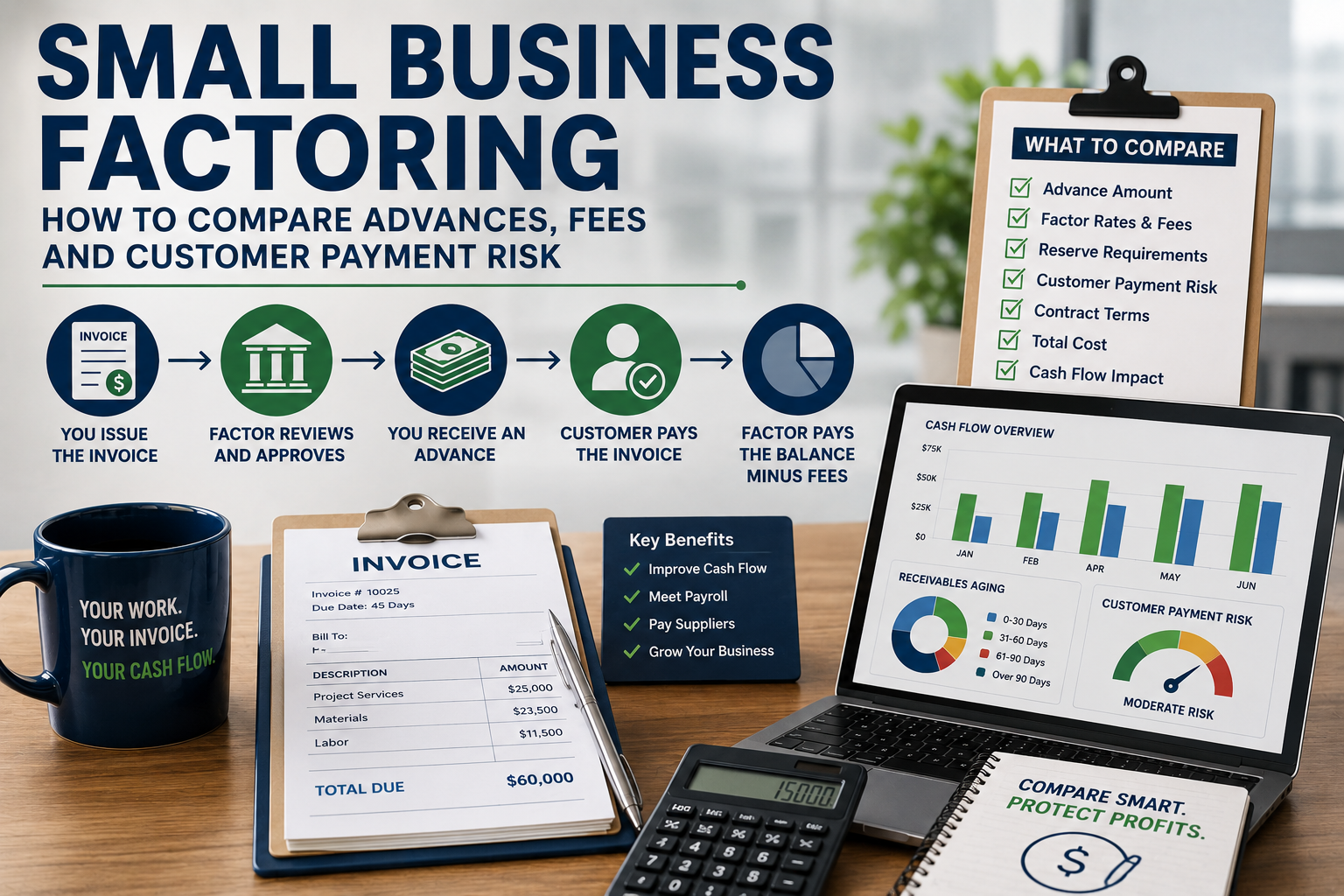
Small Business Factoring can turn eligible unpaid business invoices into cash before customers actually pay them.
That can help when a business has already:
- completed the work
- delivered the goods
- issued the invoice
but may still wait:
- 30 days
- 45 days
- 60 days
- or longer
for customer payment.
The important point is that factoring is generally not the same thing as taking out a conventional business loan.
The CFPB’s current Regulation B interpretation describes factoring as an accounts-receivable purchase transaction involving the purchase, transfer or sale of a legally enforceable claim for payment for goods or services already supplied but not yet fully paid.
That creates a very different decision from:
How much can we borrow?
The better question is:
How much future invoice value are we giving up, what cash do we receive today, and what happens if the customer pays late or does not pay?
For businesses considering borrowing against invoices rather than selling or assigning them, Kevanzo’s invoice financing for small business guide explains that separate structure.
Educational note: Kevanzo.com provides general business-financing education only. Kevanzo is not a lender, factor, broker, loan marketplace, financial adviser, attorney, accountant or approval service. Factoring costs, advance percentages, reserve arrangements, customer-notification procedures, recourse provisions, contract terms and eligibility requirements vary by provider and agreement.
What Is Small Business Factoring?
Small Business Factoring generally involves a business selling or assigning eligible accounts receivable to a factoring company in exchange for earlier access to cash.
A simplified cycle looks like this:
business performs work → invoice issued → invoice factored → business receives earlier cash → customer pays → transaction settles according to agreement
That differs from a traditional loan cycle:
lender advances money → business owes debt → business makes scheduled repayments
The distinction matters.
The financing provider is primarily evaluating an existing receivable rather than merely lending money against future business hopes.
The Kevanzo Earned-Revenue Rule
Factoring should normally begin with something the business has already earned.
Ask:
Has the Work Been Completed?
Yes or no?
Have the Goods Been Delivered?
Yes or no?
Is There a Valid Invoice?
Yes or no?
Does a Real Customer Owe the Money?
Yes or no?
Is the Invoice Undisputed?
Yes or no?
The stronger those answers are, the clearer the receivables situation becomes.
Why Businesses Consider Factoring
Imagine a staffing company.
Workers must be paid:
every week
Commercial clients pay invoices:
45 days later
The company may be profitable.
But cash timing can still be difficult.
Factoring can potentially shorten the wait between:
earning revenue
and
having spendable cash.
Other receivables-heavy businesses can face similar timing issues, including:
- wholesalers
- contractors
- transport companies
- manufacturers
- staffing businesses
- commercial cleaners
- professional service companies
- suppliers
- distributors
Businesses with broader operating-cash needs can also compare cash flow loans for small business.
The Kevanzo Receivables-Gap Test
Calculate:
customer-payment date
minus
date business expenses must be paid
The difference is the receivables gap.
Example:
Payroll due:
Day 7
Customer invoice due:
Day 45
Cash gap:
approximately 38 days
Factoring may address that timing gap.
But financing the gap only makes sense if the cost is reasonable.
How Small Business Factoring Works
The exact process varies, but a simplified example may look like this.
Invoice:
$50,000
The factor accepts the invoice.
An agreed portion is advanced to the business.
The remaining amount may be held back temporarily.
The customer later pays according to the agreement.
The factoring company deducts its agreed charges.
Any remaining amount due to the business is then settled according to the contract.
The precise:
- advance
- reserve
- fees
- customer-payment process
- nonpayment responsibility
depend on the agreement.
Advance Rate Is Not the Same as Cost
This is extremely important.
Suppose:
Invoice:
$100,000
Advance:
85%
Immediate cash:
$85,000
That does not mean the cost is 15%.
Part of the remaining 15% may simply be held as a reserve until the customer pays.
The actual financing cost needs to be calculated separately.
The Kevanzo Advance-versus-Cost Test
Always separate:
Invoice Value
What is the customer expected to pay?
Initial Advance
What arrives immediately?
Reserve
What amount is temporarily held back?
Factoring Charges
What does the service actually cost?
Final Business Proceeds
What does the business ultimately retain?
Never treat those numbers as interchangeable.
The Kevanzo Five-Number Factoring Snapshot
For every serious factoring offer, record:
- invoice face value
- initial advance
- reserve
- total factoring charges
- final net proceeds
That five-number snapshot can expose a confusing offer very quickly.
Net Proceeds Matter Most
Suppose an invoice is:
$60,000
Initial advance:
$48,000
Later settlement to business:
$9,000
Total received by business:
$57,000
Total difference from invoice value:
$3,000
That $3,000 deserves close examination.
Ask what produced it:
- factoring fee
- service charges
- transaction charges
- customer-payment delay
- other contract costs
The business needs to understand the complete economics.
The Kevanzo Net-Invoice Value Test
Calculate:
invoice face value
minus
all factoring-related charges
equals
net invoice value retained by business
Then ask:
Was receiving the money earlier worth that cost?
That is a far better question than simply asking whether the advance was fast.
Earlier Cash Has Economic Value
Factoring can be expensive and still sometimes create business value.
Imagine:
Invoice:
$80,000
Customer pays in:
60 days
The business needs:
$40,000
immediately to fulfil another profitable order.
That order may create:
$20,000
of additional gross profit.
If obtaining earlier invoice cash costs:
$3,000
the business can compare:
$3,000 financing cost
against
the business value protected or created.
That does not automatically make factoring worthwhile.
But it gives the decision a rational basis.
The Kevanzo Early-Cash Value Test
Estimate:
business value created or protected by earlier cash
minus
factoring cost
equals
estimated economic benefit
Then test whether that benefit survives weaker assumptions.
Customer Quality Matters
Factoring is unusual because the business’s customer can become central to the financing decision.
A factor may care about:
- whether the customer is real
- payment history
- creditworthiness
- invoice age
- likelihood of payment
- disputes
- concentration
- documentation
This means a strong business with weak-paying customers can still encounter problems.
Likewise, a relatively small company serving strong commercial customers may present a different receivables profile.
The Kevanzo Customer-Payment Test
For each major factored customer, ask:
Average Payment Time
How long do they normally take?
Late-Payment History
How often are payments delayed?
Dispute History
Are invoices regularly challenged?
Concentration
How much of receivables depends on this customer?
Financial Reliability
Is there reason to question future payment?
The customer is not just a buyer anymore.
Their payment behaviour can affect financing.
Customer Concentration Risk
Suppose a company has:
$200,000
in outstanding invoices.
One customer owes:
$150,000
That customer represents:
75% of receivables.
If that customer:
- pays late
- disputes work
- experiences financial trouble
- ends the commercial relationship
the impact can be substantial.
The Kevanzo Customer-Concentration Test
Calculate:
largest customer receivable
divided by
total eligible receivables
Then ask:
What happens if that one customer pays 30 days late?
Do not judge the factoring arrangement only under perfect payment conditions.
Invoice Quality Matters
A $50,000 invoice is not automatically a strong $50,000 receivable.
The provider may want evidence that the invoice represents:
- completed work
- delivered goods
- agreed pricing
- genuine customer obligation
- no active dispute
Poor documentation can make the receivable less attractive.
The Kevanzo Invoice-Quality Test
Check:
- Is the invoice accurate?
- Is the work completed?
- Is delivery documented?
- Did the customer accept the work or goods?
- Is there a purchase order where relevant?
- Is the invoice disputed?
- Is payment already overdue?
- Is another party claiming rights over the receivable?
A strong receivable starts with strong business records.
Invoice Financing Versus Factoring
These terms are sometimes used loosely in the marketplace.
For Kevanzo’s article architecture, we keep them clearly separated.
Small Business Factoring
Core concept:
sale or assignment of receivables
Customer payment and collection may be more directly involved.
Invoice Financing for Small Business
Core concept:
financing secured or supported by receivables
The business may retain more responsibility for collecting customer payments depending on the agreement.
The contract—not merely the marketing label—determines the actual structure.
The Kevanzo Control Test
Ask:
Who controls customer collection?
Business Retains Collection
The structure may resemble invoice financing more closely.
Factor Receives Customer Payment
The arrangement may resemble traditional factoring more closely.
Always follow the agreement rather than the product name.
Recourse Factoring
Some factoring agreements can leave the business responsible for certain unpaid invoices.
That is commonly described as recourse.
For example, depending on the agreement, the business might need to:
- repurchase an unpaid invoice
- replace it with another eligible invoice
- repay an amount
- satisfy another contractual obligation
The exact consequences must come from the contract.
Non-Recourse Does Not Mean No Risk
Some arrangements may shift particular customer nonpayment risks toward the factor.
But the phrase non-recourse should never be interpreted as automatically covering every possible failure to pay.
Contracts can contain:
- exclusions
- conditions
- dispute provisions
- fraud provisions
- documentation requirements
- specific definitions of covered nonpayment
Read the agreement carefully.
The Kevanzo Recourse Reality Check
Before signing, answer:
Who Bears Nonpayment Risk?
Business or factor?
What Type of Nonpayment?
Insolvency?
Dispute?
Late payment?
What Events Are Excluded?
Read them.
What Must the Business Do?
Repurchase?
Replace?
Repay?
When Does Responsibility End?
Know the trigger.
The label alone is not enough.
Factoring Fees
Potential pricing structures can include:
- discount charges
- factoring fees
- service charges
- processing fees
- wire fees
- invoice-handling charges
- due-diligence charges
- minimum-volume requirements
- contract-related fees
Not every arrangement includes every cost.
The correct comparison comes from the actual offer.
The Kevanzo Complete-Cost Stack
Build one list containing:
base factoring charge
plus
additional fees
plus
cost created by longer customer-payment time
plus
any required minimums or contractual costs
This gives a much more realistic view than the advertised starting fee alone.
Time Can Increase Factoring Cost
Some factoring agreements may price partly according to how long the invoice remains unpaid.
That means:
customer takes longer → financing remains outstanding longer → cost may increase
depending on the contract.
This creates a special factoring risk.
The business may not fully control the factor that determines cost.
Its customer does.
The Kevanzo Payment-Delay Stress Test
Calculate cost under:
Expected Payment
Customer pays in 30 days.
Slow Payment
Customer pays in 45 days.
Very Slow Payment
Customer pays in 60 days.
Then compare the business’s final proceeds.
An agreement that works at 30 days may look much less attractive at 60.
Margin Erosion
Imagine:
Invoice revenue:
$50,000
Gross profit before factoring:
$10,000
Factoring costs:
$3,000
Remaining gross contribution:
$7,000
The financing has consumed:
30% of the original $10,000 gross profit.
That is why factoring should be compared with business margin, not merely invoice size.
The Kevanzo Margin-Erosion Test
Calculate:
factoring cost
divided by
profit expected from the underlying sale or project
This shows how much economic value the financing consumes.
A small percentage of invoice value can represent a much larger percentage of business profit.
Customer Communication Matters
Traditional factoring arrangements can affect the customer’s payment process.
Customers may be instructed to:
- send payment elsewhere
- use different remittance information
- communicate with the factor about payment
That means the financing arrangement can become visible to customers.
This is not automatically bad.
But it should be handled professionally.
The Kevanzo Customer-Relationship Test
Before factoring ask:
- Will customers be notified?
- Who contacts them?
- What will customers be told?
- Where will customers send payment?
- Who handles payment questions?
- Who handles disputes?
- Does the process fit the company’s customer-service standards?
Factoring affects more than finance.
It can affect relationships.
Customer Disputes Can Change Everything
Suppose:
Invoice:
$40,000
Customer says:
The work was incomplete.
Now the issue is no longer merely payment timing.
It is invoice validity.
Before factoring, businesses should identify:
- unresolved complaints
- credits
- returns
- incomplete work
- disputed quantities
- pricing disagreements
Factoring works best with clean receivables.
The Kevanzo Dispute-Risk Test
Ask:
If the customer challenged this invoice tomorrow, what would happen under the factoring agreement?
If you cannot answer, keep reading the contract.
Minimum Volume Requirements
Some arrangements may require a business to factor:
- minimum invoice amounts
- minimum monthly volume
- all invoices from certain customers
- other agreed volumes
Those requirements can reduce flexibility.
A business that only needs occasional financing should compare carefully before committing.
The Kevanzo Flexibility Test
Ask:
Can We Choose Individual Invoices?
Or must more receivables be included?
Is There a Minimum Volume?
Monthly?
Annual?
Is There a Long Contract?
How long?
Can We Leave?
At what cost?
Does the Business Still Want Factoring After the Immediate Gap Is Solved?
Flexibility has real financial value.
Contract Length
A company might need financing for:
two months
but sign an agreement lasting:
one year
That mismatch deserves attention.
Short cash-flow problem.
Long contractual obligation.
The Kevanzo Need-to-Contract Match
Compare:
expected duration of cash need
with
duration of factoring commitment
If the contract lasts much longer, identify why.
Factoring Versus Working Capital Loans
A working capital loans for small business option may create a direct debt repayment schedule.
Factoring is tied more closely to existing receivables and customer payment.
Compare:
Working-Capital Loan
Business receives financing.
Business repays according to agreement.
Factoring
Business monetizes eligible receivables.
Customer payment plays a central role in settlement.
Neither structure is automatically superior.
Factoring Versus a Business Line of Credit
A business line of credit may allow repeated draws and repayments.
That can suit recurring working-capital needs.
Factoring instead uses invoice value.
Questions to compare include:
- total cost
- collateral
- customer involvement
- credit availability
- repayment structure
- administrative work
- flexibility
The Kevanzo Funding-Source Test
Ask:
What asset or cash flow supports this financing?
Factoring
Existing receivables.
Line of Credit
Business credit capacity and whatever security/support the agreement requires.
Term Loan
General repayment ability plus whatever underwriting/security applies.
Choose the structure connected most logically to the business problem.
Factoring Versus Short-Term Business Finance
Businesses may also compare short term business finance where the funding need is temporary.
If the problem is specifically:
valuable invoices exist but customer cash has not arrived
factoring has a clear structural connection.
If the problem is:
equipment repair
or:
inventory purchase without receivables
another structure may fit better.
The Kevanzo Receivables-First Rule
Use factoring because:
receivables are the problem
not simply because:
cash is needed quickly.
That distinction prevents the financing product from being chosen for the wrong reason.
Factoring and Existing Debt
Receivables may already be connected to:
- existing financing
- security interests
- lender arrangements
- other contractual rights
Before entering a factoring agreement, determine whether the business is legally able to transfer or assign the receivables involved.
This is an area where professional legal or financial advice may be valuable.
The Kevanzo Receivables-Ownership Check
Before factoring an invoice ask:
- Does the business legally own the receivable?
- Has it already been pledged?
- Is another lender claiming rights over it?
- Does the customer contract restrict assignment?
- Is the invoice free from dispute?
Do not assume every outstanding invoice is automatically factorable.
Factoring Dependency
Factoring can solve a timing problem today.
But repeated use can become a permanent operating cost.
Suppose a business factors invoices:
January.
February.
March.
April.
May.
June.
Ask:
Why can the business no longer operate without selling receivables early?
There may be a legitimate reason.
But it deserves investigation.
The Kevanzo Factoring-Dependency Test
Review:
Frequency
How often are invoices factored?
Cost
How much has been spent over 12 months?
Cause
What cash-flow problem keeps returning?
Exit
Could the company eventually operate without factoring?
Alternatives
Would another financing or operational solution be cheaper?
Factoring should be periodically reassessed rather than automatically renewed.
Fixing the Underlying Cash Cycle
Repeated receivables gaps can sometimes be reduced through operational changes.
Businesses may investigate:
- shorter customer terms
- deposits
- progress payments
- faster invoicing
- improved collections
- supplier terms
- expense timing
- pricing
- margins
- working-capital reserves
Financing may help.
Better cash-flow management may reduce how much financing is needed.
The Kevanzo Cash-Cycle Improvement Test
Ask:
What could reduce the number of days between completing work and receiving customer cash?
Even a small improvement can reduce financing dependence.
Small Business Factoring Scenario: Staffing Company
Weekly payroll:
$60,000
Customers pay:
45 days after invoice
The company has high-quality commercial invoices but limited working cash.
Factoring may help bridge:
payroll now
to
customer payment later.
But the company should model:
- advance amount
- total factoring charges
- customer-payment delays
- reserve
- customer communication
- margin after financing
Small Business Factoring Scenario: Wholesale Distributor
Invoice:
$100,000
Customer pays in:
60 days
Supplier requires:
$55,000
now.
Factoring may release enough cash to pay the supplier and fulfil another order.
But calculate whether:
profit from the transaction
comfortably exceeds:
the complete cost of obtaining early cash.
Small Business Factoring Scenario: Contractor
Completed project invoice:
$75,000
Customer disputes:
$15,000
The business should not casually assume the complete $75,000 represents a clean receivable.
Invoice quality matters.
A dispute can affect eligibility and settlement.
Small Business Factoring Scenario: Customer Concentration
Receivables:
$250,000
Largest customer:
$200,000
That customer represents:
80%
of outstanding receivables.
The business is highly exposed to one customer’s payment behaviour.
Factoring does not remove the need to understand concentration risk.
Small Business Factoring Scenario: Permanent Dependency
A company factors nearly every invoice.
Annual factoring charges:
$90,000
The business should compare whether changes to:
- pricing
- working-capital reserves
- customer terms
- line-of-credit access
- collections
could reduce that permanent expense.
The Kevanzo Ten-Number Factoring Comparison
For every serious offer write down:
1. Invoice Face Value
What is owed?
2. Initial Advance
What arrives first?
3. Advance Percentage
How much of invoice value arrives initially?
4. Reserve
What is withheld?
5. Base Factoring Charge
What is the core cost?
6. Additional Fees
What else can be charged?
7. Expected Customer-Payment Date
When should settlement occur?
8. Slow-Payment Cost
What happens if payment is delayed?
9. Final Net Proceeds
How much should the business ultimately retain?
10. Profit Remaining
What business margin remains after financing?
Those ten numbers tell far more than the headline advance.
The Kevanzo Three-Condition Factoring Stress Test
Model three outcomes.
Normal
Customer pays as expected.
Slow
Customer pays significantly later.
Difficult
Customer delays payment and disputes part of the invoice.
Under each condition estimate:
- cash received initially
- fees
- reserve
- additional cost
- final proceeds
- remaining margin
- business obligation under recourse provisions
This is especially useful because customer behaviour can influence the financing outcome.
Common Small Business Factoring Mistakes
Treating Factoring Like a Standard Loan
It is structurally different.
Comparing Only the Advance Percentage
Advance is not cost.
Ignoring Final Net Proceeds
Know what the business ultimately keeps.
Ignoring Payment Delays
Customer timing may affect cost.
Ignoring Recourse
Know who carries nonpayment risk.
Assuming Non-Recourse Means No Risk
Read exclusions.
Factoring Disputed Invoices
Receivable quality matters.
Ignoring Customer Communication
Relationships matter.
Ignoring Contract Length
Temporary need can become long commitment.
Ignoring Minimum Volume
Flexibility may disappear.
Ignoring Customer Concentration
One slow customer can create substantial exposure.
Ignoring Business Margin
Financing can consume profit.
Automatically Factoring Every Month
Watch for dependency.
Small Business Factoring Red Flags
Investigate further when:
- total fees are unclear
- advance and cost are presented as though they are the same thing
- reserve rules are unclear
- customer-notification procedures are unclear
- recourse terms are difficult to understand
- non-recourse exclusions are unclear
- contract length is hidden
- minimum-volume requirements are unclear
- termination charges are unclear
- disputed invoices are common
- one customer dominates receivables
- costs rise sharply when customers pay late
- factoring consumes a substantial portion of business margin
- another party may already have rights over receivables
- the business cannot operate without factoring every invoice
- the provider pressures the business to sign before reviewing the agreement
Several red flags together deserve serious caution.
Questions to Ask a Factoring Company
Ask:
- Which invoices are eligible?
- Do we choose invoices individually?
- What advance percentage applies?
- What amount is held in reserve?
- What is the base factoring fee?
- What additional fees apply?
- Does cost increase over time?
- What happens if the customer pays late?
- What happens if the customer never pays?
- Is the arrangement recourse?
- What exactly triggers recourse?
- What does non-recourse cover, if offered?
- What exclusions apply?
- Who contacts customers?
- What will customers be told?
- Where will customers send payment?
- Who handles disputes?
- Is there a minimum monthly volume?
- Must every invoice be factored?
- Is there a minimum contract period?
- How can the agreement be terminated?
- Are termination fees charged?
- Are there renewal provisions?
- How quickly is the initial advance made?
- When is the reserve released?
- What documentation is required?
- Are personal guarantees involved?
- Are receivables subject to a security interest?
- What happens if another lender already has a claim?
- What is the estimated final net amount retained by the business?
Do not stop at:
How fast can we get funded?
The Kevanzo 20-Point Small Business Factoring Check
Before accepting Small Business Factoring, complete this final review.
1. Genuine Receivable
Does the invoice represent completed work or delivered goods?
2. Invoice Quality
Is it documented and undisputed?
3. Customer Quality
How reliable is payment?
4. Customer Concentration
How dependent is the business on one customer?
5. Invoice Face Value
What is owed?
6. Initial Advance
What arrives today?
7. Reserve
What amount is withheld?
8. Factoring Charge
What is the base cost?
9. Additional Fees
What other charges apply?
10. Payment Timing
When should the customer pay?
11. Delay Cost
What happens if payment is late?
12. Final Net Proceeds
What should the business ultimately keep?
13. Profit Remaining
How much margin survives?
14. Recourse
Who bears customer nonpayment risk?
15. Customer Communication
Who handles collections?
16. Contract Length
How long is the commitment?
17. Minimum Volume
What ongoing usage is required?
18. Receivables Ownership
Can the business legally assign the invoice?
19. Dependency Risk
Will factoring be required again immediately?
20. Economic Value
Does earlier cash create or protect more business value than factoring costs?
If several answers remain unclear, keep comparing.
Practical Next Steps
Start with the invoices.
List:
- customer
- invoice amount
- issue date
- due date
- expected payment date
- dispute status
- payment history
Then identify exactly how much cash the business needs.
For every factoring offer record:
- invoice value
- advance
- reserve
- base fee
- additional fees
- customer-payment timing
- recourse provisions
- customer-notification process
- contract length
- minimum volume
- final net proceeds
Then compare other financing structures where appropriate.
The broader business financing guide can help place factoring alongside other business-funding approaches.
Finally ask:
Does converting this receivable into cash today create enough business value to justify the amount of invoice value we give up?
Final Takeaway
Small Business Factoring can help a receivables-heavy business convert valid unpaid invoices into usable cash sooner.
But factoring should not be judged by:
speed alone
or:
advance percentage alone.
The real comparison includes:
- invoice quality
- customer quality
- initial advance
- reserve
- total fees
- payment timing
- recourse
- customer communication
- final net proceeds
- business margin
- contract flexibility
- dependency risk
The strongest factoring cycle looks like:
completed work → valid invoice → earlier cash → productive business use → customer payment → settlement → healthy margin retained
The warning cycle looks like:
invoice → factoring → reduced margin → cash shortage → another factored invoice → permanent dependency
The goal is not merely to obtain cash sooner.
It is to decide whether receiving the cash sooner is worth what the business gives up to get it.
Small Business Factoring Q&A
Q: What should a business compare first with Small Business Factoring?
A: Start with the invoice value, initial advance, reserve, complete fees, expected customer-payment timing, final net proceeds and who carries the risk if the customer does not pay.
Q: Is Small Business Factoring the same as invoice financing?
A: Not necessarily. Traditional factoring generally involves selling or assigning receivables, while invoice financing can involve borrowing supported by receivables while the business retains more control over collections. Actual contract terms determine the structure.
Q: What is the biggest risk with Small Business Factoring?
A: One major risk is focusing on the immediate advance while overlooking the total reduction in invoice value, customer-payment delays, recourse obligations, contract restrictions and the effect repeated factoring can have on business profit.
Frequently Asked Questions About Small Business Factoring
What Is Small Business Factoring?
Small Business Factoring generally involves selling or assigning eligible accounts receivable to a factor in exchange for receiving some of the invoice value earlier.
Is Small Business Factoring a Loan?
Traditional factoring is generally structured as a purchase of accounts receivable rather than a standard business loan. The CFPB’s current Regulation B interpretation specifically describes factoring as an accounts-receivable purchase transaction.
Why Do Small Businesses Use Factoring?
A business may use factoring when customer invoices will be paid later but operating expenses need to be paid sooner.
What Is a Factoring Advance?
It is the portion of eligible invoice value provided to the business before final customer payment and settlement.
Is the Advance Percentage the Factoring Fee?
No.
The initial advance and financing cost are separate figures.
What Is a Factoring Reserve?
Depending on the agreement, part of invoice value may be withheld until the customer pays and the transaction is settled.
What Is Recourse Factoring?
Recourse generally means the business retains specified responsibility if the customer does not pay under circumstances defined by the agreement.
What Is Non-Recourse Factoring?
It can shift certain defined customer nonpayment risks to the factoring company, but coverage and exclusions depend on the agreement.
Does the Customer Know an Invoice Has Been Factored?
That depends on the arrangement. Some factoring structures involve customer notification or direct payment to the factor.
Can Slow Customer Payment Increase Factoring Costs?
Depending on the pricing structure, it can.
Businesses should model expected and delayed payment.
Does Factoring Require Good Business Credit?
Provider criteria vary. Because the receivable is central to the transaction, the quality and payment reliability of customers can be particularly important.
Can a New Business Use Factoring?
Requirements vary.
Businesses with legitimate commercial receivables may be evaluated differently from companies seeking conventional business loans.
Can Every Invoice Be Factored?
No.
Eligibility depends on the provider, customer, invoice and agreement.
Can a Disputed Invoice Be Factored?
Providers may be reluctant to accept disputed receivables because collection is uncertain.
Should a Business Factor Every Invoice?
Not automatically.
Compare the economic value and cost of each arrangement and watch for long-term dependency.
What Is the Most Important Factoring Number?
There is no single number.
But final net proceeds after all charges is one of the most useful because it shows how much invoice value the business ultimately retains.
Q: When can Small Business Factoring make sense?
A: Small Business Factoring may make sense when a business has valid unpaid customer invoices, needs cash before those invoices are paid, and the value of receiving the money earlier reasonably outweighs the factoring costs.
Q: How should Small Business Factoring offers be compared?
A: Compare the advance amount, reserve, factoring fees, additional charges, customer-payment timing, recourse terms, contract requirements, and the final net amount the business expects to keep.
Q: Can Small Business Factoring create cash flow problems?
A: It can if fees significantly reduce business margins or if the company becomes dependent on factoring invoices repeatedly. The business should check whether normal operations can eventually continue without ongoing factoring.
Helpful Authoritative Resources
- Consumer Financial Protection Bureau small business lending resources
- Consumer Financial Protection Bureau Regulation B — covered and excluded transactions
- U.S. Small Business Administration business loan resources
- Federal Trade Commission business guidance
- SCORE small business mentoring and education
Author Bio
Kevanzo Editorial Team
Kevanzo Editorial Team creates practical, plain-English educational resources for U.S. business owners researching Small Business Factoring, invoice financing, receivables, working capital, cash-flow management, financing costs and responsible business-funding decisions.
Copyright Notice
© 2026 Kevanzo. All rights reserved.
This Small Business Factoring article is protected by copyright and may not be copied, scraped, spun, republished or used commercially without prior written permission from Kevanzo. Brief quotations may be used with clear attribution and a link to the original article.
Unauthorized reuse, bulk scraping, content spinning, AI rewriting for republication or commercial reproduction of this material is prohibited.
Educational Disclaimer
Kevanzo.com provides general educational information about business financing and accounts-receivable funding. Kevanzo is not a lender, factoring company, broker, loan marketplace, financial adviser, attorney, accountant or approval service.
Nothing in this article constitutes financial, legal, tax, accounting, investment, lending or personalized business advice. Factoring fees, advance percentages, reserve requirements, recourse provisions, customer-notification procedures, contract terms, eligibility standards and available financing structures vary according to provider, customer, receivable, business profile and market conditions.
Business owners should verify provider information, review current official information, read all agreements carefully and consider seeking advice from appropriately qualified professionals when necessary before assigning receivables or entering a factoring agreement.