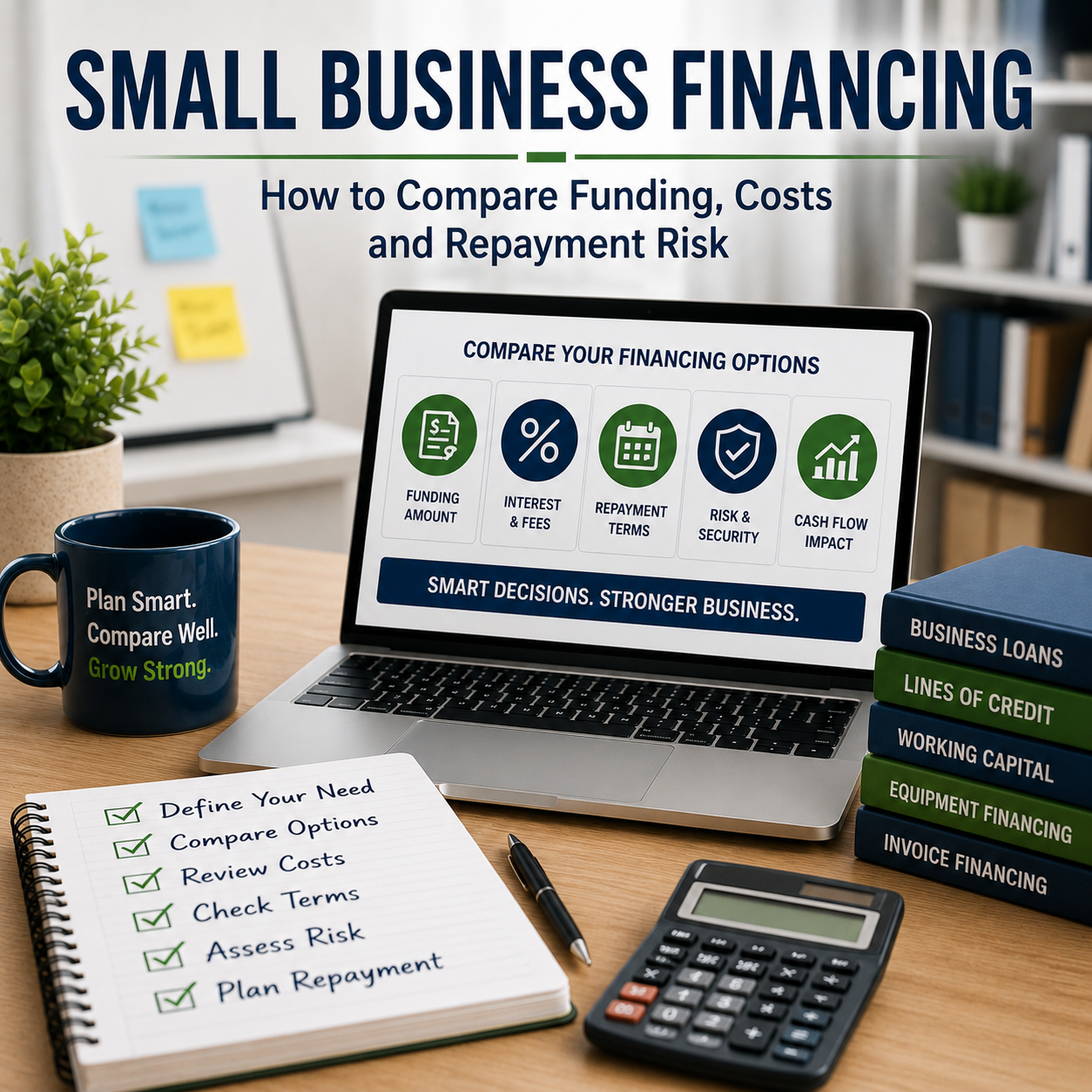
Small business financing gives companies access to capital for working capital, inventory, equipment, expansion, property, receivables gaps and other legitimate business needs.
But financing is not one product, and the most important question is not simply:
Can the business get funding?
It is:
Which financing structure solves the business problem without creating too much cost, repayment pressure or risk?
Small business financing options can include term loans, business lines of credit, working-capital financing, equipment financing, invoice financing, SBA-backed financing, secured and unsecured funding, business credit cards, supplier credit and other forms of business capital.
The right structure depends on why the money is needed, how long the need will last, what cash will repay the obligation and what happens if the business has a weaker month than expected.
A company wanting a wider overview of financing structures can also review Kevanzo’s Business Financing guide.
This guide takes the next step. It shows how smaller companies can compare financing by purpose, complete cost, repayment timing, operating-cash impact, collateral, guarantees and economic value.
Educational note: Kevanzo.com provides general business-financing education only. Kevanzo is not a lender, broker, loan marketplace, financial adviser, attorney, accountant or approval service. Financing costs, APRs, fees, repayment schedules, collateral, guarantees, eligibility requirements and available products vary by lender, borrower and financing structure.
What Is Small Business Financing?
Small business financing is the broad range of debt, credit and other capital structures that businesses may use to fund legitimate commercial needs.
Possible structures include:
- term loans
- working-capital loans
- business lines of credit
- equipment financing
- invoice financing
- secured financing
- unsecured financing
- SBA-backed financing
- commercial real-estate financing
- short-term financing
- business credit cards
- supplier or trade credit
- owner capital
- outside equity
- eligible grants
- crowdfunding
A business does not need to compare every option.
It needs to identify the financing structures that fit the actual business problem.
A company buying equipment expected to remain productive for years has a different need from a company waiting 45 days for customers to pay invoices.
A retailer preparing for a seasonal inventory cycle has a different need again.
The first rule is therefore simple:
financing should match the business problem.
Small Business Financing Options at a Glance
The following comparison provides a starting point.
| Financing structure | Typical purpose | Main characteristic | Major question |
|---|---|---|---|
| Term loan | Defined purchase, project or expansion | Lump sum with scheduled repayment | Does the term fit the purpose? |
| Business line of credit | Recurring or irregular cash needs | Draw funds when needed, subject to agreement | Can draws be repaid rather than becoming permanent debt? |
| Working-capital financing | Payroll, suppliers, inventory and operating gaps | Supports ordinary business operations | Is the problem temporary or structural? |
| Equipment financing | Machinery, vehicles and equipment | Financing connected to productive assets | Does repayment match the asset’s useful life? |
| Invoice financing | Cash tied up in unpaid invoices | Uses receivables as part of the financing structure | What are the fees, recourse and final net proceeds? |
| SBA-backed financing | Eligible business purposes | Financing through participating lenders under SBA program requirements | Does the business and purpose fit the program? |
| Secured financing | Funding supported by assets | Collateral helps secure the obligation | What assets are exposed? |
| Unsecured financing | Funding without a specifically pledged asset for that obligation | May depend more heavily on credit and cash flow | What guarantees, liens or other protections still apply? |
| Short-term financing | Temporary business need | Compressed repayment period | Can the business handle the payment pressure? |
| Business credit card | Smaller recurring purchases | Revolving credit | Will balances be repaid or repeatedly carried? |
| Supplier credit | Inventory or supplies | Payment occurs after delivery | Do supplier terms fit the sales cycle? |
| Commercial real-estate financing | Business property and major fixed assets | Longer-duration financing | Can the project support long-term repayment? |
There is no universal winner.
The useful comparison is:
Which structure best fits this particular need while preserving enough cash for the business to continue operating?
Why Small Businesses Need a Different Financing Approach
Smaller companies can have less room for financing mistakes.
Possible characteristics include:
- smaller cash reserves
- shorter operating histories
- fewer assets
- seasonal revenue
- uneven monthly cash flow
- owner dependence
- customer concentration
- fewer alternative funding sources
- greater sensitivity to one major expense
None of these automatically means a business is weak.
They simply mean the financing decision deserves careful measurement.
A large company might absorb:
- one delayed customer
- an unexpected repair
- a temporary cost increase
- a weak sales month
A smaller company may have much less financial cushion.
That makes affordability under imperfect conditions more important than affordability during the best month.
The Kevanzo Small-Business Reality Check
Before comparing lenders or financing products, answer five questions.
1. What Is the Exact Need?
Avoid:
We need more money.
Use something measurable:
We need $35,000 for inventory before an established seasonal sales period.
The second statement identifies both amount and purpose.
2. How Long Will the Need Last?
Is the need expected to last:
- several weeks
- several months
- several years
Duration matters.
Using very short financing for a long-term asset can create repayment pressure.
Using long-term financing for a brief timing problem may leave debt outstanding long after the original problem has disappeared.
3. What Creates the Repayment Cash?
Identify the expected source.
Examples include:
- inventory sales
- customer invoices
- contract payments
- seasonal revenue
- ordinary operating cash flow
- additional capacity created by the financed asset
The repayment source should be more specific than:
future business income.
4. How Much Cushion Exists?
After normal expenses and existing debt payments, what cash remains?
Then ask what will remain after adding the proposed financing payment.
5. What Happens If Revenue Is Late?
Could the business continue operating if:
- a major customer pays late
- revenue falls temporarily
- inventory sells more slowly
- an unexpected expense occurs
Those five questions should come before lender shopping.
How Small Business Financing Works
Although financing products differ, the decision can be broken into a practical sequence.
Define the Business Need
Determine:
- amount required
- purpose
- timing
- expected duration
- expected benefit
Identify Suitable Financing Structures
Do not begin with the lender.
Begin with the problem.
Then identify structures that might logically fit that problem.
Prepare the Business Information
Depending on the lender and product, businesses may be asked for information involving:
- bank statements
- financial statements
- tax information where required
- business ownership
- existing debts
- accounts receivable
- accounts payable
- collateral
- revenue
- financing purpose
Compare the Complete Economics
Compare more than the rate.
Review:
- gross amount
- net amount received
- fees
- payment
- payment frequency
- repayment term
- total repayment
- collateral
- guarantees
- early-payment rules
Stress-Test Repayment
Model what happens under:
- normal conditions
- slower conditions
- difficult conditions
Review the Agreement
Product names are summaries.
The written financing agreement controls the actual obligation.
Start With the Business Problem
A business should not begin by asking:
Which loan can we get?
A stronger starting question is:
What exactly are we financing?
Possible needs include:
- inventory
- payroll timing
- equipment
- vehicles
- supplier payments
- expansion
- renovations
- receivables gaps
- acquisitions
- real estate
- emergency repairs
- marketing
- technology
Different needs can point toward different financing structures.
The Kevanzo Purpose-to-Structure Map
This is a simple first-stage filter.
One Defined Purchase
Potentially compare:
- term financing
- equipment financing
- other fixed-purpose financing
Recurring Working-Capital Need
Potentially compare:
- business line of credit
- working-capital financing
- supplier credit
Unpaid Customer Invoices
Potentially compare:
- invoice financing
- factoring
- revolving credit
Short Temporary Gap
Potentially compare:
- short-term financing
- line of credit
- supplier terms
Long-Term Growth Project
Potentially compare:
- longer-term loans
- eligible SBA-backed financing
- other long-duration financing
- equity where appropriate
Structure should follow purpose.
Small Business Loans
Loans remain one major part of small business financing.
Businesses comparing Small Business Loans may receive a defined amount upfront and repay it according to an agreed schedule.
A term structure may make sense when:
- the funding amount is known
- the purpose is specific
- the project can be defined
- repayment can be forecast
Example:
A company needs $60,000 for a defined renovation.
A term loan may be easier to evaluate than revolving credit because the amount and purpose are known.
But a fixed loan can be inefficient when the business does not know exactly when or how much funding it will require.
That is where revolving credit may deserve comparison.
Business Lines of Credit
A Business Line of Credit may give a company access to funds up to an approved limit, subject to lender terms.
Instead of receiving the full approved amount immediately, the business may be able to draw only what it requires.
Potential uses include:
- seasonal expenses
- inventory
- supplier payments
- short receivables gaps
- repairs
- temporary payroll timing
- recurring working-capital needs
The attraction is flexibility.
The risk is also flexibility.
Repeatedly borrowing simply because available credit exists can turn a useful financial tool into permanent debt.
The Kevanzo One-Time-or-Recurring Test
Ask:
Is This a One-Time Need?
A defined loan may be easier to control.
Example:
One equipment purchase.
Is This a Recurring Need?
A revolving facility may provide more flexibility.
Example:
Inventory requirements change throughout the year.
Then ask the critical follow-up:
Should the business still need this financing one year from now?
If the answer is no, the financing plan should include an exit path.
Working Capital Financing
Working capital supports ordinary business operations.
Common uses include:
- payroll
- suppliers
- inventory
- rent
- seasonal preparation
- operating expenses
Businesses researching this need can review Kevanzo’s guide to Working Capital Loans for Small Business.
Working-capital financing works best when it addresses a defined timing problem or supports productive operating activity.
It becomes more dangerous when it repeatedly replaces cash the business is permanently failing to generate.
The Kevanzo Working-Capital Gap Test
Calculate:
cash needed before expected revenue arrives
minus
cash already available
equals
working-capital gap
Example:
Supplier and payroll requirements:
$70,000
Available operating cash:
$45,000
Temporary financing gap:
$25,000
That gives the business a defined problem.
It is much more useful than simply applying for the maximum financing amount available.
Cash-Flow Financing
A business can be profitable on paper and still experience poor cash timing.
Example:
Customer invoice:
$60,000
Expected customer payment:
45 days
Payroll and supplier payments:
due this week
The problem is not necessarily profitability.
It may simply be:
money arrives later than expenses.
Businesses facing this issue can review Cash Flow Loans for Small Business while comparing other appropriate financing structures.
The Kevanzo Cash-Timing Test
Write down five dates:
- when expenses occur
- when sales occur
- when invoices are issued
- when customers actually pay
- when financing payments begin
The financing schedule should work with the real cash cycle rather than an idealized one.
Invoice Financing
Businesses with substantial unpaid receivables may compare Invoice Financing for Small Business or factoring.
Questions may include:
- What percentage of the invoice value becomes available?
- What financing cost applies?
- Who controls collections?
- Does the arrangement involve recourse?
- How are customers affected?
- What fees apply?
- When is the remaining balance released?
- What are the final net proceeds?
Invoice financing may deserve comparison when:
- work has already been completed
- invoices are valid
- customers are expected to pay
- cash is temporarily trapped in receivables
Receivables can be valuable business assets.
Accessing their value early still carries a cost.
Short-Term Financing
Short-duration financing may fit a genuinely short-duration problem.
Examples include:
- seasonal inventory
- temporary supplier requirements
- project materials
- emergency repairs
- brief operating gaps
The major risk is repayment compression.
Money can arrive quickly.
It can also have to leave the business quickly.
A financing structure can therefore solve today’s liquidity problem while creating next month’s cash-flow problem.
The Kevanzo Short-Need Test
Ask:
Will the business problem disappear before or around the time the financing must be repaid?
If yes, the duration may fit.
If no, investigate a different structure.
Startup Financing
New businesses can face an additional challenge:
they may have less operating history available to demonstrate revenue consistency and repayment ability.
Startup funding can potentially come from:
- owner capital
- eligible business loans
- equipment financing
- SBA-related options where eligibility requirements are met
- outside investment
- supplier terms
- other appropriate capital sources
Kevanzo’s Startup Business Loans guide examines the narrower loan-specific issues in more detail.
The central question for a startup remains:
What realistic source of cash will support repayment before the business has a long financial history?
Forecasts can help planning.
They are not the same as proven cash flow.
Growth Financing
Financing can also support expansion.
Possible uses include:
- additional staff
- equipment
- vehicles
- technology
- inventory
- new locations
- production capacity
- renovations
- marketing
Growth financing deserves additional caution because:
the cost often arrives before the expected growth does.
The Kevanzo Growth-Lag Test
Estimate five points.
Day Financing Arrives
When does the company receive the capital?
Day Spending Begins
When does deployment begin?
Day New Capacity Exists
When is the expanded operation actually ready?
Day New Revenue Starts
When should customers begin producing additional cash?
Day Financing Payment Starts
When does repayment begin?
If repayment begins months before new revenue, the existing operation must carry the gap.
That gap needs to be tested before the financing is accepted.
Equipment Financing
Equipment financing can help fund:
- machinery
- vehicles
- technology
- production equipment
- other productive business assets
The financing decision should consider more than whether the asset can be purchased.
Ask:
- How long will the equipment remain useful?
- What revenue or savings should it create?
- What payment will the business carry?
- Is the equipment itself collateral?
- What happens after default?
- Will the asset still be generating value when repayment is due?
This leads to one of the article’s most useful rules:
the financing term should make economic sense relative to the useful life of the asset.
The Kevanzo Benefit-Life Match
Compare:
how long the financed asset or project creates useful value
with
how long the business has to repay the financing
A severe mismatch deserves investigation.
Consider an $80,000 equipment purchase expected to remain productive for eight years.
If the financing must be repaid in only nine months, the business may face severe cash-flow pressure even though the asset itself is economically useful.
The financing structure can be wrong even when the purchase is right.
Business Credit Cards and Supplier Credit
Not every financing need requires a conventional business loan.
Business Credit Cards
A business credit card can provide revolving purchasing capacity for smaller expenses.
Compare:
- interest
- fees
- payment requirements
- credit limit
- balance carried forward
- effect on available cash
A card can provide convenience.
Repeatedly carrying a large balance can turn convenience into persistent debt.
Supplier or Trade Credit
A supplier may allow a business to receive inventory or materials before payment is required.
That can reduce immediate cash pressure.
But compare:
- payment deadlines
- early-payment discounts
- late-payment consequences
- supply continuity
- dependence on one supplier
- alignment between payment timing and inventory sales
Supplier credit is still a financial obligation even when no conventional lender is involved.
Commercial Real-Estate Financing
Businesses buying or improving commercial property usually face a longer financing horizon than businesses funding inventory or temporary operating gaps.
Important factors include:
- project cost
- cash contribution
- collateral
- repayment duration
- property usefulness
- expected economic benefit
- operating cash remaining after debt service
- ability to withstand slower-than-expected growth
The same core principle applies:
match financing structure and duration to the business asset and purpose.
Small Business Financing and SBA-Backed Loans
SBA-backed financing forms one part of the U.S. business-financing landscape.
The U.S. Small Business Administration generally works through participating lenders and other authorized partners for its principal business loan programs.
SBA 7(a) Financing
The SBA’s 7(a) program can support eligible purposes including:
- short- and long-term working capital
- qualifying real estate
- machinery and equipment
- furniture and supplies
- certain business-debt refinancing
- qualifying ownership changes
- other permitted purposes
Businesses apply through participating lenders, and approval remains subject to lender underwriting and applicable SBA requirements.
An SBA guarantee does not mean automatic approval.
SBA Microloans
The SBA Microloan Program operates through approved intermediary lenders.
Eligible uses can include areas such as:
- working capital
- inventory
- supplies
- furniture
- fixtures
- machinery
- equipment
Official SBA guidance states that Microloan proceeds cannot be used to purchase real estate or pay existing debts.
The broader lesson is more useful than chasing the largest available financing amount:
small financing needs do not automatically require large financing products.
The Kevanzo Minimum-Viable-Funding Test
Determine:
the smallest amount that fully solves the defined business problem.
Example:
Maximum financing potentially available:
$100,000
Actual business requirement:
$28,000
Reasonable contingency:
$4,000
Potential target:
approximately $32,000
The fact that more money may be available does not automatically mean more should be borrowed.
SBA 504 Financing
SBA 504 financing has a different purpose.
The program primarily supports qualifying major fixed assets, including certain:
- land
- buildings
- construction
- renovation
- long-term machinery
- equipment
SBA guidance states that 504 loan proceeds cannot be used for ordinary working capital or inventory.
That distinction demonstrates why financing should be chosen after the business need is defined.
Small Business Financing Is Not One Product
One of the biggest mistakes businesses can make is searching broadly for:
business funding
and treating every result as if it solves the same problem.
Different financing products can vary significantly in:
- purpose
- payment amount
- payment frequency
- total cost
- term
- collateral
- guarantees
- flexibility
- underwriting
- default provisions
- risk
A useful financing comparison therefore needs more than one headline number.
The Kevanzo Financing-Fit Triangle
Every financing decision should balance three things.
Purpose
What does the money actually do?
Cost
What does obtaining and using the money cost?
Repayment Capacity
Can the business comfortably return the money?
A financing structure that works in only two of those areas is incomplete.
For example:
A product might suit the purpose and appear affordable upfront, but repayment could overwhelm cash flow.
Another may be inexpensive but poorly suited to the actual business need.
The triangle requires all three elements to work together.
Approval Is Not Affordability
Suppose:
Amount offered:
$120,000
Actual business need:
$60,000
Comfortable borrowing capacity:
approximately $70,000
Being offered $120,000 does not make borrowing $120,000 sensible.
The Kevanzo Need-Affordability-Approval Rule
Use this order.
1. Need
How much genuinely solves the problem?
2. Affordability
How much can the business comfortably support?
3. Approval
How much is available?
The first two should control the decision.
Approval is information.
It is not a spending target.
Revenue Is Not the Same as Available Cash
A business can generate:
$1 million in annual sales
and still have weak capacity for additional financing.
Revenue may need to cover:
- payroll
- suppliers
- taxes
- rent
- insurance
- utilities
- inventory
- existing loans
- equipment payments
- owner obligations
- other operating expenses
The new financing payment comes from what remains.
The Kevanzo Cash-Available Test
Calculate:
operating cash generated
minus
essential operating expenses
minus
existing debt payments
equals
cash available before new financing
Then subtract the proposed financing payment.
What remains is the operating cushion.
That remaining cash matters.
A business can technically afford a payment and still be left dangerously exposed to normal operating surprises.
The Kevanzo Small-Business Cushion Test
Suppose:
Cash available after ordinary expenses:
$12,000 per month
Proposed financing payment:
$10,000 per month
Technically, the payment fits.
But only:
$2,000
remains.
Now ask:
Could the business still operate if one major customer paid late?
Then ask:
Could it operate if sales were 15% weaker for one month?
A financing plan that succeeds only under perfect conditions is fragile.
Small Business Financing Requirements
Requirements vary by lender, financing structure and borrower.
Possible factors a lender may review include:
- business age
- revenue
- cash flow
- bank activity
- credit
- existing debt
- ownership
- industry
- collateral
- financing purpose
- financial records
There is no single qualification threshold that applies to every small business financing product.
That is particularly important when comparing newer businesses with established companies.
The Kevanzo Documentation-Readiness Test
Before requesting financing, organize information that may be relevant, such as:
- recent business bank statements
- profit and loss statements
- balance sheet where available
- tax records where required
- accounts receivable
- accounts payable
- existing debt
- ownership information
- business registration
- funding-purpose statement
Good preparation does not guarantee approval.
It makes the business’s financial position easier to understand.
Owner Guarantees
Some small-business financing can involve a personal guarantee.
That can move part of the financing risk beyond the company itself.
Before agreeing, understand:
- who gives the guarantee
- what obligations it covers
- when liability begins
- what happens after default
- how long the guarantee remains effective
- when the obligation ends
A guarantee should not be treated as unimportant fine print.
The Kevanzo Owner-Exposure Test
Ask four questions.
Business Risk
What business assets or cash flow are exposed?
Personal Risk
What owner obligations are created?
Default Risk
What happens if payments are missed?
Exit
When does the owner’s obligation fully end?
A financing arrangement can appear affordable to the company while creating unacceptable personal exposure.
Secured Small Business Financing
Secured financing may involve assets such as:
- equipment
- inventory
- receivables
- vehicles
- property
- other business assets
Collateral can reduce lender risk.
It also creates asset exposure for the business.
That exposure belongs in the financing comparison.
Unsecured Small Business Financing
Unsecured financing generally does not rely on a specifically pledged asset in the same way as conventional secured financing.
But unsecured does not automatically mean:
- no personal guarantee
- no lien
- no lender protections
- no legal obligation
- low cost
- low risk
Businesses comparing Best Unsecured Business Loans should therefore review the complete agreement rather than treating the word unsecured as a full description of the risk.
Small Business Financing Rates and Costs
Interest rate matters.
It is not enough.
Compare:
- interest
- APR where applicable
- origination fees
- account fees
- draw fees
- documentation charges
- prepayment terms
- late-payment provisions
- other financing-specific costs
Then convert the financing into dollars wherever possible.
The Kevanzo Ten-Number Financing Comparison
For every serious offer, record ten numbers.
1. Gross Financing Amount
What amount is offered?
2. Net Cash Received
What amount actually reaches the business?
3. Interest Rate
Is it fixed or variable?
4. APR
What annualized comparison information is available where applicable?
5. Fees
What additional costs apply?
6. Payment Amount
How much must be paid?
7. Payment Frequency
Daily?
Weekly?
Monthly?
Another schedule?
8. Repayment Term
How long will the obligation continue?
9. Total Scheduled Repayment
How much should ultimately leave the business?
10. Remaining Cash Cushion
What operating cash remains after the payment?
Those ten numbers make substantially different financing offers easier to compare.
Payment Frequency Matters
Consider two hypothetical financing structures requiring roughly:
$24,000 annually
One requires:
$2,000 monthly
The other requires:
approximately $460 weekly
The total annual amount may appear similar.
The cash-flow experience can be very different.
A business whose customers pay monthly may find a monthly payment easier to synchronize with receipts than frequent withdrawals.
The Kevanzo Payment-to-Cash Match
Compare:
frequency of customer cash arriving
with
frequency of financing payments leaving
The better those two schedules align, the easier the financing may be to manage.
Total Repayment Matters
Suppose:
Financing received:
$50,000
Total scheduled repayment:
$62,000
Financing difference:
$12,000
Now ask:
What business value should the $50,000 create or protect?
If the financing protects substantially more profitable business activity than its cost, the economics may deserve consideration.
If the money merely disappears into recurring losses, the decision looks very different.
The Kevanzo Economic-Value Test
Calculate:
estimated business value created or protected
minus
complete financing cost
Then test the result under weaker assumptions.
Financing should ideally create or protect more economic value than it consumes.
Customer Concentration
Some small companies depend heavily on one customer.
Suppose:
Monthly revenue:
$100,000
Largest customer:
$45,000
That customer represents:
45% of revenue.
If that customer pays late, financing affordability can change quickly.
The Kevanzo Revenue-Concentration Test
Calculate:
largest customer revenue
divided by
total revenue
Then ask:
Can the financing still be repaid if that customer pays 30 days late?
A company with concentrated revenue should not evaluate repayment as if every customer payment were guaranteed to arrive exactly on schedule.
Seasonal Revenue
Seasonal businesses should not evaluate financing using only their strongest month.
Example:
December cash available:
$30,000
February cash available:
$9,000
Financing payment:
$8,000
The financing looks easy in December.
It looks completely different in February.
The Kevanzo Weakest-Month Test
Find the weakest realistic month.
Then calculate:
available cash
minus
existing debt
minus
proposed financing payment
What remains?
That figure can be more important than what remains during the strongest month.
Existing Debt
A business may already be paying:
- vehicle finance
- equipment loans
- credit cards
- credit lines
- tax arrangements
- earlier business loans
New financing joins that stack.
It does not exist separately from it.
The Kevanzo Total-Debt Pressure Test
Calculate:
all existing debt payments
plus
proposed financing payment
Then compare the total with realistic business cash available.
Never assess the new obligation in isolation.
Financing Stacking
A dangerous pattern can look like:
existing loan
→ line-of-credit balance
→ short-term financing
→ another advance because previous repayments reduce operating cash
At that point, financing is no longer solving the underlying cash problem.
It may be helping create it.
The Kevanzo Financing-Independence Test
Ask:
Should this financing allow the business to repay from normal operations without immediately requiring another financing product?
If the answer is no, investigate why.
A financing plan should ideally lead toward less dependence, not more.
Small Business Financing Scenario: Retailer
Inventory required:
$40,000
Expected sales cycle:
four months
Potential options might include:
- working-capital financing
- line of credit
- supplier terms
But the real analysis should include:
- expected gross margin
- sell-through
- payment timing
- leftover inventory risk
- financing cost
The funding structure is only one part of the decision.
Small Business Financing Scenario: Contractor
Project value:
$150,000
Materials required upfront:
$45,000
Customer payments:
after milestones
The project may be profitable overall while still creating a major cash-flow gap.
The business should test:
- project delays
- material-cost increases
- milestone delays
- customer-payment delays
- financing-payment dates
Profit and cash timing are not the same thing.
Small Business Financing Scenario: Equipment
Equipment cost:
$80,000
Expected useful life:
eight years
Financing term:
nine months
The purchase may make economic sense.
The financing term may not.
That is exactly the type of mismatch the Kevanzo Benefit-Life Match is designed to identify.
Small Business Financing Scenario: Permanent Losses
Suppose a business is losing:
$12,000 per month
New financing:
$50,000
The financing may cover losses for roughly four months.
Then the original problem returns.
The financing has not repaired the economics.
It has delayed the problem.
Temporary Problem Versus Structural Problem
This distinction is fundamental.
Temporary Problems
Examples include:
- seasonal inventory
- customer-payment delays
- equipment repair
- defined expansion costs
- temporary project expenses
Structural Problems
Examples include:
- persistent operating losses
- inadequate pricing
- weak margins
- excessive fixed costs
- chronic debt dependence
- declining demand
Financing can bridge timing.
It cannot permanently repair a business model that consistently consumes more cash than it generates.
The Kevanzo Three-Condition Small-Business Stress Test
Model three conditions before accepting financing.
Normal
Revenue and expenses perform approximately as expected.
Slow
Revenue falls moderately or customers pay later.
Difficult
Revenue weakens while an unexpected expense occurs.
For each scenario calculate:
- cash entering the business
- essential operating expenses
- existing debt payments
- proposed financing payments
- remaining cash
The question is not:
Can we make the payment when everything goes right?
It is:
Can the business remain functional when ordinary problems occur?
Common Small Business Financing Mistakes
Borrowing Before Defining the Problem
Purpose first.
Borrowing the Maximum Offered
Availability is not need.
Comparing Only Interest Rate
Complete cost matters.
Ignoring Payment Frequency
Timing matters.
Ignoring Net Proceeds
Know what actually reaches the business.
Ignoring Existing Debt
All obligations compete for the same cash.
Ignoring Personal Guarantees
Owner exposure matters.
Using Short Financing for Long Projects
Match duration to purpose.
Financing Permanent Losses
Debt cannot permanently repair weak economics.
Borrowing Again Before the Previous Financing Solves the Problem
Watch for dependence.
Evaluating Financing Using the Best Month
Use realistic and weak-month cash flow.
Assuming SBA Means Automatic Approval
SBA-backed financing remains subject to applicable eligibility requirements and lender underwriting.
Small Business Financing Red Flags
Investigate further when:
- the financing purpose is vague
- the business cannot calculate how much it actually needs
- repayment only works in unusually strong months
- fees are unclear
- total repayment is unclear
- payment frequency is difficult to determine
- collateral provisions are unclear
- guarantee terms are unclear
- the business is encouraged to borrow substantially more than required
- debt repeatedly covers operating losses
- multiple obligations overlap
- another loan will probably be needed immediately afterward
- one customer controls a large share of repayment cash
- the repayment term badly mismatches the funded asset
- the financing agreement cannot be explained in plain English
One issue may deserve clarification.
Several issues together deserve much greater caution.
Questions to Ask Before Accepting Small Business Financing
Ask:
- What exact problem are we financing?
- How much is genuinely needed?
- How much is being offered?
- How much cash actually reaches the business?
- What interest rate applies?
- Is it fixed or variable?
- What APR information is available where applicable?
- What fees apply?
- What is the required payment?
- How often must payment be made?
- When does repayment begin?
- How long does repayment continue?
- What is total scheduled repayment?
- What cash will repay the financing?
- What happens during the weakest month?
- What existing debt already competes for cash?
- Is collateral required?
- What security interests apply?
- Is a personal guarantee required?
- What does the guarantee cover?
- What happens after late payment?
- What constitutes default?
- Can the financing be repaid early?
- Does early repayment reduce cost?
- How long will the financed asset or project create value?
- What happens if revenue falls?
- What happens if a major customer pays late?
- Can the business operate without another loan afterward?
- What alternative financing structures were compared?
- Should this financing leave the company stronger after repayment?
The Kevanzo 20-Point Small Business Financing Check
Before accepting financing, complete this final review.
1. Purpose
What exactly is being financed?
2. Amount Needed
How much is genuinely required?
3. Product Fit
Does the financing structure match the need?
4. Net Cash
What amount actually reaches the business?
5. Interest
What rate applies?
6. APR
What annualized comparison information is available where relevant?
7. Fees
What additional charges apply?
8. Payment
How much must be paid?
9. Frequency
How often?
10. Term
How long?
11. Total Repayment
What ultimately leaves the business?
12. Repayment Source
What cash will repay the financing?
13. Weakest Month
Can repayment survive it?
14. Operating Cushion
What cash remains after payment?
15. Existing Debt
What obligations already compete for cash?
16. Collateral
What assets are exposed?
17. Personal Guarantee
What personal exposure exists?
18. Customer Concentration
How dependent is repayment on one buyer?
19. Financing Independence
Will another financing product probably be needed?
20. Economic Value
Should the financing create or protect more value than it costs?
If several answers remain unclear, the decision is not ready.
Practical Next Steps
Start with four numbers:
1. Exact funding need
2. Expected repayment source
3. Maximum comfortable payment
4. Minimum operating cash cushion
Then identify financing structures that genuinely match the problem.
For every serious offer, compare:
- net cash received
- interest
- APR where relevant
- fees
- payment amount
- payment frequency
- term
- total repayment
- collateral
- personal guarantees
- early-payment rules
- weak-month affordability
Do not choose financing simply because it offers:
- the most money
- the fastest approval
- the lowest-looking payment
- the longest term
- the lowest advertised rate
Those numbers do not tell the whole story.
Final Takeaway
Small business financing is much broader than simply finding a business loan.
A company may be comparing:
- term loans
- lines of credit
- working-capital financing
- equipment financing
- invoice financing
- SBA-backed financing
- short-term financing
- supplier credit
- business credit cards
- other sources of capital
The correct starting point remains:
define the business problem before choosing the financing product.
Then evaluate five central factors:
purpose
product fit
complete cost
repayment cushion
owner risk
A healthy financing cycle looks like:
defined need → suitable financing → productive use → business cash generated → repayment → stronger business
A dangerous financing cycle looks like:
cash shortage → financing → repayment pressure → another cash shortage → more financing
That is the pattern businesses should watch.
The most suitable small business financing option is not automatically the one offering the largest amount, fastest decision, longest repayment period or lowest headline rate.
It is the structure that fits the purpose, produces acceptable economic value, remains manageable under realistic conditions and leaves enough cash for the company to continue operating.
Frequently Asked Questions About Small Business Financing
What Is Small Business Financing?
Small business financing is the broad range of funding and capital structures that companies may use for working capital, inventory, equipment, receivables, expansion, property and other legitimate business purposes.
Is Small Business Financing the Same as a Business Loan?
No.
A business loan is one financing structure.
Small business financing is the broader category and may include loans, credit lines, asset financing, receivables financing, supplier credit and non-debt capital sources.
What Types of Small Business Financing Are Available?
Possible options include:
- term loans
- lines of credit
- working-capital financing
- equipment financing
- invoice financing
- secured financing
- unsecured financing
- SBA-backed financing
- commercial real-estate financing
- short-term financing
- business credit cards
- supplier credit
Businesses may also investigate non-debt sources such as owner capital, outside equity, eligible grants or crowdfunding.
How Do You Finance a Small Business?
Begin by identifying the exact business need, the amount required, how long the need should last and what cash is expected to support repayment.
Then compare financing structures that fit that problem before comparing individual offers.
How Much Small Business Financing Should a Company Borrow?
Start with the amount needed to solve the defined business problem.
Then test whether repayment remains manageable under realistic cash-flow conditions.
The maximum amount available is not automatically the appropriate amount to borrow.
Is More Financing Better?
No.
Additional financing can increase total borrowing cost, repayment pressure and business risk.
Do Small Businesses Need Collateral?
It depends on the financing structure and agreement.
Some financing is secured by specific assets while other products use different lender protections.
Can Small Business Financing Require a Personal Guarantee?
Yes.
Depending on the product and agreement, a personal guarantee may apply even when specific collateral is not required.
What Do Business Lenders Look At?
Possible factors include:
- revenue
- cash flow
- credit history
- business history
- existing debt
- industry
- ownership
- bank activity
- collateral
- financing purpose
- financial records
Requirements vary by lender and financing type.
What Is an SBA 7(a) Loan?
The SBA 7(a) program provides guarantees to participating lenders and can support several eligible business purposes, including working capital and certain asset, real-estate and ownership needs.
Eligibility, terms and lender underwriting requirements apply.
What Is an SBA Microloan?
SBA Microloans are offered through approved intermediary lenders for eligible smaller business funding needs.
Permitted uses can include working capital, inventory, supplies, furniture, fixtures, machinery and equipment.
Can an SBA 504 Loan Be Used for Working Capital?
No. SBA guidance states that 504 financing cannot be used for ordinary working capital or inventory.
The program primarily supports eligible major fixed assets and long-term business investment.
Is the Lowest Payment Always Best?
No.
A lower payment may result from a longer repayment term and can potentially increase total financing cost.
Is the Lowest Interest Rate Always Best?
Not necessarily.
Fees, repayment duration, payment frequency, collateral, guarantees and total repayment can materially affect the comparison.
Why Does Cash Flow Matter So Much?
Financing is repaid from available cash.
Strong revenue does not automatically mean strong available cash after operating expenses and existing debt obligations are paid.
Should a Small Business Borrow During a Cash-Flow Problem?
Potentially, when the problem is temporary, the financing structure fits the need and there is a realistic repayment source.
Repeated borrowing to cover permanent losses deserves much greater caution.
What Is the Most Important Question Before Accepting Financing?
Ask:
Can the business comfortably repay this financing under realistic—not perfect—conditions while continuing to meet ordinary operating expenses?
Helpful Authoritative Resources
- U.S. Small Business Administration — Business Loans
- U.S. Small Business Administration — 7(a) Loan Program
- U.S. Small Business Administration — Microloan Program
- U.S. Small Business Administration — 504 Loan Program
- U.S. Small Business Administration — Resources for Lenders
- Consumer Financial Protection Bureau — Small Business Lending Resources
- Federal Trade Commission — Business Guidance
- SCORE — Small Business Resources and Mentoring
Author Bio
Kevanzo Editorial Team
Kevanzo Editorial Team creates practical, plain-English educational resources for U.S. business owners researching small business financing, small business loans, working capital, business credit, financing costs, repayment structures and responsible funding decisions.
Copyright Notice
© 2026 Kevanzo. All rights reserved.
This Small Business Financing article is protected by copyright and may not be copied, scraped, spun, republished or used commercially without prior written permission from Kevanzo. Brief quotations may be used with clear attribution and a link to the original article.
Unauthorized reuse, bulk scraping, content spinning, AI rewriting for republication or commercial reproduction of this material is prohibited.
Educational Disclaimer
Kevanzo.com provides general educational information about business financing. Kevanzo is not a lender, broker, loan marketplace, financial adviser, attorney, accountant or approval service.
Nothing in this article constitutes financial, legal, tax, accounting, investment, lending or personalized business advice. Interest rates, APRs, fees, repayment schedules, collateral requirements, personal guarantees, approval requirements, eligibility standards and available financing products vary according to lender, borrower, financing type, business profile, industry, revenue, credit history and market conditions.
Business owners should verify lender information, review applicable official information, read financing agreements carefully and consider appropriately qualified professional guidance when necessary before making financing decisions.
Thanks for your comment. A business line of credit can be useful when a business wants flexible access to funds, but it is still important to compare draw fees, repayment timing, credit limits, and lender requirements before applying. Kevanzo shares general educational information only and cannot make personal finance, legal, or tax decisions for visitors.
Thanks for your comment. When comparing business funding, it is usually safest to look at the total cost, repayment timing, lender requirements, funding speed, and whether the option fits the business purpose. Kevanzo shares general educational information only, not general educational information.
Thanks for your comment. When comparing business funding, it is usually safest to look at the total cost, repayment timing, lender requirements, funding speed, and whether the option fits the business purpose. Kevanzo shares general educational information only, not general educational information.
Thanks for your comment. When comparing business funding, it is usually safest to look at the total cost, repayment timing, lender requirements, funding speed, and whether the option fits the business purpose. Kevanzo shares general educational information only, not general educational information.
Thanks for your comment. Cash-flow funding decisions are safest when the repayment timing matches how money actually enters the business. Comparing costs, payment frequency, and lender conditions can help avoid pressure later. You may also find this helpful: cash flow loans for small business. Kevanzo shares general educational information only and cannot make personal finance, legal, or tax decisions for visitors.
Thanks for your comment. When comparing business funding, it is usually safest to look at the total cost, repayment timing, lender requirements, funding speed, and whether the option fits the business purpose. Kevanzo shares general educational information only, not general educational information.
Thanks for your comment. When comparing business funding, it is usually safest to look at the total cost, repayment timing, lender requirements, funding speed, and whether the option fits the business purpose. Kevanzo shares general educational information only, not general educational information.
Thanks for your comment. When comparing business funding, it is usually safest to look at the total cost, repayment timing, lender requirements, funding speed, and whether the option fits the business purpose. Kevanzo shares general educational information only, not general educational information.
Thanks for your comment. When comparing business funding, it is usually safest to look at the total cost, repayment timing, lender requirements, funding speed, and whether the option fits the business purpose. Kevanzo shares general educational information only, not general educational information.
Thanks for your comment. When comparing business funding, it is usually safest to look at the total cost, repayment timing, lender requirements, funding speed, and whether the option fits the business purpose. Kevanzo shares general educational information only, not general educational information.
Thanks for your comment. A business line of credit can be useful when a business wants flexible access to funds, but it is still important to compare draw fees, repayment timing, credit limits, and lender requirements before applying. Kevanzo shares general educational information only and cannot make personal finance, legal, or tax decisions for visitors.
Thanks for your comment. When comparing business funding, it is usually safest to look at the total cost, repayment timing, lender requirements, funding speed, and whether the option fits the business purpose. Kevanzo shares general educational information only, not general educational information.
Thanks for your comment. When comparing business funding, it is usually safest to look at the total cost, repayment timing, lender requirements, funding speed, and whether the option fits the business purpose. Kevanzo shares general educational information only, not general educational information.