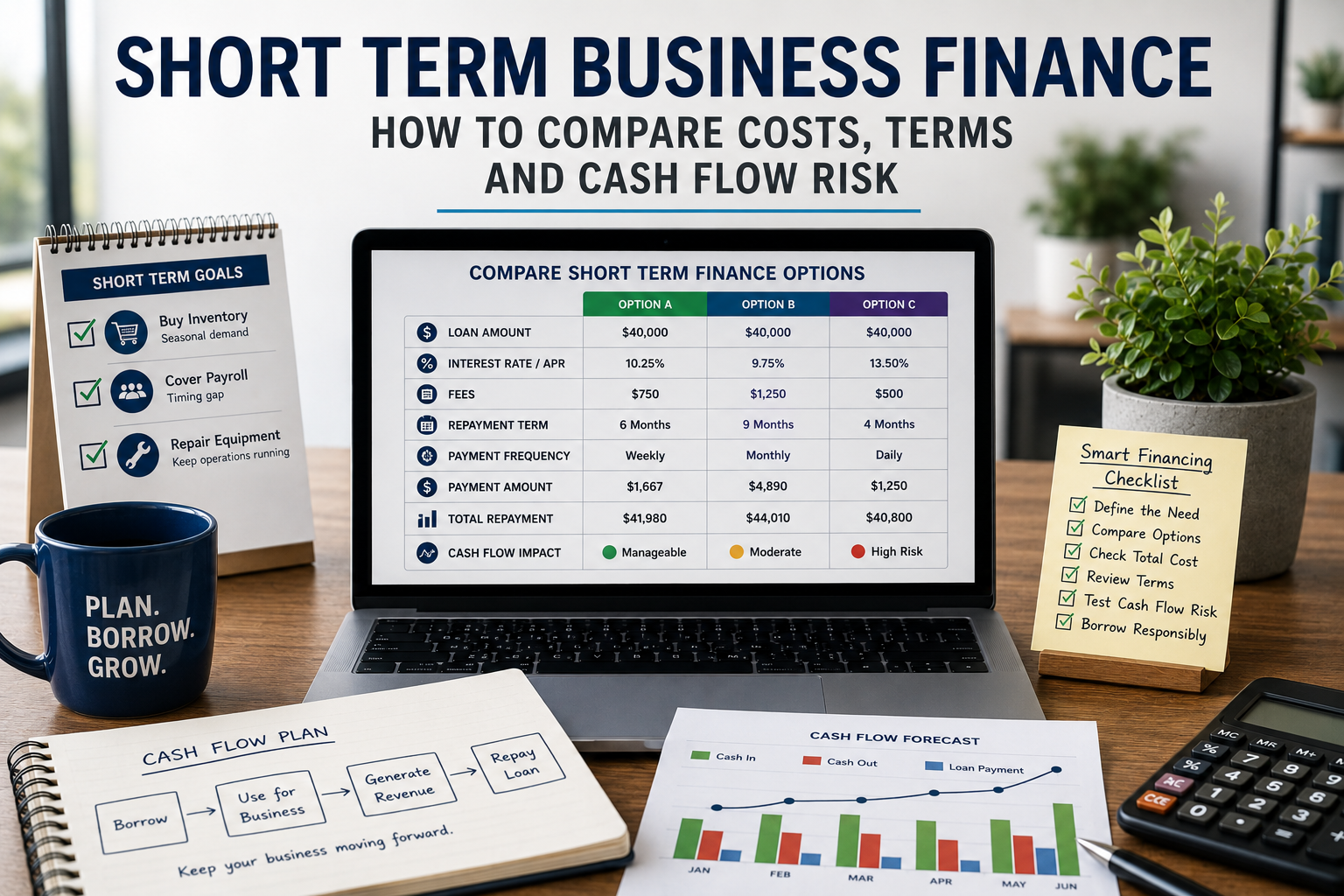
Short Term Business Finance can help a business cover a temporary funding need without committing to debt for many years.
Possible uses can include:
- seasonal inventory
- supplier payments
- project materials
- payroll timing
- emergency repairs
- temporary working-capital gaps
- short delays between expenses and customer payments
But short-term finance has one defining challenge:
the money usually has to come back out of the business relatively quickly.
That means a financing option can look affordable based on the amount borrowed while still creating substantial pressure through:
- large payments
- frequent payments
- high fees
- rapid repayment
- reduced operating cash
The strongest short-term financing decision follows a simple path:
temporary need → appropriate financing structure → productive use → incoming cash → repayment → debt cleared
Business owners specifically comparing a conventional loan structure can review Kevanzo’s short term business loan guide.
Educational note: Kevanzo.com provides general business-financing education only. Kevanzo is not a lender, broker, loan marketplace, financial adviser, attorney, accountant or approval service. Interest rates, APRs, fees, repayment schedules, financing amounts, collateral requirements, guarantees, eligibility standards and available products vary by lender and borrower. Always review the complete financing agreement before accepting business funding.
What Is Short Term Business Finance?
Short Term Business Finance is a broad category of business funding designed primarily for relatively short-duration business needs.
It can potentially include:
- short-term term loans
- revolving credit
- working-capital financing
- invoice-based financing
- unsecured financing
- secured financing
- other commercial funding structures
This is important because Short Term Business Finance is broader than a short-term business loan.
A loan is one structure.
Short-term finance describes the wider funding category.
The correct product depends on the business problem.
The Kevanzo Short-Term Purpose Rule
Short-duration financing should generally solve a short-duration problem.
Examples:
Seasonal Inventory
Cash is needed now.
Inventory sells over several months.
Sales generate repayment cash.
Customer-Payment Gap
Work is complete.
The invoice is outstanding.
Cash should arrive soon.
Emergency Repair
Equipment fails.
Repair restores normal business operations.
Those are very different from:
The company loses money every month and needs another loan to survive.
That is likely an operating problem rather than simply a temporary financing problem.
Temporary Problem or Permanent Problem?
This is one of the most important tests in Short Term Business Finance.
Ask:
If we receive this money today, what specifically changes that allows us to repay it?
A strong answer:
We are purchasing inventory expected to convert back into cash during our established seasonal sales period.
Another:
We have completed contracted work and expect customer payment within 45 days.
A weak answer:
We will probably find more money later.
The Kevanzo Temporary-or-Structural Test
Classify the problem.
Temporary
The cash shortage has:
- identifiable cause
- identifiable amount
- identifiable end
- identifiable repayment source
Structural
The shortage repeatedly results from:
- persistent losses
- inadequate margins
- excessive expenses
- weak collections
- excessive existing debt
- poor pricing
- declining revenue
Short Term Business Finance is much stronger when dealing with the first category.
How Much Money Does the Business Actually Need?
Suppose:
Business need:
$30,000
Financing available:
$80,000
The larger offer may look attractive.
But the extra $50,000 can create:
- higher interest
- higher fees
- larger payments
- greater repayment risk
- temptation to spend borrowed money unnecessarily
Availability is not need.
The Kevanzo Need-versus-Offer Test
Write down:
Amount Required
What will solve the specific problem?
Amount Offered
What will the lender provide?
Difference
Is there a defined productive use for the additional borrowing?
If not, borrowing less deserves consideration.
Short Term Business Finance Versus a Short Term Business Loan
A short-term loan usually provides:
one lump sum → scheduled repayment → loan ends
Short Term Business Finance can include that structure, but it can also include other forms of short-duration funding.
That distinction gives the two Kevanzo pages different jobs.
Short Term Business Loan
Focus:
- specific loan structure
- repayment speed
- term-loan affordability
Short Term Business Finance
Focus:
- wider category
- choosing between structures
- matching temporary needs with the right form of funding
Lump Sum or Revolving Credit?
Suppose a business needs exactly:
$40,000
for one defined purchase.
A lump-sum structure may be easy to understand.
Now suppose the business needs:
- $10,000 this month
- nothing next month
- $15,000 two months later
- another variable amount later
A small business line of credit may deserve comparison.
The Kevanzo One-Time-or-Recurring Test
Ask:
One-Time Need?
Consider structures designed around one defined amount.
Recurring Need?
Consider whether revolving financing better matches the business cycle.
The goal is not choosing the most flexible financing.
It is choosing the amount of flexibility the business genuinely needs.
Short Term Business Finance for Working Capital
Working capital supports normal business operations.
Possible uses include:
- inventory
- payroll timing
- suppliers
- materials
- seasonal preparation
- temporary operating gaps
Businesses may compare working capital loans when the main need relates to everyday operations.
The crucial issue is timing.
Money leaves first.
Business activity occurs.
Cash returns later.
The financing payment must fit somewhere inside that cycle.
The Kevanzo Working-Capital Clock
Write down:
Day Cash Leaves
When does the business spend borrowed money?
Day Revenue Is Created
When does the spending generate sales or work?
Day Cash Arrives
When does the customer actually pay?
Day Financing Payment Is Due
When must the lender receive money?
If financing payments consistently arrive before business cash, working-capital pressure increases.
Short Term Business Finance for Cash-Flow Gaps
Some businesses experience timing problems rather than profitability problems.
Example:
Customer invoices:
$75,000
Expected payment:
40 days
Immediate supplier requirement:
$20,000
The company may have enough incoming revenue overall.
It simply needs cash earlier.
Businesses facing this type of issue may also compare cash flow loans for small business.
The Kevanzo Cash-Arrival Test
For every financing need identify:
- when the borrowed money is spent
- when the funded activity creates revenue
- when actual cash enters the business
- when financing repayment occurs
The important event is not when revenue is recorded.
It is when cash becomes available.
Invoice-Based Financing
If the underlying problem is specifically unpaid customer invoices, invoice financing for small business may deserve comparison.
Suppose:
Eligible unpaid invoices:
$100,000
Cash required now:
$30,000
Expected customer payment:
45 days
That is primarily a receivables-timing problem.
A general short-term loan could potentially address it.
But invoice-related financing may match the underlying problem more directly.
The Kevanzo Problem-to-Product Test
Ask:
What exactly is causing the cash shortage?
If the answer is:
Unpaid Invoices
Compare receivables-based structures.
Recurring Working Capital
Compare revolving or working-capital structures.
One Defined Expense
Compare term financing.
Long-Lived Asset
Question whether short-duration financing is appropriate at all.
This prevents the product from being chosen before the problem is understood.
Short-Term Financing for Inventory
Inventory can be a strong short-term financing use when there is a reliable conversion cycle.
The cycle is:
purchase → receive stock → sell → collect cash → repay
But several things can go wrong:
- sales slower than forecast
- excess inventory
- lower selling price
- increased supplier cost
- reduced margin
- damaged or obsolete stock
The Kevanzo Inventory-to-Cash Test
Record:
- purchase date
- inventory arrival
- expected sales period
- expected gross margin
- customer-payment timing
- financing-payment dates
- expected final repayment
The Short Term Business Finance should broadly fit the inventory cycle.
Short-Term Financing for Project Costs
A contractor may need:
$35,000
for materials.
Contract value:
$90,000
Customer payment expected:
after project completion.
This may create a legitimate temporary financing need.
But test:
- project delays
- cost overruns
- customer disputes
- payment delays
- unexpected materials costs
A profitable contract does not guarantee perfect cash timing.
The Kevanzo Project-Cash Test
Calculate:
project revenue
minus
project costs
minus
financing cost
Then identify:
when the remaining cash actually arrives.
The financing should be repayable from realistic project cash rather than merely projected accounting profit.
Short-Term Financing for Emergency Repairs
Equipment failure can create genuine urgency.
Imagine:
Repair cost:
$15,000
Business revenue lost each day equipment remains unavailable:
$3,000
A faster financing option may have real economic value.
But speed should still be measured.
The Kevanzo Urgency-Value Test
Calculate:
estimated cost of waiting
versus:
additional financing cost required for faster access
If waiting five days could create:
$15,000 of economic loss
and faster financing costs an additional:
$2,000
speed may have measurable value.
If waiting creates almost no economic harm, paying a large speed premium may make less sense.
Short-Term Finance Versus Long-Term Financing
Shorter financing and longer financing create opposite tradeoffs.
Shorter Repayment
Potential advantages:
- debt cleared sooner
- less time carrying the obligation
- potentially less total interest depending on the offer
Potential disadvantages:
- larger payments
- greater near-term cash pressure
- less recovery time after weak trading
Longer Repayment
Potential advantages:
- potentially smaller scheduled payments
- more repayment time
Potential disadvantages:
- debt remains longer
- potentially greater total financing cost
The correct structure depends on purpose.
The Kevanzo Purpose-to-Term Match
Estimate:
how long the financed need creates business value
Then compare:
how long repayment lasts
Example:
Inventory selling in:
four months
Financing lasting:
seven years
may be unnecessarily long.
Equipment creating value for:
ten years
Financing requiring repayment in:
six months
may create unnecessary cash pressure.
Repayment Speed Is a Major Risk
Suppose two financing options each provide:
$50,000
One requires repayment over:
48 months
Another over:
10 months
The second structure returns principal much faster.
That can dramatically increase scheduled payment pressure.
A Short Term Business Finance decision therefore needs a repayment-speed calculation, not just a borrowing-cost comparison.
The Kevanzo Repayment-Speed Test
Record:
Amount Received
How much usable cash enters the business?
Repayment Window
How quickly must it return?
Payment Amount
How much leaves each period?
Available Business Cash
How much can operations realistically support?
Remaining Cushion
What is left after payment?
Short repayment should not eliminate the company’s operating buffer.
Payment Frequency Matters
A Short Term Business Finance product could potentially require:
- monthly
- weekly
- more frequent
payments depending on the financing agreement.
A business receiving most customer payments monthly may experience weekly repayment differently from a company collecting customer cash every day.
The Kevanzo Payment-Frequency Test
Compare:
customer-cash frequency
against:
lender-payment frequency
Then ask:
How much operating cash must the business hold between those events?
Never compare payment amount without payment timing.
Cash-Flow Compression
Short-term financing can create cash-flow compression.
That occurs when debt repayment absorbs a large portion of available cash over a relatively short period.
Example:
Cash available after normal operating expenses:
$20,000 monthly
New financing payment:
$12,000
Remaining cushion:
$8,000
The business can technically make the payment.
But most of its previous flexibility has disappeared.
The Kevanzo Cash-Flow Compression Test
Calculate:
cash available before financing
minus
new financing payment
equals
remaining operating cushion
Then test:
- lower sales
- higher expenses
- late customer payment
If the cushion disappears quickly, reconsider the financing.
Interest Rate, APR and Fees
Short Term Business Finance may involve:
- interest
- APR where applicable
- origination fees
- underwriting fees
- draw fees
- documentation charges
- service fees
- late fees
- other contract-specific costs
The headline rate is therefore not enough.
The Kevanzo Ten-Number Short-Term Finance Comparison
Write down these ten numbers for every serious offer.
1. Gross Financing Amount
What is stated?
2. Net Cash Received
What actually reaches the business?
3. Interest Rate
Where applicable.
4. APR
Where available and appropriate.
5. Fees
What other charges apply?
6. Payment
How much?
7. Payment Frequency
How often?
8. Repayment Period
How quickly?
9. Total Scheduled Repayment
What should ultimately leave the business?
10. Remaining Cash Cushion
What remains for operations?
Those ten numbers make different short-term structures easier to compare.
Net Cash Matters
Suppose:
Financing amount:
$40,000
Upfront fees:
$2,000
Cash reaching business:
$38,000
The business has $38,000 to solve its problem.
Not $40,000.
The Kevanzo Net-Funding Test
Calculate:
gross financing
minus
upfront deductions
equals
net funding
Then compare:
net funding
with
total repayment
This exposes the financing cost more clearly.
Factor Rates
Some short-duration financing products may use factor-rate pricing rather than conventional interest.
Example:
Funding:
$40,000
Factor rate:
1.25
Predetermined repayment:
$50,000
That does not mean the financing carries a 25% APR.
The pricing systems are different.
Whenever factor pricing appears, compare:
- net cash received
- total repayment
- payment frequency
- expected repayment duration
The Kevanzo Dollar-Cost Test
Calculate:
total repayment
minus
net cash received
equals
basic dollar difference
Then compare that cost with the business value the financing should create or protect.
Percentages matter.
Dollars make the business impact easier to understand.
Secured Short Term Business Finance
Short-duration financing can be secured.
Potential collateral may include:
- equipment
- inventory
- receivables
- other business assets
Collateral can change lender risk.
But it also exposes business assets.
Before accepting secured financing, identify exactly what is pledged and what happens after default.
Unsecured Short Term Business Finance
Businesses wanting to avoid specifically pledging a physical asset may compare unsecured business loans.
But unsecured does not automatically mean:
- no guarantee
- no contractual protection
- no consequences after default
- no repayment risk
The written agreement matters.
The Kevanzo Security-Exposure Test
Ask:
Specific Collateral?
What is pledged?
Other Security?
What does the agreement allow?
Personal Guarantee?
What owner exposure exists?
Default?
What can happen if repayment fails?
Cost and security exposure belong in the same comparison.
Existing Debt Changes Everything
Suppose the business already pays:
Equipment finance:
$2,500 monthly
Vehicle:
$1,000
Credit cards:
$1,500
Existing loan:
$2,500
Total:
$7,500
A new short-duration payment must be added to those obligations.
Never evaluate the new financing alone.
The Kevanzo Debt-Stack Test
Calculate:
existing debt payments
plus
new proposed payments
Then compare the total against:
real cash available for debt service
If the combined obligation consumes most available cash, reconsider the financing.
Loan Stacking
Loan stacking occurs when several financing obligations overlap.
Example:
Loan A remains unpaid.
Loan B is added.
Then Loan C is used because A and B have reduced available cash.
This can rapidly create financial pressure.
Short Term Business Finance should not automatically be stacked simply because additional borrowing remains available.
The Kevanzo No-Stack Warning
Before accepting another financing product ask:
Why has the existing debt not solved the original problem?
If the answer is unclear, another loan may worsen rather than solve the issue.
Reborrowing Risk
Repeated short-duration borrowing can turn temporary financing into permanent dependence.
Review the last 12 months.
Ask:
- How many loans were taken?
- Were they repaid from operating cash?
- Was another loan required before the previous one ended?
- Is the same cash shortage repeatedly returning?
The Kevanzo Finance-Independence Test
Ask:
Should normal business operations be capable of repaying this financing without another loan?
A strong short-term financing cycle ends in:
independence
not:
another financing application.
Current SBA Working-Capital Context
Short-term business needs do not always have to be financed using one lump-sum short-term loan.
Current SBA materials describe the 7(a) Working Capital Pilot as a monitored line-of-credit program designed for working-capital requirements, including recurring and short-term needs. SBA also describes asset-based and transaction-based working-capital structures within the program.
That reinforces an important principle:
compare financing structures, not simply product names.
A revolving working-capital need may deserve a revolving structure.
A one-time short-term expense may fit a term structure better.
Qualification Is Not Affordability
A lender might approve:
$100,000
The business may need:
$40,000
And cash flow may comfortably support:
$50,000
Those are three different numbers.
The Kevanzo Short-Term Finance Triangle
Compare:
Need
How much is actually required?
Affordability
How much can the business safely repay?
Approval
How much will the lender provide?
The borrowing decision should primarily be based on:
need + affordability
not simply approval.
Three-Condition Short Term Business Finance Stress Test
Test financing under three conditions.
Condition 1: Normal
Revenue and expenses perform approximately as expected.
Condition 2: Slow
Revenue declines moderately or customers pay later.
Condition 3: Difficult
Revenue falls while an unexpected expense occurs.
Under all three calculate:
- revenue
- essential expenses
- existing debt
- proposed financing payment
- remaining cash
Short-duration financing gives the business less time to recover from weak conditions.
Seasonal Business Scenario
A retailer needs:
$50,000
for holiday inventory.
Expected conversion period:
four months
The financing may fit if:
inventory → sales → cash → repayment
works as planned.
But test:
- sales 20% below forecast
- discounting
- leftover stock
- higher supplier cost
Do not build repayment around the strongest possible outcome.
Invoice-Timing Scenario
A service company has:
$90,000
of customer invoices due within 45 days.
Immediate expense:
$25,000
This may represent a genuine timing gap.
The business should compare:
- conventional short-term finance
- revolving credit
- invoice financing
- existing reserves
The best structure is the one that addresses the problem at an acceptable total cost.
Emergency Repair Scenario
Essential machinery fails.
Repair:
$20,000
Without repair, revenue stops.
Short-term funding may protect existing business value.
The decision should compare:
financing cost
against:
economic loss caused by delaying the repair.
Structural-Loss Scenario
A company loses:
$15,000 every month
It borrows:
$15,000
Nothing changes.
The next month produces another $15,000 shortage.
Short Term Business Finance has not solved the problem.
It has delayed it.
The company needs to investigate the underlying business economics.
Common Short Term Business Finance Mistakes
Borrowing Without a Specific Purpose
Know what the money does.
Borrowing the Maximum Offered
Approval does not define need.
Comparing Payment Only
Total repayment matters.
Ignoring Payment Frequency
Timing changes cash-flow pressure.
Ignoring Net Proceeds
Know how much usable cash arrives.
Using Short Debt for Long-Term Needs
Match financing duration to business purpose.
Financing Permanent Losses
Debt cannot permanently repair weak economics.
Ignoring Existing Debt
Every payment uses the same pool of cash.
Stacking Loans
Overlapping obligations can rapidly increase pressure.
Ignoring Collateral
Business assets may be exposed.
Ignoring Personal Guarantees
Owner exposure matters.
Automatically Reborrowing
Temporary finance should not automatically become permanent finance.
Short Term Business Finance Red Flags
Investigate further when:
- total repayment is unclear
- fees are difficult to identify
- payment frequency is unclear
- repayment consumes most available operating cash
- financing covers repeated losses
- the business has no identifiable repayment source
- another loan will likely be needed before this one ends
- several loans already overlap
- collateral provisions are unclear
- guarantee language is unclear
- repayment relies on unusually optimistic revenue
- the business is borrowing much more than required
- short-duration finance is funding a long-lived project
- the owner cannot explain how the financing creates or protects value
Several warning signs together deserve serious caution.
Questions to Ask Before Accepting Short Term Business Finance
Ask:
- What exact business problem are we solving?
- How much money is genuinely needed?
- How much financing is being offered?
- How much cash actually reaches the business?
- What interest rate applies?
- Is it fixed or variable?
- What APR is available where applicable?
- Are factor rates used?
- What fees apply?
- What is the payment amount?
- How often are payments required?
- When does repayment begin?
- How quickly must the financing be repaid?
- What is the total scheduled repayment?
- What business cash should repay it?
- Does repayment match customer-payment timing?
- Is collateral required?
- Is another security interest involved?
- Is a personal guarantee required?
- What happens after late payment?
- What constitutes default?
- Can repayment be accelerated?
- Can financing be repaid early?
- Does early repayment reduce cost?
- What existing debt already competes for cash?
- What happens if revenue falls?
- What happens if customers pay later?
- Would another loan probably be required afterward?
- What alternative financing structures were compared?
- Should the business be financially stronger after repayment?
If several answers remain unclear, the comparison is unfinished.
The Kevanzo 20-Point Short Term Business Finance Check
Before accepting Short Term Business Finance, complete this final review.
1. Purpose
What exactly is being funded?
2. Temporary Need
Will the problem actually end?
3. Amount Required
How much is genuinely necessary?
4. Net Cash Received
What reaches the business?
5. Interest Rate
Fixed or variable?
6. APR
What annualized information is available where relevant?
7. Other Pricing
Is a factor rate or fee structure involved?
8. Fees
What other charges apply?
9. Payment
How much is required?
10. Payment Frequency
How often?
11. Repayment Period
How quickly must the debt disappear?
12. Total Repayment
What will the financing ultimately cost?
13. Repayment Source
What business cash pays it?
14. Cash-Timing Match
Does repayment follow incoming business cash?
15. Operating Cushion
How much cash remains?
16. Existing Debt
What obligations already compete for cash?
17. Collateral
What assets are exposed?
18. Personal Guarantee
What owner exposure exists?
19. Reborrowing Risk
Will another financing product likely be needed?
20. Economic Value
Should the financing create or protect more value than it costs?
If several answers remain uncertain, keep comparing.
Practical Next Steps
Start by defining the temporary business need.
Write down:
exact amount
exact purpose
expected source of repayment
date repayment cash should arrive
Then decide which short-duration structure actually fits the problem.
Compare each serious offer using:
- net cash received
- interest
- APR where relevant
- factor-rate structure where relevant
- fees
- payment
- payment frequency
- repayment period
- total repayment
- collateral
- guarantees
Run the slow-month test.
Add existing debt.
Check whether another loan would be required afterward.
Then ask:
Does this Short Term Business Finance solve a temporary problem without creating a larger cash-flow problem?
That is the standard.
Final Takeaway
Short Term Business Finance can be useful when a business has a clearly defined temporary need and a realistic source of repayment.
Its strength is speed and limited duration.
Its main risk is also limited duration:
repayment can happen quickly.
That means business owners should look beyond approval and compare:
- net cash received
- total financing cost
- payment size
- payment frequency
- repayment speed
- cash-flow timing
- existing debt
- collateral
- guarantees
- operating cushion
- reborrowing risk
Most importantly, short-term finance should create a clear cycle:
temporary need → financing → productive use → incoming business cash → repayment → debt cleared
The danger sign is:
temporary need → financing → repayment pressure → another loan → more debt
The strongest Short Term Business Finance option is therefore not automatically the fastest or easiest funding.
It is the structure that solves the temporary business problem while allowing normal operations to repay the financing and move forward without needing another rescue loan.
Short Term Business Finance Q&A
Q: What should a business compare first with Short Term Business Finance?
A: Start with the exact funding purpose, net cash received, repayment period, payment frequency, total financing cost and the specific business cash expected to repay the funding.
Q: What makes Short Term Business Finance affordable?
A: It is more manageable when scheduled repayments fit normal business cash flow while leaving enough money for payroll, suppliers, taxes, rent and other essential operating expenses.
Q: What is the biggest Short Term Business Finance risk?
A: One major risk is repayment occurring faster than the business generates available cash, causing the company to borrow again before the original financing has solved the problem.
Frequently Asked Questions About Short Term Business Finance
What Is Short Term Business Finance?
Short Term Business Finance is a broad category of business funding generally intended for temporary or relatively short-duration business needs.
Is Short Term Business Finance the Same as a Short Term Business Loan?
Not exactly.
A short-term business loan is one possible financing structure.
Short Term Business Finance is the broader category and can include other short-duration funding structures.
What Can Short Term Business Finance Be Used For?
Depending on lender terms, possible uses may include:
- inventory
- supplier payments
- payroll timing
- project materials
- emergency repairs
- temporary working-capital needs
- cash-flow timing gaps
How Long Is Short Term Business Finance?
There is no single universal duration.
Actual repayment periods depend on the financing product, lender and borrower.
Is Short Term Business Finance Expensive?
It can be, but not universally.
Cost depends on interest, fees, repayment period, payment frequency, borrower risk and financing structure.
Should Businesses Compare APR?
APR can be useful where available and applicable.
Also compare net cash, fees, total repayment and payment frequency.
What Is a Factor Rate?
A factor rate is a pricing method used by some financing products.
It is different from a traditional interest rate or APR.
Can Short Term Business Finance Be Unsecured?
Potentially.
The lender and agreement determine collateral and guarantee requirements.
Can Short-Term Financing Require a Personal Guarantee?
Yes, depending on the product and lender.
Is a Line of Credit Short Term Business Finance?
It can potentially form part of a short-duration working-capital strategy, depending on the structure and business use.
Is Invoice Financing Short Term Business Finance?
It may be used for relatively short receivables-timing needs, depending on the arrangement.
Should a Business Borrow the Maximum Amount Available?
Not merely because it qualifies.
Borrow according to genuine business need and repayment capacity.
What Is Cash-Flow Compression?
Cash-flow compression occurs when financing requires substantial repayment over a relatively short period, reducing the cash remaining for normal operations.
When Is Short Term Business Finance Risky?
It deserves particular caution when:
- the business has ongoing losses
- repayment consumes most operating cash
- no clear repayment source exists
- several loans already overlap
- another loan will probably be required afterward
Should Short-Term Finance Be Used for Long-Term Projects?
Usually the financing term should be compared carefully with how long the funded project or asset creates value.
A severe mismatch can create unnecessary repayment pressure.
What Is the Most Important Question?
Ask:
What specific incoming business cash will repay this financing before it creates another cash shortage?
Helpful Authoritative Resources
- U.S. Small Business Administration business loan resources
- U.S. Small Business Administration 7(a) loans
- U.S. Small Business Administration lender information
- U.S. Small Business Administration Lender Match
- Consumer Financial Protection Bureau small business lending resources
- Federal Trade Commission business guidance
- SCORE small business mentoring and education
Author Bio
Kevanzo Editorial Team
Kevanzo Editorial Team creates practical, plain-English educational resources for U.S. business owners comparing Short Term Business Finance, short-term loans, working capital, revolving business credit, invoice financing, borrowing costs, repayment structures and responsible business-financing decisions.
Copyright Notice
© 2026 Kevanzo. All rights reserved.
This Short Term Business Finance article is protected by copyright and may not be copied, scraped, spun, republished or used commercially without prior written permission from Kevanzo. Brief quotations may be used with clear attribution and a link to the original article.
Unauthorized reuse, bulk scraping, content spinning, AI rewriting for republication or commercial reproduction of this material is prohibited.
Educational Disclaimer
Kevanzo.com provides general educational information about business financing. Kevanzo is not a lender, broker, loan marketplace, financial adviser, attorney, accountant or approval service.
Nothing in this article constitutes financial, legal, tax, accounting, investment, lending or personalized business advice. Interest rates, APRs, factor rates, fees, repayment schedules, collateral requirements, personal guarantees, eligibility standards and available financing products vary according to lender, borrower, financing type, business profile, industry, revenue, credit history and market conditions.
Business owners should review current official information, read all financing documents carefully and consider seeking advice from appropriately qualified professionals when necessary before making financing decisions.
Thanks for your comment. When comparing business funding, it is usually safest to look at the total cost, repayment timing, lender requirements, funding speed, and whether the option fits the business purpose. Kevanzo shares general educational information only, not general educational information.