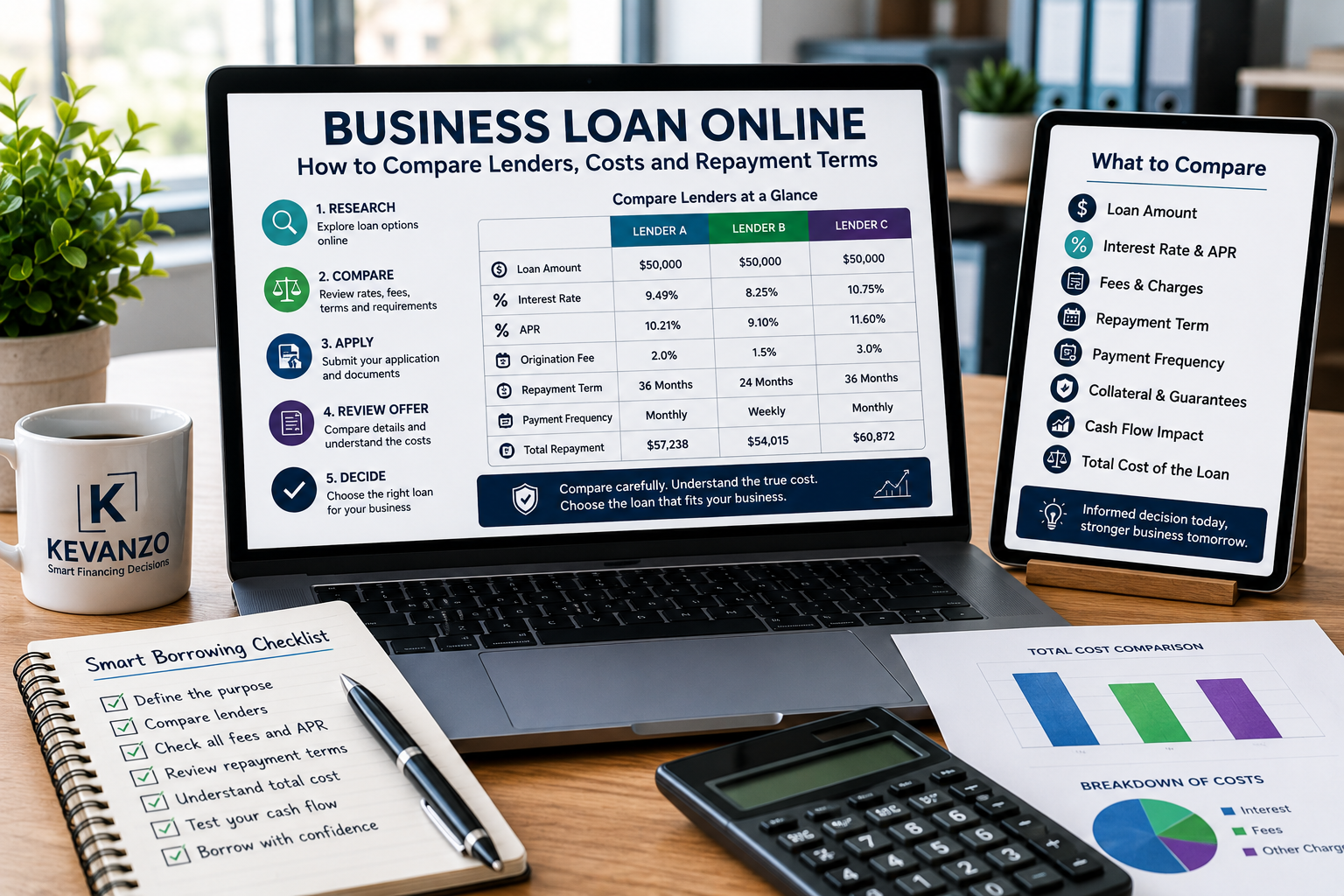
A Business Loan Online can make it easier for a business owner to research financing, submit information, upload documents, request a quote or begin a loan application without visiting a physical branch.
The technology can make the process faster and more convenient.
But it does not change the basic economics of borrowing.
An online application can still lead to:
- interest charges
- APR
- lender fees
- frequent repayments
- collateral requirements
- personal guarantees
- credit checks
- long repayment periods
- significant cash-flow pressure
That means the important question is not:
How easy is the application?
It is:
Does the financing offer make financial sense after the application is complete?
A strong online borrowing process should follow:
define the need → compare financing type → investigate lender → review preliminary offer → verify final terms → test repayment → decide
For a wider view of financing structures before choosing an online loan, review Kevanzo’s business financing guide.
Educational note: Kevanzo.com provides general business-financing education only. Kevanzo is not a lender, broker, loan marketplace, financial adviser, attorney, accountant or approval service. Interest rates, APRs, fees, loan amounts, repayment schedules, collateral requirements, guarantees, approval requirements and available products vary according to lender and borrower. Always review the complete financing agreement before accepting business funding.
What Does Business Loan Online Mean?
A Business Loan Online generally means business financing that can be researched, requested or applied for through a website or other digital process.
The lender itself might be:
- a bank
- a credit union
- an online lender
- a finance company
- another commercial lending institution
The financing might include:
- business term loans
- short-term business loans
- working-capital loans
- secured loans
- unsecured loans
- business lines of credit
- equipment financing
- other commercial funding products
The important distinction is:
online describes the process — not necessarily the financing product.
Online Does Not Mean Automatic Approval
An application form may take only a few minutes to complete.
That does not mean the financing decision takes only a few minutes.
A lender may still need to review:
- business revenue
- bank statements
- credit history
- existing debt
- profitability
- cash flow
- industry
- time in business
- ownership information
- intended use of funds
- collateral
- guarantees
A fast interface should not be confused with a guaranteed lending decision.
The Kevanzo Screen-versus-Loan Rule
Separate two things:
The Application Experience
How fast and easy is the website?
The Financing Agreement
What does the money actually cost?
The second one matters far more.
A beautifully designed application can still produce an expensive financing offer.
A plain lender website can still produce competitive terms.
Judge the loan, not the website.
Why Business Owners Search for a Business Loan Online
Convenience can be valuable.
A business owner may want to:
- research financing outside branch hours
- upload documents electronically
- compare several options
- avoid repeated branch visits
- receive preliminary information quickly
- complete paperwork digitally
- communicate remotely with the lender
That can save administrative time.
But convenience should never replace comparison.
Businesses considering traditional loan structures should also review Kevanzo’s business loans comparison guide to understand loan types, repayment terms and lender considerations.
Define the Funding Need First
Before completing an online application, write down:
Amount needed
Exact purpose
Expected business benefit
Expected source of repayment
For example:
We need $45,000 to purchase inventory for our established seasonal sales period, and we expect those sales to provide the primary repayment source.
That is much stronger than:
We want to see how much we can get.
The Kevanzo Online-Loan Purpose Test
Complete this sentence:
“Our business needs $_____ specifically for _____, and the money should create or protect business value by _____.”
If that sentence cannot be completed clearly, do not rush into applications.
Business Loan Online Versus Visiting a Bank
The core financing decision is similar whether the application begins:
- online
- over the telephone
- inside a branch
What changes is primarily the process.
An online system may provide:
- digital forms
- electronic document upload
- identity verification
- automated preliminary screening
- electronic signatures
- online account access
But the borrower should still evaluate:
- lender
- financing structure
- repayment
- total cost
- contractual obligations
Prequalification Is Not Final Approval
A Business Loan Online application may begin with:
- eligibility check
- quote request
- preliminary review
- prequalification
- pre-approval
- full application
Those stages should not be treated as interchangeable.
A lender may still need to verify information before issuing final terms.
Businesses encountering early line-of-credit offers can review the pre-approval discussion in Kevanzo’s business line of credit guide.
The Kevanzo Online-Approval Ladder
Think of the process as several steps.
Step 1: Initial Inquiry
The business provides basic information.
Step 2: Preliminary Assessment
The lender may indicate possible eligibility.
Step 3: Documentation
Financial and business records may be required.
Step 4: Underwriting
The lender evaluates risk.
Step 5: Final Offer
Actual terms are presented.
Step 6: Agreement
The borrower reviews and accepts or declines.
Do not mentally jump from Step 2 to Step 6.
An “Up To” Amount Is Not Your Loan Amount
An online page might advertise financing:
up to $250,000
That does not mean:
- your business qualifies for $250,000
- you should borrow $250,000
- your final terms will be attractive
It describes a possible product limit.
Your actual borrowing decision should still depend on need and affordability.
The Kevanzo Needed-versus-Available Test
Suppose:
Maximum potentially available:
$150,000
Business need:
$40,000
Comfortable borrowing amount:
$50,000
The $150,000 figure should not drive the decision.
The relevant numbers are:
$40,000 needed
and
what the business can safely repay.
Comparing Online Business Lenders
Do not compare only:
- approval speed
- loan amount
- advertised rate
Compare the complete offer.
At minimum, examine:
- net cash received
- interest rate
- APR where applicable
- fees
- repayment amount
- payment frequency
- repayment term
- total repayment
- collateral
- guarantees
The Kevanzo Ten-Number Online Loan Comparison
For each offer, record:
1. Gross Loan Amount
How much financing is stated?
2. Net Cash Received
How much reaches the business after upfront deductions?
3. Interest Rate
Fixed or variable?
4. APR
Where available and applicable.
5. Fees
What charges apply?
6. Payment
How much must be paid?
7. Payment Frequency
Daily, weekly, monthly or another schedule?
8. Loan Term
How long will repayment continue?
9. Total Scheduled Repayment
How much should ultimately leave the business?
10. Remaining Cash Cushion
What remains after the payment?
An online lender comparison becomes much easier when every offer is reduced to the same numbers.
Why Net Cash Received Matters
Suppose an online offer shows:
Loan amount:
$50,000
Upfront charges:
$2,500
Money deposited:
$47,500
The business does not have $50,000 available for its project.
It has $47,500.
That can matter if the project actually costs $50,000.
The Kevanzo Net-Cash Test
Calculate:
stated financing
minus
upfront deductions
equals
usable business cash
Then compare usable cash with total required repayment.
Interest Rate Is Only Part of the Cost
A Business Loan Online may include more than interest.
Potential costs can include:
- origination fees
- underwriting fees
- documentation fees
- maintenance charges
- late fees
- draw fees
- renewal fees
- other agreement-specific charges
The business needs to understand the complete dollar cost.
APR and Online Business Loans
APR can provide useful annualized information for certain credit products.
But APR alone does not answer every question.
Also identify:
- amount received
- payment
- payment frequency
- repayment period
- total repayment
- fees
The goal is understanding both:
cost
and
cash-flow impact.
Payment Frequency Can Change the Decision
Suppose two offers have similar total repayment.
Offer A
Payment:
monthly
Offer B
Payment:
weekly
A business whose customers generally pay every 30 to 45 days could experience Offer B very differently.
The financing may remove cash before customer money arrives.
The Kevanzo Payment-to-Cash Test
Record:
when customers pay
and:
when the lender gets paid
Then ask:
Does enough operating cash remain between those dates?
Payment frequency deserves as much attention as payment size.
Business Loan Online for Working Capital
A business may use online financing for:
- inventory
- payroll timing
- supplier expenses
- temporary cash-flow gaps
- materials
- seasonal needs
Businesses with these needs may compare working capital loans.
The financing should generally address a temporary or identifiable operating need.
The Kevanzo Temporary-or-Structural Test
Ask:
After this money is spent, what changes that creates the cash needed to repay it?
Strong answer:
The inventory should be sold during our established seasonal cycle.
Weak answer:
We lose money every month and need another loan.
The second problem cannot be permanently fixed by an easier online application.
Business Loan Online for Short-Term Needs
A short term business loan may deserve comparison when:
- the funding need is temporary
- the amount is defined
- repayment cash should arrive relatively quickly
But shorter repayment can create substantial cash-flow compression.
Do not mistake:
short application
for:
easy repayment.
The Kevanzo Speed-versus-Repayment Test
Compare two different kinds of speed.
Funding Speed
How quickly does money arrive?
Repayment Speed
How quickly must money be returned?
A loan can fund rapidly and also demand rapid repayment.
Those are two separate facts.
Quick Online Business Loans
Some online lenders emphasize speed.
Businesses comparing quick business loans should calculate whether faster funding has genuine economic value.
Suppose waiting five days would cost the business:
$1,000
But obtaining faster financing increases total cost by:
$9,000
Speed may not justify the premium.
Now suppose waiting would cause the business to lose a valuable contract.
The calculation may change.
The Kevanzo Speed-Value Test
Compare:
economic cost of waiting
against:
additional financing cost of speed
Speed is valuable when it protects measurable business value.
Not simply because faster feels better.
Online Business Lines of Credit
Some digital financing platforms offer revolving business credit rather than one-time loans.
A business line of credit can allow a business to borrow, repay and potentially reuse credit according to the agreement.
This may suit:
- recurring working-capital needs
- unpredictable expenses
- seasonal requirements
But repeated access can increase the risk of debt dependence.
Secured Online Business Loans
An online application does not determine whether financing is secured.
A secured loan may involve:
- equipment
- property
- inventory
- receivables
- other business assets
The borrower should understand exactly what assets are exposed.
Unsecured Online Business Loans
Businesses may also encounter unsecured business loans online.
Unsecured financing does not automatically mean:
- no personal guarantee
- no business lien
- no lender protections
- no consequences after default
Read the actual agreement.
The Kevanzo Security Check
Before accepting any Business Loan Online offer, answer:
Is Specific Collateral Required?
What asset?
Is Another Security Interest Involved?
What does the contract say?
Is There a Personal Guarantee?
Who is responsible?
What Happens After Default?
Understand the lender’s rights.
The application being digital changes none of these questions.
Personal Guarantees
A personal guarantee can create exposure for a business owner if the company fails to meet its repayment obligations.
Before signing electronically, identify:
- who provides the guarantee
- what amount it covers
- when liability begins
- whether it is limited
- when it ends
Electronic signatures still create real contractual obligations.
Do Not Click Through the Agreement
Online applications make it easy to move from screen to screen rapidly.
That convenience creates a behavioral risk:
clicking faster than you are thinking.
A borrower may spend far longer choosing office equipment than reviewing a financing agreement worth tens of thousands of dollars.
That is backwards.
The Kevanzo Stop-Before-Sign Rule
Before clicking:
Accept
Agree
Continue
or:
Sign
stop and verify:
- amount
- net proceeds
- cost
- payment
- frequency
- term
- collateral
- guarantees
- default provisions
Digital convenience should make administration easier.
It should not reduce financial caution.
Check the Lender, Not Just the Offer
Before providing sensitive business information, confirm who is actually receiving it.
Look for clear information about:
- lender identity
- business address
- contact information
- privacy practices
- loan terms
- disclosures
- customer support
Be especially cautious when a website makes major promises but provides little information about the organization behind them.
The Kevanzo Online-Lender Identity Check
Ask:
- Who is the actual lender?
- Is another company merely collecting the application?
- Who receives the business’s financial information?
- Who makes the credit decision?
- Who services the financing?
- Who receives repayments?
Know who sits on the other side of the transaction.
Online Marketplace Versus Direct Lender
Some websites are direct lenders.
Others may connect businesses with multiple lenders. For a broader comparison of provider types and borrowing requirements, read Kevanzo’s small business loan lenders guide.
Those are different models.
A business should understand whether it is dealing with:
one lender
or:
a referral or marketplace process.
Kevanzo itself is neither.
Kevanzo provides educational information only.
Current SBA Lender Match Example
The SBA’s current Lender Match service illustrates the difference between an online referral tool and an actual loan application.
SBA says businesses can describe their needs online, receive potential lender matches, compare rates and terms, and then apply directly with lenders. SBA also explicitly says Lender Match does not guarantee a match or a loan and is not itself the loan application.
That distinction is useful well beyond SBA financing:
online matching → lender contact → actual application → underwriting → final decision
These are separate stages.
Online SBA Loan Research
Eligible businesses researching SBA-backed financing online can use SBA resources to identify participating lenders.
For 7(a) loans, SBA states that application requirements can vary according to the loan size and lender processing method, and that borrowers work directly with their lender rather than receiving the 7(a) loan directly from SBA.
That is another reason to read the actual lender requirements instead of relying on general online descriptions.
Documents to Prepare
Before applying for a Business Loan Online, prepare relevant records such as:
- business bank statements
- revenue records
- profit and loss information
- balance sheet where available
- existing debt schedule
- tax information where requested
- ownership details
- business registration information
- identification
- use-of-funds explanation
- financial projections where relevant
Good preparation reduces rushed decisions.
The Kevanzo Application-Readiness Test
Before opening an application, answer:
Amount
How much do we need?
Purpose
What exactly is it for?
Repayment
What cash should repay it?
Maximum Comfortable Payment
What can normal operations support?
Documents
Do we have the required records?
Alternatives
What other financing structures should we compare?
If those six answers are clear, the business is much better prepared.
Protect Business Information Online
Online applications can involve sensitive information.
Depending on the lender and application, businesses may provide:
- bank details
- identification
- tax records
- revenue
- ownership information
- financial statements
Before uploading sensitive documents, verify that the website belongs to the intended financial organization and that the business understands how its information will be handled.
Avoid Pressure-Based Decisions
Be cautious when an online financing process creates artificial pressure such as:
- act immediately
- offer expires instantly
- borrow the maximum now
- no time to review
- guaranteed result language
A legitimate business financing decision deserves enough time to understand the contract.
The Kevanzo Clarity Test
Before accepting an offer, the owner should be able to explain in plain English:
- How much money will we receive?
- How much will we repay?
- How often will we pay?
- How long will repayment continue?
- What fees apply?
- What assets or guarantees are exposed?
- What happens if we pay late?
- What happens if revenue declines?
If the offer cannot be explained simply, keep investigating.
Business Loan Online Scenario: Equipment
A landscaping company needs:
$40,000
for equipment connected to a new contract.
An online term-loan offer appears attractive.
Before accepting, compare:
- contract revenue
- customer-payment timing
- equipment useful life
- loan term
- payment
- total cost
The online application is irrelevant to whether the economics work.
Business Loan Online Scenario: Seasonal Inventory
A retailer needs:
$30,000
for inventory.
Expected selling period:
three months
The owner should compare:
- short-term loan
- line of credit
- supplier terms
- existing cash
Then model what happens if inventory sells more slowly.
Business Loan Online Scenario: Cash-Flow Gap
A consulting company has:
$70,000
of reliable customer invoices outstanding.
Immediate payroll requirement:
$15,000
An online financing offer could bridge the timing gap.
But compare its cost with:
- waiting
- existing reserves
- revolving credit
- receivables-based alternatives
Convenience alone should not choose the product.
Business Loan Online Scenario: Persistent Loss
A company loses:
$20,000 each month
It obtains an online loan.
One month later the operating problem remains.
Another financing search begins.
That is a warning.
The business may need to address:
- pricing
- margins
- staffing
- expenses
- collections
- existing debt
rather than simply finding another application form.
Existing Debt Matters
A new online loan joins every current business obligation.
Include:
- term loans
- credit cards
- equipment financing
- vehicle loans
- lines of credit
- tax payment arrangements
- other business borrowing
The Kevanzo Total-Debt Test
Calculate:
cash available for debt service
minus
existing debt payments
minus
new proposed payment
equals
remaining repayment cushion
Run the calculation again with weaker revenue.
The Kevanzo Three-Condition Online Loan Test
Before accepting a Business Loan Online offer, model three conditions.
Normal
Revenue performs approximately as expected.
Slow
Revenue falls moderately or customers pay later.
Difficult
Revenue declines while an unexpected business expense occurs.
Calculate under each:
- operating cash
- existing debt
- proposed payment
- remaining cash
The financing should not depend entirely on perfect business conditions.
Common Business Loan Online Mistakes
Applying Before Defining the Need
Purpose comes first.
Choosing the Fastest Website
Application speed does not determine financing quality.
Treating Prequalification as Approval
Final underwriting matters.
Borrowing the Maximum Offered
Availability is not need.
Comparing Only Interest Rate
Fees and repayment structure matter.
Ignoring Payment Frequency
Weekly or daily payments can change cash-flow pressure.
Ignoring Net Proceeds
Know what reaches the business.
Ignoring Personal Guarantees
Digital contracts still create real obligations.
Clicking Through Too Quickly
Read before signing.
Using Short-Term Debt for Long-Term Problems
Match term to purpose.
Financing Permanent Losses
New debt cannot permanently repair weak operating economics.
Assuming “Online” Means Cheap
Delivery method and financing cost are separate issues.
Business Loan Online Red Flags
Investigate further when:
- lender identity is unclear
- total repayment is unclear
- fees are difficult to identify
- payment frequency is hidden
- the business is pressured to act immediately
- guaranteed approval is implied
- the maximum amount dominates the marketing
- collateral provisions are unclear
- guarantee terms are unclear
- default provisions are difficult to find
- the business is encouraged to borrow more than needed
- repayment requires unusually optimistic sales
- another loan will probably be required later
- sensitive information is requested before the business understands who is receiving it
Several red flags together deserve serious caution.
Questions to Ask Before Accepting a Business Loan Online
Ask:
- Who is the actual lender?
- Is this website a lender or referral service?
- How much financing is being offered?
- How much does the business genuinely need?
- How much cash will actually be deposited?
- What is the interest rate?
- Is the rate fixed or variable?
- What APR is provided where applicable?
- What fees apply?
- What is the payment?
- How often is payment required?
- When does the first payment occur?
- How long does repayment continue?
- What is the total scheduled repayment?
- Is collateral required?
- Is another security interest involved?
- Is a personal guarantee required?
- What does the guarantee cover?
- Can the financing be repaid early?
- Does early repayment reduce cost?
- Are there prepayment charges?
- What happens after late payment?
- What constitutes default?
- Can repayment be accelerated?
- Is automatic bank withdrawal required?
- What documents are required?
- Will credit be checked?
- Is preliminary qualification final?
- What information still needs verification?
- What happens if revenue falls?
- What business cash should repay the loan?
- What alternatives were compared?
- Why is this offer better for the business than the alternatives?
Do not accept until the important answers are clear.
The Kevanzo 20-Point Business Loan Online Check
Before accepting a Business Loan Online, complete this final review.
1. Lender Identity
Who provides the money?
2. Funding Purpose
Why is the business borrowing?
3. Amount Needed
How much is genuinely required?
4. Amount Offered
How much is available?
5. Net Cash Received
What reaches the business?
6. Interest Rate
Fixed or variable?
7. APR
Where available and applicable.
8. Fees
What additional charges apply?
9. Payment
How much?
10. Payment Frequency
How often?
11. Repayment Term
How long?
12. Total Repayment
What should ultimately leave the business?
13. Repayment Source
What cash will repay it?
14. Existing Debt
What other obligations compete for cash?
15. Collateral
What assets are exposed?
16. Personal Guarantee
What owner exposure exists?
17. Preliminary-versus-Final Status
Are these actual final terms?
18. Slow-Month Resilience
Can repayment survive weaker revenue?
19. Alternative Options
Were other structures compared?
20. Economic Value
Should the financing create or protect more value than it costs?
If several answers are unclear, do not let a fast application rush the decision.
Practical Next Steps
Before looking for a Business Loan Online, write down:
exact funding amount
exact funding purpose
expected repayment source
maximum comfortable payment
Then compare the appropriate financing structures.
For every serious offer, record:
- lender
- net cash
- interest
- APR where relevant
- fees
- payment
- payment frequency
- repayment period
- total repayment
- collateral
- guarantees
Verify whether any preliminary result is actually a final offer.
Run the slow-month test.
Compare the new payment with existing debt.
Then ask:
Would we still choose this financing if the application had taken an hour instead of five minutes?
If the answer changes merely because the online process felt easy, the business may be allowing convenience to influence a financial decision too heavily.
Final Takeaway
A Business Loan Online can make researching, comparing and applying for business financing more convenient.
That convenience can be genuinely useful.
But online is a delivery method, not a quality guarantee.
It does not automatically mean:
- cheaper
- safer
- easier to repay
- guaranteed approval
- better terms
The strongest online loan decision still comes down to:
business need → lender identity → financing structure → complete cost → repayment ability → contractual risk
Owners should compare:
- net cash received
- interest and APR where relevant
- fees
- payment frequency
- repayment term
- total repayment
- collateral
- guarantees
- slow-month affordability
- existing debt
Most importantly:
Do not let a five-minute application create a financing obligation the business may spend months or years repaying.
The best Business Loan Online process is one that makes borrowing easier to understand and compare — not merely easier to click.
Business Loan Online Q&A
Q: What should a business check first when comparing a Business Loan Online?
A: Start with the actual lender, net cash received, total borrowing cost, repayment amount, payment frequency, loan term, fees, collateral or guarantees, and whether the payments fit normal business cash flow.
Q: Does a Business Loan Online make borrowing safer or easier to repay?
A: Not automatically. A Business Loan Online can make researching and applying more convenient, but the financing still needs to be judged by its cost, repayment terms, lender requirements, and effect on the business.
Q: What is the biggest mistake when applying for a Business Loan Online?
A: One major mistake is allowing a fast and convenient application process to rush the borrowing decision before the business has compared the lender, complete costs, repayment obligations, and alternative financing options.
Business Loan Online Q&A
Q: Does applying for a Business Loan Online mean approval is faster?
A: The digital application itself may be quicker, but lender review, document verification, underwriting and final approval requirements vary.
Q: What should a business compare before accepting an online loan?
A: Compare the lender, net funds received, interest or APR where applicable, fees, repayment amount, payment frequency, term, total repayment, collateral, guarantees and cash-flow impact.
Q: Is an online prequalification the same as a final loan offer?
A: Not necessarily. Preliminary eligibility or prequalification may still be subject to documentation, underwriting, verification and final lender approval.
Frequently Asked Questions About a Business Loan Online
What Is a Business Loan Online?
A Business Loan Online generally refers to business financing that can be researched, requested or applied for through a digital process.
Is a Business Loan Online a Special Type of Loan?
Not necessarily.
“Online” generally describes how the borrower interacts with the lender rather than defining one particular financing structure.
Can Banks Offer Business Loans Online?
Yes.
Banks, credit unions, online lenders and other financing companies may provide digital application processes.
Is Online Approval Guaranteed?
No.
Applications can still require underwriting, verification and lender approval.
Can I Get an SBA Loan Completely From SBA Online?
SBA does not directly make ordinary 7(a) loans to borrowers. Businesses work with participating lenders, and SBA’s Lender Match can help identify potential lenders.
Does SBA Lender Match Guarantee a Loan?
No.
SBA explicitly states that Lender Match is a referral tool rather than a loan application and does not guarantee a lender match or financing.
What Documents Might Be Needed?
Depending on the lender, documents can include bank statements, financial records, business information, debt details, tax information and a use-of-funds explanation.
Are Online Business Loans More Expensive?
Not automatically.
Pricing varies by lender, borrower and financing product.
Actual offers must be compared.
Are Online Business Loans Faster?
The application or communication process may sometimes be faster, but underwriting and funding times vary.
Can an Online Business Loan Be Unsecured?
Potentially.
The actual collateral, security and guarantee requirements depend on the agreement.
Is a Soft Quote the Same as Final Approval?
No.
A preliminary quote or eligibility indication may change after underwriting and verification.
Should I Borrow the Maximum Online Offer?
Not merely because it is available.
Borrow according to legitimate business need and repayment capacity.
What Is the Biggest Risk With Online Business Loans?
One major risk is allowing a fast, convenient application process to reduce the amount of attention given to financing cost and repayment obligations.
What Should I Compare First?
Start with:
how much cash the business receives
and:
how much it ultimately has to repay.
Then examine payment frequency and cash-flow impact.
What Is the Most Important Question Before Clicking Accept?
Ask:
Can the business comfortably repay this financing under realistic conditions after every normal operating expense and existing debt payment is included?
Helpful Authoritative Resources
- U.S. Small Business Administration business loan resources
- U.S. Small Business Administration 7(a) loans
- U.S. Small Business Administration Lender Match
- U.S. Small Business Administration lender information
- Consumer Financial Protection Bureau small business lending resources
- Federal Trade Commission business guidance
- SCORE small business mentoring and education
Author Bio
Kevanzo Editorial Team
Kevanzo Editorial Team creates practical, plain-English educational resources for U.S. business owners researching Business Loan Online options, small business loans, working-capital financing, business credit, borrowing costs, lender comparisons and responsible business-financing decisions.
Copyright Notice
© 2026 Kevanzo. All rights reserved.
This Business Loan Online article is protected by copyright and may not be copied, scraped, spun, republished or used commercially without prior written permission from Kevanzo. Brief quotations may be used with clear attribution and a link to the original article.
Unauthorized reuse, bulk scraping, content spinning, AI rewriting for republication or commercial reproduction of this material is prohibited.
Educational Disclaimer
Kevanzo.com provides general educational information about business financing. Kevanzo is not a lender, broker, loan marketplace, financial adviser, attorney, accountant or approval service.
Nothing in this article constitutes financial, legal, tax, accounting, investment, lending or personalized business advice. Interest rates, APRs, fees, repayment schedules, collateral requirements, personal guarantees, approval requirements, eligibility standards and available financing products vary according to lender, borrower, financing type, business profile, industry, revenue, credit history and market conditions.
Business owners should verify lender information, review current official information, read all financing documents carefully and consider seeking advice from appropriately qualified professionals when necessary before making financing decisions.
Thanks for your comment. Small business loan options can vary a lot, so it is smart to compare the total cost, repayment term, lender requirements, funding speed, and whether the loan fits the business purpose. You may also find this helpful: small business loans. Kevanzo shares general educational information only and cannot make personal finance, legal, or tax decisions for visitors.
Thanks for your comment. Small business loan options can vary a lot, so it is smart to compare the total cost, repayment term, lender requirements, funding speed, and whether the loan fits the business purpose. You may also find this helpful: small business loans. Kevanzo shares general educational information only and cannot make personal finance, legal, or tax decisions for visitors.
Thanks for your comment. Small business loan options can vary a lot, so it is smart to compare the total cost, repayment term, lender requirements, funding speed, and whether the loan fits the business purpose. You may also find this helpful: small business loans. Kevanzo shares general educational information only and cannot make personal finance, legal, or tax decisions for visitors.