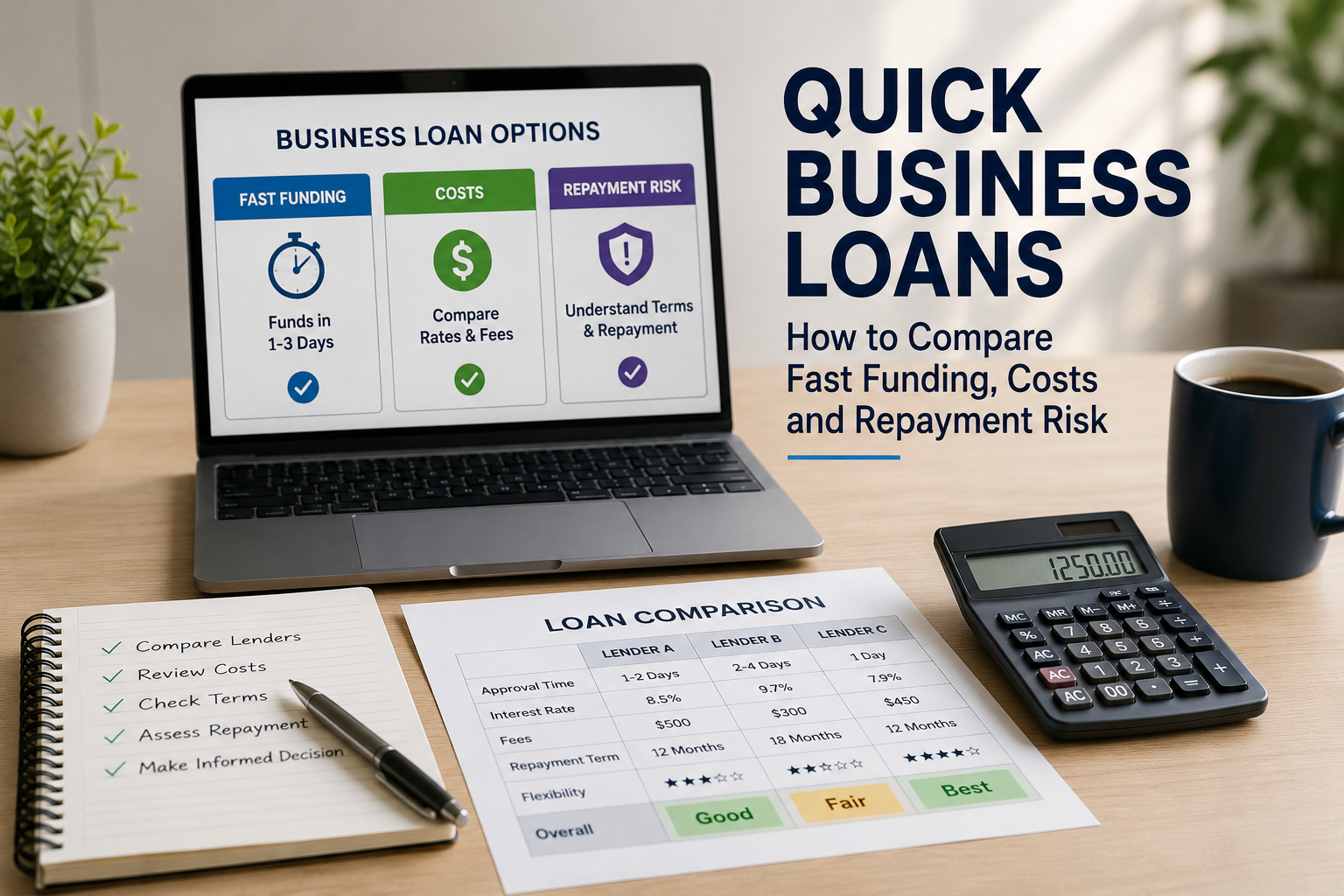
Quick business loans can be attractive when a company needs financing sooner rather than later. Equipment may have failed, inventory may need to be ordered before a deadline, payroll may arrive before customer payments, or a profitable project may require materials immediately.
In situations like these, speed has genuine value.
But speed should never become the only reason to accept business financing.
A loan that arrives quickly can still have:
- high financing costs
- frequent repayments
- a short repayment period
- substantial fees
- personal guarantee requirements
- collateral or lien provisions
- repayment that begins before the financed activity produces cash
The most useful question is therefore not:
How quickly can the business get money?
It is:
Can the business obtain the money soon enough while still accepting financing that makes financial sense after repayment begins?
Quick business loans should solve a timing problem without creating a larger cash-flow problem afterward.
For businesses comparing the wider financing market, Kevanzo’s small business loans guide explains the broader loan structures that may be available.
Educational note: Kevanzo.com provides general business-financing education only. Kevanzo is not a lender, broker, loan marketplace, financial adviser, attorney, accountant, or approval service. Rates, APRs, fees, repayment terms, eligibility requirements, approval standards, funding speed, guarantees, collateral requirements, and available products vary. Always review the complete financing agreement before accepting business funding.
What Quick Business Loans Mean
Quick business loans generally describe business-financing options designed to move through application, underwriting, decision, or funding stages faster than some traditional lending processes.
The term does not describe one single loan product.
Quick business loans may include:
- short-term business loans
- working-capital financing
- unsecured business loans
- business lines of credit
- invoice-related financing
- sales-based financing
- other alternative business-funding structures
Different products may have very different costs and repayment rules.
That means two offers marketed as quick business loans could be completely different financially.
One could provide:
one lump sum + fixed monthly payments
Another might provide:
one lump sum + frequent repayments
Another could provide:
revolving credit + repeated draws
Another might involve:
financing linked to receivables or sales
The marketing emphasis may be speed.
The business owner’s emphasis should be structure.
Fast Funding Is Valuable Only When the Financing Still Fits
There are legitimate situations where speed matters.
Imagine critical equipment breaks on Monday.
A company has a customer project scheduled for Wednesday.
Without the repair, the company may lose:
- project revenue
- customer confidence
- employee productivity
- future work
Obtaining financing quickly could have significant business value.
Now consider another company.
It wants money quickly because its ordinary revenue has not covered ordinary expenses for six months.
The urgency is real.
But a quick loan may simply postpone the underlying problem.
Those situations should not be treated the same.
Quick business loans make the strongest sense when:
- the funding purpose is specific,
- timing genuinely matters,
- the business understands the financing cost,
- repayment comes from a realistic source, and
- the financing improves the business position rather than simply delaying pressure.
The Kevanzo Speed-Value Test
Before paying for faster financing, answer five questions.
1. What Happens If the Business Waits?
Determine the actual cost of delay.
For example:
- will inventory sell out?
- will a supplier opportunity disappear?
- will equipment remain unusable?
- could a customer project be lost?
- could payroll be disrupted?
If waiting has little financial consequence, paying more for speed may provide little value.
2. How Much Faster Is the Quick Option?
Compare actual expected timelines.
Do not assume:
traditional = slow
and:
alternative = immediate
Processing time varies.
A difference of one or two days may not justify materially higher financing cost.
3. What Does Faster Funding Cost?
Calculate the financial difference.
Compare:
- interest
- APR where available
- origination charges
- other fees
- total repayment
- payment frequency
4. What Cash Will Repay the Financing?
Identify the source.
Examples might include:
- inventory sales
- customer receivables
- contract payments
- ordinary operating cash
- seasonal revenue
5. Does Speed Create Pressure Later?
Fast funding can solve today’s problem while creating next month’s problem.
Always model repayment after the money arrives.
The Kevanzo Urgency-versus-Cost Check
Put the decision into two columns.
Cost of Waiting
Estimate:
- lost revenue
- missed discount
- delayed project
- repair downtime
- additional supplier cost
- lost customer opportunity
Cost of Financing
Estimate:
- interest
- fees
- total repayment
- administrative costs
- cash-flow pressure
- guarantee or collateral exposure
Then compare them.
If waiting may realistically cost the business $25,000 and faster financing costs an additional $2,000, speed may deserve serious consideration.
If waiting costs virtually nothing and faster financing costs thousands more, urgency may be artificial.
Quick Business Loans Versus Standard Business Loans
The wider category of business financing includes many products that are not primarily marketed around speed.
Traditional or more thoroughly underwritten financing may require:
- more documentation
- more financial review
- longer processing
- additional lender questions
That can seem inconvenient.
But deeper underwriting can sometimes be associated with financing structures that deserve comparison for:
- longer repayment periods
- lower financing costs
- larger amounts
- more predictable payments
There is no universal rule.
A quick loan is not automatically expensive.
A slower loan is not automatically inexpensive.
Compare actual offers.
How Quick Business Loans May Work
A business applying for quick business loans may be asked for information such as:
- legal business name
- ownership details
- time in business
- industry
- requested amount
- intended use of funds
- business revenue
- bank activity
- credit information
- existing debt
- financial statements
- tax records
- accounts receivable
The exact documentation depends on the financing provider and product.
Some processes may rely heavily on electronic financial data.
Others may still require substantial documentation.
Fast underwriting does not mean no underwriting.
The financing provider still wants to estimate whether repayment is likely.
Streamlined Documentation Does Not Eliminate Risk
A short application can feel attractive.
But fewer application steps do not automatically produce better financing.
A business owner may think:
I only needed to upload a few documents, so this is easier.
That may be true operationally.
But the important financial questions remain:
- how much will the business receive?
- how much must it repay?
- how frequently?
- for how long?
- what fees apply?
- what guarantees apply?
- what happens after default?
Application convenience and financing quality are two different things.
Quick Business Loans Versus Short-Term Business Loans
A short term business loan may be one type of financing considered when speed matters.
Short-term financing generally involves repayment over a shorter period than longer-term borrowing.
That can create an important tradeoff.
A shorter term may:
- clear the debt sooner
- potentially reduce the period during which financing costs accumulate
But it may also:
- increase required payments
- compress repayment into fewer months
- create greater cash-flow pressure
This is why businesses should not confuse:
short term
with:
small obligation.
A $30,000 loan repaid over a short period can create much stronger weekly or monthly pressure than the same principal spread over a longer period.
The Kevanzo Repayment Compression Test
Consider two simplified fictional loans.
Loan A
Funding: $30,000
Repayment period: 24 months
Loan B
Funding: $30,000
Repayment period: 8 months
Ignoring differences in cost for the moment, Loan B requires the principal to be recovered from business cash much more rapidly.
That matters even if Loan B is approved faster.
Ask:
How much business cash must be generated during the repayment period?
Speed on Day 1 can create compression on Days 30 through 240.
Quick Business Loans Versus a Business Line of Credit
A business line of credit may offer another form of rapid access once a facility has already been established.
Instead of arranging a completely new loan every time an expense occurs, the business may be able to draw from available credit subject to lender terms.
That can be useful for:
- recurring inventory purchases
- temporary cash gaps
- emergency repairs
- seasonal needs
- supplier timing
But repeated access has its own risk.
A term loan generally creates one borrowing decision.
A revolving facility can create many.
Businesses should not continually draw simply because credit remains available.
Quick Business Loans Versus a Small Business Line of Credit
A small business line of credit can be particularly useful to compare for smaller companies with recurring, unpredictable funding needs.
Imagine:
January: $8,000 needed
March: $4,000 needed
July: $12,000 needed
Repeatedly arranging separate quick business loans may be inefficient.
A revolving facility could provide a more suitable structure.
But if the business needs exactly $25,000 once, a term loan may be easier to manage.
The financing structure should follow the business need.
Quick Business Loans Versus Working Capital Loans
Businesses frequently investigate working capital loans when they need money for ordinary operating requirements.
Examples include:
- inventory
- supplier payments
- payroll timing
- seasonal expenses
- project materials
A quick loan could potentially be used for the same purpose.
The distinction is that working capital describes why the money is needed, while quick financing describes an important part of how rapidly the financing may be processed or delivered.
A working-capital loan could be quick.
It could also involve a more traditional process.
Do not let product labels replace actual comparison.
Quick Business Loans Versus Cash Flow Loans
Businesses considering cash flow loans for small business should concentrate on timing.
Imagine:
Payroll: Friday
Customer payment expected: Wednesday
The business has a temporary six-day gap.
Quick access to financing could have substantial value.
But now suppose:
Payroll: Friday
Expected future revenue: unknown
There is no clear repayment source.
The same financing product creates much greater risk.
Quick business loans are strongest when the business can explain both:
why the money is needed now
and:
what cash should repay it later.
Quick Business Loans Versus Unsecured Business Loans
Recently rebuilt Kevanzo guidance on unsecured business loans focuses on financing without a specifically pledged asset in the traditional secured-loan sense.
Quick business loans may be unsecured.
But they do not have to be.
These terms describe different characteristics.
Quick refers primarily to process or timing.
Unsecured refers primarily to the financing’s collateral or security structure.
A loan could theoretically be:
- quick and unsecured
- quick and secured
- slower and unsecured
- slower and secured
The agreement determines what the business is actually accepting.
Quick Business Loans and Best Unsecured Business Loans
Owners comparing best unsecured business loans may naturally encounter products emphasizing rapid applications or funding.
The word best should not be defined as:
- fastest
- biggest
- easiest
- fewest documents
A better definition is:
the financing that solves a genuine business requirement with an acceptable total cost and manageable repayment structure.
Speed is one factor.
It is not the entire decision.
Quick Business Loans Versus Small Business Cash Advances
A small business cash advance is structurally different from a conventional business loan.
Some cash-advance products may provide rapid access to capital and repayments connected to sales or receivables.
Business owners should be especially careful when comparing these structures with conventional loans.
Review:
- funding amount
- total repayment
- collection method
- payment frequency
- estimated repayment period
- fees
- factor rate where applicable
A factor rate should not be read as if it were a conventional interest rate or APR.
Product structure matters.
Merchant Cash Advances Are Not Conventional Loans
This distinction deserves to be explicit.
A merchant cash advance generally involves the purchase of a portion of future receivables rather than a conventional loan structure.
It may appear alongside quick business loans in online searches because both can potentially provide rapid business funding. Businesses seeking a digital application route can also compare a business loan online by total cost, repayment frequency, funding conditions, and lender requirements.
But they should not be treated as identical products.
Before comparing them, understand:
- the legal structure
- repayment mechanism
- total purchased amount
- collection method
- reconciliation provisions where applicable
- default conditions
The label used in marketing does not replace the contract.
Quick Business Loans Versus Invoice Financing
A business waiting on customer invoices may compare quick business loans with invoice financing for small business.
Consider:
Customer invoices outstanding: $120,000
Immediate cash requirement: $25,000
The problem may be fundamentally connected to receivables.
Invoice financing may therefore deserve comparison with a general-purpose loan.
The better solution depends on:
- customer payment reliability
- financing cost
- repayment structure
- invoice eligibility
- length of the receivables gap
A business should solve the actual financial problem rather than automatically select the fastest product advertised.
What Lenders May Review
Even quick business loans may involve review of factors such as:
- revenue
- cash flow
- credit history
- bank deposits
- existing debt
- time in business
- industry
- repayment history
- requested amount
- business purpose
Requirements vary by lender.
Some lenders may rely heavily on recent business bank activity.
Others may place greater weight on credit or financial statements.
A streamlined process does not mean the business should submit incomplete or inaccurate information.
Revenue Is Not the Same as Affordability
Suppose Business A produces:
Monthly revenue: $120,000
Monthly operating expenses: $112,000
Remaining operating cash: $8,000
Business B produces:
Monthly revenue: $80,000
Monthly operating expenses: $56,000
Remaining operating cash: $24,000
Business A has considerably more revenue.
Business B appears to have substantially more room before adding a new financing payment.
This illustrates why quick business loans should not be judged using revenue alone.
Debt is repaid from available cash, not headline sales.
The Kevanzo Fast-Funding Affordability Test
Before accepting financing, calculate:
Operating cash available before new debt
minus
Proposed financing payment
equals
Remaining cash-flow cushion
Example:
Monthly operating cash available: $20,000
Proposed new repayment: $7,000
Remaining cushion: $13,000
Now test a slower month.
Operating cash available: $12,000
Financing payment: $7,000
Remaining cushion: $5,000
The second scenario is often more informative than the first.
The Kevanzo Three-Speed Scenario Test
Quick business loans should be tested under three business conditions.
Scenario 1: Normal Operations
Revenue and expenses behave approximately as expected.
Can the business make repayment comfortably?
Scenario 2: Delayed Cash
One important customer pays late.
Can the business still make:
- payroll
- financing payments
- rent
- taxes
- supplier payments?
Scenario 3: Revenue Shock
Revenue falls while an unexpected expense occurs.
Would the business immediately need another loan?
If financing works only when everything goes according to plan, it may be too aggressive.
Cost Terms to Compare
The actual cost of quick business loans may involve several components.
Review:
- interest
- APR where applicable
- origination fees
- underwriting fees
- documentation charges
- payment-processing costs
- late fees
- prepayment provisions
- factor rates where applicable
- total repayment
Not every financing offer uses every charge.
The purpose of comparison is to identify the full economic obligation.
The Kevanzo Ten-Number Quick Loan Comparison
For each serious offer, write down these ten numbers.
1. Amount Requested
What does the business actually need?
2. Gross Funding Amount
What financing amount appears in the agreement?
3. Net Cash Received
How much usable money reaches the business?
4. Interest Rate
What rate applies where relevant?
5. APR
What APR is disclosed where applicable?
6. Fees
What additional charges apply?
7. Payment Amount
How much must be paid each period?
8. Payment Frequency
How often does money leave the business?
9. Repayment Period
How long does the obligation continue?
10. Total Repayment
How much should the business repay overall?
A fast approval should never prevent these ten numbers from being understood.
Net Funding Can Be More Important Than the Headline Amount
Suppose an offer is described as $50,000 financing.
If upfront charges reduce the cash deposited into the company’s account, the business may receive materially less usable money.
This matters if the actual business requirement is $50,000.
Compare:
headline amount
with:
net usable funding.
The business needs to know how much cash will actually be available to solve the problem.
Payment Frequency Deserves Extra Attention
Quick business loans may use:
- monthly payments
- weekly payments
- more frequent withdrawals
- another contractual schedule
Payment frequency can dramatically change how the obligation feels operationally.
Consider a business that receives most customer payments near the end of each month.
A frequent repayment structure may remove cash before customer receipts arrive.
Another business that receives cash daily may experience the same schedule differently.
Ask:
Does repayment match the way this business actually earns and receives money?
The Kevanzo Cash-Arrival Timeline
Write the financing transaction as a timeline.
Example:
Day 1: financing received
Day 2: inventory ordered
Day 14: inventory arrives
Day 21: customer sales begin
Day 35: meaningful cash starts returning
Now add financing payments.
If repayments start on Day 5, the business must fund payments for several weeks before the financed inventory begins producing cash.
That gap should be included in the decision.
Fixed Payments Versus Variable Repayment
Some quick business loans may use fixed scheduled payments.
Others may involve repayment that changes with sales or another formula.
Fixed Repayment
Potential advantage:
- predictable budgeting
Potential downside:
- payment remains due even during weaker revenue periods
Variable Repayment
Potential advantage:
- payment may move with business activity depending on structure
Potential downside:
- future payments may be more difficult to forecast
Neither is automatically superior.
Match repayment to the business’s actual cash flow.
APR Versus Factor Rate
APR and factor rates should not be treated as interchangeable.
APR expresses certain financing costs on an annualized basis.
A factor rate generally works differently.
Suppose:
Funding amount: $40,000
Factor rate: 1.25
Simplified total repayment:
$50,000
That does not mean the financing carries a 25% conventional annual interest rate.
The repayment period and payment schedule affect the economic comparison.
When factor-rate financing appears beside quick business loans, calculate:
- amount received
- total repayment
- repayment period
- payment frequency
Do not compare numbers with different meanings as though they were equivalent.
Existing Debt Changes Everything
Before taking fast financing, list existing debt.
Imagine a business already pays:
Term loan: $2,500 monthly
Equipment financing: $1,800 monthly
Vehicle loan: $900 monthly
Credit cards: $1,300 monthly
Proposed quick loan: $4,000 monthly
The new payment is $4,000.
The total financing burden becomes:
$10,500 monthly
Affordability has to be measured against the whole debt picture.
The Kevanzo Debt-Stack Test
Create a simple table containing every current obligation.
For each one record:
- outstanding balance
- payment
- frequency
- remaining term
- collateral
- guarantees
Add the proposed quick loan.
Then ask:
Does the business still have sufficient cash after every debt obligation is paid?
If new borrowing simply stacks another payment onto already stressed cash flow, speed does not solve the problem.
Personal Guarantees
Some quick business loans may require personal guarantees.
A personal guarantee can create personal responsibility for repayment depending on the agreement.
Do not assume:
business loan = business-only risk
Review:
- whether a guarantee applies
- who provides it
- what obligations it covers
- what happens after default
Guarantee language deserves careful reading.
Collateral and Liens
Some quick financing may be secured.
Other products may be described as unsecured while still involving broader security interests or lien provisions.
Read the agreement.
Ask:
- what assets are involved?
- is a lien created?
- is a personal guarantee required?
- what rights does the lender have after default?
- what happens once the obligation is repaid?
Marketing terminology is not enough.
Eight Practical Quick Business Loan Scenarios
Scenario 1: Emergency Equipment Repair
A machine required for daily operations breaks.
Repair cost: $18,000
Each day of downtime costs the business meaningful revenue.
Quick financing may have genuine economic value.
Compare:
- financing cost
- cost of continued downtime
- repayment schedule
- remaining cash reserves
This is one of the clearest examples where speed may justify some additional cost.
Scenario 2: Seasonal Inventory Deadline
A retailer can purchase inventory at an attractive price but must order within five days.
Funding required: $30,000
The owner should compare:
- expected gross margin
- inventory turnover
- financing cost
- sales downside
- repayment timing
Fast access can be valuable if the inventory economics remain strong after financing cost.
Scenario 3: Contractor With Confirmed Work
A contractor wins a $100,000 project.
It needs $22,000 in materials immediately.
The customer is expected to make a milestone payment after 30 days.
Quick business loans may deserve comparison.
But the contractor should test:
What if payment arrives 30 days late?
A confirmed project reduces some uncertainty.
It does not eliminate cash-flow risk.
Scenario 4: Waiting on Customer Invoices
A service business has $80,000 of legitimate receivables but needs $15,000 for payroll.
The company could compare:
- quick business loans
- invoice financing
- a line of credit
- stronger collection procedures
The right option depends on the length and reliability of the receivables gap.
Scenario 5: Marketing Campaign
A company wants $40,000 immediately for advertising.
Unlike a confirmed receivable, future marketing returns are uncertain.
The business should test:
- expected conversion
- gross margin
- customer acquisition cost
- downside scenario
- repayment without campaign success
Urgency should not turn speculative revenue into assumed revenue.
Scenario 6: Long-Term Expansion
A business wants to open another location.
It needs $200,000 and expects the new location to take 18 months to reach stable profitability.
Fast short-term financing may provide the money quickly.
But the repayment term may be badly matched to the project.
Longer-term financing deserves comparison.
Scenario 7: Tax or Supplier Deadline
A legitimate obligation is due soon.
The business may avoid penalties, lost supplier relationships, or operational disruption by obtaining money quickly.
Calculate the cost of the missed deadline versus the financing cost.
This is exactly where the urgency-versus-cost test becomes useful.
Scenario 8: Repeated Cash Shortages
A company takes one quick loan.
Three months later, it takes another.
Then another loan is needed partly to make existing payments.
This is a serious warning sign.
The business should investigate:
- margins
- pricing
- expenses
- collections
- inventory
- existing debt
- customer profitability
Quick business loans can buy time.
They cannot permanently repair a business whose operations continually consume more cash than they generate.
Warning Signs Before Accepting Fast Financing
Slow down if:
- the lender emphasizes speed but makes cost difficult to understand
- total repayment is unclear
- fees are unclear
- payment frequency is unclear
- the business has no specific funding purpose
- the business cannot identify a repayment source
- repayment begins well before the funded activity generates cash
- the financing term is much shorter than the business need
- existing debt is already heavy
- personal guarantee language is unclear
- lien provisions are unclear
- the business is being pressured to sign immediately
- the business expects to refinance the loan almost immediately
- borrowing is covering persistent operating losses
- another loan will probably be required to repay this one
Fast financing should not require fast judgment.
Questions to Ask Before Accepting Quick Business Loans
Get clear answers to questions such as:
- How much financing is being offered?
- How much cash will the business actually receive?
- What interest rate applies?
- What APR is disclosed where applicable?
- Is a factor rate used?
- What fees apply?
- What is the total repayment amount?
- What is each required payment?
- How frequently are payments collected?
- When does repayment begin?
- How long is the repayment period?
- Is early repayment allowed?
- Does early repayment reduce the financing cost?
- Are there prepayment charges?
- Is collateral required?
- Is a personal guarantee required?
- Is a business lien involved?
- What constitutes default?
- What happens after a missed payment?
- Can payment amounts change?
- Are automatic bank withdrawals required?
- What documents are provided before signing?
- How long should funding actually take after approval?
- Are there conditions that can delay funding?
- What happens if the business experiences a temporary cash-flow problem?
The word quick should never prevent a complete contract review.
Documents to Prepare
Businesses comparing quick business loans may benefit from preparing:
- business bank statements
- revenue records
- profit and loss statements
- balance-sheet information
- tax records where required
- debt schedules
- accounts receivable
- accounts payable
- ownership information
- business formation records
- identification
- explanation of funding purpose
Requirements vary.
Prepared records help in two ways.
They may help the application move efficiently.
More importantly, they allow the business owner to evaluate repayment ability independently.
The Kevanzo 18-Point Quick Business Loan Check
Before accepting quick business loans, complete this final review.
1. Urgency
Why does the money need to arrive quickly?
2. Cost of Waiting
What happens financially if the business waits?
3. Funding Purpose
What exactly will the money accomplish?
4. Required Amount
How much does the business genuinely need?
5. Net Funding
How much usable cash will arrive?
6. Funding Timeline
When should the money realistically be available?
7. Repayment Source
What business cash will repay the financing?
8. Interest Rate
What interest rate applies?
9. APR
What APR is disclosed where applicable?
10. Factor Rate
Is alternative pricing involved?
11. Fees
What additional charges apply?
12. Total Repayment
How much should be repaid overall?
13. Payment Amount
How much leaves the business each payment period?
14. Payment Frequency
How often does repayment occur?
15. Existing Debt
What obligations already compete for cash?
16. Slow-Month Test
Can the business still pay during weaker revenue?
17. Guarantee and Collateral Review
What lender protections apply?
18. Speed Premium
Is the additional value of receiving money quickly greater than the additional financing cost?
If several answers are unclear, the financing decision is not ready.
Practical Next Steps
Start with the reason for urgency.
Write down exactly what happens if the business does not receive financing within:
- 24 hours
- three days
- one week
- two weeks
This helps determine whether speed actually has measurable value.
Then define:
- required amount
- funding purpose
- expected repayment source
- required timing
Next, compare financing structures rather than simply providers.
Consider whether the business actually needs:
- a term loan
- revolving credit
- working-capital financing
- invoice-related financing
- equipment financing
- another structure
For each serious offer, write down:
- net funding
- interest
- APR where applicable
- factor rate where relevant
- fees
- payment
- payment frequency
- repayment period
- total repayment
- guarantees
- collateral or liens
Then run the three-scenario stress test.
Finally, compare the cost of waiting with the cost of speed.
Quick business loans should be chosen because receiving financing rapidly creates enough legitimate business value to justify the financing structure—not simply because the application is convenient.
Final Takeaway
Quick business loans can be useful when timing has real economic value, but speed is only one part of a responsible financing decision.
The strongest fast-funding decision connects a specific urgent need with a realistic repayment source and a financing structure the company can continue to manage after the immediate problem has passed.
Before accepting quick business loans, compare the net amount received, interest or APR where applicable, factor-rate pricing where relevant, fees, payment amount, payment frequency, total repayment, personal guarantees, collateral or liens, existing debt, and cash-flow impact.
Most importantly, calculate whether the value of getting money quickly actually exceeds the additional cost or risk of the fast financing option.
Fast funding can solve a real timing problem. It should never replace careful comparison.
Frequently Asked Questions About Quick Business Loans
What Are Quick Business Loans?
Quick business loans generally refer to business-financing options designed to move through the application, underwriting, decision, or funding process faster than some traditional financing paths.
They do not represent one single loan product.
How Fast Are Quick Business Loans?
There is no universal funding time.
Processing and funding timelines vary by lender, financing type, business profile, documentation, underwriting requirements, banking processes, and other factors.
Avoid treating any generic timing claim as a guarantee.
Are Quick Business Loans Always More Expensive?
No.
However, businesses should compare pricing carefully because faster or more streamlined financing can sometimes have different rates, fees, terms, or repayment structures.
Compare actual offers rather than assuming.
Can Quick Business Loans Be Used for Working Capital?
Depending on lender terms, they may potentially be used for inventory, payroll timing, suppliers, seasonal needs, materials, temporary cash-flow gaps, and other working-capital purposes.
Are Quick Business Loans the Same as Short-Term Business Loans?
Not necessarily.
Short term describes the repayment period.
Quick generally describes the financing process or availability.
A quick loan could have a short or longer repayment term depending on the product.
Are Quick Business Loans the Same as a Business Line of Credit?
No.
A business line of credit generally provides access to an approved borrowing limit.
A quick term loan may provide one lump sum.
The structures work differently.
Can Quick Business Loans Be Unsecured?
Some may be unsecured.
Others may involve collateral or other security interests.
Review the actual agreement.
Do Quick Business Loans Require a Personal Guarantee?
Some may.
Requirements vary by provider and product.
A business owner should confirm guarantee requirements before signing.
What Costs Should a Business Compare?
Compare:
- net amount received
- interest
- APR where applicable
- factor rates where relevant
- fees
- payment amount
- payment frequency
- repayment period
- total repayment
What Is a Factor Rate?
A factor rate is a pricing method used by some business-funding products.
It is not the same as a conventional interest rate or APR.
Business owners should calculate the total contractual repayment and consider the repayment period when comparing financing.
Can Fast Repayment Hurt Business Cash Flow?
Yes.
A financing product can solve an immediate cash shortage but create future cash-flow pressure if payments are too large or too frequent.
When Can Faster Financing Be Worth Considering?
Speed may have meaningful value when delay could cause:
- equipment downtime
- lost customer work
- missed inventory opportunities
- supplier disruption
- another measurable business loss
The cost of waiting should be compared with the financing cost.
When Might Quick Business Loans Be a Poor Fit?
They may deserve reconsideration when:
- urgency is artificial
- repayment is unclear
- financing costs are not understood
- the business has persistent losses
- existing debt is already heavy
- the term does not fit the business need
- slower financing would work equally well at materially better terms
Should a Business Accept the First Fast Funding Offer?
Not automatically.
When practical, compare several available options using the same cost and repayment criteria.
What Is the Most Important Question Before Accepting Quick Business Loans?
Ask:
Will this financing leave the business in a stronger position after repayment begins, or is it simply moving today’s cash problem into the future?
Helpful Authoritative Resources
- U.S. Small Business Administration loan programs
- U.S. Small Business Administration 7(a) loan program
- U.S. Small Business Administration Lender Match
- Consumer Financial Protection Bureau small business lending resources
- Federal Trade Commission business guidance
- SCORE small business mentoring and education
Author Bio
Kevanzo Editorial Team
Kevanzo Editorial Team creates practical, plain-English educational resources for U.S. business owners comparing quick business loans, small business financing, working-capital funding, business credit, borrowing costs, repayment structures, and responsible financing decisions.
Copyright Notice
© 2026 Kevanzo. All rights reserved.
This article about quick business loans is protected by copyright and may not be copied, scraped, spun, republished, or used commercially without prior written permission from Kevanzo. Brief quotations may be used with clear attribution and a link to the original article.
Unauthorized reuse, bulk scraping, content spinning, AI rewriting for republication, or commercial reproduction of this material is prohibited.
Educational Disclaimer
Kevanzo.com provides general educational information about business financing. Kevanzo is not a lender, broker, loan marketplace, financial adviser, attorney, accountant, or approval service.
Nothing in this article constitutes financial, legal, tax, accounting, investment, lending, or personalized business advice. Rates, APRs, fees, repayment terms, funding speed, approval requirements, guarantees, collateral requirements, funding amounts, and available financing products vary by lender, borrower, business profile, industry, revenue, credit history, and market conditions.
Business owners should review current official information, read financing agreements carefully, and consider obtaining advice from appropriately qualified professionals when necessary before making borrowing decisions.