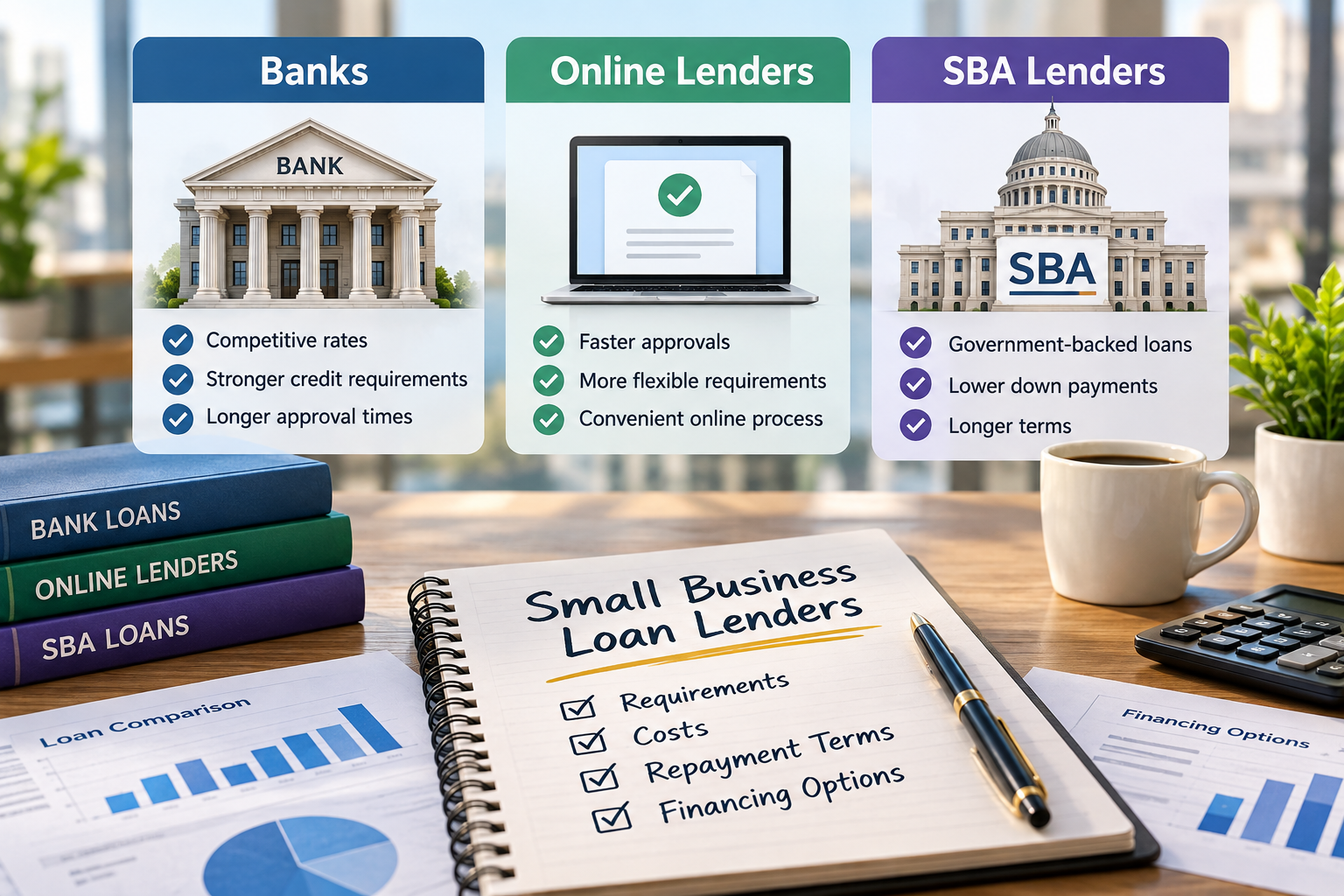
Small business loan lenders can differ just as much as the loans they provide. A bank may offer lower-cost financing but require stronger credit and a longer operating history. An online lender may make the application process faster but use shorter repayment periods or higher borrowing costs. An SBA-partarticipating lender may offer government-backed financing, while a community lender or CDFI may serve businesses that do not fit a conventional bank profile.
The practical question is not simply, “Which lender will approve me?” It is: Which lender type, loan product and written offer fit the business need, repayment capacity and level of risk?
A strong lender comparison should examine the amount available, total borrowing cost, APR or rate structure where applicable, fees, payment frequency, loan term, collateral, personal guarantees, minimum credit expectations, time in business, revenue or cash-flow requirements, documentation, prepayment terms and what happens if the business struggles to repay.
For a broader explanation of the products themselves, see Kevanzo’s small business loans guide. This page has a different job: helping a business decide who to approach, what to compare and what to verify before applying or accepting an offer.
Educational note: Kevanzo.com provides general educational information about business financing. It is not a lender, broker, loan marketplace, financial adviser, attorney, accountant or approval service. Financing availability and terms depend on the lender, borrower, business profile, documentation, underwriting and applicable rules.
Quick Answer: How to Compare Small Business Loan Lenders
Do not start with a lender name. Start with the business problem.
A useful sequence is:
funding need → suitable product → realistic lender type → qualification check → written-offer comparison → repayment stress test → decision
| Decision | What to compare | Why it matters |
|---|---|---|
| Funding need | Exact amount, purpose and timing | Prevents borrowing more or choosing the wrong structure |
| Product | Term loan, line of credit, SBA-backed loan, equipment financing or another structure | The product determines how money is accessed and repaid |
| Lender type | Bank, credit union, SBA lender, online lender, fintech, CDFI or specialist provider | Different lender types may have different strengths, requirements and processes |
| Qualification | Credit, revenue, cash flow, time in business, existing debt and documentation | Helps focus on realistic options |
| Cost | APR or rate, fees, total repayment and amount actually received | A low headline rate does not reveal the full cost |
| Repayment | Monthly, weekly or daily payments; term; variable or fixed features | Payment timing can matter as much as total cost |
| Security | Collateral, UCC liens, guarantees and covenants | Shows what the business or owner may be putting at risk |
| Flexibility | Prepayment, renewals, redraws, refinancing and early payoff rules | Determines how easily the financing can adapt |
| Transparency | Clear disclosures, written terms and identifiable lender | Reduces the risk of comparing incomplete offers |
| Downside fit | Ability to pay during a weaker month | Tests whether the financing remains manageable when forecasts miss |
The objective is not to identify one universal “best” small business lender. It is to build a shortlist of lenders whose products match the business need, then compare actual offers on the same basis.
Lender Type and Loan Product Are Two Different Decisions
A common mistake is treating the lender and the loan as though they are the same thing.
They are not.
The lender is the institution or company providing or arranging the financing.
The product is the financing structure the business receives.
One bank may offer term loans, lines of credit, SBA-backed financing and commercial real estate loans. One online lender may offer a term loan and a revolving line of credit. Another provider may specialize in equipment or receivables.
This distinction matters because a business can choose the right lender category but the wrong product.
For example, a business with recurring short cash-flow gaps may be better served by a small business line of credit than by repeatedly taking separate lump-sum loans. A business with a defined one-time project may prefer a term loan. A business seeking government-backed financing should investigate SBA loans and participating lenders rather than assuming every business lender offers the same SBA programs.
Always make both decisions:
- What financing structure fits the need?
- Which lender is a realistic source for that structure?
Major Types of Small Business Loan Lenders
Traditional Banks
Banks can provide term loans, lines of credit, commercial real estate financing, equipment loans and SBA-backed products, depending on the institution.
They may be worth investigating when a business has:
- established operating history
- consistent revenue
- stronger credit
- organized financial records
- predictable cash flow
- time for a more detailed underwriting process
- a desire to build a longer-term banking relationship
Possible weaknesses include stricter qualification standards, more documentation and a slower process than some online alternatives.
A bank’s published minimum requirements are not an approval promise. Underwriting may also consider leverage, industry, existing obligations, repayment capacity, collateral, guarantor strength and the overall banking relationship.
Credit Unions
Credit unions are member-owned financial institutions. Some offer business loans, lines of credit, commercial real estate financing or SBA-related lending, while others have a narrower business-finance menu.
They may deserve investigation when the business values local decision-making, an existing member relationship or a more relationship-driven application process.
Availability varies substantially. Membership rules, geographic reach, product limits and commercial-lending capacity differ among credit unions, so borrowers should verify that a particular institution actually offers the required product before spending time on an application.
SBA-Participating Lenders
The U.S. Small Business Administration generally does not make ordinary 7(a) loans directly to business borrowers. SBA-backed loans are instead delivered through participating lenders, with 504 loans involving Certified Development Companies and Microloans provided through approved intermediaries.
That means the borrower is still comparing lenders.
Important questions include:
- Which SBA program does the lender offer?
- Does the business appear to meet the program and lender requirements?
- What rate, fees and repayment term apply?
- What collateral or guarantee requirements apply?
- What documentation is required?
- How experienced is the lender with the relevant SBA program?
- What happens after the application is submitted?
SBA’s Lender Match connects businesses with participating lenders, but SBA expressly states that using the service does not guarantee a match or a loan offer.
Online Business Lenders
Online lenders can make research, prequalification, document submission and funding more digital. Some provide term loans, lines of credit or other forms of commercial financing.
The category can be useful when speed, convenience or a streamlined application is important. It may also provide options to businesses that do not fit a traditional bank’s underwriting profile.
But “online” does not mean one specific product, cost structure or underwriting standard.
Businesses comparing online business loans should pay particular attention to:
- APR or equivalent cost information where available
- origination and draw fees
- payment frequency
- short repayment periods
- personal guarantees
- UCC liens
- minimum revenue
- credit requirements
- automatic withdrawals
- renewal practices
- early repayment rules
Fast processing is useful only when the resulting financing is affordable and appropriate.
Fintech Lenders and Platforms
“Fintech” describes the use of technology in financial services rather than one uniform type of lender.
A fintech company may be:
- a direct lender
- a servicer
- a platform working with partner banks
- a marketplace
- a financing broker
- a software company connecting applicants with third-party lenders
That distinction should be identified before applying.
Look for the legal lender named in the disclosures and loan agreement. If a platform works with several providers, determine who will actually extend the credit, service the account and receive payments.
Community and Mission-Based Lenders
Community lenders may include nonprofit organizations, local loan funds and mission-oriented institutions serving particular communities or business segments.
A Community Development Financial Institution, or CDFI, is a mission-driven financial institution certified by the U.S. Department of the Treasury’s CDFI Fund. CDFIs can include credit unions, banks and loan funds.
A CDFI or mission-based lender may deserve investigation when a business wants a relationship-oriented lender, technical assistance or financing designed for borrowers and communities that may not be well served by conventional credit channels.
Products, service areas and eligibility rules vary. Certification does not mean every CDFI offers every type of small business loan.
Equipment-Financing Lenders
Equipment lenders focus on financing machinery, vehicles, technology or other business assets.
They can be useful when the asset being purchased is central to the credit decision and may serve as collateral.
Compare:
- cash down payment
- financed amount
- interest or APR
- term
- lien on the equipment
- personal guarantee
- documentation fees
- early payoff
- end-of-term ownership if the structure is a lease rather than a loan
Equipment financing should be compared as its own product rather than assumed to be interchangeable with unrestricted working capital.
Invoice-Financing and Factoring Providers
Invoice financing and factoring providers focus on receivables rather than a conventional general-purpose term loan.
These arrangements can be relevant when a financially sound business has legitimate invoices but must wait for customers to pay.
Important distinctions include:
- whether invoices are sold or used to support financing
- advance percentage
- fees
- recourse or non-recourse provisions
- customer notification
- collection control
- minimum volumes
- concentration limits
- what happens if a customer pays late or does not pay
A receivables problem should not automatically be solved with a generic business loan if a more directly matched structure is available.
Banks Versus Online Lenders: What Changes for the Borrower?
Traditional banks and online lenders often differ in process, qualification, pricing and repayment design.
| Factor | Traditional bank | Online lender |
|---|---|---|
| Application | May involve branch, banker or detailed underwriting | Often digital and streamlined |
| Speed | Can be slower | Can be faster |
| Qualification | Often stronger credit and operating history | May accept a wider range of profiles |
| Cost | Can be competitive for strong borrowers | Can be materially higher depending on product and risk |
| Payment schedule | Often monthly | May be monthly, weekly or daily |
| Documentation | Can be extensive | May use bank-data connections and streamlined documents |
| Relationship | May include broader banking relationship | Often transaction- or platform-focused |
| Product range | Can be broad | Varies widely by provider |
Federal Reserve Small Business Credit Survey research found meaningful differences in borrower experience across lender types. In its latest employer-firm report, online-lender borrowers were more likely than bank or credit-union borrowers to report that their actual borrowing costs were higher than expected. The survey is a nationwide convenience sample rather than a random sample, so it should be treated as useful market evidence rather than a prediction for any individual borrower.
That does not make every online lender expensive or every bank loan inexpensive. It shows why borrowers should compare the complete written economics, not merely approval speed.
Current U.S. Lender Examples: Compare the Product, Not a Ranking
The examples below are not ranked recommendations. They show how selected current lender products can differ materially in amount, eligibility, pricing structure and repayment design.
Product details can change, and approval depends on underwriting. Verify the current official lender page and final agreement before applying or accepting financing.
| Lender / selected product | Published amount | Selected current published details | What the example demonstrates |
|---|---|---|---|
| Bank of America Business Advantage Credit Line | $10,000–$250,000 | Unsecured revolving line; minimum two years in business under existing ownership; personal credit above 700 FICO is typically required; at least $100,000 in prior-year business revenue; annual fee applies after the first year | A major bank may publish relatively clear business-history, revenue and credit expectations. |
| Wells Fargo BusinessLine line of credit | $10,000–$150,000 | Unsecured revolving line; published rate as low as Prime + 1.75%; annual fee applies after the first year; personal guarantees required | Rate structure, annual fees and guarantees should be compared together. |
| Chase Business Line of Credit | $10,000–$500,000 | Available to existing Chase for Business customers; five-year revolving access with a subsequent repayment period; published eligibility factors include at least $100,000 annual revenue and a minimum 660 FICO | Existing banking relationships can form part of product eligibility. |
| OnDeck term loan / line of credit | Term loan $5,000–$400,000; line up to $200,000 | Published minimums include one year in business, $100,000 annual revenue and 625 personal FICO; term loans use a general business lien and personal guarantee; funding may be available as soon as the same day after approval | Faster online financing can involve different security, cost and repayment characteristics. |
| Bluevine Line of Credit | Up to $250,000 | Published standard-line minimums include 12+ months in business, $10,000 monthly revenue and 625+ personal FICO; the line is issued by Celtic Bank; weekly or monthly repayment plans may apply | A fintech brand may service financing issued by a partner bank, so the legal lender should be identified. |
Do not compare these examples by maximum amount alone.
A $250,000 line with one repayment structure, a $150,000 bank line with an annual fee and a $400,000 short-term term loan are not substitutes merely because all provide business capital.
The comparison must be normalized.
The Kevanzo Lender Comparison Framework
Before choosing among small business loan lenders, put every serious offer through the same framework.
1. Confirm the Legal Lender
Identify the institution actually extending credit.
Do not rely only on the brand name of a website, marketplace or fintech platform. Review the disclosures and agreement for the legal lender, servicer and payment instructions.
2. Compare the Amount You Can Actually Use
The approved amount is not always the usable amount.
Ask:
- Is an origination fee deducted?
- Is a deposit required?
- Are closing costs withheld?
- Is part of the amount restricted?
- Is the credit revolving or one-time?
- Must the business draw a minimum amount?
Compare net usable proceeds, not merely the headline approval.
3. Compare APR, Rate and Total Borrowing Cost
A percentage alone can be misleading when products use different terms, fees or repayment schedules.
Ask for enough information to understand:
- APR where applicable and available
- stated interest rate
- fixed or variable rate
- origination fee
- annual fee
- draw fee
- maintenance fee
- closing cost
- broker fee
- late fee
- total scheduled repayment
- dollar cost of financing
If one provider uses a factor rate or another non-APR pricing method, compare the economics on as consistent a basis as practical before deciding.
4. Compare Payment Frequency
Monthly, weekly and daily repayment can affect cash flow very differently.
A business that generates uneven customer receipts may struggle with frequent automatic withdrawals even when the total amount borrowed appears manageable.
Ask:
- How often is payment collected?
- Is the amount fixed?
- Can it change?
- Is payment automatically withdrawn?
- What happens on a low-cash day?
- Is there a grace period?
5. Compare the Repayment Term
The term should fit the useful life of the thing being financed and the timing of the expected cash benefit.
Short-term financing for an asset expected to produce value over many years can compress cash flow unnecessarily.
Long-term financing for a short experiment can keep the business paying long after the benefit has disappeared.
6. Compare Collateral, Liens and Personal Guarantees
“Unsecured” does not always mean the owner has no exposure.
A lender may not require a specifically pledged asset but may still require:
- a general UCC lien
- a personal guarantee
- other contractual security
- control over designated accounts
- covenants or restrictions
Review the agreement, not the marketing label.
For a deeper comparison of financing without specifically pledged collateral, see Kevanzo’s guide to best unsecured business loans.
7. Compare Qualification Requirements
Lenders may consider:
- personal credit
- business credit
- annual revenue
- monthly deposits
- operating cash flow
- profitability
- debt-service capacity
- time in business
- industry
- ownership history
- existing debt
- recent bankruptcies
- tax filings
- collateral
- business plan
- use of proceeds
A published minimum is usually a starting point, not an approval guarantee.
8. Compare Funding Speed Only After Cost and Fit
Speed matters when a delay has a real business cost.
It matters less when the financing itself creates a larger long-term problem.
If the business genuinely needs rapid funding, compare quick business loans while still checking total cost, repayment frequency and security.
9. Compare Prepayment and Refinancing Rules
Ask whether early repayment:
- is permitted
- reduces interest or finance charges
- triggers a fee
- changes an outstanding fixed-fee obligation
- affects future eligibility
- requires advance notice
Also ask whether the lender restricts refinancing or requires existing debt to remain in place for a period.
10. Compare Default and Acceleration Provisions
The most important terms may be the ones that apply when the business has trouble.
Review:
- late-payment provisions
- default triggers
- cross-default provisions
- acceleration rights
- UCC remedies
- guarantee enforcement
- collection costs
- legal fees
- covenant breaches
A financing decision should be evaluated not only under the expected case but also under a weaker case.
11. Compare Transparency
A commercially serious lender should be able to explain the product clearly.
Be cautious when it is difficult to determine:
- who the lender is
- how much the financing costs
- how repayment works
- what fees apply
- whether a broker is being paid
- whether the application is being sent to multiple lenders
- what security is required
The agreement should resolve these questions before the business signs.
12. Run a Slow-Month Stress Test
Do not ask only whether the business can make the payment in a normal month.
Ask whether the business can still make it if:
- sales fall
- a major customer pays late
- inventory sells slowly
- an expansion takes longer
- an equipment purchase does not increase output immediately
- a seasonal period underperforms
A lender offer can be technically available and still be a poor fit for the business’s cash cycle.
Small Business Lender Requirements: Prepare Before You Apply
Commercially motivated borrowers can save time by assembling the information lenders commonly evaluate before contacting several providers.
Prepare:
- requested loan or credit amount
- specific use of proceeds
- preferred funding timing
- business legal name and structure
- ownership details
- Employer Identification Number where applicable
- business address and contact information
- time in business
- annual and monthly revenue
- business bank statements
- recent financial statements
- profit-and-loss statement
- balance sheet where applicable
- cash-flow information
- business and personal tax documents where requested
- existing business debt
- current monthly debt payments
- collateral information where relevant
- owner or guarantor information
- business and personal credit information where applicable
- accounts receivable and payable information when relevant
- business plan or projections when relevant, particularly for startups or SBA applications
The purpose is not to submit documents everywhere.
It is to understand the business’s own numbers first, then approach lenders whose published profile and products appear relevant.
The Kevanzo Small Business Lender Fit Matrix
This matrix does not pick a winner. It identifies which lender categories and product characteristics may deserve investigation for different business situations.
| Business situation | Lender categories to investigate | Product characteristics to investigate | Main risk to compare |
|---|---|---|---|
| Established business with strong credit | Banks, credit unions, SBA lenders | Longer terms, monthly repayment, competitive cost | Slow process or stricter documentation |
| Startup | SBA-participating lenders, community lenders, CDFIs, specialized startup financing | Flexible use, realistic startup underwriting, longer runway | Personal exposure and limited operating history |
| Average credit | Banks where requirements fit, credit unions, SBA lenders, online lenders | Clear qualification rules and manageable payment structure | Applying too broadly without comparing costs |
| Weaker credit | CDFIs, community lenders, selected online lenders | Transparent costs, affordability, realistic underwriting | High cost or frequent repayment |
| Urgent funding | Online lenders, existing bank relationship, line-of-credit provider | Fast decision and access | Paying too much merely for speed |
| Large borrowing need | Banks, SBA lenders, commercial lenders | Longer terms, collateral structure, debt-service fit | Overleveraging the business |
| Equipment purchase | Banks, equipment lenders, SBA lenders | Asset-matched term, down payment, lien structure | Financing term not matching asset life |
| Working capital | Banks, credit unions, online lenders, line-of-credit providers | Revolving access or short-duration financing | Turning a temporary gap into permanent debt |
| Business acquisition | Banks, SBA lenders, acquisition-finance specialists | Longer amortization, cash-flow underwriting, equity contribution | Overestimating acquired cash flow |
| Commercial real estate | Banks, credit unions, SBA lenders, commercial real estate lenders | Long-term secured financing | Collateral and long-term fixed obligations |
| Existing debt refinance | Banks, SBA lenders, specialist refinance lenders | Lower total cost or improved cash-flow structure | Extending debt without fixing the cause |
| SBA-backed financing | SBA-participating banks, credit unions and nonbank SBA lenders | Program fit, lender experience, documentation | Assuming SBA backing guarantees approval |
Startup Borrowers
A startup usually cannot present the same operating history as an established company.
That may move attention toward:
- SBA-related options where program rules and lender underwriting permit
- community lenders
- CDFIs
- specialized startup products
- owner equity
- other forms of financing
The business should avoid hiding the short history by applying indiscriminately. Instead, identify lenders that explicitly work with younger companies.
Kevanzo’s startup business loans guide covers that narrower decision in more detail.
Businesses With Weaker Credit
Weaker credit can reduce the number of realistic lenders or increase financing cost.
The business should compare:
- minimum credit expectations
- revenue strength
- cash-flow evidence
- collateral
- guarantees
- payment frequency
- total repayment
- whether improving the application first could produce a better outcome
See business loans for bad credit for the specialist credit-constrained borrowing decision.
Businesses With Urgent Funding Needs
Urgency can justify paying attention to application and funding speed, but it should not erase cost discipline.
A business should calculate the economic cost of waiting and compare it with the cost of faster financing.
If a repair prevents the business from operating, speed may carry real value.
If the funding is for a discretionary project that can wait, paying materially more for rapid funding may be harder to justify.
Businesses Seeking Working Capital
Working capital is a use of funds, not one single product.
A company may investigate:
- revolving line of credit
- short-term term loan
- SBA working-capital structure
- receivables financing
- other operating finance
The correct structure depends on whether the need is recurring, seasonal, temporary or structural.
Kevanzo’s guide to working capital loans for small business examines that decision in more depth.
Questions to Ask a Small Business Lender Before Applying or Accepting an Offer
A commercially serious borrower should be able to get clear answers to questions like these.
Cost Questions
- What interest rate applies?
- Is the rate fixed or variable?
- What APR applies, if available?
- What is the total scheduled repayment?
- What origination fee applies?
- Are there annual, maintenance, draw, closing or broker fees?
- Will any fees be deducted before funds are received?
- What late-payment fees apply?
Repayment Questions
- How often are payments made?
- Are payments fixed?
- Can they change?
- Is repayment automatically withdrawn?
- What is the full loan term?
- Is there a balloon payment?
- Is there a draw period and separate repayment period?
Security Questions
- Is collateral required?
- Will the lender file a UCC lien?
- Is a personal guarantee required?
- Which owners must guarantee the debt?
- Are specific assets pledged?
- What can the lender do after default?
Prepayment Questions
- Can the loan be repaid early?
- Is there a prepayment penalty?
- Does early payoff reduce total interest or fees?
- Are fixed finance charges still owed after early payoff?
- Are there restrictions on refinancing with another lender?
Qualification Questions
- What minimum credit profile is generally required?
- What time in business is required?
- What annual or monthly revenue is required?
- Is profitability required?
- What cash-flow measure is used?
- What documents are needed?
- Will applying cause a hard personal credit inquiry?
- Does prequalification affect credit?
Lender-Identity Questions
- Who is the legal lender?
- Is this company a direct lender, broker or marketplace?
- Will my information be shared with multiple lenders?
- Is a broker fee or referral fee being paid?
- Who will service the financing after closing?
A refusal or inability to answer basic cost and lender-identity questions is a reason to slow down.
Direct Lender Versus Broker or Marketplace
A direct lender makes the credit decision and provides the financing itself or through a clearly disclosed lending entity.
A broker or marketplace may collect an application and connect the business with one or more lenders.
Neither structure is automatically better.
The borrower should determine:
- who receives the application
- how widely the information is shared
- whether there is a broker fee
- whether the broker is compensated by the lender
- whether one application may generate multiple credit inquiries
- whether the quoted terms come from the lender or an intermediary
- who will appear on the final agreement
The key is transparency.
Do not confuse “one online application” with “one lender.”
Small Business Loan Lender Warning Signs
Commercial financing can involve legitimate complexity, but some warning signs deserve extra scrutiny.
Unclear Lender Identity
If the website does not make it reasonably clear whether the company is a lender, broker, marketplace or lead generator, investigate before submitting sensitive information.
Pressure to Sign Immediately
A legitimate business decision should allow the owner to read the agreement and understand the cost.
Artificial urgency can interfere with comparison.
Cost Explained Only as a Payment Amount
A weekly payment may sound manageable without revealing the term, fees or total repayment.
Ask for the full economics.
Guaranteed Approval Language
No responsible lender can guarantee approval before completing whatever underwriting the product requires.
Vague Security Terms
Do not assume “no collateral” means no lien or personal guarantee.
Read the agreement.
Advance Fees With Unclear Purpose
Understand every fee, who receives it and what happens if financing does not close.
Request to Misstate Information
Never change revenue, ownership, business age, use of funds or other application facts to improve apparent eligibility.
Repayment That Only Works in the Best-Case Forecast
If the financing requires every future month to go perfectly, the margin for error may be too small.
Prequalification, Pre-Approval and Credit Checks
“Prequalified,” “pre-approved” and “eligible” can mean different things across lenders.
They may represent an early assessment rather than a final underwriting decision.
Before providing information, ask:
- Is this a soft or hard credit inquiry?
- Is personal credit checked?
- Is business credit checked?
- Is the preliminary amount guaranteed? Usually it is not.
- What additional documents are required?
- Can the lender change the amount or terms after verification?
- When does a binding offer exist?
The final written agreement matters more than the language on an initial marketing screen.
A Practical Lender-Selection Process
Step 1: Define the Business Need
Write down:
- exact amount required
- use of funds
- date funds are needed
- expected business benefit
- expected source of repayment
- acceptable payment amount
- maximum tolerable downside
Step 2: Choose the Product Family
Decide whether the need is more consistent with:
- term loan
- line of credit
- SBA-backed financing
- equipment financing
- invoice financing
- commercial real estate financing
- acquisition financing
- another structure
Do not compare lenders offering fundamentally different products until the product decision is clear.
Step 3: Build a Lender Shortlist
Identify lender categories that appear realistic based on:
- credit
- revenue
- operating history
- industry
- loan amount
- location
- collateral
- funding urgency
- documentation capacity
Step 4: Check Published Requirements
Before a full application, review each lender’s current official information.
Eliminate obvious mismatches.
Step 5: Prepare Consistent Information
Use the same accurate business information across applications.
Inconsistent revenue, ownership, debt or business-history information can cause confusion and may undermine underwriting.
Step 6: Compare Written Offers Side by Side
Record:
- gross amount
- net amount received
- APR or rate
- fees
- total repayment
- payment amount
- payment frequency
- term
- collateral
- lien
- guarantee
- prepayment terms
- default provisions
Step 7: Stress-Test Repayment
Model at least:
- expected month
- weaker month
- delayed-revenue month
If repayment is uncomfortable in a plausible weaker scenario, reconsider the amount, term, product or lender.
Step 8: Read the Agreement Before Signing
Check whether the final contract matches what was discussed.
Marketing language is not a substitute for the agreement.
Step 9: Borrow Only When the Financing Solves a Defined Business Problem
Approval is not the objective.
The objective is financing that supports the business without creating repayment pressure greater than the expected benefit.
When the Right Answer May Be a Different Financing Structure
Sometimes lender selection reveals that a conventional business loan is not the best fit.
The business may need:
- revolving credit rather than a term loan
- equipment financing rather than unrestricted cash
- receivables financing rather than general working capital
- equity rather than additional debt
- more internal cash reserves
- a smaller project
- delayed expansion
- renegotiated supplier terms
- improved collections
- another source of small business financing
The strongest lender comparison includes the option not to borrow.
Frequently Asked Questions About Small Business Loan Lenders
What Is a Small Business Loan Lender?
A small business loan lender is a bank, credit union, nonbank lender or other financing institution that provides commercial credit to qualifying businesses. Some lenders provide several products, while others specialize in one area such as SBA lending, lines of credit, equipment financing or short-term loans.
How Do I Choose a Small Business Lender?
Start with the funding purpose, amount and repayment source. Then compare lender types whose products and published requirements appear relevant. Compare actual offers using cost, payment frequency, term, fees, collateral, guarantees, prepayment provisions and default terms rather than choosing by brand name or maximum loan amount alone.
Are Banks Better Than Online Small Business Lenders?
Neither category is universally better. Banks may offer attractive pricing and longer-term relationships for borrowers who meet their standards. Online lenders may provide faster digital processes or broader eligibility. The appropriate choice depends on the product, written terms, borrower profile and business need.
Where Can I Get an SBA Loan?
SBA-backed loans are generally made through participating lenders and intermediaries rather than directly by SBA. Borrowers can approach participating banks, credit unions and eligible nonbank lenders, or use SBA’s Lender Match to identify potential lenders.
What Credit Score Do Small Business Lenders Require?
There is no universal minimum. Published requirements vary by lender and product, and underwriting may consider much more than one score. Credit, revenue, cash flow, time in business, existing debt, collateral and use of funds can all matter.
Do Small Business Lenders Require a Personal Guarantee?
Many business financing products require guarantees, but requirements vary. A loan described as unsecured may still include a personal guarantee or general UCC lien. Review the lender’s current terms and the final agreement.
Should I Apply to Several Business Lenders at Once?
Comparing several realistic options can be useful, but indiscriminate applications can waste time and may create unnecessary credit inquiries or lead-sharing. Shortlist lenders first, understand whether each application uses a soft or hard inquiry, then compare offers consistently.
Is the Fastest Business Lender Usually the Best Choice?
No. Speed is one decision factor. Total cost, payment frequency, repayment term, security, guarantees and affordability may matter more. Fast financing is most valuable when delay itself has a measurable business cost.
What Documents Do Business Lenders Usually Ask For?
Requirements vary, but lenders may request business bank statements, financial statements, tax documents, identification, ownership information, business history, debt information and details about the intended use of funds. Startups or SBA applicants may need additional plans or projections.
What Is the Difference Between a Direct Lender and a Loan Marketplace?
A direct lender provides the financing through its own lending entity or a clearly disclosed partner. A marketplace or broker connects applicants with third-party lenders. Borrowers should identify who receives their information, who makes the credit decision, whether fees apply and who will appear on the final agreement.
Can a Lender Approve More Than a Business Should Borrow?
Yes. Approval reflects the lender’s underwriting decision, not necessarily the business owner’s preferred risk level. A business should independently decide how much debt its cash flow can support, including during weaker periods.
What Should I Compare Immediately Before Accepting a Loan?
Compare the net amount received, APR or rate, fees, total repayment, payment frequency, term, collateral, liens, guarantees, prepayment terms, late-payment rules, default provisions and the business’s ability to make payments under a plausible downside scenario.
Helpful Resources
- U.S. Small Business Administration — Lender Match: use the official referral tool to identify participating SBA lenders and compare rates, terms, fees and qualification factors.
- U.S. Small Business Administration — Loan Programs: review official information about 7(a), 504 and Microloan structures.
- U.S. Department of the Treasury CDFI Fund: learn what certified CDFIs are and how to locate mission-driven financial institutions.
- Federal Reserve Small Business Credit Survey: review research on small-business financing demand, lender experiences and borrowing outcomes.
Final Takeaway
The strongest small business loan lenders comparison begins with the business, not the lender.
Define the amount, purpose, timing and repayment source. Choose the financing structure that matches that need. Then shortlist lender types that appear realistic for the company’s credit, revenue, operating history, industry and documentation.
When actual offers arrive, compare them on the same basis: net proceeds, total cost, payment frequency, term, collateral, liens, personal guarantees, prepayment rules, default provisions and slow-month affordability.
A fast approval, large credit limit or recognizable lender name does not prove that an offer is appropriate. The better decision is the one in which the lender, product and repayment structure fit together and the business understands the written agreement before taking on the obligation.
Author Bio
Kevanzo Editorial Team
Kevanzo Editorial Team creates practical, plain-English educational resources for U.S. business owners comparing small business loans, business financing, borrowing costs, repayment structures, lender requirements and responsible funding decisions.
Copyright Notice
© 2026 Kevanzo. All rights reserved.
This Small Business Loan Lenders article is protected by copyright and may not be copied, scraped, spun, republished or used commercially without prior written permission from Kevanzo. Brief quotations may be used with clear attribution and a link to the original article.
Educational Disclaimer
Kevanzo.com provides general educational information about business financing. Kevanzo is not a lender, broker, loan marketplace, financial adviser, attorney, accountant or approval service.
Nothing in this article constitutes financial, legal, tax, accounting, investment, lending or personalized business advice. Rates, APRs, fees, repayment terms, eligibility requirements, loan limits, collateral requirements, guarantees, funding availability and financing products vary by lender, borrower, business profile, industry, revenue, credit history and market conditions.
Current lender examples are included for general comparison only and are not rankings or recommendations. Product terms and eligibility requirements can change. Business owners should verify current information directly with the lender, review financing agreements carefully and consider obtaining advice from appropriately qualified professionals when necessary before making a borrowing decision.
3 thoughts on “Small Business Loan Lenders: How to Compare Banks, Online Lenders, SBA Lenders and Loan Offers”