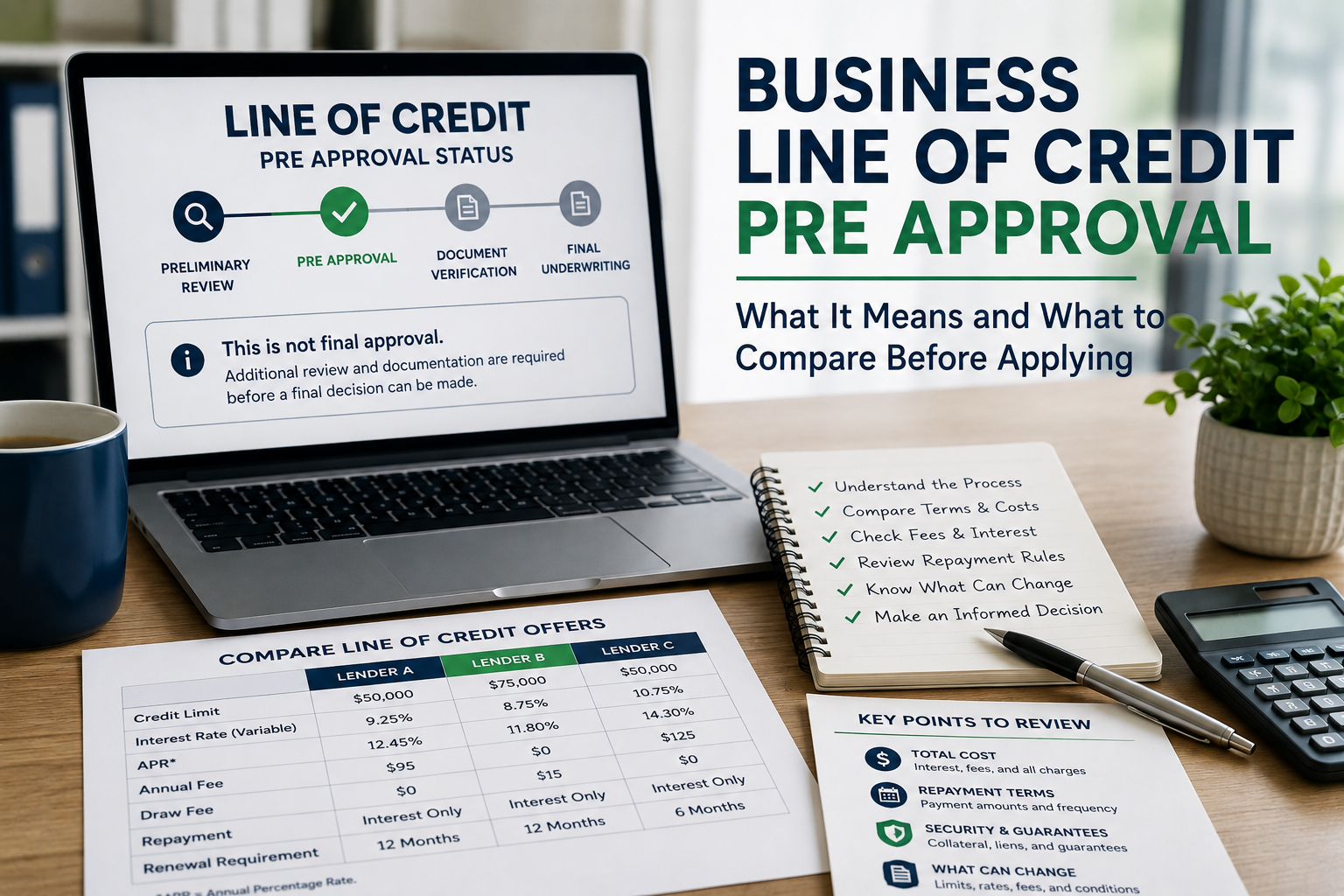
Business line of credit pre approval can sound as though a business already has financing waiting to be used.
Usually, that is not what it means.
A business line of credit pre approval generally represents an early-stage assessment indicating that a business appears to meet some initial criteria for a credit facility. A lender or financing provider may still need to review financial records, bank activity, revenue, credit information, existing debt, business ownership, industry risk, repayment capacity, and other information before making a final decision.
That distinction matters.
A message stating that a business is “pre approved,” “pre qualified,” “eligible,” or “matched” should not automatically be interpreted as:
- final approval
- guaranteed funding
- a guaranteed credit limit
- guaranteed rates
- guaranteed fees
- guaranteed repayment terms
- guaranteed access to future draws
The strongest way to use business line of credit pre approval is as a starting point for comparison, not as permission to borrow.
Before proceeding, a business owner should understand what was actually reviewed, what additional underwriting remains, what the final credit line may cost, and whether the business can comfortably repay any future draws.
For the broader financing structure behind this product, see Kevanzo’s business line of credit guide.
Educational note: Kevanzo.com provides general business-financing education only. Kevanzo is not a lender, broker, loan marketplace, financial adviser, attorney, accountant, or approval service. Rates, APRs, fees, credit limits, repayment terms, eligibility standards, collateral requirements, guarantees, approval requirements, and available products vary. Always review the complete financing agreement before accepting business funding.
What Business Line of Credit Pre Approval Means
Business line of credit pre approval generally means that a lender, financing company, or other provider has performed some form of preliminary assessment.
The depth of that assessment can vary considerably.
One provider might base an early indication on:
- information supplied by the business owner
- basic revenue information
- time in business
- industry
- requested credit amount
Another may review:
- credit information
- business-bank activity
- revenue history
- existing obligations
- ownership records
The important point is that pre approval is not one standardized stage used identically by every lender.
The words used in an advertisement, email, account dashboard, or preliminary offer should therefore be interpreted according to what the provider actually means.
Pre Approval Is Not Final Approval
This is the most important principle in the entire article.
Business line of credit pre approval is not the same as final approval.
After the preliminary stage, a lender may still:
- request additional documents
- verify business revenue
- examine bank statements
- review cash flow
- examine business or personal credit
- verify ownership
- evaluate existing debt
- review industry risk
- assess collateral
- request a personal guarantee
- alter the proposed credit limit
- change pricing or terms
- decline the application
A preliminary result can therefore change substantially during final underwriting.
Business owners should treat the process as:
early review → deeper verification → final underwriting → final offer → agreement → potential funding
rather than:
pre approval → guaranteed money
Pre Approval, Prequalification and Final Approval
Business-financing terminology can be confusing because different providers may use similar words differently.
It helps to separate three concepts.
Prequalification
Prequalification may represent an early estimate of potential eligibility based on relatively limited information.
It may involve information supplied directly by the applicant.
Pre Approval
Business line of credit pre approval may indicate that additional information has been considered, but it still generally falls short of a final lending commitment.
The exact meaning depends on the provider.
Final Approval
Final approval generally occurs after the lender has completed the underwriting steps it requires and is prepared to issue specific financing terms, subject to any remaining contractual conditions.
Even at this stage, the business should read the entire agreement before accepting.
The terminology itself is less important than understanding:
What has actually been verified, and what still has to happen?
The Kevanzo Pre-Approval Reality Check
Whenever a business receives a business line of credit pre approval message, answer these six questions.
1. What Information Was Actually Reviewed?
Was the decision based on:
- a short questionnaire?
- bank information?
- credit data?
- revenue records?
- financial statements?
The less information reviewed, the more preliminary the result may be.
2. Is This a Prequalification, Pre Approval or Final Offer?
Do not rely on the headline.
Read the explanatory language.
3. What Still Needs to Be Verified?
Ask whether the provider still needs:
- bank statements
- financial records
- identification
- ownership details
- tax information
- credit review
- collateral information
4. Can the Proposed Terms Change?
They often can until the financing is finalized.
Ask what remains provisional.
5. Has the Business Been Given an Actual Agreement?
Marketing copy and preliminary dashboards are not substitutes for a financing contract.
6. Has the Business Evaluated Affordability?
Even a genuine final approval does not mean borrowing is a good decision.
Approval determines what a lender is willing to offer.
Affordability determines what the business should consider accepting.
Why Businesses Seek Pre Approval
Business owners may explore business line of credit pre approval because they want to understand potential financing access before going through a full application process.
That can be useful.
For example, a business may be planning:
- seasonal inventory
- project materials
- supplier purchases
- emergency repairs
- temporary payroll timing
- a short receivables gap
The owner may want an indication of whether flexible credit is worth investigating before investing more time in documentation.
Businesses considering wider funding alternatives should also review small business loans rather than assuming revolving credit is automatically the best structure.
Why a Line of Credit Is Different From a Lump-Sum Loan
A business line of credit typically provides borrowing capacity up to an approved limit rather than forcing the business to receive the entire amount upfront.
Depending on the agreement, the business may be able to:
- draw part of the approved credit,
- use the funds,
- repay principal,
- potentially restore borrowing availability,
- draw again later.
A term loan generally works differently.
The borrower usually receives one amount and follows an established repayment schedule.
This makes lines of credit particularly relevant to businesses with variable or recurring short-term needs.
It also creates a risk:
The business can make multiple borrowing decisions instead of one.
Business Line of Credit Pre Approval Versus Actual Credit Availability
A preliminary credit amount should not always be treated as money the business can immediately access.
For example, a business may see:
You may qualify for up to $75,000.
That phrase may describe:
- an estimated range
- preliminary eligibility
- a marketing threshold
- an amount subject to underwriting
- a potential maximum
It does not necessarily mean $75,000 is sitting in an account ready to withdraw.
The business should determine:
- whether the amount is provisional
- what underwriting remains
- what documents are required
- whether collateral affects availability
- whether credit information still needs to be checked
- whether the final limit can be lower
The written final agreement matters.
The Kevanzo “Up To” Test
Whenever business line of credit pre approval includes the words “up to,” ask:
What Is the Minimum?
The business may qualify for substantially less than the advertised maximum.
What Determines the Final Limit?
Possible factors may include:
- revenue
- cash flow
- debt
- credit
- industry
- time in business
- collateral
- receivables
Will the Business Actually Need the Maximum?
Even if the full amount becomes available, it does not automatically need to be borrowed.
A credit limit is borrowing capacity.
It is not business income.
Business Line of Credit Pre Approval Versus Small Business Line of Credit
A small business line of credit describes the actual financing structure available to a smaller business.
Business line of credit pre approval describes a stage before final financing may be established.
That distinction is useful.
One term describes:
the product
The other describes:
a preliminary step toward potentially obtaining the product
A business should not confuse interest from a lender with an activated credit facility.
Business Line of Credit Pre Approval Versus Unsecured Business Line of Credit
An unsecured business line of credit may provide revolving credit without requiring one specifically pledged asset in the same way as traditional secured financing.
Business line of credit pre approval may relate to either:
- secured financing
- unsecured financing
The pre-approval stage does not by itself tell the borrower which lender protections will eventually apply.
The final agreement may still involve:
- personal guarantees
- general business liens
- specific collateral
- other security interests
Never infer the final security structure from a preliminary marketing message.
Business Line of Credit Pre Approval Versus Unsecured Business Loans
Businesses comparing unsecured business loans should distinguish between financing structure and underwriting stage.
Unsecured describes an important aspect of the financing structure.
Pre approval describes where the borrower may be in the application process.
An unsecured term loan could have a preliminary approval stage.
An unsecured line of credit could also have one.
The terms are not interchangeable.
Business Line of Credit Pre Approval Versus Working Capital Loans
A business investigating working capital loans is usually focused on operating needs such as:
- inventory
- payroll timing
- suppliers
- seasonal expenses
- project materials
- temporary cash-flow gaps
A line of credit may also serve a working-capital purpose.
Business line of credit pre approval may therefore be useful when a company expects recurring or uncertain working-capital needs.
But if the business needs exactly $40,000 once, a fixed working-capital term loan may deserve comparison.
The financing purpose should determine the structure.
Business Line of Credit Pre Approval Versus Cash Flow Loans
Businesses considering cash flow loans for small business are usually dealing with timing between incoming and outgoing cash.
For example:
Supplier payment due: Monday
Customer invoice expected: Friday
A line of credit might help bridge the gap.
But business line of credit pre approval does not automatically mean the business should proceed.
First calculate:
- amount needed
- expected repayment source
- timing of customer cash
- cost of the draw
- effect on remaining operating cash
The financing should match the cash cycle.
Business Line of Credit Pre Approval Versus Quick Business Loans
Businesses under time pressure may also encounter quick business loans.
A quick application or preliminary decision may be useful.
But speed does not turn preliminary approval into final approval.
Nor does it establish affordability.
A fast business line of credit pre approval should still be evaluated using the same questions:
- What was reviewed?
- What remains provisional?
- What does the financing cost?
- When does repayment begin?
- What happens if cash arrives late?
Fast information can be useful.
Fast judgment is not required.
Business Line of Credit Pre Approval Versus a Short-Term Business Loan
A short term business loan generally provides a defined amount repaid over a relatively short period.
A business line of credit may provide reusable borrowing capacity.
If the company expects:
one temporary expense
a short-term term loan may deserve comparison.
If it expects:
several unpredictable temporary expenses
a line of credit may provide more flexibility.
A pre-approval message should therefore trigger a product comparison—not end one.
The Kevanzo Pre-Approval Funnel
Think of business line of credit pre approval as one step in a funnel.
Stage 1: Initial Interest
The business considers flexible financing.
Stage 2: Preliminary Information
Basic business details are supplied.
Stage 3: Early Assessment
The provider indicates potential eligibility.
Stage 4: Documentation
Additional records may be requested.
Stage 5: Underwriting
The lender evaluates repayment risk and verifies information.
Stage 6: Final Terms
A credit limit, pricing, fees, repayment requirements, and other conditions are established.
Stage 7: Agreement Review
The business reviews the contract.
Stage 8: Acceptance
The business decides whether the financing actually fits.
Stage 9: Draw
Only then may money actually be borrowed according to the facility.
Pre approval is therefore near the beginning of the decision—not the end.
What Lenders May Review After Pre Approval
Business line of credit pre approval may be followed by considerably deeper review.
A lender may request or examine:
- recent bank statements
- financial statements
- profit and loss information
- balance-sheet information
- business tax records
- revenue history
- cash-flow patterns
- accounts receivable
- accounts payable
- existing debt
- business credit
- personal credit
- ownership
- industry
- time in business
- collateral
- requested amount
- use of funds
The lender’s requirements vary.
The fact that more information is requested does not necessarily mean something has gone wrong.
It may simply mean the preliminary assessment has moved into underwriting.
Revenue Does Not Guarantee Approval
High revenue alone does not guarantee that a business line of credit will be approved.
Consider:
Business A
Monthly revenue: $150,000
Monthly operating expenses: $143,000
Approximate remaining operating cash: $7,000
Business B
Monthly revenue: $90,000
Monthly operating expenses: $62,000
Approximate remaining operating cash: $28,000
Business A has higher revenue.
Business B appears to have considerably more operating room before new financing.
Lenders may consider multiple factors.
Business owners should do the same.
The Kevanzo Pre-Approval Affordability Test
Receiving business line of credit pre approval should trigger an affordability calculation.
Start with:
average operating cash available
Subtract:
existing debt payments
Subtract:
expected new credit-line repayment
What remains?
Then repeat the calculation using a slower revenue month.
A preliminary approval may tell the business that financing appears possible.
This test helps determine whether using that financing appears sensible.
What Can Change After Pre Approval?
Several important parts of the potential facility may change.
Credit Limit
A preliminary estimate may be reduced.
Interest Rate
Final pricing may depend on underwriting results.
APR
Where applicable, final APR may differ from preliminary illustrations.
Fees
Final documents may reveal:
- origination costs
- annual fees
- draw fees
- maintenance fees
- other charges
Collateral
A lender may determine that security is required.
Personal Guarantee
The final agreement may require one or more owners to guarantee repayment.
Repayment Rules
Payment frequency or required amounts may differ from preliminary expectations.
Renewal Conditions
Future access to the line may depend on periodic review.
This is why a business should never plan a transaction around preliminary terms as though they were guaranteed.
Does Pre Approval Affect Credit?
There is no universal answer because lenders and financing providers may use different processes.
A preliminary assessment may involve:
- no credit inquiry
- a soft inquiry
- another form of data review
- a hard credit inquiry later in the process
Before proceeding, ask:
Will checking my eligibility affect my credit, and at what stage?
Do not assume.
The provider should explain its process.
Soft Inquiry Versus Hard Inquiry
A soft credit inquiry generally differs from a hard inquiry associated with an application for credit.
Because business-financing practices vary, the owner should clarify:
- whether personal credit will be reviewed
- whether business credit will be reviewed
- whether an initial check is soft
- whether a later application creates a hard inquiry
Understanding the sequence helps prevent surprises.
The Kevanzo Credit-Check Question
Before requesting business line of credit pre approval, ask the provider directly:
“What type of credit review occurs at this stage, and will a later application involve another inquiry?”
That one question can clarify much of the process.
Cost Matters More Than the Pre-Approval Amount
Imagine two preliminary offers.
Offer A
Potential credit line: $100,000
Offer B
Potential credit line: $60,000
At first glance, Offer A may appear better.
But the business only needs $25,000.
The important comparison becomes:
- borrowing rate
- APR where applicable
- fees
- payment requirements
- renewal terms
- collateral
- guarantees
- draw rules
The larger possible credit limit may have no practical advantage.
The Kevanzo Eight-Number Final-Offer Test
When business line of credit pre approval becomes an actual offer, record these eight numbers.
1. Final Credit Limit
What amount was actually approved?
2. Planned Initial Draw
How much does the business actually expect to borrow?
3. Interest Rate
What rate applies?
4. APR
What APR is disclosed where applicable?
5. Fees
What annual, maintenance, draw, origination, or other charges apply?
6. Required Payment
How is repayment calculated?
7. Payment Frequency
How often must the business pay?
8. Remaining Available Credit
How much unused capacity remains after the planned draw?
The final comparison should use final numbers—not preliminary marketing figures.
The Kevanzo Pre-Approval-to-Final Comparison
Write down what changed between the preliminary stage and the final offer.
Compare:
| Item | Preliminary Indication | Final Offer |
|---|---|---|
| Credit limit | What was suggested? | What was approved? |
| Rate | What was estimated? | What applies? |
| Fees | What was mentioned? | What actually applies? |
| Repayment | What was indicated? | What is required? |
| Collateral | What was expected? | What is required? |
| Guarantee | What was expected? | What is required? |
If a final offer differs materially from the preliminary indication, evaluate the financing from the beginning.
Do not accept unfavorable final terms simply because time was already spent applying.
A Higher Credit Limit Is Not Automatically Better
Suppose a business needs $20,000.
It receives business line of credit pre approval suggesting access to $80,000.
Later, final approval provides the full $80,000.
That does not mean the business should draw $80,000.
Borrowing more can create:
- greater interest cost
- greater repayment pressure
- less unused credit capacity
- greater temptation to spend debt unnecessarily
The business should separate:
amount available
from:
amount genuinely needed
The Kevanzo Needed-versus-Available Test
Record:
Approved credit limit: $80,000
Actual business need: $20,000
Potential unused capacity after draw: $60,000
That unused capacity may be more valuable than unnecessarily borrowing it.
Flexible financing works best when flexibility remains.
Personal Guarantees After Pre Approval
A business line of credit pre approval message may not always make guarantee requirements immediately obvious.
The final agreement may involve a personal guarantee.
A guarantee can create personal responsibility for repayment depending on the contract.
Before accepting, determine:
- whether a guarantee applies
- who must sign it
- what obligations it covers
- when it can be enforced
- what happens after default
This should never be treated as minor contract wording.
Collateral and Lien Requirements
Business line of credit pre approval may also precede the final determination of collateral or security requirements.
Depending on the facility, the lender may request:
- specific assets
- accounts receivable
- inventory
- another security interest
- a general business lien
Review exactly what property or rights are affected.
A financing product described as flexible can still carry serious lender protections.
Repayment Frequency Matters
A business line of credit may require:
- monthly payments
- weekly payments
- another repayment schedule
The business should compare that schedule with its cash cycle.
A company collecting customer payments mostly at month-end may experience weekly withdrawals very differently from a retailer receiving revenue every day.
The correct question is not:
Is the payment small?
It is:
Does this repayment schedule fit the way the business actually receives cash?
The Kevanzo Cash-Timing Test
For each expected draw, write down:
Day financing is drawn
Day the funded expense is paid
Day the financed activity should produce cash
Day repayment begins
For example:
Day 1 — $15,000 draw
Day 2 — inventory purchased
Day 18 — inventory begins selling
Day 30 — meaningful cash starts returning
If repayment begins well before customer cash returns, the business must fund that gap from somewhere else.
That should be part of the decision.
Existing Debt Still Matters
Business line of credit pre approval should never be evaluated in isolation.
Suppose a business already has:
Term-loan payments: $2,800 monthly
Vehicle finance: $900 monthly
Equipment financing: $1,700 monthly
Credit cards: $1,100 monthly
Potential new line repayment: $3,000 monthly
Total potential debt-related payments:
$9,500 monthly
The relevant affordability question involves all $9,500.
Not merely the newest $3,000.
The Kevanzo Debt-Stack Test
List every existing financing obligation.
For each, record:
- outstanding balance
- payment amount
- payment frequency
- remaining repayment period
- collateral
- guarantees
Then add the potential line of credit.
Calculate how much operating cash remains after all obligations are paid.
Pre approval should never hide the rest of the debt picture.
Seven Practical Business Line of Credit Pre Approval Scenarios
Scenario 1: Seasonal Retailer
A retailer wants to determine whether revolving credit might be available before placing seasonal inventory orders.
Business line of credit pre approval may help identify whether further application is worthwhile.
The owner should still calculate:
- inventory requirement
- expected margin
- sales timing
- repayment schedule
- slower-sales scenario
Pre approval does not make the inventory profitable.
Scenario 2: Contractor Before a Large Project
A contractor expects to need $25,000 for materials.
The contract has been signed, but customer payment will arrive later.
Business line of credit pre approval may provide early information about possible credit access.
The contractor should still test what happens if the customer payment is delayed.
Scenario 3: Professional Service Business
A consulting company experiences uneven receivables.
The company wants revolving credit available as a backup.
A line may fit recurring timing gaps better than repeated term loans.
But the owner should also improve:
- invoicing
- collections
- deposits
- payment terms
Credit should support cash-flow management rather than replace it.
Scenario 4: Business With No Immediate Funding Need
A company receives an unsolicited business line of credit pre approval message.
The business has healthy reserves and no clear funding requirement.
There is no reason to borrow simply because financing may be available.
The owner can review the offer if useful, but available credit does not create a business need.
Scenario 5: Growing Business
A company expects to hire employees and purchase more inventory.
The exact timing is uncertain.
A line of credit might provide flexibility.
Before proceeding, management should estimate whether growth will generate enough additional cash to support repayment.
Growing revenue does not automatically mean growing free cash flow.
Scenario 6: Business Already Carrying Heavy Debt
A company receives pre approval for another line.
Existing loan payments already consume substantial operating cash.
Adding revolving credit may make short-term liquidity look stronger while increasing long-term pressure.
The business should perform the debt-stack test before continuing.
Scenario 7: Persistent Operating Losses
A business seeks a new credit line because ordinary revenue does not cover ordinary expenses.
Pre approval may provide temporary optimism.
But additional borrowing does not fix:
- weak margins
- excessive costs
- pricing problems
- slow collections
- unprofitable operations
Management should investigate the underlying problem before adding more debt.
Common Business Line of Credit Pre Approval Mistakes
Treating Pre Approval as Guaranteed Funding
It is not.
Planning Spending Before Final Terms Arrive
Do not commit the business based on preliminary financing.
Borrowing the Maximum Available
A credit limit is not a borrowing target.
Comparing Only the Credit Limit
Cost and repayment matter more.
Ignoring Credit-Inquiry Details
Understand when and how credit may be reviewed.
Ignoring Personal Guarantees
Unsecured does not necessarily mean no personal exposure.
Ignoring Renewal Risk
A line may not remain unchanged indefinitely.
Using New Credit to Cover Continuing Losses
Financing does not repair weak business economics.
Accepting Final Terms Because of Sunk Time
The business is not obligated to accept a poor final offer merely because it completed the application process.
Business Line of Credit Pre Approval Red Flags
Slow down if:
- the message says “guaranteed” without clear conditions
- the provider makes the final cost difficult to understand
- important fees are unclear
- repayment frequency is unclear
- the business is pressured to act immediately
- the credit-check process is unclear
- guarantee language is hidden or confusing
- lien or collateral provisions are unclear
- the final terms differ substantially from the preliminary indication
- the business has no defined use for the money
- repayment depends entirely on optimistic future growth
- another loan will probably be needed to make payments
Pre approval should provide information.
It should not create pressure.
Questions to Ask After Receiving Business Line of Credit Pre Approval
Ask:
- What information was used for this preliminary decision?
- Is this prequalification, pre approval, or final approval?
- What underwriting remains?
- What documents are still required?
- Will personal credit be reviewed?
- Will business credit be reviewed?
- Will any credit inquiry occur?
- Is the stated credit limit provisional?
- Can the final limit change?
- What interest rate may apply?
- What APR will apply where applicable?
- What fees apply?
- Is there an annual fee?
- Is there a draw fee?
- Is there a maintenance fee?
- How are repayments calculated?
- How frequently are payments required?
- Is collateral required?
- Is a personal guarantee required?
- Is a business lien involved?
- Does the line require renewal?
- Can the lender alter future availability under the agreement?
- What constitutes default?
- What happens after a missed payment?
- When will final terms be provided?
- When does actual funding become available?
If the business cannot obtain clear answers, more review is justified.
Documents Worth Preparing
Business owners proceeding beyond business line of credit pre approval may benefit from organizing:
- business bank statements
- revenue records
- profit and loss statements
- balance-sheet information
- debt schedules
- tax records where requested
- accounts receivable
- accounts payable
- ownership records
- business formation documents
- identification
- collateral information where relevant
- explanation of funding purpose
Requirements vary by lender.
Good preparation also helps the business owner independently evaluate affordability.
The Kevanzo 18-Point Pre-Approval Check
Before proceeding from business line of credit pre approval to a full application, complete this review.
1. Meaning
What exactly does the provider mean by pre approval?
2. Information Reviewed
What has already been checked?
3. Remaining Underwriting
What still needs verification?
4. Funding Purpose
Why does the business want revolving credit?
5. Required Amount
How much credit is actually needed?
6. Preliminary Limit
What amount has been suggested?
7. Final-Limit Risk
Can that number change?
8. Interest
What rate may apply?
9. APR
What APR will be disclosed where applicable?
10. Fees
What additional charges may apply?
11. Repayment
How will required payments be calculated?
12. Payment Frequency
How often will the business pay?
13. Repayment Source
What cash will repay future draws?
14. Existing Debt
How much business cash already goes toward financing?
15. Credit Inquiry
What credit review occurs and when?
16. Security
What collateral, liens, or guarantees may apply?
17. Slow-Month Test
Could the business handle repayment if revenue weakens?
18. Final Comparison
Will the business compare the final terms rather than relying on the preliminary message?
If several answers remain unknown, pre approval has not provided enough information to make a borrowing decision.
Practical Next Steps
When a business receives business line of credit pre approval, begin by determining exactly what the message means.
Do not assume.
Find out:
- what was reviewed
- what underwriting remains
- whether the credit limit is provisional
- whether credit inquiries are involved
- what additional documentation is required
Then define the business need.
Write down:
- how much may be required
- what each draw would fund
- what cash should repay each draw
- when repayment should occur
Next, compare the potential line with other financing structures.
A term loan, working-capital loan, invoice-related financing, or another product may fit the business need better.
Then wait for final terms.
Compare the final:
- credit limit
- interest
- APR where applicable
- fees
- payment requirements
- guarantees
- collateral or liens
- renewal provisions
- default terms
Finally, decide whether the financing remains useful after the preliminary excitement of receiving a pre-approval message has disappeared.
The goal is not to become approved.
The goal is to obtain financing that the business can use responsibly and repay without damaging normal operations.
Final Takeaway
Business line of credit pre approval can be useful because it may give a business an early indication that revolving financing is worth investigating.
But it should never be confused with final approval, guaranteed funding, or a recommendation to borrow.
The business should determine exactly what information has been reviewed, what underwriting remains, whether the proposed credit limit can change, what credit inquiries may occur, and what final lender protections will apply.
When a final offer arrives, compare the credit limit, interest or APR where applicable, fees, repayment structure, payment frequency, collateral, personal guarantees, renewal terms, existing debt, and cash-flow impact.
Most importantly:
Pre approval answers whether financing may be possible. It does not answer whether borrowing is financially sensible.
That second decision belongs to the business.
Frequently Asked Questions About Business Line of Credit Pre Approval
What Does Business Line of Credit Pre Approval Mean?
Business line of credit pre approval generally indicates that a lender or provider has conducted some form of preliminary eligibility assessment.
It is usually not the same as final underwriting or final approval.
Does Business Line of Credit Pre Approval Guarantee Funding?
No.
A lender may still verify information, request documents, perform additional underwriting, change terms, reduce the credit limit, or decline the application.
Is Pre Approval the Same as Prequalification?
Not necessarily.
Providers may use these terms differently.
Ask what information has actually been reviewed and what steps remain.
Can the Credit Limit Change After Pre Approval?
Yes.
A preliminary credit-limit indication may change after underwriting.
Can the Interest Rate Change?
Potentially.
Final pricing may depend on the lender, underwriting results, credit profile, business performance, and other factors.
Does Business Line of Credit Pre Approval Affect Credit?
It depends on the provider and process.
Ask whether the preliminary review involves a credit inquiry and whether a later full application may involve another credit check.
Can Personal Credit Be Reviewed?
Potentially.
Some business lenders may review personal credit, business credit, or both.
Requirements vary.
Does Pre Approval Mean the Business Should Borrow?
No.
Eligibility and affordability are different questions.
A business may qualify for credit that it does not need or should not use.
Is Business Line of Credit Pre Approval Better Than a Term Loan?
Pre approval is a stage in a financing process rather than a loan type.
A line of credit and term loan should be compared based on business purpose, costs, repayment, and cash-flow needs.
Can a Pre-Approved Line Be Unsecured?
Potentially.
However, unsecured financing may still involve guarantees, liens, and other contractual protections.
What Should a Business Compare When Final Terms Arrive?
Compare:
- final credit limit
- interest
- APR where applicable
- fees
- repayment rules
- payment frequency
- collateral
- guarantees
- renewal provisions
- total cash-flow impact
Should a Business Draw the Entire Approved Limit?
Not automatically.
The approved limit represents borrowing capacity.
A business should generally draw according to genuine funding needs and repayment ability.
Why Can Final Approval Be Different From Pre Approval?
Final underwriting may reveal additional information about:
- revenue
- cash flow
- debt
- credit
- bank activity
- collateral
- ownership
- repayment risk
That information may affect the lender’s final decision.
Can Pre Approval Expire?
Potentially.
Preliminary offers or eligibility indications may have time limits or be subject to updated underwriting.
Review the provider’s terms.
What Is the Most Important Thing to Remember?
Business line of credit pre approval is a starting point for investigation—not a guarantee of financing and not a reason by itself to borrow.
Helpful Authoritative Resources
- U.S. Small Business Administration loan programs
- U.S. Small Business Administration 7(a) loans and Working Capital Pilot
- U.S. Small Business Administration Lender Match
- Consumer Financial Protection Bureau small business lending resources
- Federal Trade Commission business guidance
- SCORE small business mentoring and education
Author Bio
Kevanzo Editorial Team
Kevanzo Editorial Team creates practical, plain-English educational resources for U.S. business owners comparing business line of credit pre approval, revolving business credit, small business loans, working-capital financing, borrowing costs, lender terms, and responsible business-financing decisions.
Copyright Notice
© 2026 Kevanzo. All rights reserved.
This article about business line of credit pre approval is protected by copyright and may not be copied, scraped, spun, republished, or used commercially without prior written permission from Kevanzo. Brief quotations may be used with clear attribution and a link to the original article.
Unauthorized reuse, bulk scraping, content spinning, AI rewriting for republication, or commercial reproduction of this material is prohibited.
Educational Disclaimer
Kevanzo.com provides general educational information about business financing. Kevanzo is not a lender, broker, loan marketplace, financial adviser, attorney, accountant, or approval service.
Nothing in this article constitutes financial, legal, tax, accounting, investment, lending, or personalized business advice. Rates, APRs, fees, credit limits, repayment terms, approval requirements, personal guarantees, liens, collateral requirements, funding amounts, and available financing products vary by lender, borrower, business profile, industry, revenue, credit history, and market conditions.
Business owners should review current official information, read financing agreements carefully, and consider obtaining advice from appropriately qualified professionals when necessary before making borrowing decisions.