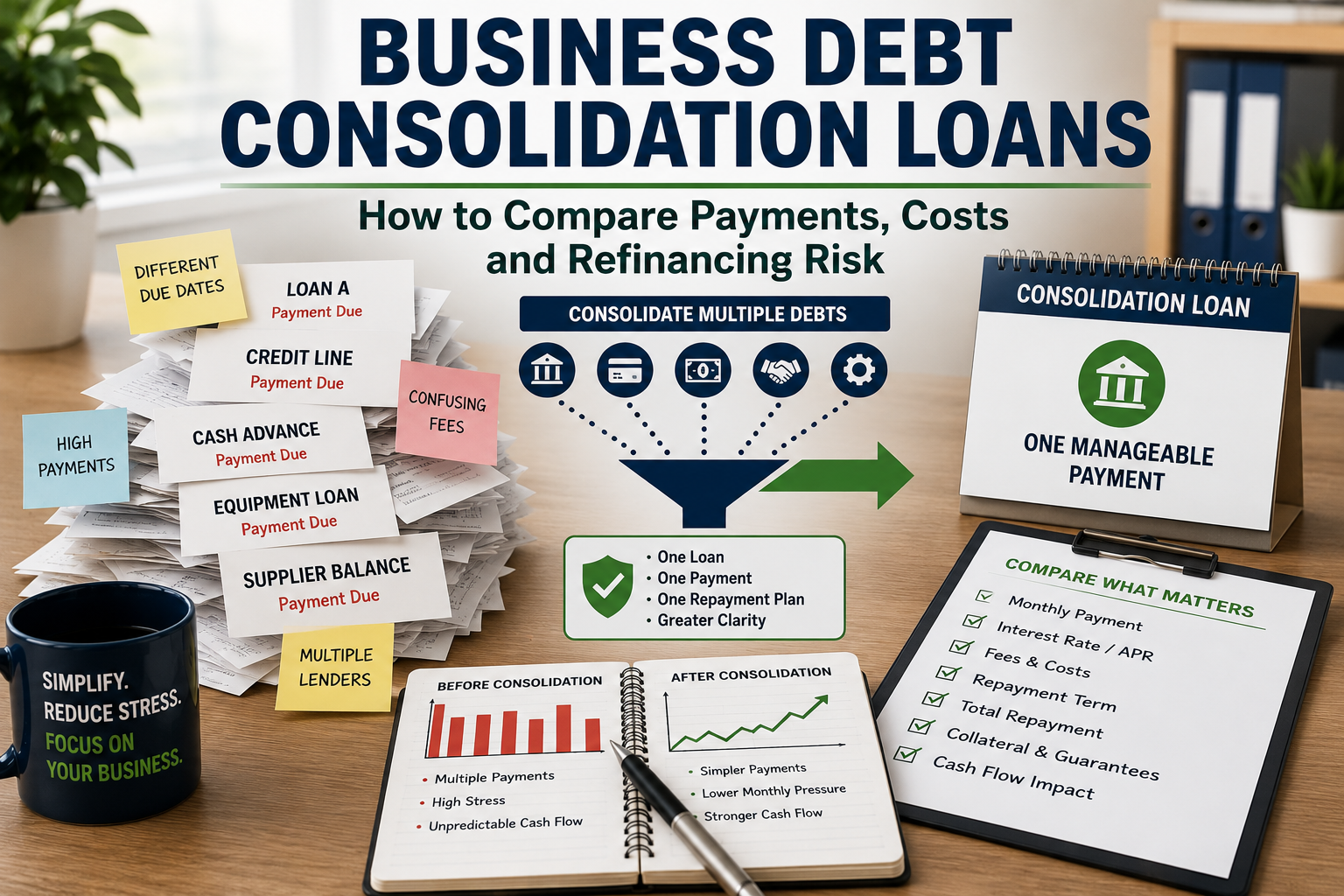
Business Debt Consolidation Loans can help a company replace several existing business debts with one new financing arrangement.
The attraction is easy to understand.
Instead of managing:
- several lenders
- different payment dates
- different interest rates
- weekly and monthly payments
- multiple fees
- several outstanding balances
the business may end up with:
one financing agreement → one repayment structure → one clearer debt plan
But consolidation is not automatically an improvement.
A lower scheduled payment can result from:
- a lower borrowing cost
- a longer repayment term
- refinancing expensive debt
- or simply stretching the same debt over more time
Those outcomes are very different.
The central question is therefore:
Will the new financing leave the business financially stronger after all old payoff amounts, new fees, repayment terms and total costs are included?
For the wider funding landscape, business owners can compare Kevanzo’s business financing guide before deciding whether debt consolidation is genuinely the right structure.
Educational note: Kevanzo.com provides general business-financing education only. Kevanzo is not a lender, broker, loan marketplace, financial adviser, attorney, accountant or approval service. Rates, APRs, fees, payoff requirements, collateral, personal guarantees, refinancing eligibility and repayment terms vary according to lender, borrower and financing agreement.
Business Debt Consolidation Loan Offer Comparison: What to Check First
If you are actively requesting business debt consolidation offers, compare every proposal on the same line-item basis. A lower payment by itself does not prove that the new financing is cheaper or safer.
| Comparison item | What to verify |
|---|---|
| Existing payoff amount | The current amount required to fully satisfy each debt being replaced. |
| Gross new financing amount | The total amount of the proposed consolidation financing. |
| Net cash received | Any money remaining for the business after old debts and financed fees are paid. |
| Interest or APR | The stated borrowing cost and whether the rate is fixed or variable. |
| Fees and closing costs | Origination, documentation, closing, administrative or other charges that affect the economics. |
| Payment amount and frequency | How much is due and whether repayment is daily, weekly, monthly or on another schedule. |
| Repayment term | How long the new obligation lasts compared with the remaining life of the debts being replaced. |
| Total repayment | The total amount expected to be repaid if the financing runs to scheduled maturity. |
| Prepayment provisions | Whether early repayment changes interest, fees, discounts, penalties or other costs. |
| Collateral and liens | Which business assets may secure the new financing and whether lien priority changes. |
| Personal guarantee | Whether an owner or other guarantor becomes personally responsible under the new agreement. |
The strongest comparison uses actual payoff statements and written financing terms. If one offer lowers the scheduled payment mainly by extending the term, calculate whether the additional time creates a higher total repayment.
What Lenders May Review Before Approving Business Debt Consolidation
Underwriting varies by lender and product, but a business seeking consolidation financing may be asked to document its ability to support the new repayment structure.
- business and, where applicable, owner credit history
- time in business
- revenue and operating cash flow
- existing debt balances and payment obligations
- recent business bank activity
- profit-and-loss and balance-sheet information
- tax returns or other financial records when required
- collateral, liens and personal guarantees
- the specific debts being refinanced and the reason for the transaction
Do not assume a lender that can approve the transaction is automatically offering the best structure. Approval answers one question; whether the new debt improves the business answers another.
Documents to Prepare Before Requesting Consolidation Quotes
Purchase-ready borrowers can make comparisons easier by assembling the same core information before contacting lenders. Exact requirements vary, but useful preparation may include:
- a complete business debt schedule
- current payoff statements for debts you may refinance
- recent business bank statements
- current profit-and-loss and balance-sheet reports
- business and personal tax returns if a lender requires them
- entity, ownership and identification documents
- information about collateral and existing liens
- a clear explanation of how consolidation is expected to improve cash flow, cost or repayment management
Before authorizing a credit check, ask whether the lender is offering an initial prequalification or a full application, what information will be reviewed, and whether the inquiry may affect personal or business credit. Practices vary by lender.
What Are Business Debt Consolidation Loans?
Business Debt Consolidation Loans generally use new financing to repay or reorganize multiple existing business debts.
A simplified example might look like:
Existing debt A
Existing debt B
Existing debt C
Existing debt D
↓
New consolidation financing
↓
Selected old debts paid off
↓
Business makes payments under the new agreement
The business has not magically eliminated debt.
It has restructured it.
That distinction matters.
Debt Consolidation Is Not Debt Cancellation
Suppose a business owes:
Loan A:
$20,000
Loan B:
$30,000
Credit balance:
$15,000
Other business financing:
$10,000
Total:
$75,000
A consolidation loan paying those balances does not erase $75,000.
The business now owes the new financing provider instead.
The goal is to improve the structure.
The Kevanzo Better-Debt Rule
Debt consolidation should create at least one meaningful improvement.
Examples:
- lower total financing cost
- lower repayment pressure
- better payment frequency
- clearer repayment schedule
- fewer overlapping debts
- improved cash-flow stability
- better loan term
- removal of unusually expensive financing
Ideally, it improves several.
If nothing meaningful improves, there may be little reason to refinance.
Start With a Complete Debt Inventory
Do not request consolidation quotes until the existing debt is understood.
For every obligation record:
- lender or provider
- outstanding balance
- current payoff amount
- interest or pricing method
- current payment
- payment frequency
- remaining term
- fees
- collateral
- personal guarantees
- prepayment provisions
- maturity date
You cannot prove consolidation is better without knowing what it replaces.
The Kevanzo Debt-Stack Map
Put every debt on one page.
For example:
| Debt | Payoff | Payment | Frequency | Remaining Term |
|---|---|---|---|---|
| Loan A | $25,000 | $1,200 | Monthly | 24 months |
| Loan B | $18,000 | $600 | Weekly | 10 months |
| Credit line | $12,000 | Variable | Monthly | Revolving |
| Equipment debt | $30,000 | $1,000 | Monthly | 32 months |
Now the business can see the whole problem.
Without this step, consolidation is guesswork.
Why Businesses Consider Debt Consolidation
A business might consider consolidation because:
- repayments have become difficult to manage
- several payment dates overlap
- expensive short-term debt is consuming cash
- weekly payments create pressure
- the business wants one predictable payment
- existing financing costs are high
- bookkeeping has become complicated
- the company wants to refinance older debt
- cash flow has improved since the original borrowing
- credit quality has improved
Businesses comparing the broader borrowing market can also review small business loans.
The Kevanzo Consolidation-Purpose Test
Complete this sentence:
“We want to consolidate our existing debts because ______.”
Strong answers:
To replace three high-cost weekly obligations with one manageable monthly structure.
To reduce total financing cost while keeping a similar payoff timeline.
To simplify several debts and improve cash-flow planning.
Weak answer:
Because we need more money.
That may be a new borrowing need rather than a consolidation need.
Consolidation Versus Refinancing
The terms overlap, but they are not always identical.
Refinancing
Often means:
one existing debt → one replacement debt
Consolidation
Usually means:
multiple existing debts → one replacement financing arrangement
A consolidation transaction can therefore involve refinancing.
But not every refinance is consolidation.
The Kevanzo Old-versus-New Test
Never judge the new offer by itself.
Create two columns:
OLD DEBT STACK
- payoff amounts
- payments
- payment frequency
- remaining term
- remaining financing cost
- collateral
- guarantees
NEW CONSOLIDATION
- amount borrowed
- amount actually used to pay old debt
- new fees
- new payment
- payment frequency
- new term
- total repayment
- collateral
- guarantees
Then compare.
That is the heart of the decision.
Payoff Amount Is More Important Than Statement Balance
Suppose a statement shows:
Balance:
$40,000
But the actual amount required to close the debt today is:
$42,500
The consolidation calculation needs the payoff amount.
Possible differences can result from:
- accrued interest
- contractual charges
- payoff fees
- other agreement-specific amounts
Request current payoff information before relying on estimates.
The Kevanzo True-Payoff Test
For every debt determine:
current payoff amount
not merely:
last statement balance
Then calculate:
total payoff required across all debts
That is the amount the new structure actually needs to replace.
Example: Three Debts Become One
Suppose a business has:
Debt A payoff:
$30,000
Debt B payoff:
$25,000
Debt C payoff:
$20,000
Combined payoff:
$75,000
Current combined payments:
$7,000 per month
A new consolidation loan offers:
$78,000
New payment:
$3,300 per month
That looks attractive.
But we still do not know whether it is better.
We need:
- new term
- APR
- fees
- total repayment
- collateral
- guarantees
A smaller payment alone proves almost nothing.
The Lower-Payment Trap
Imagine:
Existing Debt
Combined payment:
$7,000 monthly
Remaining repayment period:
approximately 12 months
New Consolidation Loan
Payment:
$3,000 monthly
Term:
36 months
The new payment is much easier.
But repayment continues three times as long.
The company must compare:
cash-flow relief
against:
additional time and total cost.
The Kevanzo Payment-Relief Test
Calculate:
old combined monthly payments
minus
new monthly payment
equals
monthly cash-flow relief
Example:
Old:
$7,000
New:
$4,000
Monthly relief:
$3,000
That $3,000 can have real value.
But now calculate what it costs to obtain that relief.
The Kevanzo Term-Stretch Test
Compare:
remaining life of current debts
with:
new consolidation term
If most existing debts would disappear within 12 months but the new financing lasts four years, the business may be restarting the debt clock.
That does not automatically make the consolidation wrong.
But the longer obligation needs to be intentional.
Total Cost Comes Next
Suppose:
Remaining cost of existing debts:
$90,000
New consolidation total repayment:
$105,000
The business could potentially gain:
- lower payments
- fewer payment dates
- greater short-term breathing room
while paying:
$15,000 more overall.
Now there is a genuine tradeoff to evaluate.
The Kevanzo Relief-versus-Cost Test
Ask two separate questions.
Cash-Flow Question
How much repayment pressure disappears each month?
Cost Question
How much more—or less—will the business ultimately pay?
Both answers matter.
A Lower Total Cost Is Stronger
Consider:
Existing combined remaining repayment:
$120,000
New consolidation:
$105,000
New monthly payment is also lower.
That could potentially produce:
- lower total cost
- lower payment pressure
- simpler administration
That is much stronger than merely reducing the monthly payment.
Actual offers still need full contractual review.
Interest Rate and APR
When conventional loan pricing applies, compare:
- interest rate
- APR where available
- fixed versus variable rate
- origination fees
- closing costs
- other financing fees
Do not assume a lower interest rate automatically produces lower overall cost.
The repayment term matters enormously.
The Kevanzo Rate-and-Term Rule
Think of:
rate + term + fees
as one package.
Not three separate decisions.
A modest rate over a very long term can still produce substantial total financing cost.
Factor-Rate Debt
Some businesses trying to consolidate debt may have cash advance-style obligations priced using factor rates.
Businesses with this type of debt should not compare the factor rate directly with a conventional interest rate as though the numbers mean the same thing.
Instead determine:
- original advance
- remaining payoff
- payment frequency
- estimated remaining payment period
- new consolidation cost
Businesses carrying this type of obligation can review Kevanzo’s small business cash advance guide for the structural differences.
The Kevanzo Remaining-Obligation Rule
Ignore what the old financing cost at the beginning.
For the consolidation decision, identify:
what it costs to eliminate the debt today
and compare that against:
what the replacement financing will cost from today forward.
That produces a cleaner decision.
Payment Frequency Can Be a Major Benefit
Suppose existing debt requires:
- one daily withdrawal
- two weekly payments
- one monthly payment
Even if the business can technically make them, cash-flow planning may be difficult.
A consolidation loan with one predictable monthly payment could make operations easier to manage.
But again:
simpler does not automatically mean cheaper.
The Kevanzo Payment-Frequency Test
Record:
Current Structure
How often does money leave the business?
New Structure
How often would it leave?
Then ask:
Does the new repayment schedule match how the business actually receives customer cash?
This is especially important for businesses with irregular revenue.
Cash-Flow Relief Can Have Real Value
Cash-flow relief is not meaningless.
Suppose consolidation releases:
$4,000 per month
That additional operating cash might help the business:
- maintain payroll reserves
- pay suppliers on time
- avoid late fees
- rebuild working capital
- reduce emergency borrowing
The business can therefore rationally accept some additional total financing cost if the cash-flow improvement creates sufficient value.
But that tradeoff should be measured.
The Kevanzo Breathing-Room Test
Calculate:
cash available after operations and existing debt
Then calculate:
cash available after operations and proposed consolidation payment
Compare the difference.
Then ask:
What will the business actually do with the improved cash cushion?
If the answer is:
immediately borrow again
the consolidation plan is incomplete.
Debt Consolidation and Working Capital
This distinction matters.
A business may need:
$80,000 to consolidate debt
plus:
$25,000 of new working capital
Those are two different needs.
Do not hide a new borrowing requirement inside the consolidation analysis.
Businesses needing operating funds should separately compare working capital loans.
The Kevanzo Consolidation-versus-New-Money Test
Separate:
Refinancing Amount
Money used to eliminate existing debts.
New-Money Amount
Additional cash provided to the business.
Then evaluate each separately.
A consolidation can look larger than expected because the transaction includes fresh borrowing.
Know why every dollar exists.
Secured Debt Consolidation
Some Business Debt Consolidation Loans may involve collateral or security interests.
Potentially exposed assets could include:
- equipment
- inventory
- receivables
- other business assets
The critical question is whether consolidation introduces new asset risk.
The Kevanzo Security-Swap Test
Compare:
Existing Debt
What collateral currently supports each obligation?
New Debt
What collateral supports the consolidation?
A business should not accidentally exchange several unsecured obligations for one cheaper loan that places a critical business asset at risk without understanding that tradeoff.
Unsecured Consolidation
Businesses may also investigate unsecured business loans for refinancing or consolidation purposes where permitted by the lender.
But unsecured does not automatically mean:
- no personal guarantee
- no lien
- no legal obligation
- no default consequences
Always review the agreement.
Personal Guarantees
A business owner may already have personally guaranteed some existing debts.
A consolidation transaction could:
- replace those guarantees
- continue owner exposure
- create a new guarantee
Do not assume paying off old loans automatically eliminates every obligation immediately.
Confirm the old debts are properly satisfied and understand the new agreement.
The Kevanzo Owner-Exposure Test
Compare:
personal exposure before consolidation
against:
personal exposure after consolidation
The transaction should not be evaluated solely at company level.
Which Debts Should Be Consolidated?
Not every debt necessarily belongs in the new loan.
Suppose:
Debt A:
high cost
Debt B:
high cost
Debt C:
very low rate with only six months remaining
Debt D:
reasonable equipment loan with favorable terms
Automatically consolidating all four may be inefficient.
The Kevanzo Keep-or-Replace Test
For each debt ask:
Is It Expensive?
Is the Payment Creating Pressure?
Is the Remaining Term Unhelpful?
Are the Terms Restrictive?
Would the New Financing Clearly Improve It?
If not, consider whether that obligation should remain separate.
The objective is not:
put everything into one loan at any cost.
It is:
improve the debt structure.
Business Line of Credit Debt
A business might have a heavily utilized business line of credit.
Consolidating the balance into a term loan could potentially restore revolving availability.
But this creates a major behavioral risk.
The company now has:
new consolidation debt
plus
a newly available credit line.
If the line is drawn again immediately, total debt can rise.
The Kevanzo Refill Risk
After consolidation ask:
Which old credit facilities become available again?
Then establish rules for their future use.
Paying down a line and immediately drawing it again is not consolidation success.
It is debt expansion.
Short-Term Debt Consolidation
Businesses with several short term business loan obligations may consider replacing them with a longer and more predictable structure.
This can reduce cash-flow compression.
But the key question becomes:
How much additional financing time are we purchasing, and what does that extra time cost?
That should be calculated before signing.
SBA 7(a) Business Debt Refinancing: Current 2026 Context
As of September 2026, the U.S. Small Business Administration lists refinancing current business debt as an eligible use of the 7(a) loan program. SBA also states that eligible businesses must be creditworthy and demonstrate a reasonable ability to repay, and borrowers apply through participating lenders. For a broader comparison of the program, see Kevanzo’s SBA 7(a) loans guide and the official SBA 7(a) program page.
That does not mean every existing debt or every borrower automatically qualifies.
It means eligible businesses may have another refinancing structure worth investigating.
The current SBA 7(a) maximum is generally $5 million, although the amount a particular borrower qualifies for can be much lower.
Refinancing Should Solve More Than Administration
Suppose consolidation changes:
five payments
into:
one payment
That is convenient.
But convenience alone may not justify:
- higher total cost
- longer repayment
- new collateral
- new guarantees
- substantial fees
Administrative simplicity is useful.
Financial improvement is more important.
The Kevanzo Consolidation Scorecard
Judge the new offer across six areas.
1. Payment Pressure
Better or worse?
2. Total Cost
Better or worse?
3. Repayment Term
Appropriate or unnecessarily long?
4. Cash-Flow Fit
Better aligned with business revenue?
5. Security Risk
Improved or increased?
6. Debt Independence
Will the business avoid immediately borrowing again?
A strong consolidation should improve several categories without creating a serious new weakness.
Existing Cash-Flow Problems Must Still Be Fixed
Debt consolidation reorganizes financing.
It does not automatically fix:
- weak margins
- falling sales
- excessive expenses
- poor collections
- overstaffing
- bad inventory management
- underpricing
- repeated operating losses
Suppose the business loses:
$10,000 every month
Consolidation reduces payments by:
$3,000
The company still loses:
$7,000 monthly.
The underlying problem remains.
The Kevanzo Root-Cause Test
Ask:
Why did these debts accumulate?
Possible answers:
One-Time Expansion
Potentially understandable.
Pandemic/Disaster Recovery
Potentially understandable.
Temporary Receivables Problem
Potentially fixable.
Permanent Operating Loss
Requires deeper business correction.
Repeated Emergency Borrowing
Needs investigation.
Consolidation should accompany a plan for the cause.
The Debt-Cycle Warning
A dangerous pattern looks like:
cash shortage → short-term loan → repayment pressure → another loan → cash advance → more pressure → consolidation → new borrowing
Consolidation should break that cycle.
Not restart it.
The Kevanzo No-New-Debt Test
After consolidation ask:
Can normal business operations cover expenses and the new repayment without another financing product?
If yes, the restructuring may have created a genuine exit path.
If no, investigate the business economics before adding more debt.
Existing Debt Payoff Confirmation
Once a consolidation closes, confirm that the intended old obligations were actually satisfied.
Keep:
- payoff statements
- lender confirmations
- account-closure information where relevant
- updated balances
- financing documents
Do not assume every account automatically disappears because the new lender was supposed to pay it.
The Kevanzo Clean-Slate Check
After closing, verify:
Debt A
Paid?
Debt B
Paid?
Debt C
Paid?
Remaining Credit Facilities
Still open or closed?
Automatic Payments
Stopped where appropriate?
New Payment Schedule
Confirmed?
This is simple administration, but it matters.
Business Debt Consolidation Scenario: Multiple Short-Term Loans
Business owes:
Debt A payoff:
$25,000
Debt B payoff:
$20,000
Debt C payoff:
$15,000
Combined payoff:
$60,000
Current combined payment:
$8,000 monthly equivalent
New consolidation:
$65,000
New payment:
$3,000 monthly
This clearly improves immediate cash flow.
Now calculate:
- fees
- total repayment
- new term
- owner guarantees
- collateral
- cost of the extra $5,000
Only then is the comparison complete.
Business Debt Consolidation Scenario: Nearly Finished Loan
Loan A:
$12,000 remaining
Only:
five months left
Interest rate:
low
Loan B:
high-cost short-term financing
It may make little sense to refinance Loan A simply to achieve one payment.
Consolidating only the expensive debt could be better.
Business Debt Consolidation Scenario: Reopened Credit Line
Business consolidates:
$50,000 credit-line balance
into a term loan.
Credit line becomes available again.
Three months later the business has:
$50,000 consolidation loan
plus
$30,000 new credit-line balance.
Total debt has increased.
The refinancing worked mechanically.
The debt strategy failed.
Business Debt Consolidation Scenario: Improved Business
A company originally borrowed when:
- revenue was lower
- credit was weaker
- business history was shorter
Two years later:
- revenue has increased
- profitability improved
- records are stronger
- cash flow is more stable
The business may now be able to compare refinancing structures unavailable earlier.
This is a much healthier reason to investigate consolidation.
The Kevanzo Ten-Number Consolidation Comparison
For every serious consolidation offer record:
1. Total Existing Payoff
What does it cost to eliminate selected debts today?
2. New Loan Amount
How much is being borrowed?
3. New Money
How much additional cash, if any, goes to the business?
4. Upfront Fees
What does the new financing cost at closing?
5. Interest or APR
What pricing applies?
6. New Payment
How much?
7. Payment Frequency
How often?
8. New Term
How long?
9. Total New Repayment
What ultimately leaves the business?
10. Monthly Cash-Flow Change
How much breathing room is gained or lost?
Those ten numbers give the business a much clearer comparison.
The Kevanzo Three-Condition Consolidation Stress Test
Model three business conditions.
Normal
Revenue performs approximately as expected.
Slow
Revenue falls moderately or customers pay later.
Difficult
Revenue falls and an unexpected business expense occurs.
Under each condition calculate:
- business cash available
- new consolidation payment
- remaining operating cushion
- likelihood of needing another loan
A consolidation that works only in the best month is weak.
Common Business Debt Consolidation Mistakes
Comparing Only the New Payment
Total cost matters.
Ignoring Payoff Amounts
Know what must actually be paid.
Refinancing Cheap Debt
Do not automatically replace good financing.
Restarting the Debt Clock
Longer repayment can increase cost.
Ignoring New Fees
They count.
Ignoring Collateral Changes
Security exposure can increase.
Ignoring Personal Guarantees
Owner exposure matters.
Adding Unnecessary New Money
Separate consolidation from new borrowing.
Reusing Paid-Off Credit Immediately
This recreates the debt stack.
Consolidating Without Fixing the Cause
The debt may return.
Assuming Approval Means Improvement
A lender offering money does not prove the transaction is good for the business.
Business Debt Consolidation Red Flags
Investigate further when:
- the lender emphasizes payment reduction but avoids total cost
- payoff amounts are not verified
- fees are difficult to identify
- the repayment term becomes dramatically longer
- collateral exposure increases substantially
- personal-guarantee terms are unclear
- cheap existing debt is being unnecessarily refinanced
- the new loan includes a large unexplained cash component
- existing revolving credit will immediately be reused
- the business still operates at a monthly loss
- another loan will probably be required soon
- prepayment provisions are unclear
- old debt contains payoff penalties that have not been included
- the business cannot explain how consolidation improves its finances
Several warning signs together deserve serious caution.
Questions to Ask Before Accepting Business Debt Consolidation Loans
Ask:
- Which debts are being consolidated?
- Why is each debt being replaced?
- What is each current payoff amount?
- What is the total payoff required?
- What existing debts should remain untouched?
- What is the new financing amount?
- Does it include new money?
- Why is additional cash needed?
- What interest rate applies?
- What APR is available where applicable?
- What fees apply?
- What is the new payment?
- How often is payment required?
- When does repayment begin?
- What is the new repayment term?
- What is total scheduled repayment?
- How does that compare with keeping existing debts?
- How much monthly cash-flow relief is created?
- What collateral is required?
- What security interests apply?
- Is a personal guarantee required?
- What happens after default?
- What prepayment rules apply?
- Does early repayment reduce cost?
- What old credit facilities remain open?
- Could those balances be rebuilt?
- Why did the old debt accumulate?
- Has that underlying problem been fixed?
- Can the business survive a weaker month?
- Will another financing product likely be needed after consolidation?
Those questions tell you far more than:
What is the new monthly payment?
The Kevanzo 20-Point Business Debt Consolidation Check
Before accepting Business Debt Consolidation Loans, complete this final check.
1. Debt Inventory
Are all existing obligations known?
2. Payoff Amounts
Are current figures verified?
3. Consolidation Purpose
Why restructure?
4. Debts Being Replaced
Should each one actually be refinanced?
5. New Loan Amount
How much?
6. New Money
Is additional borrowing included?
7. Interest
What rate applies?
8. APR
What annualized cost information is available where relevant?
9. Fees
What additional charges apply?
10. Payment
How much?
11. Payment Frequency
How often?
12. Repayment Term
How long?
13. Total Repayment
What ultimately leaves the business?
14. Cash-Flow Relief
What improves each month?
15. Total-Cost Change
Is overall cost higher or lower?
16. Collateral
What assets become exposed?
17. Personal Guarantee
What owner exposure exists?
18. Root Cause
Why did the debt accumulate?
19. Reborrowing Risk
Will old balances return?
20. Financial Improvement
Is the business genuinely stronger afterward?
If several answers are unclear, the consolidation decision is not ready.
Alternatives to Business Debt Consolidation Loans
Consolidation is only one way to improve a business debt structure. If a proposed consolidation does not clearly improve cost, cash flow, repayment timing or risk, compare other approaches before replacing every obligation.
- Refinance only the expensive debts: keeping low-cost or nearly repaid obligations separate can avoid restarting the repayment clock unnecessarily.
- Compare SBA 7(a) refinancing: eligible businesses can review Kevanzo’s SBA 7(a) loans guide and current SBA requirements before deciding whether SBA-backed refinancing belongs in the comparison.
- Separate working-capital needs from refinancing: if the business also needs fresh operating cash, compare that need independently using working capital loans rather than hiding new borrowing inside the consolidation decision.
- Keep revolving needs revolving: a business line of credit may fit recurring short-term cash gaps better than converting every funding need into a long term loan, but revolving credit creates its own reborrowing risk.
- Ask existing lenders about modification or payoff options: changing an existing repayment arrangement may sometimes avoid the cost and complexity of a completely new facility.
- Address persistent operating losses directly: if the business is repeatedly borrowing because operations do not generate enough cash, refinancing alone may postpone rather than solve the underlying problem.
The commercially attractive offer is not necessarily the fastest or the largest. It is the structure that produces the strongest measurable improvement after fees, payoff requirements, term length, collateral, guarantees and total repayment are considered together.
Practical Next Steps
Start with the current debt stack.
Write down for every obligation:
- payoff amount
- payment
- frequency
- remaining term
- remaining cost
- collateral
- guarantee
- prepayment terms
Then calculate:
total current payoff
and:
total current payment burden
For each consolidation offer compare:
- new loan amount
- fees
- APR or interest
- payment
- payment frequency
- term
- total repayment
- collateral
- guarantees
- monthly cash-flow relief
Then answer two questions:
Does this improve the debt?
and:
Does it prevent the business from needing more debt immediately afterward?
Businesses wanting a wider small-company funding comparison can also review small business financing.
Final Takeaway
Business Debt Consolidation Loans can be useful when several existing business debts have become expensive, difficult to manage or poorly matched to the company’s cash flow.
But consolidation should not be judged by:
one payment
or:
a smaller payment.
The real comparison is:
old debt stack versus new debt structure.
Compare:
- verified payoff amounts
- remaining old financing costs
- new interest or APR
- new fees
- new payment
- payment frequency
- repayment term
- total repayment
- collateral
- personal guarantees
- cash-flow relief
- reborrowing risk
The strongest consolidation cycle looks like:
several inefficient debts → one improved structure → healthier cash flow → disciplined repayment → debt declines
The warning cycle looks like:
multiple debts → consolidation → old credit reused → new debt added → another consolidation
The goal is not simply to make debt look cleaner.
It is to make the business’s debt position genuinely better.
Business Debt Consolidation Loans Q&A
Q: What should a business compare first with Business Debt Consolidation Loans?
A: Start with the verified payoff amounts of the existing debts, then compare those obligations with the new loan’s payment, fees, interest or APR where applicable, repayment term, total repayment and cash-flow effect.
Q: Can Business Debt Consolidation Loans lower monthly payments?
A: They can in some cases, but a lower payment may result from extending repayment over a longer period. The business should compare both the immediate cash-flow relief and the total cost of the new financing.
Q: What is the biggest risk with Business Debt Consolidation Loans?
A: One major risk is consolidating existing debt and then borrowing again on the accounts or credit facilities that were just paid down, leaving the business with both the new consolidation loan and new debt.
Frequently Asked Questions About Business Debt Consolidation Loans
What Are Business Debt Consolidation Loans?
They are financing arrangements used to replace, combine or reorganize selected existing business debts into a new financing structure.
Is Business Debt Consolidation the Same as Refinancing?
They overlap.
Refinancing often replaces one debt, while consolidation generally involves combining several obligations.
Does Consolidation Eliminate Business Debt?
No.
It restructures debt rather than making the financial obligation disappear.
Can Consolidation Reduce Business Payments?
Potentially.
The new payment depends on the amount refinanced, rate, fees, payment frequency and repayment term.
Does a Lower Payment Mean the Loan Is Cheaper?
No.
A longer repayment term can reduce scheduled payments while increasing total cost.
Should Every Business Debt Be Consolidated?
Not automatically.
Existing debt with attractive pricing or little time remaining may be better left alone.
Can Business Debt Consolidation Loans Include New Money?
Some financing arrangements may include additional funds.
If so, separate the new-money portion from the debt-refinancing portion when evaluating the transaction.
Can Debt Consolidation Require Collateral?
Yes, depending on the lender and financing product.
Can It Require a Personal Guarantee?
Yes, depending on the agreement.
Can SBA 7(a) Financing Refinance Business Debt?
Yes, subject to program and lender requirements. SBA currently lists refinancing current business debt among permitted 7(a) uses.
Does SBA Approval Happen Automatically?
No.
Businesses must satisfy program requirements and lender underwriting, including demonstrating a reasonable ability to repay.
Should Paid-Off Credit Lines Be Closed?
That depends on the business’s financing strategy and contractual situation.
The important point is preventing newly available credit from immediately rebuilding the debt stack.
What Is Debt-Refill Risk?
It is the risk that paid-down revolving balances are borrowed again after consolidation, causing total business debt to increase.
What Should a Business Do After Consolidation?
Monitor:
- total debt
- operating cash
- repayment
- credit-line utilization
- profitability
- cash reserves
The business should be moving toward less dependence on borrowing.
What Is the Most Important Consolidation Question?
Ask:
After every cost and risk is included, will the business be financially stronger under the new debt structure than it is today?
Q: When can Business Debt Consolidation Loans make sense?
A: Business Debt Consolidation Loans may make sense when several existing business debts can be replaced with a clearer repayment structure that improves cash flow, cost, repayment timing, or overall debt management.
Q: How should Business Debt Consolidation Loans be compared?
A: Compare Business Debt Consolidation Loans using current payoff amounts, new interest or APR, fees, repayment term, payment frequency, total repayment, collateral, guarantees, and monthly cash flow after consolidation.
Q: Can Business Debt Consolidation Loans cost more overall?
A: Yes. Business Debt Consolidation Loans can reduce scheduled payments while increasing total cost if the new repayment term is significantly longer or additional fees are charged.
Q: What debts can Business Debt Consolidation Loans replace?
A: Depending on lender requirements, Business Debt Consolidation Loans may potentially refinance selected business loans, credit balances, short-term financing, or other eligible commercial debts.
Q: What should happen after using Business Debt Consolidation Loans?
A: After using Business Debt Consolidation Loans, the business should confirm the intended old debts were paid off, monitor the new repayment schedule, and avoid rebuilding the balances that were just consolidated.
Q: Are Business Debt Consolidation Loans always cheaper?
A: No. Business Debt Consolidation Loans may simplify repayment or reduce payment pressure, but the new loan can still cost more overall if fees are high or the repayment term is extended.
Q: What is the main goal of Business Debt Consolidation Loans?
A: The main goal of Business Debt Consolidation Loans should be to replace an inefficient debt structure with one that improves repayment management, cash flow, total cost, or overall financial stability.
Helpful Authoritative Resources
- U.S. Small Business Administration 7(a) loans
- U.S. Small Business Administration lender information
- U.S. Small Business Administration business loan resources
- U.S. Small Business Administration Lender Match
- Consumer Financial Protection Bureau small business lending resources
- Federal Trade Commission business guidance
- SCORE small business mentoring and education
Author Bio
Kevanzo Editorial Team
Kevanzo Editorial Team creates practical, plain-English educational resources for U.S. business owners researching Business Debt Consolidation Loans, refinancing, small business loans, working capital, borrowing costs, repayment structures and responsible business-financing decisions.
Copyright Notice
© 2026 Kevanzo. All rights reserved.
This Business Debt Consolidation Loans article is protected by copyright and may not be copied, scraped, spun, republished or used commercially without prior written permission from Kevanzo. Brief quotations may be used with clear attribution and a link to the original article.
Unauthorized reuse, bulk scraping, content spinning, AI rewriting for republication or commercial reproduction of this material is prohibited.
Educational Disclaimer
Kevanzo.com provides general educational information about business financing. Kevanzo is not a lender, broker, loan marketplace, financial adviser, attorney, accountant or approval service.
Nothing in this article constitutes financial, legal, tax, accounting, investment, lending or personalized business advice. Interest rates, APRs, fees, payoff amounts, refinancing eligibility, repayment schedules, collateral requirements, personal guarantees and available financing products vary according to lender, borrower, existing debt, financing type, business profile and market conditions.
Business owners should obtain current payoff information, verify lender requirements, review all financing agreements carefully and consider seeking advice from appropriately qualified professionals when necessary before refinancing or consolidating business debt.
Thanks for your comment. When comparing business funding, it is usually safest to look at the total cost, repayment timing, lender requirements, funding speed, and whether the option fits the business purpose. Kevanzo shares general educational information only, not general educational information.
Thanks for your comment. Business debt consolidation may simplify several payments, but the safer move is to compare the new total cost, repayment term, fees, and whether it truly improves cash flow. You may also find this helpful: business debt consolidation loans.