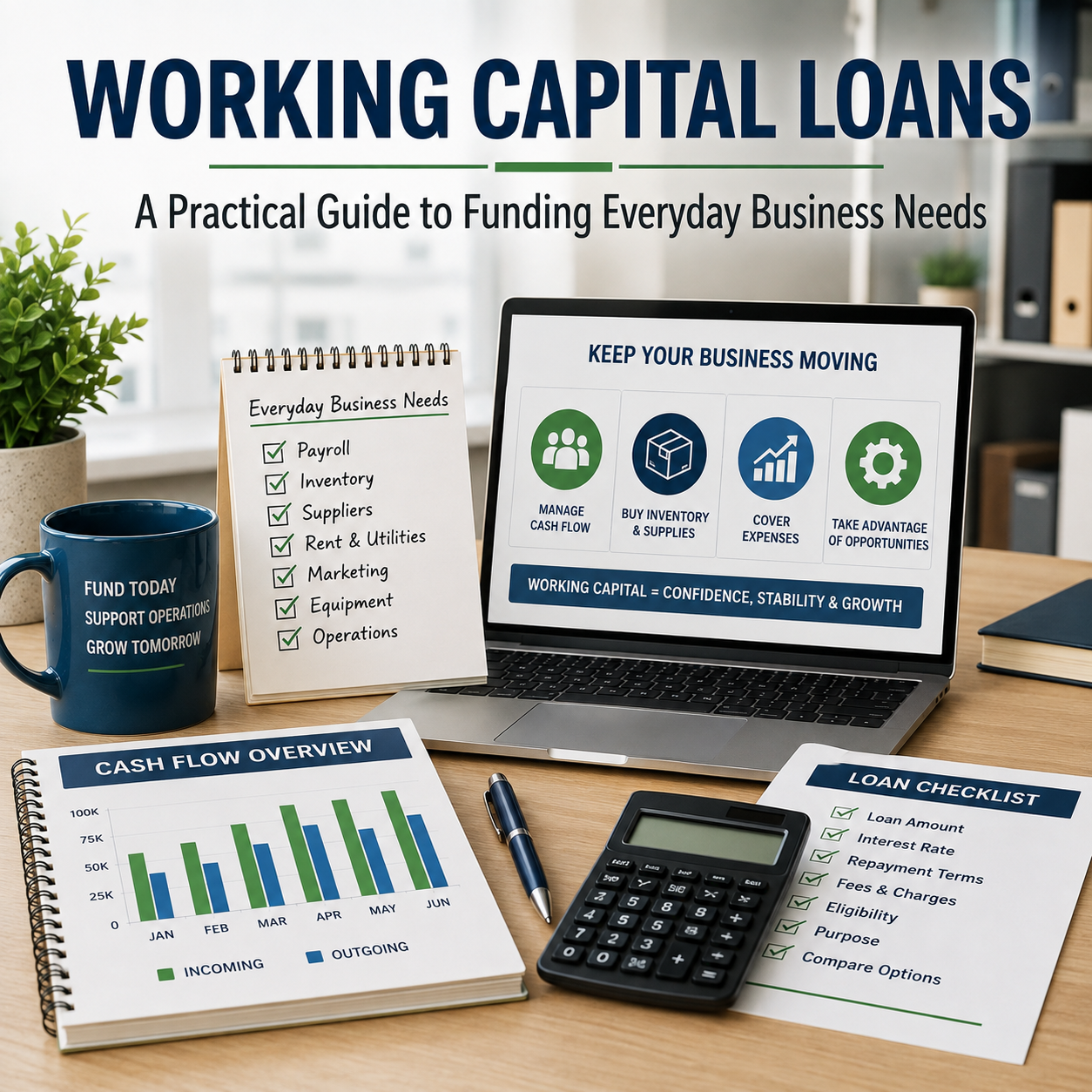
Working capital loans can help a business handle everyday operating expenses when cash coming in does not arrive at the same time as cash going out. They may be considered for inventory, payroll timing, supplier bills, seasonal expenses, delayed receivables, or other short-term business needs.
But working capital loans should not be treated as automatic solutions to every cash shortage. A useful financing decision starts by identifying why the cash gap exists, how long it should last, what the funding will accomplish, and whether future business cash flow can comfortably support repayment.
The strongest comparison looks beyond approval speed and the amount offered. Business owners should examine total repayment, fees, repayment frequency, financing term, collateral or guarantee requirements, and what happens to ordinary operating cash after payments begin.
For a broader overview of available funding structures, Kevanzo’s guide to business financing explains how different forms of business funding can serve different purposes.
Educational note: Kevanzo.com provides general business-financing education only. Kevanzo is not a lender, broker, loan marketplace, financial adviser, attorney, accountant, or approval service. Rates, APRs, fees, repayment terms, eligibility requirements, collateral requirements, guarantees, and funding availability vary. Always review the complete financing agreement before accepting business financing.
What Working Capital Loans Mean
Working capital loans are financing arrangements generally used to support normal business operations rather than major long-term investments such as purchasing commercial real estate.
Typical operating uses may include:
- inventory
- payroll timing
- supplier invoices
- rent
- utilities
- seasonal expenses
- marketing
- short-term project costs
- delayed customer payments
- temporary cash-flow gaps
The important word is temporary.
A business can be profitable and still experience a working-capital shortage.
For example, a contractor may have completed profitable work but be waiting 45 days for a customer invoice to be paid. A retailer may need inventory several weeks before its strongest selling season. A wholesaler may need to pay suppliers before customers settle their accounts.
In each case, money is expected to arrive—but the timing does not line up neatly with expenses.
Businesses wanting a more specialized explanation can also review working capital loans for small business.
The Most Important Working Capital Question
Before comparing working capital loans, determine whether the problem is primarily:
a cash-timing problem
or
a business-economics problem.
Those are very different situations.
Cash-Timing Problem
A business may have enough revenue and profit overall, but cash arrives later than expenses must be paid.
Examples include:
- customers paying on 30- or 60-day terms
- inventory purchased before a seasonal sales period
- project costs incurred before milestone payments
- temporary increases in staffing
- supplier bills becoming due before customer receipts
Working capital funding may help bridge that timing difference if the expected repayment source is reasonably clear.
Business-Economics Problem
A business may repeatedly run short of cash because:
- prices are too low
- margins are inadequate
- overhead is excessive
- inventory is poorly controlled
- sales have fallen
- customers consistently pay too slowly
- existing debt consumes too much cash
- some products or services lose money
Working capital loans can provide temporary relief, but they cannot permanently repair a business that consistently spends more cash than it generates.
That distinction should be made before another repayment obligation is added.
The Kevanzo Working Capital Gap Test
Before requesting working capital loans, answer these five questions.
1. What Is Causing the Gap?
Identify the exact reason cash is tight.
For example:
We need $35,000 to purchase seasonal inventory six weeks before customer sales are expected.
That is much stronger than:
We need extra working capital.
A specific explanation makes the financing easier to evaluate.
2. How Long Should the Gap Last?
Estimate when cash should begin returning to the business.
A six-week inventory gap is different from a cash shortage that has existed for 18 months.
If there is no realistic end point, additional borrowing deserves extra scrutiny.
3. What Will Repay the Financing?
Identify the expected repayment source.
Possible sources include:
- customer invoice payments
- seasonal sales
- contract revenue
- normal operating cash flow
- inventory sales
- increased production
- known receivables
The repayment source should be more specific than “future business growth.”
4. What Happens if Cash Arrives Late?
Working capital loans should be tested against delays.
Ask what happens if:
- the customer pays 30 days late
- sales are 20% below forecast
- inventory moves slowly
- a project is delayed
- an unexpected repair occurs
The business needs enough breathing room to handle ordinary uncertainty.
5. Does the Problem Keep Returning?
If the same funding shortage appears repeatedly, the underlying cause deserves attention.
Borrowing every few months to cover the same expenses may indicate a structural cash-flow problem rather than a temporary working-capital need.
Why Businesses Compare Working Capital Loans
Businesses compare working capital loans because financing offers can differ substantially even when the headline amount looks identical.
Consider two businesses both offered $50,000.
One offer may require monthly repayment over a longer period.
Another may require weekly payments over a shorter period.
Fees, interest, security requirements, guarantees, and prepayment provisions could also differ.
The amount received tells only part of the story.
The more useful questions are:
- How much will the business repay?
- How quickly must it repay?
- How frequently are payments required?
- How much cash remains after each payment?
- What happens during a weaker sales period?
- What collateral or guarantees are involved?
Working capital loans should therefore be compared as cash-flow obligations, not simply sources of cash.
Common Types of Working Capital Financing
Not every product marketed for working capital works the same way.
Some are loans. Others are revolving credit facilities or alternative forms of business funding.
Understanding the distinction helps business owners compare like with like.
Working Capital Term Loans
A term loan generally provides one amount that is repaid according to an agreed schedule.
A working capital term loan may be considered when the business has:
- a specific funding amount
- a defined operating purpose
- a reasonably predictable repayment source
- a preference for structured repayment
A term structure can make budgeting easier because the business knows the expected payment schedule.
However, the payment normally does not disappear simply because revenue falls.
That makes slow-month affordability important.
Business Lines of Credit
A business line of credit provides revolving access to funds up to an approved limit, subject to the agreement. An operating line of credit may be relevant when the recurring need relates directly to ordinary operating expenses.
Rather than borrowing the entire amount immediately, a business may be able to draw only what it needs.
A small business line of credit may deserve comparison when working-capital needs are recurring or difficult to predict.
Examples might include:
- recurring inventory purchases
- seasonal supplier costs
- temporary receivables delays
- emergency expenses
- uneven monthly operating cash
The flexibility can be useful.
The risk is that a revolving balance may never fully disappear if the business repeatedly draws more money.
Invoice-Related Financing
Some businesses experience working-capital pressure because customers pay invoices substantially later than the business pays its own expenses.
Invoice financing or factoring arrangements may therefore be worth comparing in some situations.
The business should still evaluate:
- financing cost
- customer-payment timing
- fees
- recourse or non-recourse provisions where applicable
- customer concentration
- effect on cash flow
Businesses should also ask whether stronger deposits, progress billing, or collection procedures could reduce the need for financing.
Cash Flow Financing
Businesses researching cash flow loans for small business are often dealing with the timing difference between incoming revenue and outgoing expenses.
Cash-flow funding and working capital loans can overlap considerably.
The important issue is not the product label.
The important issue is whether the repayment structure fits the way the business actually collects money.
Merchant Cash Advances Are Not the Same as Loans
This distinction matters.
A merchant cash advance is generally structured as a purchase of a portion of future business receivables rather than as a conventional loan.
Businesses comparing a small business cash advance should therefore avoid assuming its pricing works like ordinary loan interest.
Depending on the agreement, a merchant cash advance may use:
- a factor rate
- fixed withdrawals
- percentage-based collections
- daily or weekly remittances
- other revenue-connected arrangements
Because the structure differs from a traditional loan, compare the total amount delivered, total amount expected to be remitted, repayment method, estimated duration, and effect on daily cash flow.
The words used in marketing should never replace reading the actual agreement.
Working Capital Loans Versus Small Business Loans
Working capital loans sit inside the broader business-financing market.
The term small business loans can include financing for many purposes, including:
- operating expenses
- equipment
- expansion
- real estate
- inventory
- refinancing
- projects
- other eligible business needs
Working capital loans are more specifically associated with the money required to keep normal operations moving.
That difference helps explain why repayment timing is so important.
A long-term asset may generate value for many years.
Inventory purchased with working capital might be expected to convert into cash within months.
The financing structure should make sense relative to the economic life of the expense.
Working Capital Loans Versus Business Capital Financing
The term “capital” can be used broadly.
Businesses researching small business capital loans may be considering money for operations, growth, equipment, expansion, or other business requirements.
Working capital is narrower.
It focuses primarily on the resources available to meet shorter-term operational obligations.
When comparing funding, define the purpose before choosing the product label.
How Lenders May Evaluate Working Capital Loans
Lenders use different underwriting methods, but applicants for working capital loans may be reviewed using factors such as:
- business revenue
- cash flow
- bank-account activity
- credit history
- existing debt
- repayment history
- industry
- time in business
- profitability
- customer concentration
- receivables
- ownership information
- intended use of funds
- collateral
- guarantees
- repayment capacity
Revenue alone does not prove that a loan is affordable.
A company might generate $150,000 per month in revenue and still have very little cash left after payroll, suppliers, rent, taxes, insurance, and existing debt.
Another business may generate less revenue but retain a much larger operating cushion.
The repayment decision should therefore focus heavily on usable cash flow.
The Kevanzo Operating-Cushion Test
This is one of the most useful checks for working capital loans.
Start with the cash the business reasonably expects to collect during the repayment period.
Then subtract ordinary operating expenses.
Then subtract existing debt payments.
Then subtract the proposed new financing payment.
What remains is the business’s approximate operating cushion.
Consider a fictional example.
Monthly cash collected: $90,000
Normal operating expenses: $72,000
Existing debt payments: $5,000
Cash remaining before new financing: $13,000
Suppose the proposed working capital loan requires $6,000 per month.
After financing:
$90,000 collected
− $72,000 operating expenses
− $5,000 existing debt
− $6,000 new payment
= $7,000 remaining
That may look manageable.
Now assume customer collections decline by 10%.
Monthly cash collected becomes $81,000.
$81,000
− $72,000 operating expenses
− $5,000 existing debt
− $6,000 financing payment
= $2,000 shortfall
The loan did not change.
The operating conditions did.
That is why working capital loans should be tested against weaker months rather than evaluated only against average revenue.
Working Capital Loans and the Cash Conversion Cycle
A business can make sales without immediately receiving cash.
The time between paying for business inputs and collecting money from customers can create working-capital pressure.
Consider a simple retail cycle:
- The business purchases inventory.
- The supplier must be paid.
- Inventory sits on the shelf.
- A customer buys the inventory.
- The business finally receives the sale proceeds.
The longer this process takes, the longer business cash is tied up.
A business-to-business company may experience an even longer delay because customers receive invoices and pay later.
Working capital loans may help bridge part of this cycle, but the financing should be judged against the expected time required for cash to return.
Comparing Interest, APR, Fees and Total Repayment
The cost of working capital loans can appear in several forms.
Depending on the lender and product, the agreement may include:
- interest
- APR
- origination fees
- documentation fees
- maintenance fees
- draw fees
- servicing fees
- late-payment charges
- prepayment conditions
- other financing costs
Not every financing product uses the same pricing method.
That makes total repayment particularly important.
Ask:
How much usable money will the business receive?
and
How much money will ultimately leave the business under the agreed repayment schedule?
Those numbers help put different offers into perspective.
The Kevanzo Six-Number Working Capital Comparison
For every serious offer, record these six numbers.
1. Gross Funding Amount
How much financing is being approved?
2. Net Amount Received
How much money actually reaches the business after upfront deductions?
3. Scheduled Total Repayment
How much is expected to be repaid if the agreement runs according to schedule?
4. Payment Amount
How much is required each payment period?
5. Payment Frequency
Are payments daily, weekly, biweekly, monthly, or on another schedule?
6. Cash Remaining After Payment
How much operating cash should remain after normal expenses and financing payments?
That sixth number can be more important than the first.
Worked Example: Same Funding, Different Cash Pressure
Consider a fictional business that needs $40,000 for seasonal inventory.
These are hypothetical examples only.
Option A
Net funding received: $40,000
Scheduled repayment: $47,000
Repayment period: 10 months
Illustrative monthly repayment: $4,700
Option B
Net funding received: $40,000
Scheduled repayment: $50,400
Repayment period: 18 months
Illustrative monthly repayment: $2,800
Option A has the lower scheduled total repayment in this simplified example.
Option B has the lower monthly payment.
Which is better?
There is not enough information to answer yet.
The business must compare:
- expected inventory sales
- margins
- other operating expenses
- payment timing
- available cash reserves
- downside risk
- contractual terms
This demonstrates why working capital loans should not be compared using one number alone.
Short-Term Working Capital Loans
Working capital needs are often relatively short-lived, so businesses may compare a short term business loan with other funding options.
A shorter repayment period may have advantages when:
- the need is temporary
- the repayment source is clear
- revenue should arrive quickly
- the business wants the debt cleared sooner
But shorter repayment can increase pressure.
For example, repaying $30,000 over six months creates a very different operating burden from repaying the same principal over two years.
Shorter does not automatically mean safer.
Longer does not automatically mean cheaper.
The right comparison considers both total cost and repayment pressure.
Secured and Unsecured Working Capital Loans
Working capital loans may be secured or unsecured depending on the lender and product.
Secured financing may involve:
- receivables
- inventory
- equipment
- other business assets
- additional collateral
Unsecured financing may not require a specifically pledged asset in the same way, but obligations may still include:
- personal guarantees
- general liens
- collection rights
- default provisions
- other contractual protections
“Unsecured” should never be interpreted as “no consequences.”
Before accepting financing, understand exactly what happens if the business cannot meet the agreed repayment terms.
Existing Debt Changes the Working Capital Calculation
A new financing payment does not exist in isolation.
A business may already have:
- equipment financing
- credit-card balances
- business loans
- lines of credit
- vehicle financing
- leases
- supplier obligations
- tax payment arrangements
Adding another payment can reduce flexibility quickly.
Businesses with several existing obligations may also research business debt consolidation loans, but consolidation should not be assumed to solve the underlying problem.
A new arrangement only improves the position if its overall cost, repayment structure, and risk genuinely make sense.
Moving several debts into one payment does not automatically make the debt cheaper.
Five Working Capital Scenarios
Scenario 1: Seasonal Retailer
A retailer needs $60,000 of inventory before an important sales season.
The owner expects most inventory to sell within four months.
Before choosing working capital loans, the retailer should calculate:
- expected sales
- expected gross margin
- inventory turnover
- supplier costs
- repayment start date
- required periodic payment
- effect of unsold stock
A useful downside test would assume sales are weaker than expected.
If repayment becomes impossible when 20% of inventory sells late, the financing may be too aggressive.
Scenario 2: Contractor Waiting for a Progress Payment
A contractor has completed a project stage but must wait several weeks for the next customer payment.
Meanwhile:
- employees must be paid
- subcontractors need payment
- materials for the next stage are required
Working capital loans may help bridge the timing gap.
However, the contractor should examine what happens if the customer payment is delayed another 30 days.
The strength of the receivable matters as much as the immediate need for cash.
Scenario 3: Service Business With a Payroll Gap
A service business has recurring clients and steady annual revenue but experiences a temporary mismatch between payroll and receivables.
The business needs $20,000.
If a lender offers $50,000, taking the maximum amount could create unnecessary cost.
The better approach is to identify the actual gap and borrow accordingly.
Scenario 4: Restaurant After an Equipment Failure
A restaurant experiences an unexpected equipment failure.
Repairs and replacement costs reduce the cash available for ordinary expenses.
Working capital financing could provide temporary operating support while the restaurant restores normal trading.
For a broader industry-specific comparison, see Kevanzo’s restaurant financing guide.
The owner should still compare expected margins and repayment obligations rather than making the decision based only on urgency.
Scenario 5: Business With a Permanent Cash Shortage
A business runs short of cash every month.
It borrows to pay suppliers, then needs another loan to cover payroll, then considers additional financing to make previous payments.
This is no longer simply a timing problem.
Management should investigate:
- pricing
- margins
- overhead
- inventory
- receivables
- customer profitability
- existing debt
- operating efficiency
Working capital loans cannot indefinitely fund an unsustainable gap.
Working Capital Loans Versus Flexible Credit
Working capital loans and revolving credit can solve different problems.
A fixed loan may be appropriate when:
- the amount needed is known
- the purpose is defined
- the business wants predictable repayment
A credit line may make more sense when:
- funding needs repeat
- exact timing is uncertain
- the amount required changes
- the business wants to draw only when needed
Neither is automatically better.
Business owners researching the wider small business financing market should compare the financing structure against the actual business need rather than choosing solely by product name.
Working Capital Loans Red Flags
Consider slowing down if several of these warning signs appear:
- the business cannot clearly explain why it needs the funding
- the same cash shortage returns every month
- repayment depends on unusually optimistic sales
- the business already struggles with existing payments
- total repayment is unclear
- fees are difficult to understand
- repayment frequency does not match the revenue cycle
- collateral provisions are unclear
- personal guarantee language is not understood
- the business is being pressured to sign immediately
- the amount offered is much larger than the amount needed
- the business has not compared another realistic option
- the payment works only during strong sales periods
- the funding mainly postpones an existing debt problem
Working capital loans should improve financial flexibility, not remove it.
Questions to Ask Before Accepting Working Capital Loans
Before accepting an offer, obtain clear answers to questions such as:
- What amount will the business actually receive?
- What is the scheduled total repayment?
- What interest rate or other pricing method applies?
- What APR is disclosed where applicable?
- What fees are charged?
- How frequently are payments required?
- When does repayment begin?
- How long is the repayment term?
- Can payments change?
- Is collateral required?
- Is a personal guarantee required?
- Is a general lien involved?
- What constitutes default?
- What happens after a missed payment?
- Does early repayment reduce the cost?
- Are there prepayment penalties or conditions?
- Are renewal fees involved?
- Can the business obtain additional financing?
- How are disputes handled?
- What documents explain the complete obligation?
If the borrower cannot explain the agreement in plain English, more review is needed.
Documents to Prepare Before Applying
Lenders considering working capital loans may request different documentation.
Possible information includes:
- business bank statements
- profit and loss statements
- balance-sheet information
- tax documents
- revenue records
- accounts receivable
- accounts payable
- existing debt information
- ownership details
- business identification
- collateral information
- explanation of the funding purpose
Requirements vary by lender and financing product.
Preparing these records also helps the business owner understand the company’s financial position before taking on new debt.
When Working Capital Loans May Not Be the Best Solution
Before borrowing, consider whether another action could reduce the cash requirement.
Possible alternatives include:
- collecting invoices faster
- requesting customer deposits
- introducing progress billing
- negotiating longer supplier terms
- reducing excess inventory
- delaying discretionary purchases
- selling unused assets
- improving pricing
- reviewing unprofitable products
- reducing recurring overhead
- using existing cash reserves where appropriate
- delaying a project
These alternatives can have their own costs.
The purpose is not to avoid borrowing at all costs.
It is to compare working capital loans against realistic alternatives rather than assuming debt is the only available answer.
The Kevanzo 12-Point Working Capital Loans Check
Before accepting working capital loans, complete this final review.
1. Funding Purpose
What exact operating need will the money cover?
2. Gap Duration
How long should the working-capital shortage last?
3. Amount Required
Is the business borrowing only what it reasonably needs?
4. Repayment Source
What future cash should repay the financing?
5. Net Funding
How much usable money will actually reach the business?
6. Total Repayment
How much is expected to leave the business?
7. Payment Frequency
How often must repayments be made?
8. Operating Cushion
How much cash remains after the new payment?
9. Slow-Month Test
Can the business still pay if revenue or collections weaken?
10. Security and Guarantees
What collateral, liens, or personal obligations are involved?
11. Alternatives
Has another realistic financing or non-financing solution been considered?
12. Written Agreement
Does the business understand the actual contract?
If several answers remain uncertain, the comparison is not finished.
Practical Next Steps for Comparing Working Capital Loans
Start with the business problem.
Write down:
- the amount needed
- the exact use of funds
- when the money is required
- when the business expects cash to return
- where repayment will come from
Next, compare only funding structures that genuinely match that problem.
Record each offer using the same categories:
- net amount received
- total repayment
- fees
- APR where applicable
- payment amount
- payment frequency
- repayment term
- collateral
- guarantees
- prepayment terms
- default provisions
Then run the operating-cushion test.
Ask what happens during a normal month, a slower month, and a significantly weaker month.
Finally, review the complete agreement.
The objective is not merely to qualify for working capital loans.
The objective is to choose financing that solves a defined operating need without creating a larger cash-flow problem after the money arrives.
Final Takeaway
Working capital loans can help a business bridge temporary operating gaps involving inventory, payroll timing, suppliers, seasonal expenses, or delayed customer payments. Their value depends on whether the cash shortage is temporary and whether the business has a realistic source of repayment.
Before accepting working capital loans, compare total repayment, fees, payment frequency, repayment term, collateral or guarantees, and how much operating cash remains after payments begin.
Most importantly, determine whether financing is solving a timing problem or repeatedly covering an underlying business problem. Good working-capital funding should improve financial flexibility rather than create another cash shortage.
Frequently Asked Questions About Working Capital Loans
What Are Working Capital Loans Used For?
Working capital loans are generally used for everyday operating requirements such as inventory, payroll timing, supplier bills, seasonal expenses, temporary receivables gaps, and other short-term business costs.
Permitted uses depend on the lender and financing agreement.
Are Working Capital Loans the Same as Regular Business Loans?
Working capital loans are a type of business financing, but the broader business-loan category can include financing for equipment, property, expansion, refinancing, and other purposes.
Working-capital financing is primarily associated with normal operating needs and cash-flow timing.
Can Working Capital Loans Help a Profitable Business?
Yes, a profitable business can still experience temporary cash-flow pressure.
For example, customers may pay invoices after payroll and suppliers become due.
Profitability alone does not guarantee that cash is available at the exact time expenses must be paid.
How Do Lenders Evaluate Working Capital Loans?
Lenders may review revenue, cash flow, credit history, bank activity, existing debt, repayment history, industry, time in business, collateral, guarantees, and the intended use of funds.
Requirements vary substantially.
Is a Lower Payment Always Better?
No.
A lower periodic payment may result from a longer repayment period and could increase total borrowing cost.
Both total repayment and periodic affordability should be compared.
Are Unsecured Working Capital Loans Risk-Free?
No.
Unsecured financing may still involve guarantees, liens, collection rights, fees, and significant repayment obligations.
Read the complete agreement.
Is a Line of Credit Better Than a Working Capital Loan?
Neither option is automatically better.
A fixed loan may suit a defined funding requirement. A line of credit may suit recurring or unpredictable short-term needs.
Cost, flexibility, repayment timing, and business purpose determine which structure deserves consideration.
Are Merchant Cash Advances Working Capital Loans?
A merchant cash advance may be marketed as working-capital funding, but it is generally structured differently from a conventional business loan.
Businesses should carefully compare the amount received, factor rate or pricing method, total amount remitted, repayment method, and cash-flow effect.
Can Working Capital Loans Help During a Slow Season?
They may help some seasonal businesses bridge a known timing gap.
However, borrowing during a weak period creates risk if there is no realistic repayment source once payments begin.
What Is the Biggest Risk With Working Capital Loans?
A major risk is solving today’s cash shortage while creating a repayment obligation that weakens tomorrow’s operating cash.
That is why repayment capacity and the slow-month test matter.
Should a Business Compare More Than One Offer?
Comparing realistic alternatives can reveal important differences in total cost, repayment frequency, term, fees, collateral requirements, guarantees, and flexibility.
How Much Working Capital Should a Business Borrow?
The amount should ideally be based on a defined operating need and realistic repayment plan rather than the maximum amount a lender is willing to provide.
Helpful Authoritative Resources
- U.S. Small Business Administration loan programs
- U.S. Small Business Administration business counseling and guides
- Consumer Financial Protection Bureau small business lending resources
- Federal Trade Commission small business guidance
- SCORE small business mentoring and resources
Author Bio
Kevanzo Editorial Team
Kevanzo Editorial Team creates practical, plain-English educational resources for U.S. small business owners comparing working capital loans, business financing, repayment structures, borrowing costs, cash-flow needs, and responsible funding decisions.
Copyright Notice
© 2026 Kevanzo. All rights reserved.
This article is protected by copyright and may not be copied, scraped, spun, republished, or used commercially without prior written permission from Kevanzo. Brief quotations may be used with clear attribution and a link to the original article.
Educational Disclaimer
Kevanzo.com provides general educational information about business financing. Kevanzo is not a lender, broker, loan marketplace, financial adviser, attorney, accountant, or approval service.
Nothing in this article constitutes financial, legal, tax, accounting, investment, lending, or personalized business advice. Rates, APRs, fees, repayment terms, eligibility requirements, collateral requirements, guarantees, funding availability, and financing products vary by lender, borrower, industry, revenue, credit history, and business profile.
Business owners should review current official information, read financing agreements carefully, and consider obtaining advice from appropriately qualified professionals when necessary before making a borrowing decision.