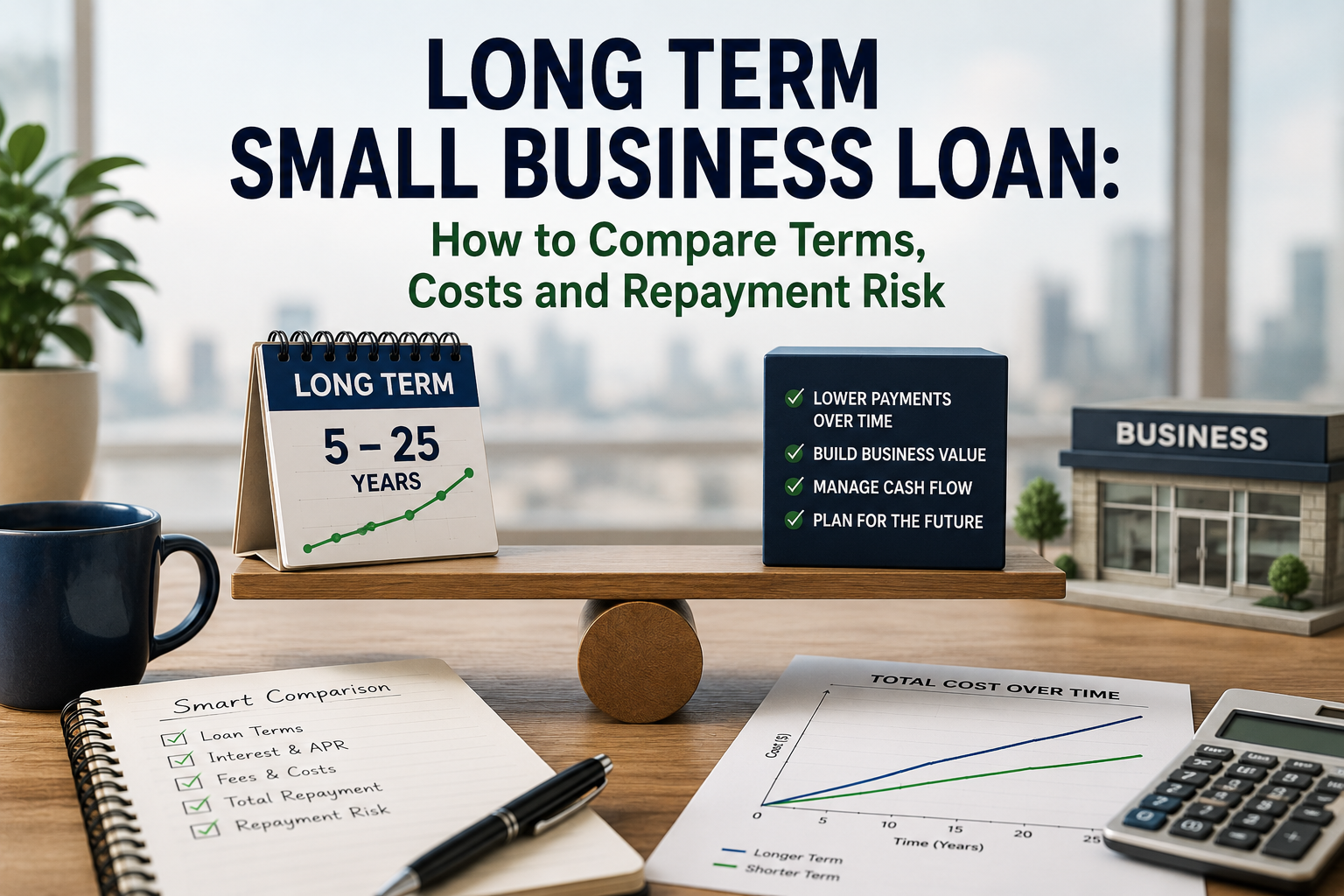
A long term small business loan can spread the cost of a major business investment over a longer repayment period, potentially reducing the pressure created by each scheduled payment.
That can make long-term financing attractive when a business needs money for:
- commercial real estate
- major equipment
- renovations
- expansion
- business acquisition
- substantial infrastructure
- refinancing eligible existing debt
- other investments expected to create value for several years
But a longer repayment period does not automatically make financing cheaper or safer.
It can produce a lower scheduled payment while keeping the business in debt longer and potentially increasing the total amount of interest or financing cost paid over the life of the loan.
That creates the central question for any long term small business loan:
Will the business asset, project or investment create useful economic value for at least as long as the financing obligation remains?
If the answer is yes, a longer repayment structure may make sense.
If a business is stretching a short-term cash problem across many years simply to make the payment appear affordable, the financing structure deserves another look.
Business owners comparing the wider financing market can begin with Kevanzo’s small business loans guide.
Educational note: Kevanzo.com provides general business-financing education only. Kevanzo is not a lender, broker, loan marketplace, financial adviser, attorney, accountant or approval service. Interest rates, APRs, fees, repayment terms, collateral requirements, guarantees, prepayment conditions, eligibility requirements and available financing products vary. Always review the complete financing agreement before accepting business funding.
What Is a Long Term Small Business Loan?
A long term small business loan generally refers to business financing repaid over an extended period rather than within a short operating cycle.
There is no single universal number of years that makes every business loan “long term.”
The appropriate duration depends partly on:
- financing type
- lender
- asset being financed
- useful life of the asset
- repayment ability
- collateral
- loan program
- business purpose
The underlying idea is straightforward.
The business receives financing today and repays it gradually from future business cash flow.
The longer schedule can make each payment easier to absorb, but repayment continues for a greater period.
The Most Important Rule: Match the Loan to the Life of the Need
Long-term financing works best when the reason for borrowing also has long-term economic value.
Suppose a business purchases machinery expected to operate productively for ten years.
Financing that equipment over several years may make economic sense because:
the asset continues producing value while the business continues repaying it.
Now imagine the same business borrows for many years simply to cover one month of payroll.
The payroll expense disappears almost immediately.
The debt remains.
That is a poor term-to-purpose match.
The Kevanzo Benefit-Life Match
Before comparing a long term small business loan, write down:
Financing Purpose
Exactly what is being purchased or funded?
Expected Useful Life
How long should the expenditure benefit the business?
Proposed Loan Term
How long will repayment continue?
Then compare them.
A strong structure usually keeps the financing period reasonably connected to the period in which the funded investment creates business value.
Example: Equipment
Equipment cost:
$180,000
Expected useful business life:
10 years
Proposed financing term:
7 years
The asset may continue producing value after the debt has been repaid.
That is a reasonably understandable relationship.
Now consider:
Equipment useful life:
4 years
Proposed financing term:
10 years
The business could still be repaying financing years after the equipment needs replacement.
That deserves caution.
Example: Commercial Improvements
A business spends:
$250,000
on substantial location improvements expected to support operations for many years.
Longer financing may better match that investment than a very short loan requiring unusually heavy payments.
The correct term still depends on:
- projected cash flow
- total cost
- lease duration where relevant
- useful life of improvements
- security
- lender requirements
Long Term Small Business Loan Versus Short-Term Financing
A short-term business loan generally places repayment into a much shorter period.
That can create:
Higher Scheduled Repayment Pressure
More principal must be repaid in less time.
Shorter Debt Exposure
The obligation may disappear sooner.
Potentially Different Total Financing Cost
Depending on the rate, fees and structure.
A long term small business loan often creates the opposite tradeoff:
Lower Scheduled Payment Pressure
Repayment is spread across more time.
Longer Debt Exposure
The business remains obligated for longer.
Potentially Greater Total Interest
Because interest may accrue across a longer repayment period.
Neither approach automatically wins.
The Kevanzo Term Tradeoff
Every term decision contains two competing forces:
shorter term → heavier payment + faster payoff
versus:
longer term → lighter payment + slower payoff
The goal is not to automatically choose either extreme.
The goal is to find a repayment period that:
- protects operating cash flow
- does not unnecessarily extend debt
- matches the funded purpose
- keeps total financing cost reasonable
Payment Size Can Be Misleading
Imagine a business comparing two hypothetical loans.
Loan amount:
$200,000
Option A
Shorter repayment term
Monthly payment:
higher
Option B
Longer repayment term
Monthly payment:
lower
Option B may immediately look more affordable.
But that does not answer:
- total interest
- total repayment
- fees
- collateral exposure
- prepayment conditions
- how long debt remains outstanding
Never choose a long term small business loan solely because the monthly payment is smaller.
The Kevanzo Payment-versus-Total-Cost Test
For each offer write down:
Monthly Payment
What leaves the business each month?
Number of Payments
For how long?
Total Scheduled Repayment
What should the company pay over the entire term if the loan remains outstanding as scheduled?
Upfront Fees
What is paid or deducted at closing?
Other Costs
What other required expenses apply?
Then compare the complete obligation.
Why Longer Terms Can Increase Total Interest
Consider a simplified example.
Two loans have:
- the same principal
- the same stated annual interest rate
But one is repaid much more slowly.
The longer loan generally allows interest to accrue over more time.
That can result in:
lower monthly payments but higher total interest paid.
This is one of the most important tradeoffs in long-term financing.
The Kevanzo Term-Cost Question
Ask:
How much additional total financing cost are we accepting in exchange for reducing the scheduled payment?
Sometimes that trade is sensible.
For example, protecting healthy operating liquidity may be more valuable than aggressively paying debt down.
Other times the longer term simply creates unnecessary cost.
Put an actual number on the tradeoff.
Monthly Payment Is Not the Same as Affordability
A lender may offer a payment the business can technically make.
That does not necessarily mean it fits comfortably.
The company must still pay:
- wages
- payroll taxes
- suppliers
- rent
- insurance
- utilities
- inventory
- maintenance
- other loans
- taxes
- unexpected expenses
The loan payment must fit into that larger picture.
The Kevanzo Debt-Service Cushion
Start with the cash available for debt repayment after essential business expenses.
Then subtract the proposed loan payment.
Example:
Monthly operating cash available before new debt:
$22,000
New monthly loan payment:
$8,000
Remaining cushion:
$14,000
Now stress-test that amount.
If operating cash falls to:
$12,000
the same $8,000 payment leaves only:
$4,000
The loan did not change.
The business did.
That is why affordability needs a cushion.
The Three-Condition Long-Term Loan Stress Test
Before accepting a long term small business loan, test three operating conditions.
Condition 1: Normal
Revenue and expenses perform approximately as expected.
Can the business comfortably make payments?
Condition 2: Slow
Revenue declines or expenses increase moderately.
Can the business still pay:
- employees
- suppliers
- taxes
- rent
- debt?
Condition 3: Difficult
Revenue falls substantially or an unexpected major expense occurs.
Can the company still service the loan without immediately requiring additional borrowing?
A loan intended to remain for years deserves more than a one-month affordability test.
Think in Years, Not Just Months
One mistake with long-term financing is basing the decision almost entirely on today’s business performance.
A long term small business loan may still exist several years from now.
Consider what could change during that time:
- customers
- competition
- interest rates
- supplier pricing
- wages
- technology
- equipment needs
- lease costs
- business ownership
- economic conditions
Nobody can forecast all of these perfectly.
The goal is not prediction.
The goal is resilience.
The Kevanzo Long-Horizon Test
Ask:
Would this loan still be manageable if the business became moderately weaker than it is today?
Then ask:
Would the funded asset or project still be useful?
Finally:
Would we regret having this debt if the expected growth takes twice as long to arrive?
These questions counter overly optimistic planning.
Long Term Small Business Loan for Equipment
A long term small business loan can be particularly well suited to equipment when the asset is expected to remain productive for many years.
Examples can include:
- manufacturing machinery
- construction equipment
- production systems
- commercial kitchen equipment
- specialized tools
- certain business technology
The financing term should be compared with:
- equipment life
- maintenance requirements
- replacement cycle
- resale value
- productivity
- expected income generated
The Kevanzo Equipment-Payback Test
For an equipment purchase estimate:
Equipment Cost
Example:
$150,000
Expected Annual Economic Benefit
Potentially from:
- increased production
- reduced labor cost
- reduced downtime
- additional revenue
Expected Useful Life
How long should it remain productive?
Annual Debt Requirement
How much cash must support financing?
The important question is not whether the business can buy the equipment.
It is whether the equipment creates enough durable business value to justify the debt.
Long Term Small Business Loan for Expansion
Expansion can include:
- opening another location
- increasing production capacity
- renovating facilities
- adding substantial infrastructure
- acquiring another operation
Expansion borrowing deserves conservative assumptions.
Growth projects often involve costs before revenue arrives.
A long term small business loan may suit expansion when the investment is expected to create lasting business value and the repayment schedule allows enough time for the project to mature.
A new location may require:
- construction
- equipment
- deposits
- hiring
- inventory
- marketing
- opening expenses
before reaching full operating capacity.
The Kevanzo Growth-Lag Test
Estimate:
When does spending begin?
Then:
When should new revenue begin?
Then:
When should the project generate enough cash to support its debt?
There may be a meaningful gap.
A business should not assume expansion produces full revenue immediately.
Long Term Small Business Loan Versus Small Business Capital Loans
Small business capital loans cover the broader decision of obtaining capital for growth, equipment, operating requirements and major business costs.
A long term small business loan focuses more specifically on the repayment horizon.
The core question becomes:
Does this business purpose justify carrying debt for an extended period?
For major assets and long-lived projects, that can be a very important distinction.
Long Term Small Business Loan Versus Working Capital Term Loan
A working capital term loan generally focuses more directly on operating-capital requirements.
That might include:
- inventory
- seasonal costs
- operating expenses
- temporary working-capital needs
Longer-term financing may be less appropriate when the original need disappears quickly.
Suppose inventory turns into sales within 90 days.
Financing that one inventory cycle for many years may create unnecessary debt duration.
Long Term Small Business Loan Versus Business Line of Credit
A business line of credit provides revolving borrowing capacity rather than one fixed lump-sum advance.
A line can make more sense when financing needs:
- repeat
- vary in size
- appear unpredictably
- can be repaid from short operating cycles
A long term small business loan can make more sense when the company knows:
- the amount needed
- the exact purpose
- the investment horizon
- the repayment plan
Long Term Small Business Loan Versus Working Capital Loans
Working capital loans generally focus on funding everyday operating requirements rather than major long-lived assets.
For example:
Short Need
Inventory for a 90-day selling cycle.
Long Need
A facility expected to support the business for 15 years.
Those purposes should not automatically receive the same financing structure.
Fixed Interest Versus Variable Interest
A long term small business loan may use fixed or variable pricing depending on the lender and product.
Fixed Rate
The interest rate generally remains unchanged according to the agreement.
This can make future payments easier to forecast.
Variable Rate
The interest rate can change according to an underlying benchmark or contractual formula.
That means future payment or interest expense may change.
Neither is universally better.
The key is knowing which risk the business is accepting.
The Kevanzo Rate-Risk Test
If the loan uses variable interest, calculate affordability under:
Current Rate
Today’s payment.
Moderately Higher Rate
A realistic stress case.
Significantly Higher Rate
A stronger stress case.
The purpose is not to predict future interest rates.
It is to determine whether the business has enough margin for change.
Secured Long-Term Financing
A long term small business loan may be secured by assets.
Possible collateral can include:
- real estate
- equipment
- business assets
- other property permitted under the agreement
Security may affect the lender’s willingness to provide financing.
It also creates borrower risk.
If the company fails to meet the loan agreement, pledged assets may be exposed according to applicable law and contract terms.
The Kevanzo Collateral Exposure Test
For every secured loan write down:
What Is Pledged?
List the assets.
What Is Their Business Importance?
Could the company operate without them?
What Is Their Approximate Value?
Understand the scale of exposure.
What Happens After Default?
Read the agreement.
Do not treat collateral as paperwork.
It represents real business property.
Unsecured Long-Term Business Loans
Some businesses may compare unsecured business loans when they do not want financing tied to a particular pledged asset.
Unsecured does not mean risk-free.
Depending on the agreement, lenders may still rely on:
- credit quality
- business cash flow
- guarantees
- contractual rights
- business performance
Pricing and terms may also differ from secured financing.
Personal Guarantees
Some business financing requires owners to personally guarantee repayment obligations.
A personal guarantee can increase the owner’s exposure beyond the operating company.
Before signing one, determine:
- who guarantees the debt
- what amount is covered
- what events trigger liability
- whether the guarantee is limited or broad
- when it ends
If the wording is unclear, appropriate professional review may be worthwhile.
Amortization
Many term loans use amortization.
Each scheduled payment may contain:
- interest
- principal
Over time, the balance declines according to the repayment schedule.
Understanding amortization helps explain why:
- early payments may contain substantial interest
- principal declines over time
- early payoff amounts differ from simply adding remaining payments
Business owners should review the lender’s actual amortization schedule where available.
Loan Term Versus Amortization Period
These terms can sometimes differ.
For example, financing might use a repayment calculation based on one period but mature earlier.
That can potentially create a larger amount due at maturity.
Do not automatically assume:
monthly payment × number shown in an advertisement = the complete contractual structure.
Ask whether the loan:
- fully amortizes
- contains a balloon payment
- requires refinancing at maturity
- has another final-payment structure
The Kevanzo Maturity Check
Before accepting a long term small business loan, ask:
- When does the loan mature?
- When does the amortization schedule end?
- Are those dates identical?
- Is any balloon payment due?
- What balance is expected at maturity?
This avoids unpleasant surprises years later.
Prepayment Matters
A business may become able to repay financing early.
That can happen because:
- revenue grows
- an asset is sold
- the company refinances
- excess cash accumulates
Early repayment may reduce future interest in some structures.
But prepayment provisions vary.
A loan may contain:
- no prepayment penalty
- declining prepayment penalties
- fixed charges
- other restrictions or calculations
Review the agreement.
The Kevanzo Early-Payoff Test
Ask the lender:
Can the Loan Be Repaid Early?
Yes or no?
What Is the Payoff Amount?
How is it calculated?
Are There Penalties?
If yes, how much and for how long?
How Much Interest Would Be Avoided?
Compare the economics.
Flexibility has value in a long-term agreement.
Refinancing Existing Business Debt
Longer-term financing may sometimes be used to refinance eligible existing obligations.
That can potentially:
- reduce payment pressure
- simplify repayment
- alter interest cost
- extend maturity
But extending debt can create a trap.
A lower payment does not automatically mean the refinancing is cheaper.
The Kevanzo Refinance Reality Check
Compare:
Current Remaining Debt
How much is owed?
Current Remaining Cost
What is expected if the existing financing continues?
New Loan Amount
Including any refinanced fees or costs.
New Payment
Is it lower?
New Term
How much longer will debt continue?
New Total Cost
What does the replacement financing ultimately cost?
The key question is:
Are we genuinely improving the financing or merely extending it?
Current SBA 7(a) Long-Term Financing
The U.S. Small Business Administration’s 7(a) program is its primary small-business loan program.
Eligible uses currently include:
- acquiring or improving real estate
- machinery and equipment
- short- and long-term working capital
- refinancing certain business debt
- furniture, fixtures and supplies
- ownership changes
- multiple-purpose financing
SBA currently states that 7(a) terms are generally 10 years or less, except where real estate or certain equipment with a longer useful life supports a longer maturity. Real-estate financing can extend to 25 years, subject to SBA program rules and lender underwriting.
A 7(a) loan is made through a participating lender rather than directly by SBA.
SBA 504 Financing
The SBA 504 program is designed primarily for major fixed assets.
SBA currently lists available 504 maturities of:
- 10 years
- 20 years
- 25 years
504 financing is commonly associated with qualifying commercial real estate and major equipment rather than general everyday working capital.
That demonstrates the importance of matching financing duration to asset life.
A long-lived property or substantial piece of equipment can justify a very different repayment structure from a short seasonal inventory gap.
A Long Term Small Business Loan Is Not Automatically an SBA Loan
This distinction is important.
“Long term small business loan” is a broad descriptive financing phrase.
It does not mean every long-term business loan:
- is SBA-guaranteed
- uses SBA terms
- has a 25-year maturity
- has government-set pricing
Banks, credit unions and other commercial lenders can offer business term financing outside SBA programs.
Always identify the actual product being offered.
APR and Interest Rate
Where APR is provided or required, it may help show certain financing costs in a standardized annualized form.
But businesses should never rely on one percentage alone.
Compare:
- stated rate
- APR where available
- origination fees
- closing costs
- documentation costs
- servicing charges
- total repayment
- prepayment terms
The most useful comparison combines rate information with actual dollars.
The Kevanzo Ten-Number Long-Term Loan Comparison
For every long term small business loan offer, record these ten numbers.
1. Loan Amount
How much is being borrowed?
2. Net Funds Received
How much usable cash reaches the business after deductions?
3. Interest Rate
Fixed or variable?
4. APR
Where provided or applicable.
5. Monthly Payment
What recurring cash obligation is created?
6. Loan Term
How many months or years?
7. Total Scheduled Repayment
How much is expected to be paid over the full term?
8. Fees and Closing Costs
What additional costs apply?
9. Early-Payoff Cost
What happens if the business repays early?
10. Remaining Monthly Cushion
How much operating cash remains after debt service?
These ten numbers are far more useful than comparing interest rate alone.
Purpose-to-Term Examples
Scenario 1: Manufacturing Equipment
Business needs:
$300,000
Equipment life:
approximately 12 years
The equipment should improve production capacity for many years.
Long-term financing may fit.
The business should compare:
- expected productivity
- maintenance
- resale value
- debt service
- total financing cost
Scenario 2: Commercial Property
A growing company wants to purchase a building it expects to occupy for many years.
The economic life of the property may justify a substantially longer financing horizon than ordinary working-capital borrowing.
The owner should still stress-test:
- occupancy needs
- property expenses
- maintenance
- taxes
- cash flow
- financing cost
Scenario 3: Major Renovation
A business invests:
$180,000
into improvements expected to support operations for ten years.
The owner should compare the financing term with:
- useful life of improvements
- lease term
- anticipated revenue
- total repayment
Scenario 4: One-Month Payroll Gap
A business is short:
$35,000
for payroll because a customer payment is delayed by 30 days.
A multi-year loan may solve the immediate shortage but create a long-lasting obligation for a temporary timing problem.
Other financing structures may fit better.
Scenario 5: Expansion Into a Second Location
The company expects the second location to take 18 months to reach mature revenue.
Long-term financing may provide a more realistic repayment horizon.
But the business should model:
- slower opening
- higher buildout cost
- weaker initial sales
- additional staffing
- debt service
Scenario 6: Refinancing Expensive Existing Debt
A business replaces several high-pressure obligations with one longer loan.
The monthly payment drops significantly.
That may help cash flow.
But the owner must calculate whether extending repayment dramatically increases total cost.
Scenario 7: Covering Ongoing Losses
A business loses:
$20,000 every month
and wants a five-year loan to cover normal expenses.
That is fundamentally different from financing an asset.
Unless the operating problem changes, the business may use the loan proceeds and still face the original monthly loss.
Long-term debt is not a substitute for fixing an unprofitable operation.
Long-Term Debt and Growth
A long term small business loan can support genuine business growth when the expected economic benefit extends well beyond the initial spending period.
But growth also creates risk.
A company may need money before growth produces cash.
Examples:
- employees hired before new revenue
- equipment installed before production
- premises opened before customers arrive
- inventory purchased before sales
The business should distinguish:
growth spending
from:
proven growth economics.
The Kevanzo Growth-Proof Test
Before borrowing for expansion ask:
What Evidence Supports Demand?
Existing orders?
Capacity constraints?
Customer contracts?
Historical sales?
When Does Revenue Arrive?
Realistically.
What Happens if Growth Is 25% Slower?
Can the loan still be serviced?
What Happens if Costs Are 20% Higher?
Does the project remain viable?
Borrowing should survive more than the optimistic forecast.
Existing Debt Matters
A new long term small business loan joins all existing obligations.
List:
- mortgages
- equipment loans
- credit lines
- vehicle finance
- credit cards
- tax payment plans
- other term loans
Then calculate the combined debt load.
A payment that looks manageable by itself may become uncomfortable when combined with everything else.
The Kevanzo Total-Debt Pressure Test
Calculate:
all existing scheduled business debt payments
plus:
proposed new loan payment
Then compare that total with cash available for debt service.
Do not evaluate financing in isolation.
Long-Term Debt Can Reduce Future Flexibility
A business may qualify comfortably today.
But years of scheduled payments can reduce its ability to borrow later.
Future needs might include:
- replacement equipment
- acquisition
- emergency repairs
- another location
- inventory
- economic downturn support
Taking too much long-term debt today can reduce tomorrow’s options.
The Kevanzo Future-Capacity Question
Ask:
If a major opportunity appeared two years from now, would this debt make financing it difficult?
Long-term financing should support future business strength rather than consume all available borrowing capacity.
What Lenders May Review
Depending on the loan and lender, underwriting may consider:
- business revenue
- profitability
- cash flow
- business bank activity
- credit history
- business credit
- personal credit
- existing debt
- time in business
- industry
- collateral
- management experience
- purpose of funds
- financial statements
- tax information
- projections
Requirements vary.
A business should prepare for long-term underwriting to examine whether repayment appears sustainable, not merely whether the business can make the first payment.
Documents Worth Preparing
Before requesting a long term small business loan, consider organizing:
- profit and loss statements
- balance sheets
- cash-flow information
- business tax records
- bank statements
- existing debt schedule
- ownership information
- business formation documents
- use-of-funds explanation
- equipment quotes
- purchase agreements where relevant
- property information where relevant
- financial projections for major expansion
Good preparation improves both lender review and the owner’s own decision-making.
Common Long Term Small Business Loan Mistakes
Choosing the Longest Term Automatically
Lower payments can hide higher total cost.
Choosing the Shortest Term Automatically
Aggressive repayment can unnecessarily damage working capital.
Ignoring Asset Life
Debt can outlive the thing it financed.
Ignoring Total Interest
Payment size is not total cost.
Ignoring Fees
Closing and origination costs matter.
Ignoring Variable-Rate Risk
Long repayment periods give rates more time to change.
Ignoring Collateral Exposure
Secured financing can place valuable assets at risk.
Ignoring Personal Guarantees
Understand owner exposure.
Ignoring Prepayment Rules
Future flexibility matters.
Ignoring Existing Debt
The business must support the entire debt stack.
Borrowing Based on Optimistic Growth
Stress-test expansion.
Financing Temporary Problems for Years
Short needs generally deserve short solutions.
Long Term Small Business Loan Red Flags
Investigate further when:
- the business cannot clearly explain the use of funds
- the debt lasts much longer than the funded asset
- affordability depends on perfect growth
- total repayment is unclear
- fees are unclear
- collateral terms are unclear
- personal guarantees are not understood
- variable-rate exposure has not been tested
- a large balloon payment exists
- refinancing will be necessary just to meet maturity
- repayment consumes most available operating cash
- the business already carries substantial debt
- the loan is covering persistent operating losses
- the owner is choosing the longest term solely for the lowest payment
Several red flags together deserve serious caution.
Questions to Ask Before Accepting a Long Term Small Business Loan
Ask:
- What is the exact loan amount?
- How much cash will the business actually receive?
- What is the interest rate?
- Is it fixed or variable?
- What APR is provided where applicable?
- What fees apply?
- What is the monthly payment?
- How long is the repayment term?
- What is the total scheduled repayment?
- When does repayment begin?
- What collateral is required?
- Is a personal guarantee required?
- Does the loan fully amortize?
- Is there a balloon payment?
- What is due at maturity?
- Can the loan be prepaid?
- Is there a prepayment penalty?
- How is early payoff calculated?
- What happens after late payment?
- What constitutes default?
- Can the rate change?
- How often can it change?
- Are covenants involved?
- What financial reporting is required?
- Can the lender call or accelerate the debt under defined circumstances?
- Are there restrictions on additional borrowing?
- What happens if collateral falls in value?
- Can existing debt be refinanced?
- Would another financing structure better match the purpose?
- What is the total dollar cost of choosing this term?
A long agreement deserves a thorough comparison.
The Kevanzo 20-Point Long Term Small Business Loan Check
Before accepting a long term small business loan, complete this review.
1. Purpose
What exactly is being financed?
2. Useful Life
How long should it create business value?
3. Loan Term
How long will debt remain?
4. Benefit-Life Match
Does useful life justify the term?
5. Amount Needed
Is the business borrowing only what it genuinely requires?
6. Net Cash
How much usable money will actually be received?
7. Interest Rate
Fixed or variable?
8. APR
What standardized annualized information is available where applicable?
9. Fees
What additional costs apply?
10. Monthly Payment
What cash obligation is created?
11. Total Repayment
What should the loan ultimately cost?
12. Debt-Service Cushion
How much cash remains after payment?
13. Stress Test
Can payments survive weaker operating conditions?
14. Collateral
What assets are exposed?
15. Guarantee
What owner obligations exist?
16. Amortization
Does the loan fully repay on schedule?
17. Maturity
Is any balance due at the end?
18. Prepayment
Can the business exit early economically?
19. Existing Debt
How does the loan affect the total debt burden?
20. Future Flexibility
Will the company still have financial room for future opportunities or problems?
If several answers remain unclear, the financing comparison is not finished.
Practical Next Steps
Start with the business purpose.
Write down exactly:
what is being financed
and:
how long it should benefit the business.
Then establish the maximum monthly payment the business can comfortably support.
Do not start with the maximum amount a lender may offer.
Next compare at least:
- loan amount
- net proceeds
- interest rate
- APR where available
- fees
- monthly payment
- term
- total repayment
- collateral
- guarantees
- prepayment
- maturity structure
Run the three-condition stress test.
Then compare the proposed loan with relevant alternatives through Kevanzo’s broader small business financing resources.
Finally, ask:
Are we choosing this term because it genuinely matches the business investment—or simply because it produces the smallest payment?
That single question can expose a weak financing decision very quickly.
Final Takeaway
A long term small business loan can be an excellent financing structure when a business is funding a long-lived asset, substantial expansion, commercial property, major equipment or another investment expected to create value over many years.
The main advantage is obvious:
repayment can be spread across a longer period, reducing the pressure created by each individual payment.
But the tradeoff matters just as much:
the business remains in debt longer and may pay substantially more total interest or financing cost.
The strongest decision therefore matches:
asset life → loan term → business cash generation → repayment capacity.
Do not choose the longest available term automatically.
Do not choose the shortest term automatically either.
Choose the shortest repayment period the business can comfortably support without damaging healthy operating cash flow, while making sure the financed investment should remain economically useful throughout the debt period.
That is the real purpose of long-term business financing.
Frequently Asked Questions About a Long Term Small Business Loan
What Is a Long Term Small Business Loan?
A long term small business loan is generally business financing repaid over an extended period rather than over a short operating cycle.
The exact duration varies by lender, product and financing purpose.
How Long Can a Small Business Loan Last?
There is no universal maximum applying to every commercial loan.
Terms depend on the product and lender.
For current SBA programs, for example, many 7(a) loans generally use terms of 10 years or less unless longer-lived real estate or qualifying equipment supports longer maturity, while qualifying real-estate financing can extend to 25 years.
Are Longer Loan Terms Better?
Not automatically.
A longer term can reduce scheduled payments but can also increase total interest and keep the business in debt longer.
What Is a Good Use for Long-Term Business Financing?
Potential uses can include:
- real estate
- major equipment
- significant renovations
- expansion
- acquisition
- refinancing eligible debt
The financed purpose should generally create lasting business value.
Is Long-Term Financing Good for Working Capital?
Sometimes, depending on the nature of the working-capital requirement.
But a temporary 30- or 60-day cash gap may not justify years of repayment.
Match the term to the need.
Can a Long Term Small Business Loan Have a Fixed Rate?
Yes, depending on the lender and product.
Other loans may have variable rates.
Always confirm the pricing structure.
Can It Be Unsecured?
Potentially.
Availability depends on lender requirements, borrower strength, loan amount and other factors.
Does a Longer Term Mean a Lower Monthly Payment?
Holding other major factors constant, spreading principal repayment across more time can generally reduce scheduled payment pressure.
But actual payments depend on interest, fees and loan structure.
Does a Longer Loan Cost More Overall?
It can.
Interest accruing for longer may increase total interest expense.
Compare total repayment, not merely monthly payment.
What Is Amortization?
Amortization is the scheduled repayment of debt through payments that generally reduce principal while paying interest according to the loan structure.
What Is a Balloon Payment?
A balloon payment is a larger remaining amount due at or near maturity in financing that does not fully amortize through the regular payment schedule.
Check whether one exists before borrowing.
Can a Business Repay a Long-Term Loan Early?
Possibly.
Early-payment rules vary by agreement.
Some loans may contain prepayment charges or other conditions.
What Is the Biggest Long-Term Loan Risk?
One major risk is committing the business to years of payments for an investment that does not produce enough lasting economic value.
Should Equipment Be Financed Longer Than Its Useful Life?
That generally deserves caution.
The business could still owe money after the equipment has stopped producing value or requires replacement.
How Should a Business Compare Loan Offers?
Compare:
- net proceeds
- interest rate
- APR where available
- fees
- payment
- loan term
- total repayment
- collateral
- guarantees
- amortization
- maturity
- prepayment provisions
When Might a Long Term Small Business Loan Be a Poor Fit?
It may be a poor fit when:
- the funding need is extremely short
- the business is covering persistent losses
- the project has a short useful life
- total cost is excessive
- repayment leaves too little cash cushion
- the business expects to refinance simply to meet maturity
What Is the Most Important Question Before Accepting One?
Ask:
Will the thing we are financing still be creating enough business value while we are continuing to repay the debt?
Helpful Authoritative Resources
- U.S. Small Business Administration 7(a) loans
- U.S. Small Business Administration 504 loans
- U.S. Small Business Administration lender information
- U.S. Small Business Administration Lender Match
- Consumer Financial Protection Bureau small business lending resources
- SCORE small business mentoring and education
Author Bio
Kevanzo Editorial Team
Kevanzo Editorial Team creates practical, plain-English educational resources for U.S. business owners comparing long term small business loans, business term financing, small business capital, working-capital loans, interest costs, repayment structures and responsible business-financing decisions.
Copyright Notice
© 2026 Kevanzo. All rights reserved.
This article about a long term small business loan is protected by copyright and may not be copied, scraped, spun, republished or used commercially without prior written permission from Kevanzo. Brief quotations may be used with clear attribution and a link to the original article.
Unauthorized reuse, bulk scraping, content spinning, AI rewriting for republication or commercial reproduction of this material is prohibited.
Educational Disclaimer
Kevanzo.com provides general educational information about business financing. Kevanzo is not a lender, broker, loan marketplace, financial adviser, attorney, accountant or approval service.
Nothing in this article constitutes financial, legal, tax, accounting, investment, lending or personalized business advice. Interest rates, APRs, fees, repayment terms, loan maturities, amortization structures, collateral requirements, guarantees, prepayment provisions, eligibility requirements and available financing products vary according to lender, borrower, business profile, financing purpose, industry, revenue, credit history and market conditions.
Business owners should review current official information, read all financing documents carefully and consider seeking advice from appropriately qualified professionals when necessary before making financing decisions.