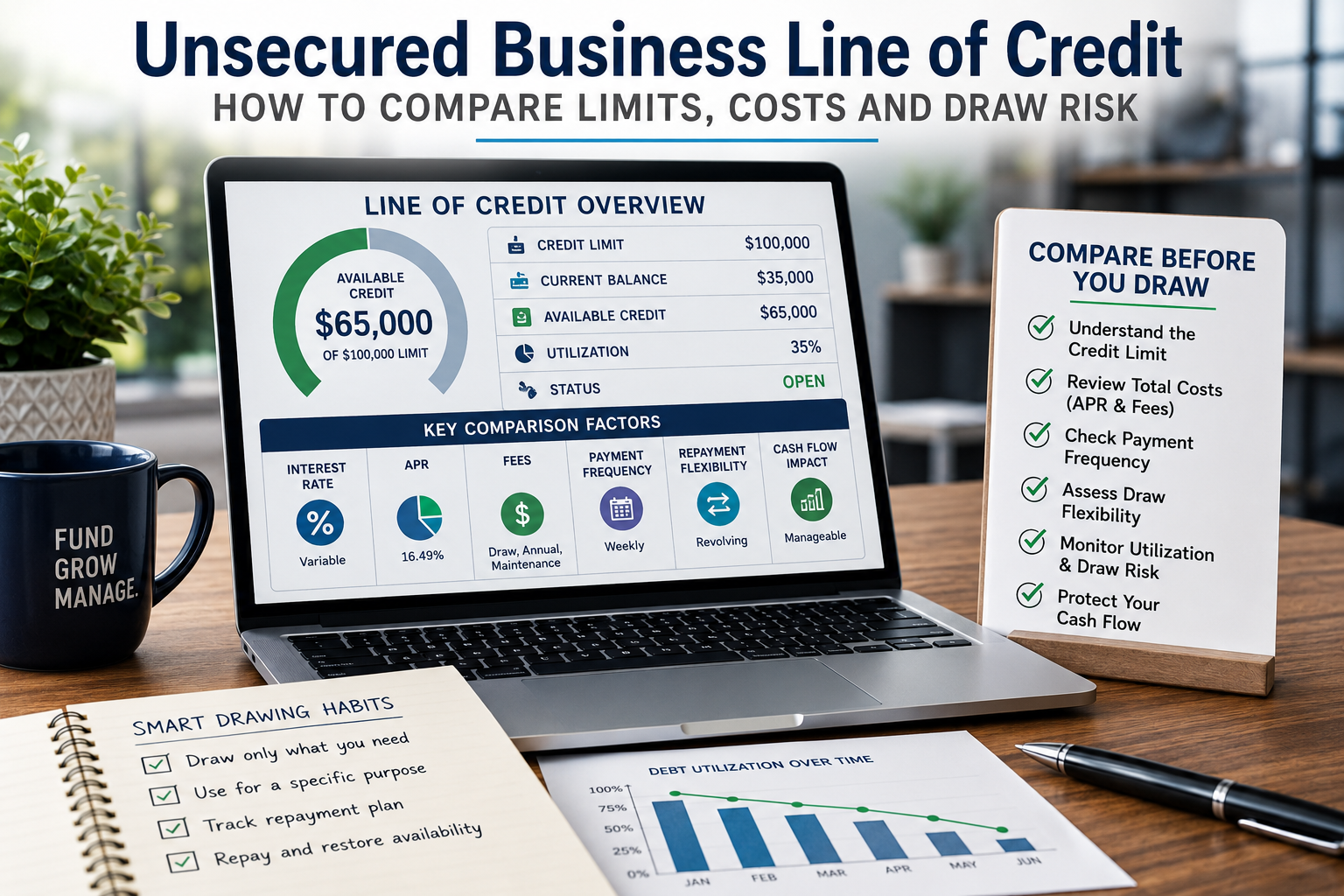
An unsecured business line of credit can give a business flexible access to borrowed funds without requiring a specifically pledged asset such as equipment or real estate in the same way as traditional secured financing.
Instead of receiving one lump sum and immediately owing the entire amount, the business may receive access to an approved credit limit.
Depending on the agreement, it may then:
draw → use funds → repay → restore available credit → potentially draw again
That flexibility can make an unsecured business line of credit useful for:
- temporary working-capital gaps
- seasonal inventory
- supplier payments
- materials for customer projects
- unexpected repairs
- short timing gaps between expenses and customer payments
- other recurring or unpredictable business costs
But flexibility creates its own risk.
A business can become comfortable drawing repeatedly because the credit remains available.
What begins as temporary financing can gradually become permanent debt.
The central question is therefore not:
How large is the credit limit?
It is:
Can the business use the line temporarily, repay draws from normal cash flow and restore its available credit without becoming dependent on borrowing?
Business owners wanting the broader foundation can review Kevanzo’s business line of credit guide.
Educational note: Kevanzo.com provides general business-financing education only. Kevanzo is not a lender, broker, loan marketplace, financial adviser, attorney, accountant or approval service. Interest rates, APRs, fees, credit limits, draw rules, repayment schedules, collateral requirements, guarantees, renewal conditions, eligibility standards and available financing products vary according to lender and borrower. Always review the complete financing agreement before accepting or drawing business credit.
What Is an Unsecured Business Line of Credit?
An unsecured business line of credit is revolving business financing that generally does not require the borrower to specifically pledge an identified asset in the same way as conventional secured credit.
A lender may approve a maximum credit limit.
For example:
Approved line: $100,000
The business does not necessarily borrow all $100,000 immediately.
It might draw:
$20,000
Then repay part or all of that amount.
Subject to the agreement, repaid principal may restore available credit.
That differs from a conventional term loan, where the business generally receives one principal amount and repays it according to a defined schedule.
Unsecured Does Not Mean Risk-Free
This distinction is essential.
“Unsecured” should not be interpreted as:
- no repayment obligation
- no personal guarantee
- no contractual protections
- no consequences after default
- no credit risk
- no fees
- no lender rights
The actual agreement determines the obligations.
Depending on the lender and financing structure, an unsecured business line of credit may still include guarantees or other contractual protections.
Business owners comparing the broader unsecured market can review unsecured business loans.
The Kevanzo Unsecured-Credit Reality Check
Before accepting the word unsecured at face value, answer four questions.
1. Is a Specific Asset Pledged?
Equipment?
Property?
Inventory?
Receivables?
2. Is a Personal Guarantee Required?
What owner exposure exists?
3. Are Other Security Provisions Included?
Read the actual financing agreement.
4. What Happens After Default?
Understand the lender’s contractual rights.
The product name is less important than the agreement.
Why Businesses Consider an Unsecured Business Line of Credit
Businesses may prefer revolving unsecured credit when they want:
- flexible access
- no need to borrow the entire approved amount
- reusable credit
- financing for recurring short-term needs
- fewer concerns about specifically pledging a physical business asset
A small business line of credit may therefore make sense when borrowing requirements vary throughout the year.
For example:
January draw:
$15,000
February:
no draw
March:
$8,000
April:
repayment
May:
$20,000 draw
A traditional single lump-sum loan may provide more money than the business needs during some periods.
Revolving credit can potentially match variable requirements more closely.
The Kevanzo One-Time-or-Recurring Test
Ask:
Is the Need One-Time?
Example:
$80,000 for one equipment purchase
A term loan may be easier to evaluate.
Is the Need Recurring?
Example:
inventory requirements that rise and fall throughout the year
A line of credit may provide useful flexibility.
The structure should match the pattern of the business need.
Available Credit Is Not Business Income
Suppose a business receives an unsecured business line of credit with a:
$150,000 limit
That does not mean the business has earned $150,000.
It has gained the ability to potentially borrow up to the limit, subject to the agreement.
Every draw creates debt.
This sounds obvious, but revolving credit can psychologically feel different from a term loan because money remains available after the account is opened.
The Kevanzo Available-Credit Rule
Treat:
available credit
as:
borrowing capacity
not:
spendable profit
Before every draw, ask:
What specific business need requires this money?
and:
What specific business cash should repay this draw?
If those answers are unclear, pause before drawing.
How an Unsecured Business Line of Credit May Work
The exact mechanics vary.
A line may include:
- approved credit limit
- minimum draw requirements
- interest
- APR where applicable
- draw fees
- annual fees
- maintenance fees
- repayment requirements
- variable or fixed pricing
- renewal provisions
- account reviews
- default provisions
Some lenders may periodically review the account.
Available credit may not necessarily be permanent.
The financing agreement controls.
The Kevanzo Credit-Line Cycle
A healthy revolving-credit pattern often looks like:
temporary need → draw → productive use → incoming cash → repayment → restored availability
A weaker pattern looks like:
draw → expense → partial repayment → another draw → higher balance → repeated borrowing
The second pattern deserves investigation.
Draw Discipline
An unsecured business line of credit should ideally be managed draw by draw.
Opening the account is not the only financing decision.
Each draw creates another decision.
Suppose the business has:
$100,000 available
It needs:
$18,000
Borrowing $18,000 and borrowing $70,000 are economically different decisions even though both are permitted by the same credit line.
The Kevanzo Draw-Purpose Test
Before every draw, write down:
Draw Amount
How much is required?
Specific Purpose
What will it fund?
Expected Benefit
What business value should it create or protect?
Repayment Source
What incoming cash should repay it?
Expected Repayment Date
When should the balance be reduced?
If a draw has no clear purpose or repayment source, the business may be using revolving credit as an operating subsidy.
Credit Utilization
Credit utilization shows how much of the available line is currently being used.
Suppose:
Credit limit:
$100,000
Outstanding balance:
$20,000
Utilization:
20%
Now suppose the balance becomes:
$85,000
Utilization:
85%
The business has far less unused borrowing capacity remaining.
That matters because unused credit can act as a financial buffer.
The Kevanzo Available-Credit Buffer
Calculate:
credit limit
minus
outstanding balance
equals
available-credit buffer
Example:
Limit:
$100,000
Balance:
$65,000
Available:
$35,000
Now ask:
If an unexpected business expense occurred tomorrow, would enough unused capacity remain?
A line continuously operating near its maximum can lose much of the flexibility that made it useful.
High Utilization Can Change the Risk
A line that occasionally reaches a high balance and then resets can be different from a line that remains heavily utilized month after month.
Consider:
Business A
Utilization:
20% → 70% → 30% → 0%
Business B
Utilization:
80% → 90% → 85% → 95%
Business B may have a more persistent financing problem.
The line is no longer acting primarily as a temporary bridge.
The Kevanzo 30-60-90 Utilization Review
At least periodically, record utilization over:
30 Days
What percentage of the line is normally used?
60 Days
Is the balance declining?
90 Days
Has the business restored substantial available credit?
The goal is not forcing the balance to zero on an arbitrary schedule.
The goal is seeing whether revolving debt actually revolves.
The Zero-Balance Question
Ask:
When was the last time the unsecured business line of credit reached zero, or at least returned to a very low balance?
If the answer is:
We cannot remember.
that deserves attention.
Permanent utilization can indicate that the business needs:
- more permanent working capital
- improved collections
- better margins
- lower expenses
- another financing structure
rather than an endlessly revolving balance.
The Kevanzo Reset Test
Define a reset as a meaningful reduction in outstanding credit.
Then ask:
- How often does the balance reset?
- What causes repayment?
- Does operating cash produce the reset?
- Does another loan produce the reset?
A reset funded by another debt obligation is not the same as repayment from healthy operations.
Unsecured Business Line of Credit for Working Capital
One of the strongest uses of revolving business credit is working capital.
Businesses considering working capital loans may compare a line of credit when working-capital needs recur rather than occur once.
Examples include:
- inventory
- payroll timing
- supplier bills
- project materials
- seasonal expenses
- temporary gaps between revenue and expenses
The main question is whether the working-capital cycle naturally creates the cash required to repay each draw.
The Kevanzo Working-Capital Cycle
Map:
cash leaves business
→ inventory/service/project activity
→ customer sale
→ customer payment
→ cash returns
→ credit-line repayment
That is a healthy borrowing story.
A weaker cycle is:
cash leaves
→ ordinary expenses
→ no additional cash generated
→ another draw required
Cash Flow Timing
Cash-flow timing is one reason revolving credit exists.
Suppose a contractor buys:
$30,000 of project materials
Customer payment:
45 days after completion
The business may have a legitimate temporary cash gap.
An unsecured business line of credit could potentially bridge that period.
But repayment must still be modeled realistically.
Businesses dealing primarily with timing gaps may also compare cash flow loans for small business.
The Kevanzo Draw-to-Cash Match
For each draw, record:
Draw Date
When does borrowed cash arrive?
Spending Date
When is it used?
Revenue Date
When should the expenditure create revenue?
Customer-Payment Date
When should cash actually arrive?
Required Repayment Dates
When does the lender require money?
The financing should fit the business cash cycle rather than fight it.
Payment Frequency Matters
An unsecured business line of credit might use:
- monthly payments
- weekly payments
- another contractual schedule
Payment frequency can substantially affect cash flow.
A business whose customers pay every 45 days may experience weekly financing withdrawals differently from a company receiving daily customer revenue.
The Kevanzo Payment-to-Revenue Test
Compare:
customer payment frequency
with:
credit-line repayment frequency
Then ask:
Does enough cash remain between lender payments to fund normal business operations?
Do not evaluate payment size without payment timing.
Interest, APR and Fees
The cost of an unsecured business line of credit may include:
- interest
- APR where applicable
- draw fees
- annual fees
- maintenance fees
- late fees
- other contractual charges
A credit line should therefore not be compared by interest rate alone.
The Kevanzo Eight-Number Credit-Line Comparison
For each serious offer, record:
1. Credit Limit
What maximum access is offered?
2. Initial Draw
How much does the business expect to use?
3. Interest Rate
Fixed or variable?
4. APR
Where available and applicable.
5. Fees
Draw, maintenance, annual or other fees?
6. Payment Requirement
How much must be repaid?
7. Payment Frequency
How often?
8. Total Draw Cost
What should a realistic draw cost if repaid according to plan?
A large limit can look impressive while hiding an expensive borrowing structure.
Cost Should Be Measured Per Draw
Suppose two lines each offer:
$100,000
But the business expects to draw only:
$25,000
The relevant cost comparison should focus heavily on what using that $25,000 will actually cost.
That includes:
- interest
- draw fee
- maintenance fees
- required payments
- time outstanding
The Kevanzo True-Cost-of-Access Test
Separate:
Cost of Having the Line
Annual or maintenance charges.
from:
Cost of Using the Line
Interest and draw-related costs.
A line that appears inexpensive when unused may become substantially more expensive when actively drawn.
Fixed Versus Variable Rates
Some credit lines may use variable rates.
That introduces rate risk.
Suppose the current payment comfortably fits cash flow.
What happens if the underlying rate increases?
The line may still be usable.
But its economics change.
The Kevanzo Rate-Stress Test
Model:
Current Rate
Is borrowing affordable?
Moderately Higher Rate
Does repayment still fit?
Significantly Higher Rate
Does the draw begin to crowd out normal operating expenses?
This is a resilience test, not an interest-rate prediction.
Unsecured Business Line of Credit Versus Term Loan
A term loan generally provides:
one amount → defined repayment schedule
An unsecured business line of credit may provide:
credit limit → multiple draws → multiple repayments
That makes the line more flexible.
But it can also make debt easier to accumulate.
Term Loan May Fit
- one known purchase
- one defined project
- fixed financing amount
Line of Credit May Fit
- recurring needs
- uncertain timing
- variable amounts
Neither is automatically better.
Unsecured Business Line of Credit Versus Secured Line of Credit
A secured line may rely more directly on collateral.
An unsecured line may avoid requiring a particular identified asset to be pledged in the same way.
That does not automatically make the unsecured option superior.
Possible tradeoffs can include:
- pricing
- available limit
- guarantee requirements
- lender underwriting
- repayment terms
The complete offer matters.
Unsecured Business Line of Credit Versus Unsecured Term Loan
An unsecured term loan and an unsecured line of credit can both avoid the structure of a conventional asset-specific secured loan, depending on their agreements.
But their use patterns differ.
Unsecured Term Loan
One principal amount.
Unsecured Line
Reusable borrowing capacity.
Businesses comparing unsecured borrowing more broadly can review best unsecured business loans.
The comparison should focus on fit, not the word “best.”
Personal Guarantees
An unsecured business line of credit may still involve a personal guarantee.
That means the owner should understand:
- who guarantees repayment
- how much is guaranteed
- what triggers liability
- whether liability is limited
- when the guarantee ends
Do not assume unsecured business credit means no personal exposure.
The Kevanzo Guarantee-Exposure Test
Compare:
business value created by access to the line
with:
owner exposure created by the guarantee
Then ask:
Is the tradeoff acceptable?
A slightly lower rate does not necessarily compensate for materially greater personal exposure.
Pre-Approval Is Not Final Approval
Businesses may encounter language such as:
- pre-approved
- pre-qualified
- eligible for
- up to
- preliminary offer
These terms should not automatically be treated as a final credit commitment.
Businesses considering this stage can review Kevanzo’s business line of credit pre approval guide.
Final terms may depend on:
- verification
- underwriting
- documentation
- lender policies
- updated financial information
- final agreement
The final written offer is what matters.
Credit Limit Versus Amount Needed
Suppose the business is approved for:
$200,000
Current need:
$35,000
The $200,000 limit does not mean a $200,000 draw is sensible.
The Kevanzo Needed-Draw Test
Before drawing, write:
actual need
then:
proposed draw
If the draw is larger, ask:
What exact business purpose justifies the difference?
Unused borrowing capacity can be valuable.
Unnecessary debt is not.
Draw Creep
Draw creep happens when each individual borrowing decision looks small but the combined balance becomes large.
Example:
First draw:
$10,000
Second:
$8,000
Third:
$12,000
Fourth:
$15,000
Outstanding balance can become substantial without one dramatic borrowing event.
The Kevanzo Draw-Creep Check
Each month record:
- beginning balance
- total new draws
- total repayments
- ending balance
Then ask:
Are repayments consistently exceeding new borrowing?
If not, the business may be moving toward greater credit dependence.
Renewal Risk
A line of credit can create a false sense that borrowing capacity will always remain available.
Depending on the agreement and lender, an account may be:
- reviewed
- renewed
- reduced
- restricted
- closed
That makes renewal risk important.
A business should not build a permanent operating model around borrowed capacity it does not control forever.
The Kevanzo Renewal-Dependence Test
Ask:
What happens to the business if this credit line is unavailable next year?
If the answer is:
We cannot operate without it.
the business may have become structurally dependent on revolving debt.
That does not automatically mean the line is inappropriate.
It means the dependence should be recognized and managed.
Available Credit Can Be an Emergency Buffer
One benefit of disciplined revolving credit is preserving unused capacity.
Suppose:
Limit:
$100,000
Normal outstanding balance:
$10,000
Unused capacity:
$90,000
An unexpected business expense may be easier to handle.
Compare that with:
Outstanding balance:
$95,000
Unused capacity:
$5,000
The second business has almost no financing buffer remaining.
The Kevanzo Buffer-Preservation Rule
Do not ask only:
Can we make another draw?
Ask:
How much flexibility remains after this draw?
Sometimes preserving unused credit is more valuable than spending it.
Seasonal Business Scenario
A retailer expects a strong holiday season.
Inventory requirement:
$50,000
The business draws from its unsecured business line of credit.
Strong pattern:
draw → buy inventory → sell inventory → receive cash → repay line
The owner should still test:
- slower sales
- discounting
- unsold inventory
- supplier increases
The expected repayment source should survive more than the best-case scenario.
Contractor Scenario
A contractor needs:
$25,000
for materials.
Customer payment should arrive after project completion.
A line may match the timing.
But the owner should model:
- project delay
- customer dispute
- cost overrun
- late payment
A contracted project improves clarity.
It does not remove risk.
Service-Business Scenario
A service business experiences a payroll timing gap.
Customer invoices:
$80,000
Expected collection:
within 30 days
Temporary requirement:
$20,000
The key question is whether the receivables are sufficiently reliable to repay the draw without needing another one.
Repeated Operating-Loss Scenario
A business loses:
$15,000 monthly
It draws:
$15,000
from its line every month.
Nothing changes operationally.
After six months, the line may have become a way of financing accumulated losses.
That is not a normal temporary working-capital cycle.
The Kevanzo Temporary-or-Structural Test
Ask:
Will the business problem disappear after this draw?
If yes, revolving financing may be addressing a temporary problem.
If no, investigate:
- margins
- pricing
- expenses
- collections
- inventory
- staffing
- existing debt
before allowing revolving credit to become permanent support.
Existing Debt Matters
A credit line payment competes with every other financing obligation.
Include:
- term loans
- equipment finance
- vehicle finance
- credit cards
- other lines of credit
- tax payment arrangements
- other business debt
The Kevanzo Total-Debt Pressure Test
Calculate:
cash available for debt service
minus
existing debt payments
minus
expected credit-line repayment
equals
remaining debt-service cushion
Then repeat the calculation under weaker revenue.
Three-Condition Unsecured Credit Stress Test
Before relying heavily on an unsecured business line of credit, model three conditions.
Normal
Revenue performs approximately as expected.
Slow
Revenue falls moderately or customers pay later.
Difficult
Revenue declines while an unexpected expense occurs.
Under all three conditions calculate:
- existing operating costs
- existing debt
- credit-line payment
- available cash
- remaining unused credit
A line should not work only during perfect conditions.
The Kevanzo Credit-Line Independence Test
Ask:
Can normal operating cash repay this line without another financing product?
Strong answer:
Yes. We expect customer receipts from the funded activity to reduce the balance.
Weak answer:
We will probably refinance the balance later.
Revolving credit is strongest when repayment comes from the business activity it supports.
Current SBA Line-of-Credit Context
An unsecured business line of credit is not the same thing as every SBA working-capital line, and SBA-backed credit should not automatically be assumed to be unsecured.
However, current SBA programs illustrate why revolving credit should be treated as its own financing structure rather than simply as a term loan.
SBA’s current 7(a) Working Capital Pilot is a monitored line-of-credit program. SBA lists a maximum WCP amount of $5 million and a maximum maturity of 60 months. The program can support transaction-based and asset-based working-capital financing, including borrowing connected to accounts receivable and inventory.
The useful lesson is structural:
working-capital lines are designed around repeated access and repayment, not a single lump-sum borrowing event.
Whether a particular line is secured, unsecured or otherwise protected depends on the specific program and agreement.
Qualification Is Not Affordability
Suppose a lender approves:
$150,000
The business needs:
$40,000
And the company can comfortably repay:
$50,000
Those are three different numbers.
The Kevanzo Credit-Line Triangle
Compare:
Need
How much does the business actually need?
Affordability
How much can cash flow comfortably support?
Availability
How much credit will the lender provide?
The first two should drive borrowing decisions.
The third only establishes maximum access.
Common Unsecured Business Line of Credit Mistakes
Treating the Limit as Cash
It is borrowing capacity.
Drawing Without a Defined Purpose
Every draw should have a job.
Drawing More Than Needed
Unused credit can remain valuable.
Comparing Rate Only
Fees and repayment rules also matter.
Ignoring Payment Frequency
Cash timing matters.
Keeping the Line Near Maximum Utilization
That removes flexibility.
Never Resetting the Balance
The line may be becoming permanent debt.
Ignoring Personal Guarantees
Unsecured does not automatically mean no owner exposure.
Assuming the Line Will Always Be Renewed
Availability may change according to the agreement and lender decisions.
Financing Permanent Losses
Revolving credit cannot permanently repair an unprofitable operation.
Repaying One Draw With Another Loan
That can hide growing debt dependence.
Unsecured Business Line of Credit Red Flags
Investigate carefully when:
- total borrowing cost is unclear
- draw fees are unclear
- payment frequency is unclear
- guarantee terms are unclear
- lender protections are unclear
- utilization remains extremely high
- the balance rarely declines
- the company repeatedly draws for ordinary losses
- another loan is needed to repay the line
- the business relies on the full limit to operate
- renewal assumptions are built into normal operations
- the company cannot identify a repayment source
- each new draw leaves almost no available-credit buffer
- borrowing is increasing faster than repayment
- the business is choosing the line only because access appears easy
Several red flags together deserve serious attention.
Questions to Ask Before Opening an Unsecured Business Line of Credit
Ask:
- What is the approved credit limit?
- How much does the business actually expect to draw?
- Is a minimum draw required?
- What interest rate applies?
- Is the rate fixed or variable?
- What APR is provided where applicable?
- Are draw fees charged?
- Is there an annual fee?
- Are maintenance fees charged?
- Are there unused-line fees?
- What payment is required?
- How often are payments due?
- How is repayment calculated after each draw?
- When does interest begin?
- Is a specific asset pledged?
- Are other security provisions involved?
- Is a personal guarantee required?
- What does the guarantee cover?
- Can the credit limit be reduced?
- Can the line be frozen?
- Can the account be closed by the lender?
- Is periodic renewal required?
- What financial information must be provided?
- What happens if revenue declines?
- What constitutes default?
- What late-payment costs apply?
- Can the business repay early?
- Are there early-repayment costs?
- What happens to available credit after repayment?
- What specific business cash should repay each draw?
- How much unused credit should the business preserve?
- What happens if the line is unavailable next year?
Those answers provide a far more useful comparison than the advertised limit alone.
The Kevanzo 20-Point Unsecured Business Line of Credit Check
Before accepting an unsecured business line of credit, review these 20 points.
1. Purpose
Why does the business need revolving credit?
2. Credit Limit
How much is available?
3. Expected Draw
How much should actually be used?
4. Interest Rate
Fixed or variable?
5. APR
What annualized information is available where applicable?
6. Fees
What costs apply to opening, maintaining or drawing?
7. Payment
How much must be repaid?
8. Payment Frequency
How often?
9. Draw Rules
How does access work?
10. Repayment Source
What cash should repay each draw?
11. Utilization
How much of the line will normally be used?
12. Available-Credit Buffer
How much unused capacity remains?
13. Reset Behavior
Does the balance meaningfully decline?
14. Existing Debt
What other obligations compete for cash?
15. Specific Collateral
Is an identified asset pledged?
16. Other Security
What protections does the agreement provide the lender?
17. Personal Guarantee
What owner exposure exists?
18. Renewal Risk
What happens if access changes?
19. Slow-Month Resilience
Can repayment continue with weaker revenue?
20. Independence
Can normal business cash repay the line without another loan?
If several answers are unclear, the comparison is not finished.
Practical Next Steps
Start by deciding why revolving credit is needed.
Write down:
expected maximum draw
specific business purpose
expected repayment source
expected repayment time
Then compare serious offers using the same numbers:
- credit limit
- expected draw
- interest
- APR where relevant
- fees
- repayment requirement
- payment frequency
- guarantee exposure
- other contractual protections
Next model the credit line for 90 days.
Track:
- opening balance
- draws
- repayments
- ending balance
- utilization
- available credit
Then run the slow-condition stress test.
Finally ask:
Can this business use the unsecured business line of credit temporarily, repay it from normal operations and restore its borrowing capacity without needing another loan?
That is the standard worth aiming for.
Final Takeaway
An unsecured business line of credit can provide valuable flexibility for businesses with recurring or unpredictable short-term financing needs.
Its strength is reusable access.
Its biggest danger is also reusable access.
Because funds can potentially be drawn repeatedly, a business can gradually move from:
temporary credit
to:
permanent reliance on debt
without one obvious borrowing event.
The strongest credit-line cycle is:
defined need → controlled draw → productive use → incoming cash → repayment → restored availability
Business owners should therefore monitor:
- draw purpose
- credit utilization
- payment frequency
- borrowing cost
- available-credit buffer
- repayment source
- balance resets
- guarantees
- lender protections
- renewal dependence
- existing debt
- slow-month resilience
Most importantly, an unsecured business line of credit should not be judged by how much a lender makes available.
It should be judged by whether the business can use it selectively, repay it reliably and preserve financial flexibility after each borrowing cycle.
Unsecured Business Line of Credit Q&A
Q: What makes an unsecured business line of credit useful?
A: Its main advantage is flexible revolving access. A business may draw only when money is needed, repay borrowed amounts and potentially restore available credit according to the agreement.
Q: What is the biggest risk with an unsecured business line of credit?
A: One major risk is repeated borrowing. A line intended for temporary needs can become permanent debt if new draws consistently replace repayment.
Q: What should a business check before every draw?
A: Check the exact amount needed, funding purpose, expected repayment source, cost of the draw, payment timing and how much unused credit will remain afterward.
Frequently Asked Questions About an Unsecured Business Line of Credit
What Is an Unsecured Business Line of Credit?
An unsecured business line of credit is revolving business financing that generally does not require a specifically pledged physical asset in the same manner as traditional secured financing.
Terms vary according to the lender and agreement.
Is an Unsecured Business Line of Credit the Same as a Loan?
Not exactly.
A conventional term loan generally provides one principal amount.
A line of credit provides revolving access up to a limit, subject to its agreement.
Does Unsecured Mean No Personal Guarantee?
No.
Some unsecured financing may still require a personal guarantee.
Always review the actual agreement.
Does Unsecured Mean No Risk?
No.
The business still has repayment obligations and may face fees, credit consequences, collection activity or other contractual consequences after default.
Is Interest Charged on the Entire Credit Limit?
Terms vary.
Many revolving credit structures charge borrowing costs based on amounts actually drawn, but businesses should confirm exactly how their lender calculates charges.
What Is Credit Utilization?
Credit utilization compares the outstanding balance with the total approved credit limit.
Is High Credit Utilization Bad?
High utilization is not automatically inappropriate, but consistently operating near the maximum can reduce flexibility and may indicate dependence on borrowed funds.
Should a Business Line of Credit Reach Zero?
There is no universal rule requiring a zero balance at a particular time.
However, periodic meaningful repayment can help demonstrate that the facility is operating as revolving rather than permanent debt.
Can a Business Line of Credit Be Used for Working Capital?
Potentially, depending on lender terms.
Possible uses can include inventory, supplier timing, project materials and temporary cash-flow gaps.
Is a Line of Credit Better Than a Term Loan?
Neither is universally better.
A line can fit recurring or variable needs.
A term loan can fit a defined one-time expense.
Can an Unsecured Business Line of Credit Have a Variable Rate?
Yes, depending on the lender and product.
Businesses should understand how the rate may change.
Can the Credit Limit Change?
Potentially, depending on the agreement and lender.
Businesses should understand review, renewal, restriction and closure provisions.
What Is the Available-Credit Buffer?
It is the amount of approved credit that remains unused.
Should a Business Draw the Maximum Available Amount?
Not simply because the credit is available.
Borrow according to the legitimate business need and repayment capacity.
What Happens if the Business Uses the Line Every Month?
That may be appropriate for some recurring working-capital cycles, but the business should verify that balances are being repaid rather than continually increasing.
What Is Credit-Line Creep?
Credit-line creep occurs when repeated smaller draws gradually create a much larger outstanding balance.
What Is Renewal Risk?
Renewal risk is the possibility that future access to the line may be changed, reduced or unavailable according to lender decisions and contractual terms.
What Is the Most Important Question Before Drawing?
Ask:
What specific incoming business cash should repay this draw?
Helpful Authoritative Resources
- U.S. Small Business Administration business loan resources
- U.S. Small Business Administration 7(a) loans
- U.S. Small Business Administration lender information
- U.S. Small Business Administration Lender Match
- Consumer Financial Protection Bureau small business lending resources
- Federal Trade Commission business guidance
- SCORE small business mentoring and education
Author Bio
Kevanzo Editorial Team
Kevanzo Editorial Team creates practical, plain-English educational resources for U.S. business owners comparing unsecured business lines of credit, revolving business credit, small business loans, working-capital financing, borrowing costs, repayment structures and responsible business-financing decisions.
Copyright Notice
© 2026 Kevanzo. All rights reserved.
This article about an unsecured business line of credit is protected by copyright and may not be copied, scraped, spun, republished or used commercially without prior written permission from Kevanzo. Brief quotations may be used with clear attribution and a link to the original article.
Unauthorized reuse, bulk scraping, content spinning, AI rewriting for republication or commercial reproduction of this material is prohibited.
Educational Disclaimer
Kevanzo.com provides general educational information about business financing. Kevanzo is not a lender, broker, loan marketplace, financial adviser, attorney, accountant or approval service.
Nothing in this article constitutes financial, legal, tax, accounting, investment, lending or personalized business advice. Interest rates, APRs, fees, credit limits, draw requirements, repayment schedules, collateral requirements, guarantees, renewal provisions, eligibility standards and available financing products vary according to lender, borrower, financing type, business profile, industry, revenue, credit history and market conditions.
Business owners should review current official information, read all financing documents carefully and consider seeking advice from appropriately qualified professionals when necessary before making financing decisions.
Thanks for your comment. A business line of credit can be useful when a business wants flexible access to funds, but it is still important to compare draw fees, repayment timing, credit limits, and lender requirements before applying. Kevanzo shares general educational information only and cannot make personal finance, legal, or tax decisions for visitors.
Thanks for your comment. A business line of credit can be useful when a business wants flexible access to funds, but it is still important to compare draw fees, repayment timing, credit limits, and lender requirements before applying. Kevanzo shares general educational information only and cannot make personal finance, legal, or tax decisions for visitors.
Thanks for your comment. A business line of credit can be useful when a business wants flexible access to funds, but it is still important to compare draw fees, repayment timing, credit limits, and lender requirements before applying. Kevanzo shares general educational information only and cannot make personal finance, legal, or tax decisions for visitors.