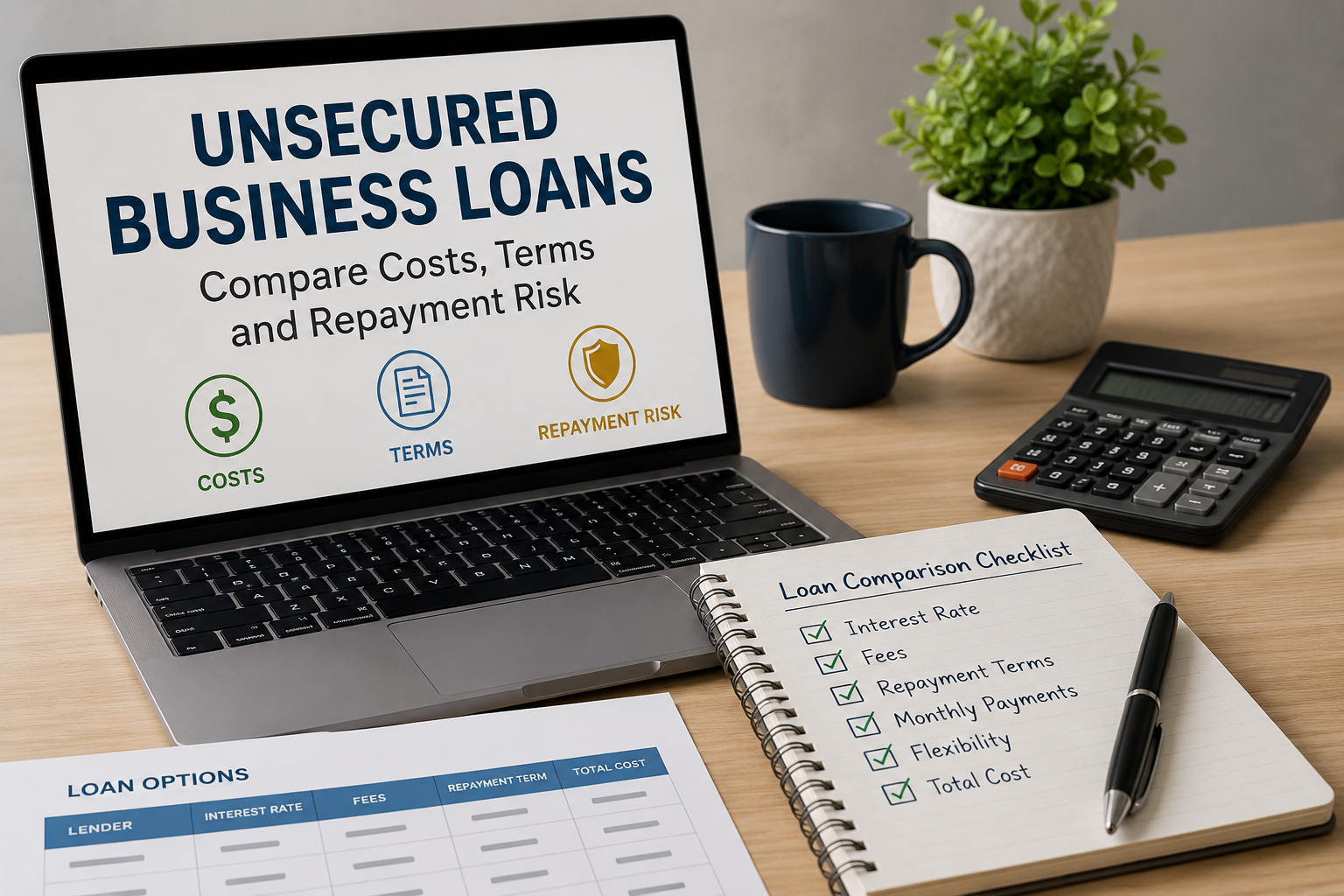
Searching for the best unsecured business loans should not mean looking for one lender that is automatically best for every U.S. business.
The more useful question is:
Which unsecured financing option provides the amount the business actually needs, with a cost, repayment schedule, financing term and level of personal or business exposure that its cash flow can reasonably support?
That is the standard Kevanzo uses throughout this comparison.
This guide compares real U.S. unsecured term-loan and line-of-credit options, then applies Kevanzo’s original decision frameworks to help business owners compare financing amounts, rates or fee structures, repayment frequency, total cost, qualification requirements, personal guarantees, security provisions and cash-flow risk.
For a broader overview of financing types and how they work, see Kevanzo’s small business loans guide.
Business owners wanting to compare the wider lending market can also use the small business loans pillar.
An important distinction comes first:
Unsecured does not necessarily mean zero security risk, zero personal exposure or zero lender protection.
A product may not require a specifically pledged asset while still involving a personal guarantee, contractual rights against the business, automatic withdrawals, a UCC filing or other lender protections.
The actual financing agreement controls.
When comparing offers, the numbers that matter most are not simply the advertised rate or maximum approval amount.
Compare:
- amount approved
- net cash the business actually receives
- interest or other financing charges
- APR where available and applicable
- upfront and ongoing fees
- payment amount
- payment frequency
- number of payments
- total scheduled repayment
- early-payoff treatment
- personal-guarantee exposure
- collateral or other security provisions
- cash remaining after payments
That approach is particularly important when comparing unsecured business loan rates, weekly versus monthly repayment, provider funding amounts or claims that one option has the lowest cost.
Educational note: Kevanzo.com provides general business-financing education only. Kevanzo is not a lender, broker, loan marketplace, financial adviser, attorney, accountant or approval service. Rates, APRs, fees, loan amounts, repayment terms, collateral requirements, guarantees, eligibility standards and available financing products vary by lender and borrower. Always review the complete financing agreement before accepting business funding.
Current U.S. Unsecured Business Loan Options to Compare
Information checked against lender-owned sources: September 29, 2026.
People searching for the best unsecured business loans often want to see how real financing options differ in amount, repayment structure, published pricing, qualification standards, collateral treatment and owner exposure.
The providers below are not ranked from best to worst.
Kevanzo includes them as comparison examples because provider-owned information describes the relevant product as unsecured or as not requiring collateral.
A lender appearing here is not an endorsement.
Where a lender does not publicly specify a figure, Kevanzo does not estimate one.
Where provider-owned pages conflict, the conflict should be identified rather than silently selecting whichever figure appears most convenient.
Current lender disclosures and the final financing agreement always control.
How Kevanzo Compares Unsecured Business Loan Options
Each option should be examined for:
- financing type
- borrowing amount
- repayment term
- published pricing
- fees
- payment frequency
- time in business
- revenue requirements
- credit considerations
- collateral
- personal guarantees
- other security provisions
- funding mechanics
- early-payoff treatment
The lender comparison is only the starting point.
The rest of this guide tests whether an actual financing offer makes economic sense for the business receiving it.
Current Comparison Snapshot
| Provider and product | Structure | Published amount and term | Published pricing or fees | Public qualification information | Collateral and personal exposure |
|---|---|---|---|---|---|
| Bank of America Business Advantage Term Loan | Unsecured term loan | $10,000–$100,000; 1–5 years | $150 origination fee if approved; applicant-specific pricing | 2 years in business; $100,000 prior-year revenue; personal credit above 700 FICO typically required | No collateral required; review final documents for guarantee and other protections |
| U.S. Bank Unsecured Quick Loan | Unsecured term loan | Up to $50,000; up to 48 months | U.S. Bank states unsecured pricing can be higher than its secured alternative | Qualification depends on credit and business circumstances | No collateral; review personal-guaranty and final-loan provisions |
| Wells Fargo BusinessLine | Unsecured revolving line | $10,000–$150,000 | Variable rate tied to Prime plus lender margin; annual fees can apply after the first year | Published requirements include operating-history and guarantor-credit considerations | No collateral required for the product; personal guarantees required |
| OnDeck Business Line of Credit | Unsecured revolving line | $6,000–$200,000; 12, 18 or 24 months | Applicant-specific cost | Published minimums include operating history, annual revenue, checking account and personal-credit considerations | Unsecured line; personal guarantee required |
| Headway Capital True Line of Credit | Revolving line; unsecured portion available | Unsecured credit up to $50,000; higher total availability may involve secured credit | Applicant-specific interest; draw fees may apply depending on state | Published revenue minimum; first-party pages have shown inconsistent operating-history requirements | Confirm guarantee and security provisions in final agreement |
| Fundbox Line of Credit | Revolving line | Up to $250,000; short scheduled repayment periods | Fee-based pricing | Published revenue, credit and banking requirements; first-party pages have shown inconsistent operating-history information | Provider materials state no collateral required; confirm final agreement |
Bank of America Business Advantage Term Loan
Bank of America’s Business Advantage Term Loan is an unsecured lump-sum financing product.
Its published information lists financing from $10,000 to $100,000, repayment terms from one to five years, fixed equal monthly payments, a $150 origination fee if approved, and no required collateral.
Published baseline qualification information includes at least two years in business under existing ownership, at least $100,000 in prior-year annual business revenue, and personal credit above 700 FICO typically required.
Bank of America does not publish one universal rate applying to every borrower.
Actual approved pricing should therefore be compared from the individual financing offer.
This structure may deserve consideration when the business knows the amount required and wants a defined repayment period.
U.S. Bank Unsecured Quick Loan
U.S. Bank’s Unsecured Quick Loan publishes financing of up to $50,000 with terms of up to 48 months and no collateral requirement for the unsecured version.
U.S. Bank notes that the unsecured alternative can carry higher pricing than its secured equivalent.
The actual offer should therefore be checked for:
- approved rate
- fees
- payment schedule
- personal guarantee
- prepayment provisions
- total repayment
This illustrates an important principle:
no collateral does not necessarily mean no personal repayment exposure.
Wells Fargo BusinessLine Line of Credit
Wells Fargo BusinessLine is an unsecured revolving business line of credit with published limits from $10,000 to $150,000.
Its pricing uses a variable rate based on Prime plus a lender margin.
Because Prime can change, financing cost can change.
Wells Fargo also publishes operating-history and guarantor-credit expectations and requires personal guarantees.
No collateral is required for the BusinessLine product.
That again demonstrates why:
unsecured does not mean no personal exposure.
A revolving line may make sense when borrowing needs vary over time, but variable pricing and repeated borrowing should still be tested against slow-month cash flow.
For more on revolving financing, see Kevanzo’s business line of credit guide.
OnDeck Business Line of Credit
OnDeck’s Business Line of Credit is described by the company as an unsecured revolving line.
Published financing limits extend from $6,000 to $200,000, with repayment choices including 12, 18 or 24 months.
Weekly or monthly payment structures may be available depending on the offer.
OnDeck also publishes minimum application criteria involving operating history, annual revenue, a business checking account and personal credit.
A personal guarantee is required.
Funding speed can be useful, but speed should not replace comparison of:
- total financing cost
- repayment frequency
- available cash after payments
- personal exposure
- early-payoff provisions
Headway Capital True Line of Credit
Headway Capital describes its True Line of Credit as providing revolving access to business funding.
Provider information has distinguished between unsecured availability up to a stated limit and potentially greater total availability involving secured credit.
Its published information also includes annual-revenue requirements.
However, provider-owned pages have not always been consistent about minimum operating history.
Where current first-party disclosures conflict, borrowers should verify the applicable requirement directly before applying rather than relying on an estimated or assumed figure.
That principle applies to any lender:
when provider-owned information conflicts, verify rather than guess.
Fundbox Line of Credit
Fundbox publishes revolving business funding through its line-of-credit product.
Its materials describe short repayment schedules, fee-based pricing and no collateral requirement.
Published baseline eligibility information includes business-revenue, personal-credit and business-banking considerations.
Fundbox provider-owned pages have also shown differing minimum operating-history figures.
Borrowers should verify the current applicable requirement directly before applying.
Fundbox demonstrates another important comparison issue:
a fee percentage should not automatically be treated as equivalent to an APR.
Compare the actual dollar cost, payment schedule, total repayment and amount of usable cash.
Why American Express Is Not Included as an Unsecured Option
American Express financing documents for its Business Line of Credit describe loans as being secured by borrower assets and requiring a personal guarantee.
Kevanzo therefore does not classify that product as an unsecured option in this comparison.
This illustrates the methodology used throughout this article:
provider-owned disclosures take priority over broad marketplace labels.
What This Comparison Shows
The products above broadly divide into:
unsecured term loans
and:
unsecured revolving business lines of credit.
Neither structure is automatically better.
The options differ in:
- funding limits
- repayment periods
- pricing methods
- payment frequency
- qualification requirements
- collateral treatment
- guarantee exposure
- flexibility
Businesses with weaker credit profiles may face different qualification or pricing outcomes. Kevanzo’s business loans for bad credit guide addresses that narrower issue.
Businesses borrowing primarily for operating cash should also compare the repayment schedule with Kevanzo’s working capital loans for small business guide.
Newer businesses should separately examine the considerations discussed in startup business loans.
The broader financing decision can then be compared with other forms of business financing.
The most useful comparison is therefore not:
Which lender advertises the lowest-looking number?
It is:
Which offer provides the required net cash at an acceptable total cost, on a repayment schedule the business can withstand, without creating guarantees or security exposure the owner has not deliberately accepted?
What Best Unsecured Business Loans Really Means
The best unsecured business loans are not necessarily:
- the largest loans
- the fastest loans
- the easiest loans to qualify for
- the loans with the smallest advertised payment
- the loans with the longest term
- the loans with the lowest headline rate
A stronger definition is:
financing that matches the business purpose, repayment capacity, total cost and acceptable level of risk.
Suppose two businesses each need $75,000.
Business A
Has strong recurring revenue, predictable monthly cash flow, relatively little existing debt and a planned expansion project.
Business B
Has highly seasonal revenue, several existing debts, thin margins and a temporary inventory requirement.
The same $75,000 unsecured loan could affect those businesses very differently.
The loan does not determine whether it is best.
Fit does.
The Kevanzo Best-Fit Rule
Before comparing lenders or offers, evaluate five factors.
1. Purpose
Why is the business borrowing?
2. Amount
How much money is genuinely required?
3. Duration
How long will the business benefit from the spending?
4. Repayment Capacity
How much can normal business cash flow comfortably support?
5. Total Cost
How much will the business ultimately pay for obtaining the money?
If an offer performs poorly on several of these factors, a fast approval or attractive headline should not make it the best choice.
What Does Unsecured Mean?
Unsecured business financing generally means the lender is not relying on a specifically pledged asset in the same way that traditional secured financing might be backed by real estate, equipment, vehicles, inventory or another identified asset.
But:
unsecured does not mean consequence-free.
Depending on the financing agreement, the lender may still rely on:
- business cash flow
- business credit
- personal credit
- personal guarantees
- contractual collection rights
- automatic payment authorization
- security interests
- other lender protections
A borrower should therefore separate:
no specifically pledged collateral
from:
no repayment risk.
They are not the same thing.
Unsecured Does Not Always Mean No Security Interest
This distinction deserves careful attention.
Some financing marketed broadly as unsecured may still include contractual provisions affecting business assets, receivables or other rights.
Before accepting an offer, ask:
- Is specific collateral required?
- Is a blanket security interest involved?
- Is a UCC filing involved?
- Is a personal guarantee required?
- What assets or rights can the lender pursue following default?
Where unfamiliar terminology appears in financing documents, Kevanzo’s business financing glossary can provide additional context.
The actual agreement controls.
Why Businesses Search for the Best Unsecured Business Loans
Business owners may prefer unsecured financing because they do not want a particular physical asset directly tied to the borrowing decision.
Possible uses include:
- working capital
- inventory
- marketing
- repairs
- payroll timing
- project expenses
- expansion
- temporary cash-flow needs
But borrowing structure should follow business purpose.
It should not be chosen simply because financing is available.
The Kevanzo Purpose-First Test
Before looking at offers, complete this sentence:
“We need $_____ specifically for _____.”
For example:
We need $40,000 specifically for seasonal inventory expected to sell within four months.
That is much stronger than:
We would like $100,000 because we qualify for it.
The business purpose should determine the financing amount.
The lender’s maximum offer should not determine the business purpose.
Borrow Only What the Business Needs
Suppose the business requires:
$40,000
but receives approval for:
$90,000.
The additional $50,000 may feel useful.
But it can also create:
- unnecessary interest
- unnecessary fees
- larger payments
- greater owner exposure
- less future borrowing capacity
- more financial pressure
Borrowing capacity is not the same thing as funding need.
Unsecured Term Loan Versus Unsecured Line of Credit
A major comparison is whether the business needs a term loan or revolving credit.
Unsecured Term Loan
A term loan generally provides one lump sum followed by scheduled repayment.
This can fit:
- known project costs
- defined purchases
- one-time expansion
- planned improvements
Unsecured Line of Credit
A revolving line can allow the business to draw, repay and potentially reuse available credit according to the agreement.
This may fit:
- irregular inventory purchases
- repeated cash-flow gaps
- seasonal working capital
- uncertain timing of expenses
The choice depends on whether the funding need is:
one-time
or:
recurring.
The Kevanzo One-Time-or-Recurring Test
Ask:
Do We Need One Known Amount?
Example:
$65,000 for a defined project.
A term loan may be easier to manage.
Or Will Needs Change?
Example:
$10,000 this month, nothing next month and $25,000 three months later.
A revolving structure may fit better.
Do not pay for flexibility the business does not need.
But do not repeatedly take separate loans when one properly managed revolving facility better matches the actual business cycle.
Fixed Versus Variable Interest
Some unsecured financing may carry fixed pricing.
Other offers may use variable rates.
Fixed Interest
The rate generally remains unchanged according to the agreement.
That can improve payment predictability.
Variable Interest
The rate may change according to a benchmark or contractual formula.
That creates interest-rate risk.
A business comparing unsecured financing should identify this before comparing payments.
The Kevanzo Rate-Stress Test
If the financing uses a variable rate, calculate affordability under three conditions.
Baseline Rate
Can the business comfortably pay?
Moderately Higher Rate
Does the payment remain manageable?
Significantly Higher Rate
Does financing begin to interfere with ordinary operations?
The purpose is not to predict future interest rates.
It is to measure resilience.
APR Versus Interest Rate
An advertised interest rate does not necessarily reveal every financing cost.
APR, where applicable and supplied, can incorporate certain costs into an annualized comparison.
But APR should not be considered alone.
Examine:
- interest
- APR
- origination fees
- annual fees
- maintenance fees
- documentation charges
- other required costs
- total repayment
The real objective is understanding what obtaining the money costs in dollars.
The Kevanzo Ten-Number Unsecured Loan Comparison
For every offer, record the same ten numbers.
1. Loan Amount
What is being offered?
2. Net Cash Received
How much actually reaches the business after deductions?
3. Interest Rate
Fixed or variable?
4. APR
What APR is supplied where available and applicable?
5. Monthly or Periodic Payment
What must actually be paid?
6. Number of Payments
How long does repayment continue?
7. Total Scheduled Repayment
How much should ultimately leave the business?
8. Upfront Fees
What is deducted or paid initially?
9. Early-Payoff Cost
What happens if the business repays sooner?
10. Remaining Cash Cushion
How much operating cash remains after financing payments?
Those numbers are more useful than a headline saying one loan is “best.”
Payment Size Versus Total Cost
Consider two hypothetical offers.
Both provide:
$100,000.
Offer A
Higher monthly payment, shorter term and lower total financing cost.
Offer B
Lower monthly payment, longer term and higher total financing cost.
Which is better?
There is not enough information yet.
If Offer A damages working capital, its lower total cost may not compensate for the cash-flow strain.
If Offer B unnecessarily stretches the debt over a long period, its smaller payment may be expensive convenience.
The comparison must balance:
payment affordability
against:
total financing cost.
The Kevanzo Payment-Cost Balance
Ask two questions together.
Question 1
What payment can the business comfortably make?
Question 2
What is the shortest reasonable term that preserves healthy operating cash?
That helps avoid two extremes:
payment too high
and:
debt unnecessarily long.
Best Unsecured Business Loans for Working Capital
Working capital generally supports ordinary business operations.
Examples include inventory, supplier payments, payroll timing, seasonal expenses and short operating gaps.
The financing duration should match the expected cash cycle.
A three-month inventory requirement may not justify years of debt.
Likewise, an extremely short repayment structure may create unnecessary pressure when the business does not receive customer cash for several months.
The Kevanzo Cash-Cycle Match
Write down four dates or periods.
Cash Leaves
When does the business spend the borrowed money?
Revenue Is Created
When does that spending produce sales or billable work?
Cash Arrives
When does the customer actually pay?
Loan Payment Is Due
When must the lender receive repayment?
The better these events align, the easier financing is generally to manage.
Best Unsecured Business Loans for Short-Term Needs
Short-duration financing may suit a temporary funding requirement.
Potential benefits can include faster payoff and shorter debt exposure.
Potential disadvantages can include larger periodic payments and greater working-capital pressure.
A temporary expense should not automatically become years of debt.
Best Unsecured Business Loans for Longer-Term Needs
Longer-term financing can make more sense for a project expected to produce economic value for several years.
The key principle is:
match financing duration to benefit duration.
Do not fund a multi-year investment with borrowing that must be repaid before the project has had time to produce value.
Likewise, do not stretch a temporary cash shortage into unnecessary long-term debt solely to obtain a lower periodic payment.
Personal Guarantees
A major comparison point is whether the lender requires a personal guarantee.
A personal guarantee can expose an owner to repayment obligations if the business cannot meet the agreement.
Before signing, determine:
- who guarantees the financing
- what amount is covered
- when liability begins
- whether liability is limited
- when the guarantee ends
Unsecured financing should therefore be compared by owner exposure as well as business cost.
The Kevanzo Guarantee-Risk Test
Ask three questions.
What Business Benefit Is Created?
How much economic value should the financing produce?
What Personal Exposure Exists?
What could the owner become responsible for?
Is That Tradeoff Acceptable?
A slightly cheaper financing offer is not necessarily economically superior if its guarantee provisions create substantially greater owner exposure.
Credit Quality
Because a specifically pledged asset may not support the transaction, lenders can place significant attention on borrower financial strength.
Depending on the lender and product, factors may include:
- business credit
- personal credit
- revenue
- cash flow
- existing debt
- time in business
- repayment history
- industry
- profitability
A lender’s willingness to approve financing is only one data point.
It is not proof that accepting the financing is economically wise.
Qualification Is Not Affordability
Suppose a lender is willing to provide:
$150,000.
The business needs only:
$80,000.
Its cash flow comfortably supports payments on:
$90,000.
The maximum available financing is not automatically the correct amount to borrow.
The Kevanzo Qualification-versus-Affordability Rule
Separate these questions:
How much can we qualify for?
How much can we comfortably repay?
How much do we actually need?
The smallest sensible answer often deserves the greatest attention.
Revenue Stability
Revenue pattern can materially affect financing suitability.
Stable Business
Predictable monthly revenue may make scheduled fixed payments easier to manage.
Seasonal Business
A business generating most of its profits during several months may struggle with the same payment during the off-season.
Project-Based Business
Revenue may arrive only after milestones or customer payments.
Repayment structure should reflect that reality.
The Kevanzo Revenue-Match Test
Review the last 12 months.
Identify the:
- strongest month
- average month
- weakest realistic month
Then place the proposed financing payment into each one.
Ask:
Could we comfortably make this payment in the weakest realistic month?
If not, the financing may rely too heavily on ideal conditions.
Cash Flow Matters More Than Revenue Alone
A business can have substantial revenue and still struggle with debt repayment.
Suppose Business A produces:
$200,000 monthly revenue
but has:
$188,000 in operating expenses.
Cash remaining:
$12,000.
A new financing payment of $9,000 would consume most of the remaining cushion.
Now suppose Business B produces:
$100,000 monthly revenue
with:
$70,000 in operating expenses.
Cash remaining:
$30,000.
The same $9,000 payment may be much easier to manage.
Revenue size alone does not determine affordability.
The Kevanzo Repayment-Cushion Test
Calculate:
cash available after essential operating expenses
minus
existing debt payments
minus
proposed new financing payment
equals
remaining repayment cushion.
Then repeat the calculation using a weaker month.
If the cushion disappears quickly, reconsider the amount, term, timing or financing structure.
Existing Debt
A new unsecured loan must coexist with every current business obligation.
Include:
- business credit cards
- equipment financing
- vehicle loans
- existing term loans
- lines of credit
- tax payment arrangements
- other financing
Do not evaluate the new offer in isolation.
The Kevanzo Total-Debt Test
Write down all scheduled debt payments for one month.
Add the proposed financing payment.
Compare that total with actual business cash available for debt service.
Good financing should improve the company’s ability to solve a business need.
It should not leave the company one weak month away from severe financial pressure.
Refinancing Existing Debt
Unsecured financing may sometimes be considered for refinancing or consolidation.
A lower monthly payment can look attractive.
But determine why it is lower.
Possible reasons include:
- lower interest rate
- longer term
- different fees
- larger refinancing balance
Extending repayment can reduce monthly pressure while increasing total cost.
The Kevanzo Refinancing Reality Check
Compare:
Current Balance
What does the business owe now?
Current Remaining Payments
How much remains under the existing agreement?
New Loan Amount
What is being refinanced?
New Payment
How much lower or higher is it?
New Term
How much longer does the debt remain?
New Total Cost
Does refinancing actually improve the economics?
Do not confuse:
payment relief
with:
cost savings.
Speed of Funding
Speed can matter.
Examples include an essential equipment breakdown, emergency repair, time-sensitive inventory purchase or contract mobilization.
But speed has an economic value that can be measured.
The Kevanzo Speed-Value Test
Ask:
What economic loss occurs if the business waits?
Then compare it with:
the extra financing cost required to obtain funds faster.
If waiting costs the business $1,000 but faster financing costs an additional $12,000, speed may not justify the premium.
If waiting would result in losing a profitable contract, the conclusion could be different.
Speed should have a business reason.
Prepayment Flexibility
A business may later have sufficient cash to repay financing ahead of schedule.
That makes prepayment provisions important.
Ask:
- Is early repayment allowed?
- Is there a penalty?
- How is the payoff amount calculated?
- Does early repayment reduce future interest or fees?
- Do any charges remain?
Two otherwise similar loans can have very different exit flexibility.
The Kevanzo Exit-Flexibility Test
Before accepting financing, ask:
How expensive is it to get out early?
Long contracts deserve an exit strategy.
A slightly higher initial cost may occasionally be reasonable when an alternative structure imposes substantial early-payoff restrictions.
The complete economics matter.
Fixed Payment Versus Revenue-Based Repayment
Not every financing product uses the same repayment method.
Fixed Payment
This can simplify budgeting.
But the payment may remain unchanged when revenue weakens.
Revenue-Based Payment
Payments may fluctuate with business activity depending on the agreement.
However, payment mechanics and total cost can be harder to compare.
Transparency matters.
If the business cannot understand the repayment formula, it cannot properly evaluate affordability.
The Kevanzo Clarity Test
A financing offer should allow the owner to answer seven questions:
- How much will we receive?
- How much must we repay?
- When must we repay it?
- What causes the payment to change?
- What fees apply?
- What happens following late payment?
- What happens if we repay early?
If those questions cannot be answered clearly, the offer should not receive a high comparison score.
What Lenders May Review
Requirements vary substantially.
Potential underwriting information can include:
- revenue
- bank statements
- cash flow
- business credit
- personal credit
- operating history
- industry
- existing debt
- tax information
- financial statements
- use of funds
- repayment history
Approval does not establish affordability.
Documents Worth Preparing
Businesses comparing unsecured financing may benefit from preparing:
- recent business bank statements
- profit and loss statements
- balance sheet
- cash-flow information
- existing debt schedule
- business tax records where requested
- formation information
- ownership information
- use-of-funds explanation
- revenue history
Good preparation makes comparison easier.
It may also reveal whether borrowing is necessary at all.
The Kevanzo Best-Unsecured-Loan Scorecard
Instead of ranking lenders by name, score each actual offer against the same business-focused criteria.
Give each category a score from 1 to 5.
Funding Fit
Does the amount match the genuine need?
Cost
How competitive is the complete financing cost?
Payment Fit
Does repayment fit business cash flow?
Term Fit
Does financing duration match the business purpose?
Transparency
Are costs and obligations understandable?
Guarantee Risk
How much owner exposure exists?
Security Risk
Are there broader asset claims or security provisions?
Prepayment Flexibility
Can the business exit economically?
Slow-Month Resilience
Can repayment survive weaker revenue?
Overall Business Value
Does obtaining the money create more value than the financing costs?
Maximum score:
50.
This does not create a universal lender ranking.
It creates something more useful:
a comparison of actual offers based on the economics of the individual business.
Example Comparison
Suppose a business receives three hypothetical $75,000 offers.
Offer A
Cheapest total cost, high monthly payment, short term and good prepayment flexibility.
Offer B
Moderate cost, moderate payment, longer term and strong flexibility.
Offer C
Fast funding, highest cost, frequent repayment and limited operating cushion.
There is no automatic winner.
A company with strong cash flow may prefer A.
A business prioritizing payment stability may prefer B.
C might make sense only where the measurable economic value of speed genuinely exceeds the additional cost.
That is why best is a business-specific conclusion.
Seven Practical Unsecured Financing Scenarios
Scenario 1: Seasonal Inventory
A retailer needs $60,000 before its busiest sales period.
Compare inventory margin, expected sales timing, repayment timing and what happens if sales are slower than expected.
Scenario 2: Emergency Repair
A critical piece of equipment fails.
Without it, the company cannot operate normally.
Speed can have substantial economic value, although equipment-specific financing may still deserve comparison.
Scenario 3: Marketing Campaign
A company wants $50,000 for advertising.
The return is uncertain.
Repayment should therefore be tested against conservative performance rather than optimistic forecasts.
Scenario 4: Payroll Timing
Customers pay in 45 days while payroll occurs every two weeks.
The business should determine whether revolving cash-management financing fits better than a one-time term loan.
Scenario 5: Expansion
The business plans to open another location.
Longer-term financing may better match an investment expected to produce value for several years.
Scenario 6: Debt Consolidation
The business wants one easier payment.
Calculate whether the complete financing cost actually improves rather than looking only at the monthly payment.
Scenario 7: Persistent Losses
The business loses money every month.
Another unsecured loan may postpone the underlying problem rather than solve it.
Operational problems deserve attention before repeated borrowing becomes the operating model.
Common Best Unsecured Business Loan Mistakes
Even a competitive financing product can become a poor decision when amount, repayment structure or total cost does not fit the business.
Common mistakes include assuming unsecured means no risk, choosing the largest approval, comparing rate only, comparing payment only, choosing the fastest funding automatically, ignoring guarantees, ignoring security provisions, ignoring existing debt, relying on optimistic revenue, financing persistent losses, accepting the first offer and assuming a generic “best lender” list can decide what is appropriate for a particular business.
Best Unsecured Business Loan Red Flags
Investigate further when:
- total repayment is unclear
- fees are difficult to identify
- payment frequency is unclear
- guarantees are not understood
- security provisions are unclear
- the business is pressured to borrow more than needed
- affordability depends on unusually strong revenue
- financing cost consumes most expected project profit
- payments consume most available cash
- existing debt is already substantial
- new borrowing is being used to make old debt payments
- the business cannot explain how the money should create value
- prepayment conditions are unclear
- default provisions are unclear
- approval ease is the main reason for choosing the offer
Questions to Ask Before Accepting an Unsecured Business Loan
Before signing, ask:
- How much will the business receive?
- Are fees deducted before funding?
- What is the interest rate?
- Is the rate fixed or variable?
- What APR is provided where applicable?
- What other fees apply?
- What is the payment amount?
- How often are payments required?
- How many payments are required?
- What is the total scheduled repayment?
- Is specific collateral required?
- Is another security interest involved?
- Is a UCC filing involved?
- Is a personal guarantee required?
- What does the guarantee cover?
- Can financing be repaid early?
- Is there a prepayment charge?
- How is the payoff amount calculated?
- What happens following late payment?
- What constitutes default?
- Can the lender accelerate repayment?
- Can the business obtain additional financing?
- Are financial covenants involved?
- What reporting is required?
- Can payment amounts change?
- What happens if revenue falls?
- Is automatic bank withdrawal required?
- What amount actually reaches the business?
- What is the total dollar cost?
- Why is this particular offer a better fit than the alternatives?
If the final question cannot be answered clearly, calling the financing “best” is premature.
The Kevanzo Three-Condition Unsecured Loan Stress Test
Before accepting financing, model three conditions.
Normal
Revenue and expenses perform approximately as expected.
Slow
Revenue declines moderately or expenses increase.
Difficult
Revenue falls substantially while an unexpected business expense occurs.
Under all three conditions calculate:
- financing payments
- existing debt
- payroll
- suppliers
- rent
- taxes
- remaining cash
The best unsecured business loans should not work only during perfect months.
The Kevanzo 20-Point Best Unsecured Business Loan Check
Before choosing an offer, complete this final comparison.
1. Purpose
Why is the business borrowing?
2. Amount Needed
What is genuinely required?
3. Net Cash
How much reaches the business?
4. Interest Rate
Fixed or variable?
5. APR
What standardized annualized cost information is available where applicable?
6. Fees
What additional charges apply?
7. Payment
How much is due?
8. Payment Frequency
How often?
9. Term
How long does repayment continue?
10. Total Repayment
What does the financing ultimately cost?
11. Cash-Flow Fit
Does repayment fit normal business cash flow?
12. Slow-Month Fit
Can the business withstand weaker revenue?
13. Existing Debt
What other obligations already exist?
14. Specific Collateral
Is an identified asset pledged?
15. Other Security
Do broader security provisions apply?
16. Personal Guarantee
What owner exposure exists?
17. Prepayment
Can the business exit early economically?
18. Term-to-Purpose Match
Does financing duration match the business need?
19. Alternatives
Would another financing structure work better?
20. Economic Value
Does obtaining the money create more value than its complete financing cost?
The strongest offer is the one that survives this test most successfully.
Practical Next Steps
Finding the best unsecured business loans starts with defining the business need before comparing lenders, rates or maximum approval amounts.
Write down:
exact amount required
exact business purpose
expected economic benefit
expected source of repayment
Then determine the maximum financing payment the business can comfortably make during a slow month, not merely a strong one.
Next compare:
- net cash received
- interest
- APR where applicable
- fees
- payment amount
- repayment frequency
- term
- total repayment
- guarantees
- security provisions
- prepayment flexibility
Score the offers using the Kevanzo comparison framework.
Then compare the proposed unsecured financing with alternative financing structures appropriate to the same purpose.
Finally ask:
Why is this offer the best fit for our business?
The answer should come from numbers and business economics.
Not advertising.
Final Takeaway
The best unsecured business loans are not defined by a lender name, the largest approval amount, the fastest funding promise or the lowest-looking payment.
The stronger financing choice is the one that best matches:
business purpose → amount actually needed → repayment capacity → financing term → total cost → acceptable risk.
Unsecured financing can reduce reliance on a specifically pledged physical asset.
It does not eliminate repayment obligations, guarantees, contractual protections or financial consequences.
Business owners should therefore compare complete offers rather than labels.
Look at net cash received, interest and APR where applicable, fees, total repayment, payment frequency, cash-flow pressure, guarantees, security provisions, prepayment flexibility and slow-month affordability.
Most importantly, separate:
what the lender is willing to provide
from:
what the business actually needs and can comfortably repay.
The best unsecured business financing is ultimately financing that solves a legitimate business problem without creating a larger financial problem in the process.
Frequently Asked Questions About Best Unsecured Business Loans
What Are the Best Unsecured Business Loans?
There is no single unsecured business loan that is best for every business.
The strongest fit depends on purpose, amount required, repayment ability, financing cost, term, flexibility and acceptable risk.
Does Unsecured Mean No Collateral?
It generally means financing is not secured by a specifically pledged asset in the traditional sense.
However, agreement terms may still contain guarantees, security provisions, UCC filings or other lender protections.
Is an Unsecured Business Loan Risk-Free?
No.
The business still has contractual repayment obligations.
Late payment or default can have financial, credit and legal consequences depending on the financing agreement and applicable law.
Can an Unsecured Loan Require a Personal Guarantee?
Yes.
An unsecured loan can still require the business owner to personally guarantee repayment.
Always distinguish specific collateral from personal liability.
Are Unsecured Business Loans More Expensive?
They can be, but not universally.
Pricing depends on borrower risk, credit quality, cash flow, financing structure, term, lender and market conditions.
Compare actual offers rather than assuming unsecured financing is always more expensive.
Is the Lowest Interest Rate Always Best?
No.
Fees, financing term, payment frequency, guarantees, prepayment provisions and total financing cost also matter.
Is the Lowest Monthly Payment Best?
Not automatically.
A lower payment can result from a longer repayment period and potentially greater total cost.
Should I Borrow the Maximum Amount Offered?
Not simply because it is available.
Borrow according to the genuine business requirement and realistic repayment capacity.
Can Unsecured Financing Be Used for Working Capital?
Potentially, depending on lender terms.
Working-capital uses can include inventory, payroll timing, supplier payments and other operating requirements.
Is a Term Loan Better Than a Line of Credit?
Neither is universally better.
A term loan can fit a one-time defined funding need.
A line of credit can fit recurring or variable requirements.
Can an Unsecured Business Loan Have a Variable Rate?
Yes.
Variable-rate borrowers should understand the benchmark, adjustment method and potential effect on financing cost.
Should I Compare APR?
APR can be useful where available and applicable.
It should still be considered alongside fees, total repayment, payment frequency, financing term and the amount of usable cash received.
Can an Unsecured Loan Affect Personal Credit?
Potentially.
The answer depends on the lender, reporting practices, guarantee structure and borrower circumstances.
Confirm the applicable terms.
What Is the Biggest Risk?
One major risk is borrowing more than the business’s normal cash flow can comfortably support.
When Might an Unsecured Business Loan Be a Poor Fit?
It deserves additional scrutiny when cash flow is already extremely weak, existing debt is substantial, financing is covering persistent losses, repayment relies on optimistic revenue, total cost is excessive or another financing structure better matches the business purpose.
How Many Offers Should a Business Compare?
There is no universal number.
The objective is to obtain enough reliable information to understand whether the proposed cost, payment structure and terms are competitive and appropriate for the business.
What Should Be Compared First?
Start with:
net money actually received
and:
total amount that must be repaid.
Then compare payment timing and effect on operating cash.
How Do I Compare Unsecured Business Loan Rates?
Do not compare interest rates alone.
Where applicable, compare APR, fees, payment frequency, term, total repayment, early-payoff treatment and cash-flow impact.
Can Unsecured Business Loans Have Weekly Repayments?
Yes.
Some business financing uses weekly repayment while other products use monthly schedules.
The payment frequency should match the business’s actual cash-flow pattern.
How Should I Compare Unsecured Business Loan Providers by Funding Amount?
Start with the amount the business actually needs.
Then compare the provider’s funding range with net cash received, total cost, repayment term, payment frequency, qualification requirements, guarantees and other security provisions.
A larger maximum approval does not automatically make one provider better.
Which Unsecured Business Loan Has the Lowest Total Cost?
There is no single lender that can be identified as lowest cost for every business without comparing actual financing offers.
Pricing depends on borrower circumstances, financing type, amount, term, rates or fees and other underwriting factors.
Compare the total dollars repaid for the amount of usable cash received.
What Does “Best” Actually Mean?
It means:
best fit for the specific business — not best lender for every business.
Helpful Authoritative Resources
- U.S. Small Business Administration 7(a) loans
- U.S. Small Business Administration lender information
- U.S. Small Business Administration Lender Match
- Consumer Financial Protection Bureau small business lending resources
- Federal Trade Commission business guidance
- SCORE small business mentoring and education
Author Bio
Kevanzo Editorial Team
Kevanzo Editorial Team creates practical, plain-English educational resources for U.S. business owners comparing best unsecured business loans, unsecured financing, business lines of credit, working-capital funding, borrowing costs, repayment structures and responsible business-financing decisions.
Copyright Notice
© 2026 Kevanzo. All rights reserved.
This article about best unsecured business loans is protected by copyright and may not be copied, scraped, spun, republished or used commercially without prior written permission from Kevanzo. Brief quotations may be used with clear attribution and a link to the original article.
Unauthorized reuse, bulk scraping, content spinning, AI rewriting for republication or commercial reproduction of this material is prohibited.
Educational Disclaimer
Kevanzo.com provides general educational information about business financing. Kevanzo is not a lender, broker, loan marketplace, financial adviser, attorney, accountant or approval service.
Nothing in this article constitutes financial, legal, tax, accounting, investment, lending or personalized business advice. Interest rates, APRs, fees, repayment terms, collateral requirements, security interests, personal guarantees, credit requirements, eligibility standards and available financing products vary according to lender, borrower, financing type, business profile, industry, revenue, credit history and market conditions.
Business owners should review current official information, read all financing documents carefully and consider seeking advice from appropriately qualified professionals when necessary before making financing decisions.
Thanks for your comment. Small business loan options can vary a lot, so it is smart to compare the total cost, repayment term, lender requirements, funding speed, and whether the loan fits the business purpose. You may also find this helpful: small business loans. Kevanzo shares general educational information only and cannot make personal finance, legal, or tax decisions for visitors.