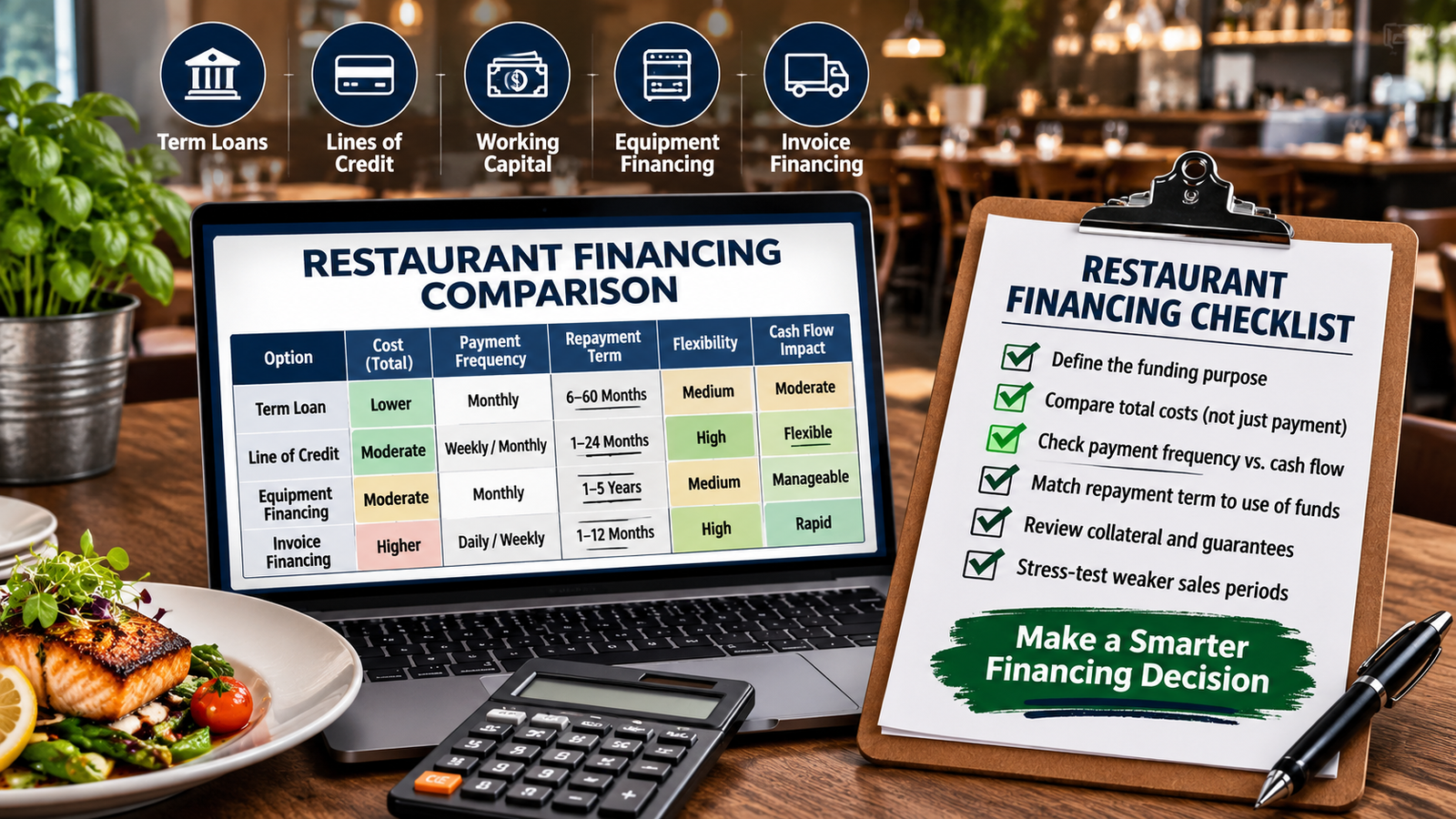
Restaurant financing can help a food-service business replace essential equipment, purchase inventory, manage supplier timing, renovate premises, support working capital or fund a carefully planned expansion.
But restaurants create a financing challenge that many other businesses do not face as intensely.
Cash constantly moves through:
- food purchases
- wages
- rent
- utilities
- delivery-platform costs
- insurance
- equipment maintenance
- taxes
- waste
- repairs
- supplier payments
A dining room can look busy while the business has very little spare cash after expenses.
That makes the central restaurant financing question:
After making the financing payment, will the restaurant still have enough cash to operate normally?
Getting approved is not enough.
The financing needs to match:
purpose → restaurant cash cycle → repayment schedule → total cost → operating cushion
Restaurant owners wanting a broader overview of commercial borrowing can also review Kevanzo’s small business loans guide.
Educational note: Kevanzo.com provides general business-financing education only. Kevanzo is not a lender, broker, loan marketplace, financial adviser, attorney, accountant or approval service. Interest rates, APRs, fees, loan amounts, repayment schedules, collateral requirements, guarantees, eligibility standards and financing options vary according to lender, financing product and restaurant. Always review the complete financing agreement before accepting funding.
What Is Restaurant Financing?
Restaurant financing means business funding used for restaurant-related purposes.
That can include financing for:
- kitchen equipment
- refrigeration
- ovens
- ventilation
- furniture
- dining-room improvements
- leasehold improvements
- opening costs
- inventory
- food and beverage supplies
- payroll timing
- supplier payments
- emergency repairs
- delivery equipment
- catering expansion
- working capital
- acquisition
- refinancing certain existing business debt
Restaurant financing is therefore not one specific loan.
Depending on the business and lender, it may involve:
- term loans
- business lines of credit
- equipment financing
- secured loans
- unsecured loans
- working-capital financing
- invoice financing
- other commercial financing structures
Businesses comparing the wider market can review Kevanzo’s business financing pillar.
Why Restaurants Need Their Own Financing Test
Restaurants operate differently from many professional or service businesses.
A consultant may have relatively low inventory requirements.
A restaurant may need to pay for:
- food before customers order it
- employees before all revenue is settled
- rent regardless of sales
- equipment repairs immediately
- utilities required to keep operating
- waste and spoilage
- delivery commissions
- cleaning
- licensing and compliance costs
That means revenue alone can be misleading.
A restaurant generating substantial sales may still have a relatively thin amount of cash remaining after operating expenses.
The Kevanzo Restaurant-Cash Rule
Never test restaurant financing against gross sales alone.
Test it against:
cash remaining after essential restaurant expenses.
Suppose a restaurant generates:
$180,000 monthly sales
but essential operating expenses consume:
$166,000
Cash remaining before new financing:
$14,000
A proposed:
$10,000 monthly financing payment
would consume most of that cushion.
The restaurant may technically generate large revenue.
Its repayment capacity is much smaller.
The Kevanzo Restaurant Funding-Purpose Map
Before comparing offers, place the funding need into one of six groups.
1. Emergency Protection
Examples:
- broken refrigeration
- failed oven
- plumbing failure
- essential ventilation repair
The financing protects existing revenue.
2. Temporary Working Capital
Examples:
- supplier timing
- payroll gap
- seasonal stock
- temporary cash-flow mismatch
3. Equipment
Examples:
- commercial oven
- refrigeration
- dishwasher
- food-preparation machinery
4. Renovation or Long-Lived Improvement
Examples:
- kitchen remodel
- dining-room renovation
- leasehold improvement
- major building work
5. Growth
Examples:
- catering expansion
- additional location
- outdoor dining
- delivery operation
- larger production capacity
6. Receivables Timing
This may apply particularly to restaurants with:
- corporate catering
- event catering
- business accounts
- institutional customers
where payment arrives after service has already been provided.
The funding purpose should narrow the financing options.
Define the Need Before Looking for a Loan
A weak financing request sounds like:
We need extra cash.
A stronger request sounds like:
We need $28,000 to replace a failed commercial refrigeration system that is essential to normal service.
An even stronger version adds:
Based on normal operating cash flow, we believe the proposed repayment must remain below $3,000 per month to preserve our operating cushion.
Now the business has:
- a defined amount
- a defined purpose
- a repayment ceiling
That makes restaurant financing easier to compare.
The Kevanzo One-Sentence Restaurant Funding Test
Complete:
“Our restaurant needs $_____ specifically for _____, and the expenditure should create or protect business value for approximately _____.”
If the owner cannot complete that sentence clearly, the borrowing purpose needs more thought.
Equipment Financing for Restaurants
Restaurants depend heavily on equipment.
Examples include:
- refrigeration
- freezers
- commercial ovens
- grills
- fryers
- dishwashers
- coffee equipment
- ventilation
- point-of-sale hardware
When one of these systems fails, financing can sometimes protect existing revenue rather than create new revenue.
That distinction matters.
The Kevanzo Equipment-Revenue Protection Test
Calculate:
Equipment Cost
What will replacement or repair cost?
Revenue at Risk
How much revenue is lost or threatened while the equipment is unavailable?
Useful Life
How many years should the equipment remain productive?
Financing Term
How long will repayment continue?
Payment
Can normal restaurant cash flow support it?
If a $20,000 repair protects substantially more than $20,000 of otherwise threatened revenue, obtaining financing quickly may have measurable value.
Long-Lived Equipment Should Not Automatically Use Ultra-Short Debt
Suppose a restaurant buys equipment expected to remain productive for:
10 years
but finances it over:
9 months
The debt may disappear quickly.
But the payments could unnecessarily crush working capital.
A longer-lived asset may justify comparing financing with a repayment schedule that better matches the useful life.
Restaurant owners considering longer repayment can compare a long term small business loan.
The Kevanzo Equipment-Life Match
Compare:
expected useful life of equipment
with:
financing term
The goal is not making the loan as long as possible.
It is avoiding an extreme mismatch between:
long-lived asset
and:
unnecessarily compressed repayment.
Restaurant Working Capital
Working capital keeps daily operations moving.
For a restaurant this can include:
- food purchasing
- payroll timing
- suppliers
- packaging
- cleaning supplies
- small repairs
- utilities
- seasonal preparation
Owners may compare working capital loans for small business when the need relates primarily to ordinary operations.
But working-capital borrowing needs discipline.
Temporary Gap Versus Permanent Shortage
Suppose a profitable restaurant normally has healthy cash flow but faces a temporary supplier and payroll overlap.
That may be a financing problem.
Now suppose the restaurant loses:
$15,000 every month
and borrows $15,000 each month to keep operating.
That is primarily an operating problem.
New financing cannot permanently repair:
- poor pricing
- excessive labor costs
- weak margins
- high rent
- excessive waste
- persistent low sales
The Kevanzo Temporary-or-Structural Restaurant Test
Ask:
What happens after this financing is spent that causes the restaurant’s cash position to improve?
Strong answer:
The financing purchases seasonal inventory before our historically strongest trading period.
Weak answer:
We need financing because we are always short before payday.
The second answer deserves investigation before additional debt is added.
Restaurant Line of Credit
A business line of credit may suit restaurants with recurring or unpredictable short-term requirements.
Examples include:
- smaller emergency repairs
- inventory fluctuations
- supplier timing
- temporary payroll gaps
- seasonal preparation
The potential advantage is flexibility.
The restaurant may draw only what it needs, subject to the financing agreement.
But flexibility creates another risk:
credit-line creep.
The Kevanzo Restaurant Credit-Line Rule
A line of credit should ideally move through:
draw → solve temporary need → repay → restore available credit
A weaker pattern is:
draw → partial repayment → draw again → larger balance → another draw
If the line never resets, temporary financing may have become permanent debt.
One-Time Loan or Revolving Credit?
Ask:
Is the Need Specific and One-Time?
Example:
$35,000 refrigerator replacement.
A term structure may be easier to evaluate.
Is the Need Recurring and Variable?
Example:
supplier and inventory timing changes throughout the year.
A revolving structure may fit better.
Do not pay for financial flexibility that the restaurant does not need.
But do not repeatedly take separate loans when one responsibly managed revolving facility better matches recurring cash-flow requirements.
Cash Flow Loans for Restaurants
Some restaurants may compare cash flow loans for small business where funding is primarily evaluated around the company’s ability to generate cash.
For restaurants, this requires special care.
Sales can fluctuate because of:
- weather
- season
- tourism
- local events
- holidays
- delivery demand
- customer traffic
- competition
A payment that works during Friday and Saturday trade may look very different during a quiet Tuesday-to-Thursday period.
The Kevanzo Seven-Day Restaurant Cash Test
Instead of looking only at monthly revenue, examine cash flow across an ordinary week.
Record:
Monday
Cash in and cash out.
Tuesday
Cash in and cash out.
Continue through:
Sunday
Then add financing payments on the actual days they will leave the business account.
This helps expose timing problems hidden by monthly totals.
Weekly Repayment Can Matter Enormously
Suppose restaurant customers pay immediately.
That may make frequent repayment easier than for a business waiting 60 days for invoices.
But restaurants also have frequent expenses.
Weekly cash may already be required for:
- wages
- suppliers
- food purchasing
- delivery
- cleaning
- utilities
- petty expenses
Frequent financing withdrawals join that competition for cash.
The Kevanzo Payment-Rhythm Test
Compare:
restaurant sales rhythm
against:
expense rhythm
against:
financing-payment rhythm
The financing schedule should leave enough money between payment dates to keep the restaurant operating normally.
Short-Term Restaurant Financing
A short term business loan may fit a genuinely temporary restaurant need.
Examples can include:
- emergency repairs
- short seasonal inventory
- event-related supplies
- temporary working-capital timing
The attraction is faster debt clearance.
The danger is cash-flow compression.
The Kevanzo Short-Term Restaurant Test
Calculate:
cash normally available after restaurant expenses
minus
proposed short-term payment
equals
remaining operating cushion
Then ask:
Can the restaurant survive a slower-than-normal month with that cushion?
If not, the repayment term may be too aggressive.
Restaurant Financing for Renovations
Renovations can create a different problem.
Money leaves the business before the renovation has had time to produce a return.
Potential costs include:
- construction
- kitchen upgrades
- furniture
- lighting
- flooring
- permits
- professional services
- closure or reduced operating capacity
The restaurant may even experience lower revenue while work is underway.
The Kevanzo Renovation-Lag Test
Estimate:
Project Start
When does spending begin?
Reduced-Trading Period
Will revenue fall during construction?
Reopening
When should the upgraded operation resume?
Revenue Improvement
When might the renovation begin producing economic value?
Loan Payment Start
When does repayment begin?
Financing should give the restaurant enough room to survive the period between:
money spent
and:
benefit received.
Restaurant Expansion Financing
Expansion can include:
- second location
- larger premises
- catering
- outdoor seating
- takeaway operation
- additional kitchen capacity
- delivery expansion
Growth sounds positive.
But growth consumes cash before it necessarily creates profit.
The Kevanzo Restaurant Growth-Lag Test
Write down:
- total project cost
- expected opening date
- expected monthly operating cost increase
- expected revenue ramp-up
- expected break-even point
- proposed financing payment
Then model slower growth.
If the plan only works when the new location is immediately busy, the assumptions may be too optimistic.
Restaurant Financing and SBA 7(a)
Eligible restaurants may encounter SBA-backed financing among the options they compare.
The SBA currently describes 7(a) as its primary business loan program.
Eligible uses can include:
- short- and long-term working capital
- machinery and equipment
- furniture
- fixtures
- supplies
- certain real estate or building needs
- refinancing certain business debt
- certain ownership changes
Eligibility and lender underwriting still apply, and the business must demonstrate a reasonable ability to repay.
A restaurant should therefore view SBA financing as one possible structure to compare rather than assuming it is automatically the best choice.
Restaurant Financing and SBA 504
For major fixed assets, eligible restaurant businesses may also encounter SBA 504 financing.
Current SBA guidance describes 504 as long-term financing for major fixed assets and identifies eligible uses that can include:
- real estate
- buildings
- qualifying long-term machinery
- qualifying long-term equipment
- certain renovation or modernization projects
It is not designed as ordinary everyday working-capital financing.
That makes the purpose distinction important.
Working-capital problem and major fixed-asset investment are not the same financing problem.
Restaurant Microloans
For relatively smaller financing requirements, eligible businesses may also encounter SBA Microloans.
Current SBA information says Microloans can be used for purposes including:
- working capital
- inventory
- supplies
- furniture
- fixtures
- machinery
- equipment
SBA currently lists the maximum Microloan amount as $50,000.
Again, availability and actual terms depend on the approved intermediary and borrower.
Restaurant Invoice Financing
Some restaurants operate heavily through:
- corporate catering
- events
- schools
- business accounts
- institutional customers
Those customers may not pay immediately.
The restaurant may have:
- purchased food
- paid staff
- provided service
while waiting for invoice payment.
In that situation, invoice financing for small business may deserve comparison.
The Kevanzo Catering Receivables Test
Calculate:
Eligible Unpaid Invoices
How much has already been billed?
Expected Payment Date
When should customers pay?
Immediate Cash Requirement
How much is needed now?
Financing Cost
What does receiving the money earlier cost?
Customer Delay Risk
What happens if payment arrives late?
The core question becomes:
Is earlier access to already-earned revenue worth the financing cost?
Secured Restaurant Financing
Secured restaurant financing may expose assets such as:
- equipment
- property
- receivables
- other business assets
depending on the agreement.
Collateral can support a lending decision.
But essential restaurant equipment may be critical to daily operations.
That means collateral exposure deserves serious attention.
Unsecured Restaurant Financing
Restaurant owners may also compare unsecured business loans.
Unsecured does not automatically mean:
- no guarantee
- no contractual protections
- no business obligation
- no collection rights
- no consequences after default
Read the agreement carefully.
The Kevanzo Restaurant Security Test
For every financing offer answer:
What Is Specifically Pledged?
Equipment?
Property?
Receivables?
Nothing specific?
Is a Broader Security Interest Involved?
Read the agreement.
Is There a Personal Guarantee?
What owner exposure exists?
What Happens After Default?
What rights does the lender have?
A small difference in financing cost may be less important than a major difference in asset or owner exposure.
Restaurant Financing Costs
Restaurant financing cost can include more than interest.
Potential costs can include:
- interest
- APR where applicable
- origination fees
- documentation fees
- maintenance fees
- draw fees
- late fees
- other contract-specific charges
Always look beyond the headline payment.
The Kevanzo Ten-Number Restaurant Financing Comparison
For every serious offer, record these ten numbers.
1. Financing Amount
How much is offered?
2. Net Cash Received
How much actually reaches the restaurant?
3. Interest Rate
Where applicable.
4. APR
Where available and relevant.
5. Fees
What additional costs apply?
6. Payment Amount
How much must be paid?
7. Payment Frequency
Daily, weekly, monthly or another schedule?
8. Repayment Term
How long does the debt remain?
9. Total Scheduled Repayment
How much should ultimately leave the restaurant?
10. Remaining Restaurant Cash Cushion
How much money remains after repayment?
Those numbers create a stronger comparison than an advertisement or approval amount.
Net Cash Received
Suppose a restaurant receives financing advertised as:
$75,000
Upfront fees:
$3,000
Cash reaching the business:
$72,000
The approved amount and useful cash are not identical.
The Kevanzo Net-Funding Test
Calculate:
gross financing amount
minus
upfront deductions
equals
net cash available to restaurant
Then compare that with:
total amount required to be repaid
That reveals the basic financing economics more clearly.
Total Cost Versus Payment Size
Imagine two hypothetical restaurant financing offers.
Both provide:
$80,000
Offer A
Higher monthly payment.
Shorter term.
Lower total financing cost.
Offer B
Lower monthly payment.
Longer term.
Higher total financing cost.
Which is better?
There is not enough information yet.
If Offer A leaves the restaurant short for payroll, its lower total cost may not make it workable.
If Offer B keeps unnecessary debt alive for years, its smaller payment may be expensive convenience.
The Kevanzo Payment-Cost Balance
Ask:
What payment can the restaurant safely support?
Then:
What is the shortest reasonable financing term that preserves a healthy operating cushion?
That helps balance:
affordability
and:
total cost.
Restaurant Labor Costs Matter
Restaurants often have substantial labor requirements.
Financing payments compete with:
- chefs
- kitchen staff
- servers
- managers
- cleaners
- casual employees
- payroll taxes and related costs
That means repayment should be tested after realistic staffing expense.
Not before.
The Kevanzo Payroll-Protected Payment Test
Take:
expected sales
minus
food and beverage costs
minus
realistic payroll
minus
rent
minus
utilities
minus
essential operating costs
minus
existing debt
Then examine what remains for the new financing payment.
Payroll should not depend on unusually strong restaurant trading just because a new loan has been added.
Food Cost and Margin Risk
Food prices can change.
Waste can increase.
Menu pricing can lag behind supplier increases.
Suppose restaurant financing is affordable today because food cost represents:
30% of sales
What happens if food cost rises to:
34%?
The financing payment has not changed.
But the restaurant’s available cash has.
The Kevanzo Margin-Stress Test
Model repayment under:
Normal Food Cost
Current margin.
Moderately Higher Food Cost
Supplier prices rise.
Difficult Food Cost
Margin is materially compressed.
If repayment only works under today’s best margin, the financing deserves caution.
Delivery Platform Costs
Restaurants using third-party delivery may generate additional sales while also paying:
- commissions
- service charges
- promotional expenses
- packaging costs
Gross delivery revenue is therefore not the same as available repayment cash.
Restaurant financing should be compared against revenue after the meaningful costs required to generate it.
Seasonality
Restaurants can be highly seasonal.
Examples include businesses influenced by:
- tourist seasons
- university calendars
- summer trade
- winter trade
- holiday periods
- local events
A payment chosen during the strongest month may become uncomfortable during the weakest.
The Kevanzo Restaurant Weakest-Month Test
Review at least the previous 12 months where reliable records are available.
Identify:
- strongest month
- average month
- weakest realistic month
Then insert the proposed financing payment into each.
The restaurant financing should not rely entirely on peak-season conditions.
Three-Condition Restaurant Financing Stress Test
Every substantial restaurant financing decision should be tested under three conditions.
Condition 1: Normal
Sales and expenses perform approximately as expected.
Condition 2: Slow
Sales fall moderately or food/labor costs rise.
Condition 3: Difficult
Sales fall while an unexpected equipment or supplier expense appears.
Under each condition calculate:
- revenue
- food cost
- payroll
- rent
- utilities
- suppliers
- taxes
- existing debt
- proposed financing payment
- remaining cash
If the restaurant immediately becomes cash-negative in a modest slowdown, reconsider the financing structure.
Emergency Equipment Scenario
A restaurant’s primary refrigerator fails.
Replacement cost:
$24,000
Without replacement:
- food safety is affected
- inventory may be lost
- menu capacity may fall
- revenue may be threatened
Restaurant financing may protect existing business value.
The owner should compare:
cost of financing
against:
economic damage caused by waiting.
The Kevanzo Urgency-Value Test
Calculate:
estimated loss caused by delay
and compare it with:
additional cost of faster financing
If waiting one week could cost:
$40,000
while obtaining faster funding costs an additional:
$4,000
speed may have genuine economic value.
If waiting creates little measurable loss, a large speed premium may be unnecessary.
Seasonal Inventory Scenario
A restaurant expects historically strong holiday bookings.
Additional inventory requirement:
$30,000
Before borrowing, test:
- confirmed bookings
- historical sales
- expected margin
- spoilage risk
- cancellation risk
- repayment timing
Restaurant financing should not depend entirely on an optimistic sales forecast.
Catering Expansion Scenario
A restaurant wants to build its catering business.
Investment:
$70,000
Potential uses:
- equipment
- transport
- additional staff
- marketing
- packaging
The financing decision should consider how long catering revenue may take to mature.
A good idea can still have the wrong financing structure.
New Location Scenario
A successful restaurant wants a second location.
Costs might include:
- deposits
- fit-out
- kitchen equipment
- furniture
- permits
- inventory
- hiring
- training
- marketing
- working capital
Revenue may take months to stabilize.
The owner should model:
slow opening
not simply:
full restaurant from day one.
Existing Restaurant Debt
A new loan joins existing obligations.
Suppose the restaurant already pays:
Equipment financing:
$2,500 monthly
Vehicle:
$900
Credit cards:
$1,600
Existing loan:
$3,000
Total:
$8,000 monthly
The proposed restaurant financing payment must be added to that amount.
The Kevanzo Restaurant Debt-Stack Test
List every debt.
For each record:
- outstanding balance
- payment
- payment frequency
- remaining term
Then add the new financing.
Compare all payments together with actual free restaurant cash flow.
Qualification Is Not Affordability
A lender might approve:
$150,000
The restaurant might need:
$70,000
And cash flow might safely support:
$80,000
Those are three different numbers.
The Kevanzo Restaurant Funding Triangle
Compare:
Need
How much does the restaurant actually require?
Affordability
How much financing can operations comfortably support?
Approval
How much will the lender provide?
The borrowing decision should be driven by:
need + affordability
not simply:
approval.
Reborrowing Risk
Repeated short-term restaurant borrowing deserves attention.
Suppose:
Loan 1 handles a cash shortage.
Before Loan 1 is repaid, Loan 2 is required.
Then another financing arrangement follows.
That may indicate that debt is becoming part of the restaurant’s ordinary operating budget.
The Kevanzo Restaurant Independence Test
Ask:
If we take this financing today, should normal restaurant operations be capable of repaying it without another loan?
If the expected answer is no, investigate the underlying economics.
Common Restaurant Financing Mistakes
Borrowing Because the Restaurant Looks Busy
Busy does not automatically mean profitable.
Looking Only at Sales
Available cash matters more.
Ignoring Food Costs
Margin changes can destroy repayment cushion.
Ignoring Payroll
Labor competes directly with debt repayment.
Choosing the Largest Approval
Borrow according to purpose.
Choosing Based on Speed Alone
Urgency should have measurable value.
Using Short Debt for Long-Lived Improvements
Match term to useful life.
Using Long Debt for Tiny Temporary Needs
Do not carry unnecessary debt for years.
Ignoring Payment Frequency
Weekly payments can substantially affect restaurant cash rhythm.
Ignoring Collateral
Essential equipment may be exposed.
Ignoring Personal Guarantees
Owner risk belongs in the comparison.
Financing Permanent Losses
Debt cannot permanently repair weak restaurant economics.
Reborrowing Automatically
Repeated borrowing may indicate dependency.
Restaurant Financing Red Flags
Investigate further when:
- total repayment is unclear
- fees are difficult to understand
- payment frequency is unclear
- food and labor costs have not been included in affordability
- repayment consumes most operating cash
- sales projections are unusually optimistic
- the restaurant already has substantial debt
- financing covers recurring monthly losses
- another loan will probably be needed before this one is repaid
- collateral language is unclear
- personal guarantee terms are unclear
- repayment begins before a project can reasonably create cash
- funding amount exceeds the actual purpose
- the owner cannot explain the repayment source
- the lender emphasizes approval while repayment terms remain unclear
Several red flags together deserve serious caution.
Questions to Ask Before Accepting Restaurant Financing
Ask:
- How much money does the restaurant actually need?
- What exactly will the funds be used for?
- How much financing is being offered?
- How much cash will actually reach the restaurant?
- What is the interest rate?
- Is it fixed or variable?
- What APR is provided where applicable?
- What fees apply?
- What is the payment?
- How often is payment required?
- When does the first payment occur?
- How long does repayment continue?
- What is the total scheduled repayment?
- Is collateral required?
- Is restaurant equipment exposed?
- Is another security interest involved?
- Is a personal guarantee required?
- What does the guarantee cover?
- Can the financing be repaid early?
- Does early repayment reduce cost?
- Is there a prepayment charge?
- What happens after a late payment?
- What constitutes default?
- Can repayment be accelerated?
- Is automatic bank withdrawal required?
- Can payments change?
- What happens if restaurant sales decline?
- What happens if food costs rise?
- What happens if payroll costs increase?
- What happens during the restaurant’s weakest month?
- How does the payment affect existing debt?
- What exact cash will repay the financing?
- Does the financing term match the funded purpose?
- What alternative financing structures were compared?
- Should the restaurant be financially stronger after the financing is repaid?
Clear answers make comparison easier.
The Kevanzo 20-Point Restaurant Financing Check
Before accepting restaurant financing, complete this final check.
1. Funding Purpose
What exactly is being financed?
2. Amount Needed
How much is genuinely required?
3. Net Cash Received
What reaches the restaurant?
4. Useful Life
How long should the spending create value?
5. Interest Rate
Fixed or variable?
6. APR
What annualized information is available where applicable?
7. Fees
What additional charges exist?
8. Payment
How much?
9. Payment Frequency
How often?
10. Repayment Term
How long?
11. Total Repayment
What should ultimately be paid?
12. Restaurant Cash Flow
How much free operating cash is available?
13. Food-Cost Stress
What happens if supplier costs rise?
14. Payroll Stress
What happens if labor costs increase?
15. Weakest-Month Test
Can the restaurant still pay during slower trade?
16. Existing Debt
What obligations already exist?
17. Collateral
What assets are exposed?
18. Guarantee
What owner exposure exists?
19. Reborrowing Risk
Will another loan probably be required?
20. Economic Value
Should the financing create or protect more value than it costs?
If several answers remain uncertain, the financing comparison is not finished.
Practical Next Steps
Start with the restaurant problem.
Write down:
amount needed
exact use
expected economic benefit
expected source of repayment
how long the expenditure should create value
Next calculate the restaurant’s genuine operating cushion after:
- food
- wages
- rent
- utilities
- suppliers
- insurance
- taxes
- delivery expenses
- existing debt
Then compare financing structures.
For every serious offer record:
- net funds received
- interest
- APR where relevant
- fees
- payment amount
- payment frequency
- repayment term
- total repayment
- collateral
- guarantees
Run the weakest-month test.
Run the food-cost stress test.
Run the payroll stress test.
Then ask:
Will this restaurant financing solve the defined business problem while leaving enough cash to keep the restaurant operating normally?
That is the decision standard.
Final Takeaway
Restaurant financing can be valuable when it supports a clearly defined need such as equipment, working capital, inventory, repairs, renovation, receivables timing or responsible expansion.
But restaurant financing deserves stricter cash-flow testing than simply asking whether the business has strong sales.
Restaurants must continuously fund:
- food
- labor
- rent
- utilities
- suppliers
- repairs
- taxes
- normal operating costs
The strongest financing structure therefore matches:
restaurant purpose → useful life → cash-flow cycle → affordable payment → total cost → acceptable risk
A restaurant should not borrow simply because financing is available.
It should understand:
- how much money reaches the business
- how much must ultimately be repaid
- when payments occur
- what happens during slow trade
- what happens when food or labor costs rise
- what collateral or guarantees are involved
- whether normal operations can repay the debt without another loan
The strongest restaurant financing is financing that helps the restaurant solve a genuine problem or create durable business value without leaving too little cash to buy food, pay staff, keep equipment running and open the doors tomorrow.
Restaurant Financing Q&A
Q: What should a restaurant compare first when looking for financing?
A: Start with the exact funding purpose, amount needed and realistic repayment capacity. Then compare financing cost, payment frequency, repayment term, collateral, guarantees and the effect on daily restaurant cash flow.
Q: What makes restaurant financing affordable?
A: Restaurant financing is more manageable when payments leave enough cash after food costs, payroll, rent, utilities, suppliers, taxes, existing debt and other essential operating expenses.
Q: Why is cash flow especially important for restaurant financing?
A: Restaurants can generate strong sales while retaining relatively little free cash after food, labor and other operating costs. Financing should therefore be tested against the restaurant’s actual remaining cash rather than gross revenue alone.
Frequently Asked Questions About Restaurant Financing
What Is Restaurant Financing?
Restaurant financing refers broadly to commercial funding used for restaurant purposes such as equipment, working capital, inventory, repairs, renovations, receivables timing or expansion.
What Types of Restaurant Financing Are Available?
Depending on the lender and business, options may include:
- term loans
- business lines of credit
- equipment financing
- working-capital loans
- secured financing
- unsecured financing
- invoice financing
- other commercial funding structures
Can Restaurant Financing Be Used for Equipment?
Potentially, depending on lender terms.
Equipment financing, term loans and certain SBA-backed structures may be among the options a qualifying restaurant compares.
Can Restaurant Financing Be Used for Working Capital?
Potentially.
Working-capital needs can include supplier costs, inventory and temporary operating gaps, depending on lender terms.
Can Restaurants Get SBA Loans?
Eligible restaurant businesses may potentially qualify for SBA-backed financing through participating lenders if they meet the relevant program and underwriting requirements.
What Is the Biggest Restaurant Financing Risk?
A major risk is accepting repayment obligations that leave too little cash after food costs, labor, rent and other essential operating expenses.
Should a Restaurant Borrow Based on Sales?
Not by sales alone.
Repayment capacity should be based more closely on cash remaining after essential operating costs.
Is a Business Line of Credit Useful for Restaurants?
It can potentially suit recurring or unpredictable short-term needs, depending on the business and lender.
Repeated draws should still be managed carefully.
Can Restaurant Financing Cover Renovations?
Potentially, depending on the financing product.
Long-lived renovations should be compared with financing whose repayment schedule allows the improvement enough time to create economic value.
Is Unsecured Restaurant Financing Risk-Free?
No.
Unsecured financing can still involve guarantees, contractual obligations, fees, repayment requirements and consequences after default.
Should Restaurants Compare APR?
APR can be helpful where available and applicable.
Restaurant owners should also compare fees, net funds received, payment frequency, repayment term and total scheduled repayment.
What Is a Factor Rate?
A factor rate is a pricing structure used by some financing products.
It works differently from a traditional interest rate and should be compared using total dollar repayment and repayment timing.
Should a Restaurant Borrow the Maximum Amount Offered?
Not simply because the lender offers it.
The amount borrowed should be tied to a defined business purpose and realistic repayment capacity.
How Should a Restaurant Test a Financing Payment?
Test it against:
- normal trading
- a slower month
- higher food costs
- higher labor costs
- existing debt
- an unexpected operating expense
Can Restaurant Financing Help With Cash Flow?
Potentially, but financing payments also consume cash.
The repayment schedule needs to fit the restaurant’s actual operating cycle.
What Is the Most Important Restaurant Financing Question?
Ask:
After making this financing payment, will the restaurant still have enough cash to operate normally during a realistic slow period?
Helpful Authoritative Resources
- U.S. Small Business Administration business loan resources
- U.S. Small Business Administration 7(a) loans
- U.S. Small Business Administration 504 loans
- U.S. Small Business Administration Microloans
- U.S. Small Business Administration Lender Match
- Consumer Financial Protection Bureau small business lending resources
- Federal Trade Commission business guidance
- SCORE small business mentoring and education
Author Bio
Kevanzo Editorial Team
Kevanzo Editorial Team creates practical, plain-English educational resources for U.S. restaurant owners comparing restaurant financing, small business loans, working capital, equipment financing, business lines of credit, borrowing costs, repayment structures and responsible financing decisions.
Copyright Notice
© 2026 Kevanzo. All rights reserved.
This article about restaurant financing is protected by copyright and may not be copied, scraped, spun, republished or used commercially without prior written permission from Kevanzo. Brief quotations may be used with clear attribution and a link to the original article.
Unauthorized reuse, bulk scraping, content spinning, AI rewriting for republication or commercial reproduction of this material is prohibited.
Educational Disclaimer
Kevanzo.com provides general educational information about restaurant and business financing. Kevanzo is not a lender, broker, loan marketplace, financial adviser, attorney, accountant or approval service.
Nothing in this article constitutes financial, legal, tax, accounting, investment, lending or personalized business advice. Interest rates, APRs, fees, repayment schedules, collateral requirements, guarantees, eligibility standards and available financing products vary according to lender, borrower, financing type, restaurant profile, industry, revenue, credit history and market conditions.
Restaurant owners should review current official information, read all financing documents carefully and consider seeking advice from appropriately qualified professionals when necessary before making financing decisions.