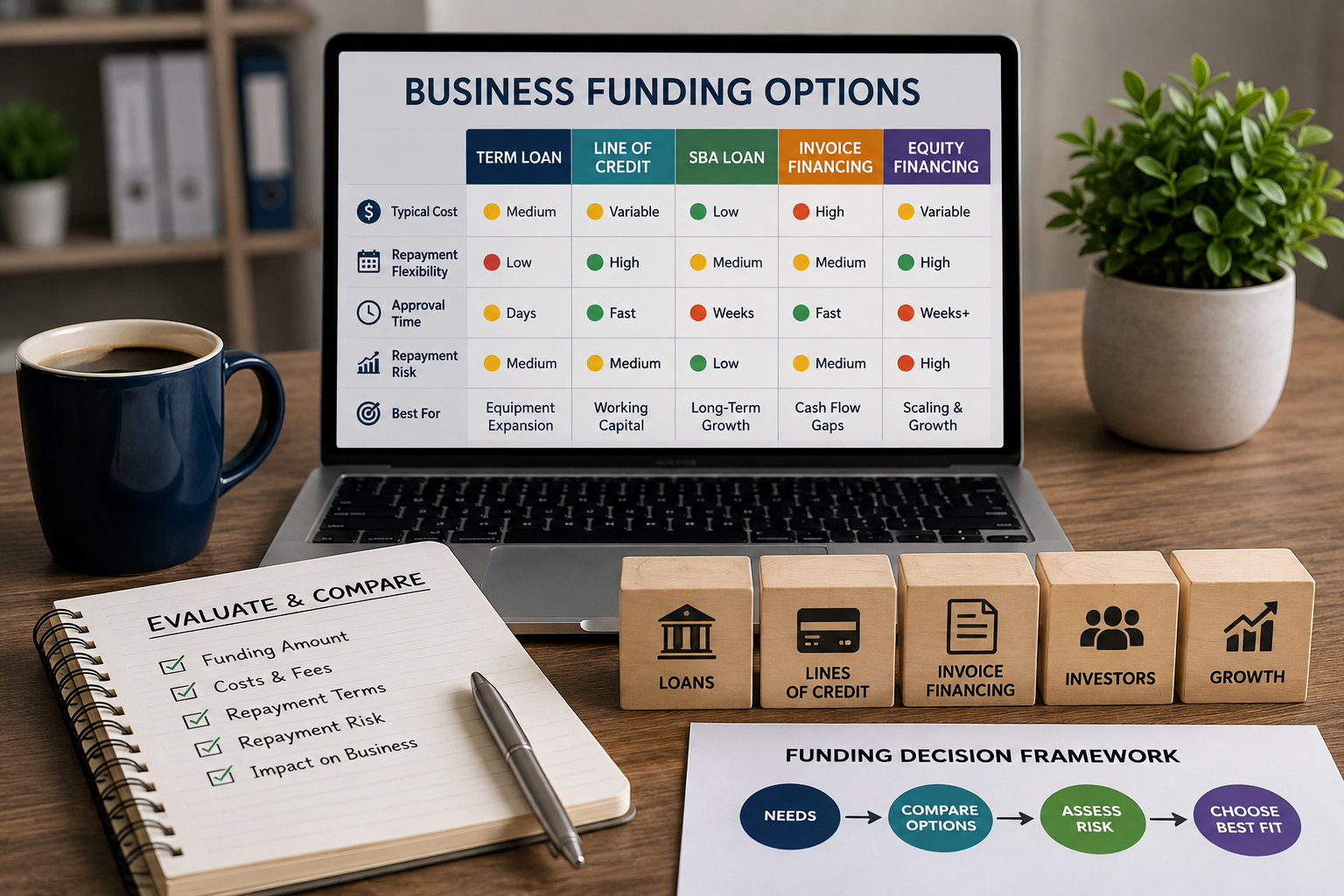
Business financing can help a company manage cash flow, purchase equipment, cover temporary operating needs, fund expansion, acquire inventory or support other legitimate business purposes.
But getting access to money is only the beginning of the decision.
The more important questions are:
- What is the money actually for?
- How much does the business genuinely need?
- How long will the funded expense create value?
- How quickly must the financing be repaid?
- What will the financing cost in total?
- How much operating cash will remain after each payment?
- What collateral, guarantees or other obligations are involved?
That is because business financing is not one product.
It can include:
- business term loans
- working capital loans
- business lines of credit
- secured or unsecured debt
- invoice and equipment financing
- SBA-backed financing
- revenue-based financing
- equity financing
- grants
- crowdfunding
- self-funding and other legitimate capital structures
Different financing structures solve different problems.
A retailer purchasing seasonal inventory may need something very different from a manufacturer buying equipment expected to operate for ten years.
A contractor waiting for customer invoices to be paid may face a timing problem rather than a long-term capital problem.
A growing company opening another location may need financing that gives the investment enough time to produce revenue.
The strongest approach is therefore:
define the business problem → match the financing structure → calculate the complete cost → stress-test repayment → compare alternatives
Business owners looking specifically at loan products can also review Kevanzo’s small business loans guide.
Educational note: Kevanzo.com provides general business-financing education only. Kevanzo is not a lender, broker, loan marketplace, financial adviser, attorney, accountant or approval service. Interest rates, APRs, fees, loan amounts, repayment schedules, collateral requirements, guarantees, eligibility standards and available financing options vary by lender, financing product and borrower. Always review the complete financing agreement before accepting funding.
Table of Contents
- What Is Business Financing?
- The Kevanzo Financing-Purpose Map
- Start With the Problem, Not the Product
- The Kevanzo One-Sentence Funding Test
- How Much Business Financing Does the Company Actually Need?
- The Kevanzo Need-versus-Offer Test
- Match Financing Duration to Business Purpose
- The Kevanzo Benefit-Life Match
- Short-Term Business Financing
- Long-Term Business Financing
- The Kevanzo Term-Tradeoff Test
- Working Capital Financing
- The Kevanzo Operating-Cycle Map
- Business Line of Credit
- The Kevanzo One-Time-or-Recurring Test
- Secured Business Financing
- Unsecured Business Financing
- The Kevanzo Security-Exposure Test
- Invoice Financing
- The Kevanzo Receivables-Gap Test
- Revenue-Based and Cash-Advance Structures
- Factor Rate Versus Interest Rate
- Interest Rate and APR
- The Kevanzo Complete-Cost Stack
- Net Cash Received Matters
- The Kevanzo Net-Cash Test
- Payment Frequency Can Change Everything
- The Kevanzo Payment-Frequency Test
- Cash Flow Is More Important Than Revenue Alone
- The Kevanzo Repayment-Cushion Test
- Existing Debt Must Be Included
- The Kevanzo Total-Debt Pressure Test
- Financing for Inventory
- The Kevanzo Inventory-to-Cash Test
- Financing for Equipment
- Financing for Expansion
- The Kevanzo Growth-Lag Test
- Financing for Emergency Expenses
- The Kevanzo Urgency-Value Test
- Refinancing Existing Business Debt
- The Kevanzo Refinancing Reality Check
- Fixed Versus Variable Interest
- The Kevanzo Rate-Stress Test
- Personal Guarantees
- Prepayment and Exit Flexibility
- The Kevanzo Exit-Flexibility Test
- Lender Requirements
- Qualification Is Not Affordability
- The Kevanzo Financing Triangle
- Three-Condition Business Financing Stress Test
- The Kevanzo Ten-Number Financing Comparison
- Compare Financing in Dollars
- The Kevanzo Economic-Value Test
- Business Financing Red Flags
- Common Business Financing Mistakes
- Starting With the Product
- Borrowing the Maximum Offered
- Looking Only at Interest Rate
- Looking Only at Payment Size
- Ignoring Net Proceeds
- Ignoring Existing Debt
- Matching Short Debt to Long Projects
- Matching Long Debt to Tiny Temporary Needs
- Assuming Unsecured Means Risk-Free
- Ignoring Personal Guarantees
- Using New Debt to Pay Old Debt Repeatedly
- Financing Persistent Losses
- Business Financing Decision Tree
- Questions to Ask Before Accepting Business Financing
- The Kevanzo 20-Point Business Financing Check
- 1. Purpose
- 2. Amount Needed
- 3. Net Cash Received
- 4. Funding Duration
- 5. Benefit Duration
- 6. Interest Rate
- 7. APR
- 8. Fees
- 9. Payment Amount
- 10. Payment Frequency
- 11. Repayment Term
- 12. Total Repayment
- 13. Repayment Source
- 14. Operating Cushion
- 15. Existing Debt
- 16. Collateral
- 17. Guarantees
- 18. Slow-Month Resilience
- 19. Alternative Structures
- 20. Economic Value
- Practical Next Steps
- Final Takeaway
- Frequently Asked Questions About Business Financing
- What Is Business Financing?
- What Types of Business Financing Are Available?
- Is Business Financing the Same as a Business Loan?
- What Should I Compare First?
- Is the Lowest Interest Rate Always Best?
- Should I Compare APR?
- What Is a Factor Rate?
- What Is Working Capital Financing?
- What Is a Business Line of Credit?
- Is Unsecured Business Financing Risk-Free?
- Is Secured Financing Better?
- Can Business Financing Help Cash Flow?
- Should a Business Borrow the Maximum Amount Offered?
- What Is the Biggest Business Financing Risk?
- How Can a Business Test Affordability?
- Can Business Financing Be Used for Expansion?
- When Might Business Financing Be a Poor Idea?
- How Many Financing Offers Should a Business Compare?
- Helpful Authoritative Resources
- Author Bio
- Copyright Notice
- Educational Disclaimer
What Is Business Financing?
Business financing means capital, credit or other funding used for legitimate business purposes rather than personal spending.
Possible uses include inventory, equipment, repairs, payroll timing, supplier costs, working capital, receivables gaps, expansion, project expenses, acquisitions and certain debt-management needs.
The term is broad. A business loan is business financing, but business financing is not limited to loans.
Debt financing includes term loans, lines of credit, equipment financing, invoice financing and other arrangements that create a repayment obligation.
SBA-backed financing is also debt financing. Participating lenders and intermediaries provide eligible financing under SBA programs, while eligibility, permitted uses and other rules depend on the specific program and should be verified directly with the U.S. Small Business Administration.
Equity financing raises capital in exchange for ownership. It generally does not create the same scheduled repayment obligation as a loan, but it can dilute existing owners and create investor rights or governance obligations.
Grants can provide non-debt funding when a business or project qualifies, but eligibility, use-of-funds and reporting restrictions can apply.
Crowdfunding can take different forms. Reward-based or pre-sale crowdfunding differs from investment crowdfunding, which can involve securities-law requirements and investor disclosures.
Self-funding can include retained earnings or owner capital. It may avoid an external lender payment or outside investor, but it can reduce reserves or concentrate more financial risk on the owner.
The first question is therefore broader than choosing a loan product:
Is the business willing to repay debt, share ownership, accept restricted funding, use its own capital, or compare several of those paths?
Only after that is clear should the business compare specific financing structures.
The Kevanzo Financing-Purpose Map
Before comparing lenders, identify which of these six purposes most closely matches the business need.
1. Temporary Operating Need
Examples:
- payroll timing
- supplier payments
- seasonal inventory
- temporary expense gap
2. Recurring Working-Capital Need
Examples:
- repeated inventory cycles
- ongoing receivables timing
- irregular operating expenses
3. One-Time Business Purchase
Examples:
- machinery
- equipment
- vehicle
- technology system
4. Long-Term Growth Investment
Examples:
- new location
- major expansion
- long-lived improvements
- acquisition
5. Receivables Timing Problem
The business has earned revenue but customers have not yet paid.
6. Existing Debt Problem
The business is considering:
- refinancing
- consolidation
- restructuring repayment
Identifying the purpose immediately narrows the comparison.
Start With the Problem, Not the Product
A common mistake is searching for a financing product before defining the business problem.
For example:
We need a business loan.
That tells us very little.
Compare it with:
We need $45,000 to purchase seasonal inventory that historically sells within four months.
Now the decision has:
- amount
- purpose
- expected duration
- potential repayment source
That makes financing easier to evaluate.
The Kevanzo One-Sentence Funding Test
Before looking at offers, complete:
“Our business needs $_____ for _____, and we expect the expenditure to create or protect cash flow over approximately _____.”
If the sentence cannot be completed clearly, the financing purpose probably needs more work.
How Much Business Financing Does the Company Actually Need?
The amount a lender is willing to provide and the amount a business should borrow are not the same thing.
Suppose:
Business need:
$60,000
Financing offered:
$125,000
The additional $65,000 might feel attractive.
But additional borrowing can mean:
- more interest
- more fees
- larger payments
- greater debt exposure
- reduced future borrowing capacity
- temptation to spend money without a defined purpose
Approval should not determine borrowing.
Purpose should.
The Kevanzo Need-versus-Offer Test
Write down:
Amount Required
What does the defined business purpose actually cost?
Amount Offered
What is the lender willing to provide?
Productive Use
Can every additional borrowed dollar be connected to a legitimate economic purpose?
If the answer to the third question is no, borrowing less deserves serious consideration.
Match Financing Duration to Business Purpose
One of the most important principles in business financing is matching the life of the financing to the life of the need.
Imagine financing:
Seasonal Inventory
Expected to sell within four months.
Major Equipment
Expected to remain productive for eight years.
Property Improvement
Expected to create value for many years.
Those needs should not automatically use the same repayment structure.
The Kevanzo Benefit-Life Match
Estimate:
How long will this expenditure create useful business value?
Then compare:
How long will the business remain in debt?
A useful rule is:
short-lived need → usually consider shorter-duration financing
long-lived value → potentially consider longer-duration financing
This is not absolute.
But large mismatches deserve investigation.
Short-Term Business Financing
A short term business loan can fit a temporary requirement when the repayment source is identifiable.
Potential uses might include:
- seasonal inventory
- project materials
- urgent repairs
- temporary working-capital gaps
Its major advantage can be faster debt clearance.
Its major risk is repayment compression.
The business must return the money over a relatively short period.
That can leave less cash available for ordinary operations.
Long-Term Business Financing
A long term small business loan may be more appropriate when the financed activity is expected to create value for several years.
Examples can include:
- substantial expansion
- major equipment
- long-lived improvements
- larger strategic projects
Longer repayment can reduce scheduled payment pressure.
But carrying debt longer can increase total financing cost depending on the terms.
The Kevanzo Term-Tradeoff Test
Every financing term creates a tradeoff.
Shorter Term
Potentially:
- faster payoff
- less time in debt
- higher scheduled payments
- more short-term cash pressure
Longer Term
Potentially:
- lower scheduled payments
- more time in debt
- more repayment flexibility
- higher total interest depending on the offer
The correct question is not:
Which term is longest?
or:
Which term is shortest?
It is:
Which term gives the business enough time to repay without carrying debt unnecessarily?
Working Capital Financing
Working capital supports ordinary business operations.
Possible needs include:
- inventory
- payroll timing
- suppliers
- short revenue gaps
- seasonal expenses
- materials
- recurring operating costs
Businesses with these needs may compare working capital loans.
The important word is timing.
Working-capital financing should generally support the operating cycle rather than permanently replace operating cash.
The Kevanzo Operating-Cycle Map
Write down four dates.
Cash Leaves
When does the business spend the money?
Product or Service Is Delivered
When does the spending create commercial activity?
Customer Cash Arrives
When does the business actually get paid?
Financing Payment Is Due
When does the lender require repayment?
The closer the financing schedule matches the operating cycle, the easier repayment may be to manage.
Business Line of Credit
A business line of credit can provide reusable access to financing up to an approved limit, subject to lender terms.
A business may also compare an operating line of credit when it needs flexible funding for recurring working capital needs.
The general cycle may look like:
draw → use funds → repay → restore available credit
That can make revolving credit useful for:
- recurring working-capital needs
- unpredictable expenses
- seasonal requirements
- repeated inventory purchases
- temporary cash-flow gaps
But available credit is not additional profit.
Repeatedly drawing without restoring the balance can turn a flexible facility into permanent debt.
The Kevanzo One-Time-or-Recurring Test
Ask:
Is This Need One-Time?
Example:
$80,000 for a specific equipment purchase.
A term structure may be easier to evaluate.
Is This Need Recurring?
Example:
Inventory requirements fluctuate throughout the year.
A revolving structure may offer useful flexibility.
The financing structure should follow the business need.
Secured Business Financing
Secured financing connects repayment obligations with collateral or other pledged assets.
Possible collateral might include:
- equipment
- machinery
- vehicles
- inventory
- receivables
- business property
Collateral can affect lender risk and financing terms.
But it also creates risk for the business.
If repayment problems occur, the pledged asset may be exposed according to the agreement and applicable law.
Unsecured Business Financing
Unsecured business loans generally do not rely on a specifically pledged physical asset in the same way as conventional secured financing.
That does not mean:
- no risk
- no repayment obligation
- no guarantee
- no lender protection
- no consequences after default
Depending on the financing agreement, additional protections may still apply.
Always read the written terms.
The Kevanzo Security-Exposure Test
For any financing arrangement, identify:
Specific Collateral
What assets are directly pledged?
Other Security
Are broader security interests involved?
Personal Guarantee
Does an owner personally guarantee repayment?
Default Exposure
What can happen if contractual obligations are not met?
Financing cost should never be compared without considering what the business or owner is putting at risk.
Invoice Financing
invoice financing for small business can be relevant when the central problem is delayed customer payment.
Some businesses may also compare small business factoring when unpaid invoices create a short-term cash-flow gap.
Example:
Goods or services have already been delivered.
Invoices outstanding:
$120,000
Typical customer payment:
45 days
Immediate cash requirement:
$40,000
The business may be profitable but temporarily cash constrained.
Receivables financing may address that specific timing problem more directly than a general-purpose loan.
The Kevanzo Receivables-Gap Test
Calculate:
eligible unpaid invoices
average customer payment time
immediate cash needed
cost of obtaining cash early
Then compare:
cost of waiting
against:
cost of financing
Receiving money sooner only creates value when that earlier cash is worth more to the business than the financing cost.
Revenue-Based and Cash-Advance Structures
Some businesses also encounter financing where repayment is connected to business sales or revenue.
A small business cash advance can operate differently from a conventional term loan.
Pricing may involve structures such as:
- factor rates
- predetermined repayment amounts
- frequent collections
- revenue-related payments
Do not compare these products using the name alone.
Compare:
- money received
- total amount repaid
- payment frequency
- expected repayment duration
- effect on cash flow
Factor Rate Versus Interest Rate
A factor rate is not the same thing as a traditional interest rate.
Suppose:
Funding amount:
$50,000
Factor rate:
1.25
Predetermined repayment:
$62,500
The difference is:
$12,500
But that does not mean the financing automatically has a 25% APR.
The pricing methods work differently.
Business owners should compare dollar costs, repayment timing and annualized information where available and applicable.
Interest Rate and APR
Interest rate is one financing cost.
APR may provide a broader annualized measure for some credit products because certain fees can be incorporated.
But no single percentage tells the complete story.
A business should also know:
- net amount received
- payment amount
- payment frequency
- number of payments
- fees
- repayment term
- total repayment
The Kevanzo Complete-Cost Stack
Break financing cost into layers.
Layer 1: Principal
How much is borrowed?
Layer 2: Interest
What interest is charged?
Layer 3: Upfront Fees
Examples might include origination or documentation charges.
Layer 4: Ongoing Fees
Examples might include maintenance or draw fees depending on the product.
Layer 5: Event-Based Fees
Examples might include late-payment charges.
Layer 6: Exit Cost
What happens if the financing is repaid early?
Only after examining all six layers does the business have a fuller picture of cost.
Net Cash Received Matters
Imagine an approved loan of:
$100,000
Upfront fees:
$4,000
Actual cash reaching the business:
$96,000
Repayment is based on the financing agreement, not simply the amount arriving in the bank account.
That makes net proceeds an important comparison number.
The Kevanzo Net-Cash Test
Calculate:
gross financing amount
minus
upfront deductions
equals
net cash received
Then compare the net cash received with the total amount the business must repay.
This prevents an approved amount from appearing more valuable than the cash the business actually receives.
Payment Frequency Can Change Everything
Businesses often focus on payment size without considering frequency.
Compare:
$5,000 Monthly
with:
$1,250 Weekly
They may look similar at first glance.
But cash-flow timing can make them feel very different.
A business whose customers pay monthly may find weekly withdrawals more difficult to manage.
The Kevanzo Payment-Frequency Test
Compare:
customer cash-arrival frequency
with:
lender payment frequency
If customers pay every 30–45 days but financing payments leave the account every week, the business needs enough working capital to cover the mismatch.
Cash Flow Is More Important Than Revenue Alone
A business can generate substantial revenue and still struggle with debt.
Business A
Revenue:
$250,000 monthly
Essential expenses:
$235,000
Cash before debt:
$15,000
Business B
Revenue:
$120,000 monthly
Essential expenses:
$80,000
Cash before debt:
$40,000
Business A is larger.
Business B may have substantially more repayment capacity.
That is why business financing should be evaluated against actual available cash rather than headline revenue alone.
The Kevanzo Repayment-Cushion Test
Calculate:
cash available after essential operating expenses
minus
existing debt payments
minus
proposed financing payment
equals
remaining operating cushion
The financing should leave enough room for the business to continue functioning normally.
Existing Debt Must Be Included
Suppose a business already pays:
Equipment financing:
$3,500 monthly
Vehicle finance:
$1,500
Credit cards:
$2,000
Existing term loan:
$4,000
Total:
$11,000 monthly
A proposed new payment must be added to this debt load.
Never evaluate a new financing offer in isolation.
The Kevanzo Total-Debt Pressure Test
List:
- every existing financing obligation
- monthly payment
- remaining term
- outstanding balance where known
Then add the proposed financing.
Ask:
How much of normal available business cash will all debt payments consume together?
This is more useful than examining the new loan alone.
Financing for Inventory
Inventory financing decisions require particular attention to cash conversion.
The company spends money first.
Then inventory must:
arrive → sell → produce revenue → convert to cash
The lender may require repayment before that entire cycle finishes.
The Kevanzo Inventory-to-Cash Test
Record:
- inventory purchase date
- expected arrival
- normal selling period
- expected gross margin
- customer payment timing
- financing payment schedule
A good financing structure should broadly respect the inventory cycle.
Financing for Equipment
Equipment can create value for years.
That may justify comparing financing with a longer repayment period than would be sensible for temporary inventory.
Ask:
- How long will the equipment remain productive?
- How much revenue or cost saving should it produce?
- What is the financing term?
- What happens if the equipment becomes obsolete?
- Is the equipment collateral?
The useful life of the asset and the financing term should make economic sense together.
Financing for Expansion
Expansion often requires money before new revenue appears.
Possible costs include:
- fit-out
- inventory
- hiring
- marketing
- deposits
- technology
- equipment
- professional services
The central risk is growth lag.
The expense happens immediately.
Revenue may take months to mature.
The Kevanzo Growth-Lag Test
Estimate:
Month Money Is Spent
When does the investment begin?
Month New Revenue Begins
When should the project start producing?
Month Break-Even Occurs
When should cumulative benefits cover the investment?
Financing Payment Start
When does repayment begin?
A strong financing structure gives the project enough time to generate cash without relying on unrealistic growth assumptions.
Financing for Emergency Expenses
Sometimes speed matters.
A broken refrigerator at a restaurant or failed machine at a manufacturer may stop revenue immediately. Restaurant owners comparing funding for urgent repairs should also review restaurant financing and the repayment implications before borrowing.
In those situations, faster financing can have measurable economic value.
But urgency should still be calculated.
The Kevanzo Urgency-Value Test
Estimate:
economic loss caused by waiting
Then compare it with:
extra cost of obtaining financing faster
Example:
Business loses:
$5,000 per day
Waiting another five days could cost approximately:
$25,000
If faster financing costs several thousand dollars more, the premium may deserve consideration.
If waiting creates almost no economic loss, paying a large speed premium may make little sense.
Refinancing Existing Business Debt
New business financing may occasionally be considered to replace existing debt. A business considering whether to combine several obligations can compare business debt consolidation loans by total cost, repayment term, fees, and cash-flow effect.
A smaller monthly payment can look attractive.
But determine why the payment is lower.
It may come from:
- lower interest
- longer repayment
- different fee structure
- larger consolidated balance
Lower payment does not automatically mean lower cost.
The Kevanzo Refinancing Reality Check
Compare:
Current Outstanding Balance
How much is owed?
Remaining Current Payments
What will the business pay if nothing changes?
New Financing Amount
What amount will replace the old debt?
New Payment
How does cash flow change?
New Term
How much longer will repayment continue?
New Total Cost
Does refinancing actually improve the economics?
Payment relief and cost savings are different things.
Fixed Versus Variable Interest
Some financing uses fixed rates.
Other financing uses variable rates.
Fixed Rate
Can improve predictability.
Variable Rate
Can change according to the contractual benchmark or formula.
A variable-rate offer should be tested under higher-rate conditions.
The Kevanzo Rate-Stress Test
Model:
Current Rate
Is payment affordable?
Moderately Higher Rate
Does the business remain comfortable?
Significantly Higher Rate
Does financing begin to crowd out essential business expenses?
The purpose is not predicting interest rates.
It is measuring resilience.
Personal Guarantees
Some commercial financing requires an owner or other guarantor to accept personal repayment obligations.
Before signing, understand:
- who guarantees
- what is guaranteed
- when liability begins
- whether liability is limited
- when the guarantee ends
A financing offer with a slightly lower cost may not automatically be better if it creates substantially more personal exposure.
Prepayment and Exit Flexibility
A business may later want to repay financing early.
Before borrowing, ask:
- Is early repayment allowed?
- Is there a prepayment charge?
- Does early repayment reduce future interest?
- Are any fees retained?
- How is the payoff amount calculated?
The ability to exit financing can have real economic value.
The Kevanzo Exit-Flexibility Test
Ask:
If the company suddenly had enough cash to repay this financing tomorrow, what would it cost to close the obligation?
Know the answer before signing.
Lender Requirements
Different lenders and financing products can evaluate different information. Kevanzo’s small business loan lenders guide explains how to compare provider types, qualification requirements and loan offers.
Possible review areas include:
- business revenue
- cash flow
- bank statements
- credit history
- existing debt
- profitability
- time in business
- industry
- ownership
- tax information
- intended use of funds
- collateral
- receivables
- inventory
- repayment history
Approval standards vary.
A lender approving financing does not prove taking the financing is a good business decision.
Qualification Is Not Affordability
This distinction is critical.
Ask three separate questions.
What Can We Qualify For?
This is the lender’s decision.
What Can We Afford?
This is a cash-flow decision.
What Do We Need?
This is a business-purpose decision.
The financing decision should be driven primarily by the last two.
The Kevanzo Financing Triangle
The strongest borrowing decisions sit where three things overlap:
Need
The money solves a legitimate business problem.
Affordability
The company can repay without damaging normal operations.
Value
The economic benefit is expected to justify the financing cost.
If one side is missing, investigate further.
Three-Condition Business Financing Stress Test
Every major financing decision should be tested under more than one forecast.
Condition 1: Normal
Revenue and costs perform approximately as expected.
Condition 2: Slow
Revenue falls moderately or customers pay more slowly.
Condition 3: Difficult
Revenue falls substantially while an unexpected expense occurs.
Under each condition calculate:
- operating revenue
- essential expenses
- existing debt
- proposed financing payment
- remaining cash
Financing that only works under perfect conditions deserves caution.
The Kevanzo Ten-Number Financing Comparison
For every serious offer, write down these ten numbers.
1. Financing Amount
What is being provided?
2. Net Cash Received
How much reaches the business?
3. Interest Rate
Where applicable.
4. APR
Where available and relevant.
5. Fees
What additional costs apply?
6. Payment Amount
How much must be paid?
7. Payment Frequency
How often?
8. Repayment Term
How long?
9. Total Scheduled Repayment
What should ultimately leave the business?
10. Remaining Operating Cushion
How much cash remains after repayment?
If these ten numbers are unclear, the offer is not ready for comparison.
Compare Financing in Dollars
Percentages can be useful.
But owners eventually need to understand dollars.
For each offer ask:
How much money reaches us?
How much money leaves us?
How quickly?
How much business value should the money create?
Those four questions make complicated financing easier to understand.
The Kevanzo Economic-Value Test
Calculate:
expected economic benefit
minus
complete financing cost
equals
remaining expected benefit before other risks
Example:
Financing cost:
$12,000
Expected additional gross profit:
$40,000
Potential remaining benefit:
$28,000
Then stress-test the benefit.
What if expected revenue is:
- 10% lower?
- 20% lower?
- delayed by three months?
Financing decisions should survive more than the optimistic scenario.
Business Financing Red Flags
Investigate further when:
- total repayment is unclear
- fees are difficult to identify
- payment frequency is unclear
- collateral provisions are unclear
- guarantee language is unclear
- the company is encouraged to borrow substantially more than needed
- repayment consumes most available cash
- financing depends on unusually strong future revenue
- another loan may be needed before this one is repaid
- financing is covering persistent operating losses
- speed is being prioritized over economics
- the owner cannot explain the repayment source
- default terms are unclear
- prepayment terms are unclear
- the financing duration does not match the purpose
Several red flags together deserve serious caution.
Common Business Financing Mistakes
Starting With the Product
Define the problem first.
Borrowing the Maximum Offered
Borrowing capacity is not financing need.
Looking Only at Interest Rate
Fees, term and repayment frequency also matter.
Looking Only at Payment Size
A smaller payment can come from a longer and more expensive repayment period.
Ignoring Net Proceeds
Know how much cash actually reaches the business.
Ignoring Existing Debt
All debt competes for the same operating cash.
Matching Short Debt to Long Projects
Give long-lived investments enough time to produce value.
Matching Long Debt to Tiny Temporary Needs
Do not unnecessarily stretch a short-lived expense across years.
Assuming Unsecured Means Risk-Free
Contractual obligations still matter.
Ignoring Personal Guarantees
Owner exposure belongs in the comparison.
Using New Debt to Pay Old Debt Repeatedly
That may indicate financing dependence.
Financing Persistent Losses
Borrowing cannot permanently repair a structurally unprofitable operation.
Business Financing Decision Tree
A simple decision process can narrow the options.
Before using the debt-financing branches below, decide whether the business is actually seeking repayable debt, ownership capital, or another funding source. Equity financing changes ownership rather than creating a conventional repayment schedule. Grants can carry eligibility, use and reporting restrictions. Crowdfunding can create reward, delivery, disclosure or securities obligations depending on the structure. Self-funding avoids an outside lender or investor but can reduce reserves.
If debt financing is the appropriate category, continue with the questions below.
Is the Need Temporary?
If yes, consider short-duration or working-capital structures.
Is the Need Recurring?
If yes, compare revolving financing.
Is the Need Connected to Unpaid Invoices?
If yes, compare receivables-based options.
Is the Need a Long-Lived Asset or Project?
If yes, compare longer-term financing appropriate to the asset life.
Is a Specific Asset Available and Appropriate as Collateral?
If yes, compare secured structures.
Does the Business Want to Avoid Specifically Pledging an Asset?
If yes, compare unsecured options while reviewing guarantees and other protections.
This does not choose the financing.
It identifies the categories worth comparing.
Questions to Ask Before Accepting Business Financing
Ask:
- How much does the business actually need?
- What exactly will the money fund?
- How much financing is being offered?
- How much cash will actually reach the business?
- What interest rate applies?
- Is the rate fixed or variable?
- What APR is provided where applicable?
- What fees apply?
- What is the payment amount?
- How often are payments due?
- When does the first payment occur?
- How long will repayment continue?
- What is the total scheduled repayment?
- Is collateral required?
- What assets are exposed?
- Is another security interest involved?
- Is a personal guarantee required?
- What does the guarantee cover?
- Can the financing be repaid early?
- What happens to cost after early repayment?
- Are there prepayment charges?
- What happens after late payment?
- What constitutes default?
- Can repayment be accelerated?
- Can payment amounts change?
- Are financial covenants involved?
- What reporting is required?
- Can the business obtain additional financing?
- How does this obligation affect existing debt?
- What happens if revenue falls?
- What business cash will repay the financing?
- Does the term match the life of the funded need?
- What alternative financing structures were compared?
- What economic value should the money create?
- Why is this offer better for the business than the alternatives?
A good financing decision should have clear answers.
The Kevanzo 20-Point Business Financing Check
Before accepting business financing, complete this final review.
1. Purpose
What exactly is being funded?
2. Amount Needed
How much is genuinely required?
3. Net Cash Received
What reaches the business?
4. Funding Duration
How long will the need exist?
5. Benefit Duration
How long should the investment create value?
6. Interest Rate
Fixed or variable?
7. APR
What annualized cost information is available where relevant?
8. Fees
What additional charges apply?
9. Payment Amount
How much is due?
10. Payment Frequency
How often?
11. Repayment Term
How long does debt remain?
12. Total Repayment
What should ultimately be paid?
13. Repayment Source
What cash will repay it?
14. Operating Cushion
How much cash remains after repayment?
15. Existing Debt
What obligations already compete for cash?
16. Collateral
What business assets are exposed?
17. Guarantees
What owner exposure exists?
18. Slow-Month Resilience
Can the company still pay in weaker conditions?
19. Alternative Structures
Has the business compared other suitable financing types?
20. Economic Value
Should the financing create or protect more value than it costs?
If several answers remain unclear, keep comparing.
Practical Next Steps
Start with the business problem.
Do not start with:
“How much can we borrow?”
Start with:
“What exactly are we trying to accomplish?”
Then write down:
- amount needed
- purpose
- expected benefit
- expected repayment source
- time before the benefit appears
Next identify the financing structures that actually fit that need.
Then compare each serious offer using the same numbers:
- net cash received
- interest
- APR where relevant
- fees
- payment
- payment frequency
- repayment term
- total repayment
- collateral
- guarantees
- remaining operating cash
Run the three-condition stress test.
Compare the financing against existing debt.
Then ask one final question:
Will this financing leave the business stronger after the debt is repaid?
That is the standard worth aiming for.
Final Takeaway
Business financing can provide valuable capital for working capital, equipment, inventory, receivables, expansion, projects and other legitimate business needs.
But financing should not begin with a lender offer.
It should begin with a clearly defined business problem.
The strongest process is:
purpose → amount → structure → repayment → cost → risk → economic value
Short-term needs generally deserve comparison with structures suited to short-duration cash cycles.
Recurring needs may justify revolving financing.
Unpaid invoices may point toward receivables-based financing.
Long-lived assets or projects may justify longer repayment periods.
Secured and unsecured financing introduce different forms of risk.
No structure is automatically best.
Business owners should compare:
- net cash received
- total financing cost
- payment size
- payment frequency
- repayment term
- cash-flow impact
- collateral exposure
- guarantees
- existing debt
- slow-month resilience
- economic value
Most importantly, separate:
what a lender is willing to provide
from:
what the business actually needs and can safely repay.
Good business financing should solve a legitimate business problem without creating a larger financial problem after the money arrives.
What Is the Most Important Business Financing Question?
Ask:
Will the business reasonably be stronger after using this capital and meeting every repayment, ownership, restriction or reporting obligation attached to it?
Frequently Asked Questions About Business Financing
What Is Business Financing?
Business financing is capital, credit or other funding used for legitimate business purposes such as working capital, equipment, inventory, operating costs, expansion, receivables timing or growth.
What Types of Business Financing Are Available?
The broad categories include debt financing, SBA-backed financing, equity financing, grants, crowdfunding and self-funding. Debt financing can include term loans, lines of credit, working-capital loans, secured or unsecured financing, invoice financing, equipment financing and other commercial structures.
Is Business Financing the Same as a Business Loan?
No. A business loan is one type of business financing. The broader category can also include revolving credit, receivables-based financing, equity capital, grants, crowdfunding and self-funded capital.
What Should I Compare First?
Start with the business purpose, amount genuinely needed and expected economic benefit. Then compare complete cost, repayment flexibility, cash-flow impact, ownership consequences, restrictions, collateral, guarantees and exit terms that apply to the structure being considered.
Is the Lowest Interest Rate Always Best?
No. Fees, net proceeds, repayment period, payment frequency, collateral, guarantees and other terms can materially change the comparison.
Should I Compare APR?
APR can help with certain financing products where it is available and relevant. It should be considered alongside dollar cost, total repayment, payment frequency, repayment term and net cash received.
What Is a Factor Rate?
A factor rate is a pricing method used with some financing products. It works differently from a conventional interest rate or APR and should be translated into total dollar repayment and repayment-timing comparisons.
What Is Working Capital Financing?
Working-capital financing generally supports ordinary operating needs such as inventory, supplier payments, payroll timing and temporary cash-flow gaps.
What Is a Business Line of Credit?
A business line of credit can provide revolving access to financing up to an approved limit, subject to lender terms. Compare draw rules, fees, payment frequency, renewal conditions and the cash needed to reduce the balance.
Is Unsecured Business Financing Risk-Free?
No. Financing can still involve repayment obligations, guarantees, security provisions, fees and default consequences.
Is Secured Financing Better?
Not automatically. Secured financing may fit an asset-backed need, but pledged assets can be exposed if contractual obligations are not met. The appropriate structure depends on the business need and agreement.
Can Business Financing Help Cash Flow?
Potentially, but repayments also consume cash. The financing schedule should fit the company’s actual revenue, expense and customer-payment cycle.
Should a Business Borrow the Maximum Amount Offered?
Not simply because it qualifies. The amount should be connected to an identified business need and realistic repayment capacity.
What Is the Biggest Business Financing Risk?
One major risk is accepting a structure whose repayment, ownership or other obligations leave the business financially weaker after the capital is used.
How Can a Business Test Affordability?
Model the proposed payment alongside normal operating expenses, existing debt, weaker revenue and unexpected costs. Then calculate how much operating cash remains.
Can Business Financing Be Used for Expansion?
Potentially, depending on the funding structure and terms. Expansion financing should give the investment enough time to begin creating economic value without relying on unrealistic growth assumptions.
When Might Business Financing Be a Poor Idea?
It deserves particular caution when the business has no clear use for the money, repayment depends on unrealistic revenue, existing debt is already excessive, or financing is repeatedly covering structural losses without an operational solution.
How Many Financing Offers Should a Business Compare?
There is no universal number. The goal is to obtain enough reliable written information to compare the complete tradeoffs, including repayment flexibility, total cost, security, guarantees and cash-flow impact.
Helpful Authoritative Resources
- U.S. Small Business Administration business loan resources
- U.S. Small Business Administration 7(a) loans
- U.S. Small Business Administration 504 loans
- U.S. Small Business Administration investment capital
- U.S. Small Business Administration grants
- Consumer Financial Protection Bureau small business lending resources
- SEC Regulation Crowdfunding guidance
- Federal Trade Commission business guidance
Author Bio
Kevanzo Editorial Team
Kevanzo Editorial Team creates practical, plain-English educational resources for U.S. business owners comparing business financing, small business loans, working capital, business lines of credit, secured and unsecured financing, repayment structures, borrowing costs and responsible business-financing decisions.
Copyright Notice
© 2026 Kevanzo. All rights reserved.
This article about business financing is protected by copyright and may not be copied, scraped, spun, republished or used commercially without prior written permission from Kevanzo. Brief quotations may be used with clear attribution and a link to the original article.
Unauthorized reuse, bulk scraping, content spinning, AI rewriting for republication or commercial reproduction of this material is prohibited.
Educational Disclaimer
Kevanzo.com provides general educational information about business financing. Kevanzo is not a lender, broker, loan marketplace, financial adviser, attorney, accountant or approval service.
Nothing in this article constitutes financial, legal, tax, accounting, investment, lending or personalized business advice. Interest rates, APRs, fees, repayment terms, payment frequencies, collateral requirements, guarantees, eligibility standards and available financing products vary according to lender, borrower, financing type, business profile, industry, revenue, credit history and market conditions.
Business owners should review current official information, read all financing documents carefully and consider seeking advice from appropriately qualified professionals when necessary before making financing decisions.
Thanks for your comment. When comparing business funding, it is usually safest to look at the total cost, repayment timing, lender requirements, funding speed, and whether the option fits the business purpose. Kevanzo shares general educational information only, not general educational information.
Thanks for your comment. When comparing business funding, it is usually safest to look at the total cost, repayment timing, lender requirements, funding speed, and whether the option fits the business purpose. Kevanzo shares general educational information only, not general educational information.
Thanks for your comment. When comparing business funding, it is usually safest to look at the total cost, repayment timing, lender requirements, funding speed, and whether the option fits the business purpose. Kevanzo shares general educational information only, not general educational information.
Thanks for your comment. When comparing business funding, it is usually safest to look at the total cost, repayment timing, lender requirements, funding speed, and whether the option fits the business purpose. Kevanzo shares general educational information only, not general educational information.
Thanks for your comment. When comparing business funding, it is usually safest to look at the total cost, repayment timing, lender requirements, funding speed, and whether the option fits the business purpose. Kevanzo shares general educational information only, not general educational information.
Thanks for your comment. When comparing business funding, it is usually safest to look at the total cost, repayment timing, lender requirements, funding speed, and whether the option fits the business purpose. Kevanzo shares general educational information only, not general educational information.
Thanks for your comment. When comparing business funding, it is usually safest to look at the total cost, repayment timing, lender requirements, funding speed, and whether the option fits the business purpose. Kevanzo shares general educational information only, not general educational information.