SBA 7(a) loans are one of the best-known forms of government-backed small-business financing in the United States, but the name can create confusion. The U.S. Small Business Administration does not usually hand the borrower money directly. Instead, a participating lender makes the loan, while the SBA provides a guaranty under program rules that can reduce part of the lender’s risk.
That structure can make SBA 7(a) loans useful for eligible businesses that need capital for an appropriate business purpose and can demonstrate an ability to repay. It does not mean approval is automatic, every lender uses the same underwriting standards, or every offer will have the same costs and terms.
Before considering SBA 7(a) loans, a business owner should understand three separate questions: whether the business and financing purpose fit SBA program requirements, whether a lender is willing to approve the application under its underwriting standards, and whether the resulting repayment obligation makes sense for the business’s cash flow.
This guide explains how SBA 7(a) loans fit those questions in plain English. It also shows how to compare costs, documents, repayment pressure, alternatives and financing agreements without treating any single headline rate or approval amount as the whole decision.
What SBA 7(a) Loans Are
SBA 7(a) loans are loans made by participating lenders under the SBA’s 7(a) program. The SBA provides a guaranty to the lender on an eligible loan rather than replacing the lender’s own role. For SBA 7(a) loans, the lender receives the application, evaluates the business, structures the financing, documents the loan and services the borrower relationship.
For borrowers comparing broader small business loans, the 7(a) program is best understood as one financing structure within a much larger lending market rather than as a universal solution.
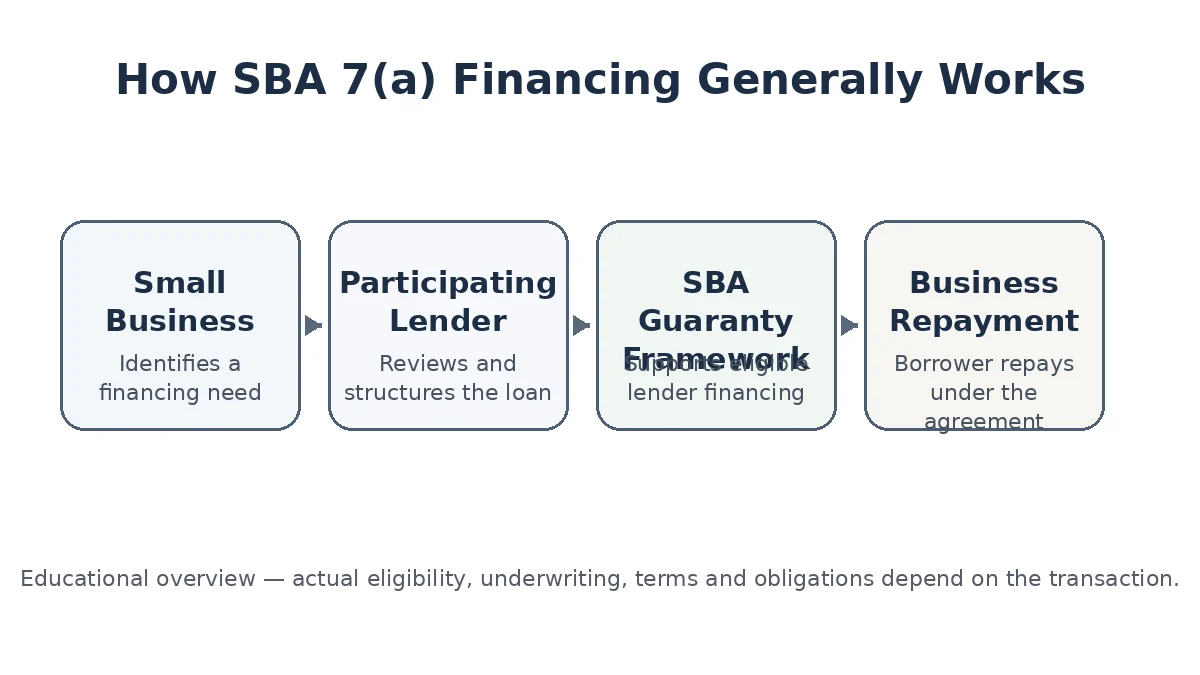
How SBA 7(a) Financing Generally Works
For SBA 7(a) loans, the process usually begins with a business need: perhaps buying equipment, acquiring or improving business real estate, funding working capital, refinancing qualifying business debt, purchasing supplies or supporting another eligible business purpose.
For borrowers considering SBA 7(a) loans, it helps to document the requested amount, intended use of funds and expected repayment source before approaching a lender.
The borrower approaches a participating lender. The lender considers the requested use of funds, the business’s financial condition, repayment capacity and other underwriting factors. The lender also determines whether the proposed transaction fits the applicable SBA program requirements.
If the financing is approved and documented under the program, the lender makes the loan and the SBA provides its guaranty to the lender according to the applicable rules. That guaranty protects the lender, not the borrower, from a portion of loss if the borrower defaults. The borrower still owes the debt and remains responsible for complying with the financing agreement.
The broader business financing market includes many structures with different trade-offs, so it is worth comparing the 7(a) option with realistic alternatives before making a decision.
What Businesses May Use SBA 7(a) Financing For
SBA 7(a) loans can support a range of eligible business purposes. Official SBA guidance includes broad categories such as acquiring, refinancing or improving real estate and buildings; short- or long-term working capital; refinancing certain business debt; purchasing and installing machinery and equipment; purchasing furniture, fixtures and supplies; and certain ownership changes.
For a business focused mainly on operating liquidity, working capital loans may also be worth understanding as a broader financing category. A business considering the consolidation or refinancing of existing obligations can separately review business debt consolidation loans to understand the commercial questions that arise when one debt structure replaces another.
The key principle is that proceeds should be tied to a legitimate, permitted business purpose and documented accordingly. Not every expense or transaction is automatically eligible simply because it serves a business in some way.
Because program rules can change, a borrower should verify the proposed use of funds with the participating lender and the SBA’s official 7(a) resources rather than relying on an old checklist or a third-party summary.
Eligibility and Qualification Considerations
Eligibility for SBA 7(a) loans is not the same thing as lender approval. Understanding SBA 7(a) loans therefore requires keeping program eligibility and lender underwriting separate.
SBA program eligibility generally concerns whether the applicant and proposed financing meet the program’s requirements. Official SBA guidance identifies core considerations that can include whether the applicant is an operating for-profit business, operates in the United States, meets applicable SBA size standards, is not an ineligible type of business, has a sound business purpose and can demonstrate repayment ability.
Individual lender underwriting is different. A lender may apply its own credit analysis within the SBA framework. That analysis can be more detailed and can vary by lender, transaction, loan size, industry, risk profile and processing method.
This distinction protects borrowers from a common mistake: assuming that a requirement mentioned by one lender must be a universal SBA rule. A lender may prefer a certain credit profile, financial history, collateral position or documentation standard without that preference becoming a blanket rule for every 7(a) application.
What Lenders May Review
A lender evaluating SBA 7(a) loans may examine several areas to understand both risk and repayment capacity. The exact mix varies, but common categories can include:
- the business’s financial condition and operating history;
- business and owner credit history where relevant;
- cash flow and ability to service new debt;
- existing loans and other obligations;
- ownership and management information;
- the purpose and amount of the requested financing;
- tax returns, financial statements and bank information;
- collateral that may be available or required;
- guarantees that may apply;
- the business’s industry, structure and legal documentation.
None of these categories should be converted into a made-up universal cutoff. A rigid claim such as “every applicant needs the same credit score” or “every lender requires the same revenue” can be misleading.
The better question is whether the business can produce reliable information that helps a lender understand what the business does, how the funds will be used and how the debt is expected to be repaid.
SBA 7(a) Costs
The cost of SBA 7(a) loans is broader than the stated interest rate. Comparing this financing responsibly means looking at the full economic obligation.
A borrower may need to consider interest, permitted fees, closing-related costs where applicable, required professional or third-party expenses where applicable, the amount of cash actually received, the timing of payments and the total amount repaid over the life of the financing.
A useful comparison starts with gross financing amount versus net cash received. If costs are deducted or paid at closing, the face amount of a loan can be different from the amount the business can actually deploy.
Next, examine total repayment rather than focusing only on the monthly payment. A longer term may reduce the required periodic payment but can change the total amount paid over time. A shorter term can create heavier cash-flow pressure even when the nominal borrowing amount is smaller.
Prepayment provisions also matter. Some SBA-backed loans can be subject to specific prepayment rules under defined circumstances, while the actual agreement may contain other relevant terms. Borrowers should verify current SBA requirements and read the lender’s documents before assuming early repayment will be cost-free.
How SBA 7(a) Interest and Pricing Work
When borrowers compare SBA 7(a) loans, “What is the rate?” is often one of the first questions. It is important, but it is not enough.
Interest may be fixed or variable depending on the loan structure. SBA rules can establish limits and other conditions, while the lender and borrower may negotiate within the applicable framework. Because benchmarks, program details and lender pricing can change, a durable comparison should focus on how pricing works rather than freezing a temporary rate table into an evergreen article.
Compare:
- whether the rate is fixed or variable;
- what can cause a variable rate to change;
- the fees and closing costs that apply;
- the amount of usable cash the business receives;
- the repayment term;
- the required payment amount and frequency;
- the total repayment obligation;
- any prepayment provision;
- the effect of collateral, guarantees and covenants;
- any other material cost or obligation in the agreement.
Two offers with similar interest rates can create different economic outcomes if their fees, terms, payment schedules or net proceeds differ. Likewise, a lower required payment is not automatically cheaper if it results from a substantially longer repayment period.
Before acting, verify the applicable SBA program rules through official SBA resources and compare the lender’s written terms rather than relying on advertising language.
Loan Terms and Repayment
The correct financing term is not simply “the longest available term” or “the shortest possible term.” It should be evaluated in relation to what the money is financing and what the business can reasonably repay.
A long-lived asset may create value over many years, while a short-term operating expense is consumed quickly. The relationship between asset life, financing purpose and repayment period therefore deserves attention.
For SBA 7(a) loans, required payments are commonly expected to come from business cash flow. That makes cash-flow resilience central to the decision.
A borrower should test the payment against ordinary months and weaker months. The business should also consider how a delayed project, slower receivables, unexpected repair, customer loss or seasonal dip could affect debt service.
The Kevanzo Repayment-Capacity Test
Before comparing lenders, a business can use this simple six-question framework.
1. What exactly will the borrowed money fund?
Name the purpose precisely. “Growth” is too vague. Equipment, an acquisition, inventory, buildout or a defined working-capital need gives the business something concrete to evaluate.
2. How much does the business genuinely need?
Borrowing capacity is not the same as borrowing need. Extra funds create extra repayment obligations.
3. What cash flow is expected to repay the financing?
Identify the expected repayment source. Is repayment dependent on existing cash flow, new revenue, cost savings, an acquired operation or another identifiable source?
4. Can the business handle the payment during a weaker month?
Test the payment against a realistic downside case rather than only the strongest recent month.
5. What if the expected benefit is delayed?
A new asset, expansion or acquisition may take longer than expected to produce results. The financing should be evaluated against that possibility.
6. How much cushion remains after the required payment?
A business still needs liquidity after making debt payments. If the payment consumes nearly all available free cash flow, the financing may reduce flexibility even if the application can be approved.
The Kevanzo Repayment-Capacity Test is not a lender underwriting model and does not determine eligibility. It is a practical way to ask whether the debt structure appears compatible with the business’s own operating resilience.
Documents Businesses May Need to Prepare
Applications for SBA 7(a) loans can require substantial documentation, but there is no single universal document packet that applies identically to every borrower and lender. Preparing for this financing is therefore partly an exercise in making the business’s financial information clear and consistent.
Common categories may include:
- business financial statements;
- tax information;
- bank statements;
- ownership and organizational documents;
- debt schedules;
- information about affiliates where relevant;
- business plans, projections or transaction explanations where relevant;
- purchase agreements, leases or asset information for applicable transactions;
- personal financial information from owners or guarantors where required;
- documentation showing the intended use of proceeds.
SBA 7(a) Loans Versus Conventional Business Loans
SBA 7(a) loans and conventional business loans can both provide term financing, but their structures can differ. Comparing SBA 7(a) loans with conventional credit should focus on structure and business fit rather than labels.
SBA 7(a) loans operate within federal program requirements and include an SBA guaranty to the lender. A conventional business loan is made without that SBA guaranty and is governed primarily by the lender’s own product structure, underwriting and applicable law.
SBA 7(a) loans may support financing that a lender is willing to make with the guaranty but would not structure in the same way conventionally. At the same time, SBA-backed financing can involve program-specific eligibility, documentation and compliance requirements that a conventional product does not have.
SBA 7(a) Loans Versus Other Business Financing
When weighing SBA 7(a) loans against other business financing, the right comparison set depends on what the business is trying to accomplish.
A small business line of credit can provide revolving access to funds and may fit repeated short-term cash-flow needs better than a one-time term loan.
Unsecured business loans can have a different collateral structure, although “unsecured” does not necessarily mean the borrower has no guarantee obligations or that underwriting is easier.
A short term business loan may repay over a shorter period and can create very different payment pressure from longer-duration financing.
Other small business financing structures may fit particular needs depending on timing, flexibility, asset type, repayment source and the business’s financial profile.
The key is to compare the financing structure to the business need, not simply compare approval amounts.
How to Compare SBA 7(a) Financing Offers
When comparing SBA 7(a) loans from different lenders, use the same checklist for each offer so that differences are visible.
Start with the economics:
- Gross financing amount — What is the stated principal amount?
- Net cash received — How much usable cash reaches the business after applicable costs?
- Interest structure — Is it fixed or variable, and how does the rate work?
- Fees and closing costs — What charges apply, who receives them and when are they paid?
- Repayment term — How long does the obligation remain outstanding?
- Payment frequency — How often must payments be made?
- Required payment — What is the actual scheduled payment?
- Total repayment — What is the expected overall amount paid if the loan follows its scheduled course?
Then compare legal and operational obligations:
- collateral requirements;
- personal or business guarantees;
- financial reporting covenants;
- restrictions on use of proceeds;
- prepayment provisions;
- default provisions;
- insurance or documentation requirements;
- other material commitments in the financing agreement.
Finally, compare service and execution issues that matter to the transaction. Who will answer questions? What documentation is still outstanding? Which conditions must be met before closing or disbursement? What happens if the transaction changes?
Do not rely on a salesperson’s summary when the written agreement says something more precise. The signed documents govern the obligation.
Questions to Ask Before Applying
Before applying for SBA 7(a) loans, a strong preparation process begins with clear questions.
Ask the lender:
- Is this requirement an SBA program rule or your own underwriting policy?
- Which 7(a) structure are you considering for this request, and why?
- Which uses of proceeds will you permit for this transaction?
- What documentation will you require from the business and owners?
- Is the interest structure fixed or variable?
- What fees and third-party costs may apply?
- How much net cash should the business expect to receive?
- What collateral or guarantees may be required?
- What is the proposed repayment term and payment frequency?
- Are there prepayment provisions or other material restrictions?
- Which conditions must be satisfied before closing?
- Which parts of the offer could change before documents are signed?
Ask your own business:
- Does this amount match the actual need?
- Can cash flow support the required payment?
- What happens if revenue is weaker than expected?
- Is the financed asset or project likely to remain useful long enough to justify the obligation?
- What flexibility will remain after taking on the debt?
These questions do not replace professional advice. They make the financing discussion more specific.
Common Mistakes
One mistake is treating the SBA guaranty as a guarantee of approval. It is not. The borrower still has to meet applicable program requirements and satisfy lender underwriting.
Another is focusing on one attractive number. An advertised interest rate, maximum loan amount or monthly payment can distract from fees, total repayment, net proceeds and contractual obligations.
Borrowing more than necessary can also create avoidable cost. A larger approval is not automatically a better financing decision.
Some borrowers compare monthly payments without asking why the payments differ. A lower payment may reflect a longer term rather than a lower total cost.
Guarantees and collateral can also be misunderstood. Read what the documents actually require rather than assuming that SBA involvement eliminates personal or business exposure.
Another mistake is submitting an application before financial information is organized. Inconsistent records can create questions that could have been addressed earlier.
Finally, do not confuse SBA program rules with lender underwriting preferences. Ask for clarification when a requirement is described as mandatory.
When SBA 7(a) Financing May Not Fit the Business Need
SBA 7(a) loans can be useful, but they will not fit every transaction.
A business may prefer another structure when it needs revolving access rather than a term loan, when the financing purpose falls outside program rules, when documentation requirements do not fit the transaction, or when another legitimate financing option provides a more suitable combination of cost, flexibility and repayment structure.
A business should also be cautious if repayment depends on aggressive assumptions. Financing that requires perfect sales growth, uninterrupted customer payments or immediate project success can put the company under pressure.
When considering SBA 7(a) loans, the most important question is not whether SBA-backed capital is available. It is whether the specific financing agreement supports the business objective without creating an unreasonable repayment burden.
Frequently Asked Questions
Does the SBA lend the money directly for a 7(a) loan?
Generally, the borrower applies through a participating lender. The SBA provides a guaranty to the lender under the program rather than functioning as the borrower’s ordinary direct lender.
Does SBA eligibility mean a business will be approved?
No. Program eligibility and lender underwriting are separate. A business may appear to satisfy program criteria and still fail to receive approval from a particular lender.
Are SBA 7(a) loans only for working capital?
No. The program can support multiple eligible business purposes, including certain real estate, equipment, working-capital, debt-refinancing, supply and ownership-change uses. The exact transaction should be verified against applicable SBA rules.
Do all lenders use the same credit standards?
No. SBA rules establish program requirements, but participating lenders can apply underwriting standards and credit analysis within the applicable framework. Do not treat one lender’s internal threshold as a universal SBA rule.
Can the interest rate change?
Some loans may use variable rates while others may use fixed rates. Review the agreement to understand the rate structure, how changes are determined and how a change could affect the required payment.
Is the lowest rate always the best offer?
No. Compare fees, net proceeds, repayment term, payment amount, total repayment, collateral, guarantees, covenants and other material terms as well as the interest rate.
What should a business prepare before speaking with a lender?
Start with clear financial records, an explanation of the funding purpose, the amount needed, existing debt information and a realistic repayment story. The lender can identify the specific documents required for the transaction.
Can a borrower repay early?
Early repayment may be possible, but applicable SBA rules and the financing documents should be checked for prepayment provisions and other conditions before assuming there is no cost or restriction.
Helpful Authoritative Resources
For program-specific details and changing requirements, use official sources rather than relying only on third-party summaries:
- U.S. Small Business Administration — 7(a) Loans
- U.S. Small Business Administration — Loans
- U.S. Small Business Administration — SBA Lenders
- U.S. Small Business Administration — Lender Match
Official SBA resources should be used to confirm program rules, applicable requirements and lender-process information that may change over time.
Final Summary
SBA 7(a) loans combine a participating lender’s financing with an SBA guaranty framework. That can expand financing possibilities for eligible small businesses, but it does not remove the need for careful underwriting, documentation or repayment planning.
A responsible comparison of SBA 7(a) loans looks beyond the approval amount and headline rate. Examine the financing purpose, program eligibility, lender requirements, net funds received, interest structure, fees, repayment term, payment pressure, total repayment, collateral, guarantees, covenants and default provisions.
Most importantly, test whether the business can support the debt when conditions are less than perfect. A financing structure is useful only when it helps solve a real business need at a cost and repayment burden the business can responsibly manage.
Author Bio
Kevanzo Editorial Team
Kevanzo Editorial Team creates plain-English educational resources designed to help U.S. business owners understand financing choices, borrowing costs, repayment structures, lender terminology, and funding considerations before making business decisions.
Copyright Notice
© 2026 Kevanzo. All rights reserved.
This article is protected by copyright and may not be copied, scraped, spun, republished, or used commercially without prior written permission from Kevanzo. Brief quotations may be used with clear attribution and a link to the original article.
Educational Disclaimer
Kevanzo.com provides general educational information about SBA 7(a) financing and business borrowing. Kevanzo is not a lender, broker, loan marketplace, financial adviser, attorney, accountant, or approval service.
Nothing in this article guarantees approval, eligibility, funding, a particular rate, or specific loan terms. SBA program requirements and individual lender underwriting are not identical, and available terms can depend on the applicant, financing purpose, financial circumstances, documentation, collateral, guarantees, disclosures, lender policies, and applicable program rules.
Readers should review official SBA resources and actual lender agreements carefully. This article is not individualized financial, legal, tax, accounting, investment, lending, or business advice.
4 thoughts on “SBA 7(a) Loans: How They Work, Costs, Eligibility and Repayment”