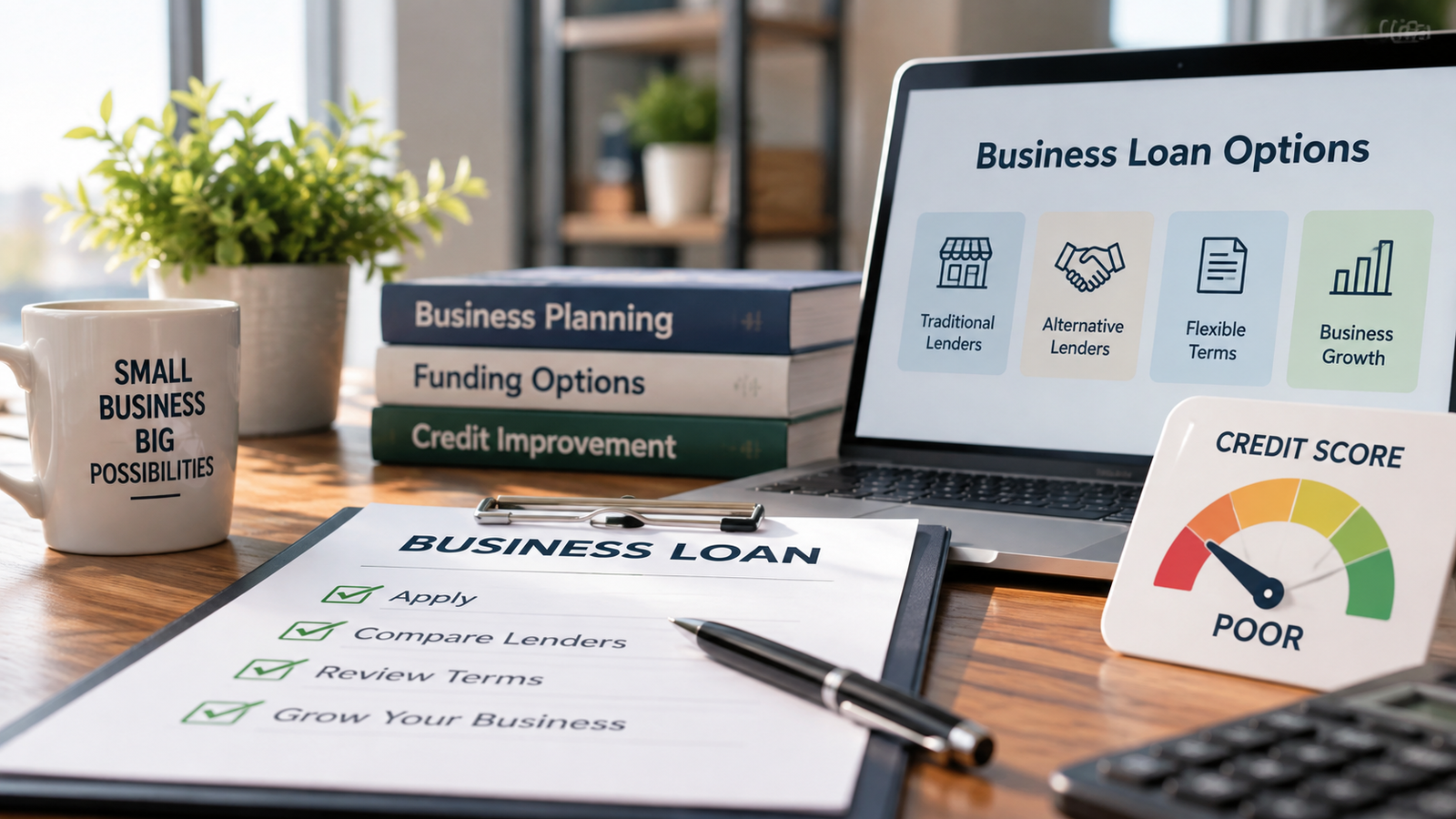
Business loans for bad credit can give U.S. business owners with weaker credit profiles a way to explore financing, but the phrase can be misleading if it sounds like a special product with guaranteed approval. In practice, lenders may review a combination of personal credit, business credit, revenue, cash flow, existing debt, time in business, collateral, guarantees, industry, repayment history, and the purpose of the financing.
A lower credit profile can narrow the available choices, affect the structure of an offer, or increase the importance of other strengths in the application. It does not automatically tell you whether a loan is available, affordable, or sensible for the business.
For a broader foundation before comparing weaker-credit options, see Kevanzo’s guide to small business loans. This guide goes deeper into the specific problem of borrowing when credit is imperfect: how to define the funding need, understand what lenders may examine, compare different financing structures, test repayment pressure, identify contract risks, prepare documentation, and decide whether borrowing actually solves the business problem.
Educational note: Kevanzo.com provides general business-financing education only. Kevanzo is not a lender, broker, loan marketplace, financial adviser, attorney, accountant, credit-repair provider, or approval service. Financing availability and terms depend on the lender, borrower, business profile, documentation, credit history, revenue, cash flow, industry, loan structure, and other underwriting factors.
What Business Loans for Bad Credit Actually Means
Business loans for bad credit is a search phrase, not one universal lending product. There is no single definition of “bad credit” that every business lender applies in the same way. Different lenders can use different credit models, data sources, underwriting methods, risk tolerances, documentation requirements, and product rules.
That distinction matters because a business owner should not begin with the assumption that one credit score determines the entire decision. Credit is one part of a broader risk picture. Depending on the lender and financing structure, the application may also be assessed through business revenue, cash-flow consistency, existing obligations, operating history, collateral, owner guarantees, industry characteristics, and the reason the funds are being requested.
A useful way to think about business loans for bad credit is therefore:
Financing options that may still be considered when the business owner’s or business’s credit profile is weaker than a lender would ideally prefer, subject to the rest of the underwriting picture.
That definition shifts the decision away from a single question—“Who will approve me?”—and toward a more useful one:
Can the business obtain financing whose complete cost, repayment structure, obligations, and risks still make sense after the weaker credit profile is taken into account?
That is the question this article is designed to help answer.
What Weaker Credit Can Change
Credit history helps a lender estimate the risk of nonpayment. A weaker history may reflect late payments, high balances, defaults, collections, a thin credit file, or other information that makes the application look less predictable.
When the lender perceives more risk, several things may change. The applicant may encounter fewer available products, more documentation requests, stronger collateral or guarantee requirements, smaller approved amounts, shorter repayment structures, higher overall borrowing costs, or more frequent repayments.
None of those outcomes is universal. They are possibilities, not promises.
The important point is that weaker credit can change the economics of the financing. A loan that looks useful because it is available may become unattractive once the owner examines the total repayment, payment frequency, guarantees, security interests, default rights, and the amount of cash left in the business after each payment.
That is why a weaker-credit application needs two separate tests:
- Can the business potentially qualify?
- Can the business safely carry the obligation if it does qualify?
Passing the first test does not automatically mean the second test has been passed.
The Kevanzo Four-Layer Bad-Credit Loan Test
A clear way to evaluate business financing with imperfect credit is to separate the decision into four layers: credit, capacity, stability, and structure.
Layer 1: Credit
Credit asks how the owner or business has handled previous obligations.
Review the credit information that may be visible to lenders. Look for errors, old information that should have been corrected, unfamiliar accounts, duplicated obligations, or other inaccuracies. If something appears wrong, use the appropriate credit-report dispute process rather than assuming the lender will ignore it.
Also be prepared to explain material problems truthfully. A temporary setback and a continuing pattern of missed obligations are not the same story. The purpose is not to create excuses. It is to make sure the financing application presents accurate information and that the owner understands what the record actually shows.
Layer 2: Capacity
Capacity asks whether the business has enough cash to make the proposed payments while continuing to operate.
This is the heart of the borrowing decision.
The business may need to pay payroll, rent, taxes, suppliers, utilities, insurance, inventory, maintenance, existing debt, and other ordinary expenses before or alongside the new obligation. If the proposed repayment only works when revenue is unusually strong, the financing may be too tight.
Capacity should be tested using real operating cash flow, not optimism.
Layer 3: Stability
Stability asks how predictable the business is.
A lender may care about the consistency of deposits, the history of the business, concentration in a small number of customers, seasonal swings, recurring contracts, margins, receivables, and other indicators that help explain whether future payments look dependable.
The owner should care about the same issues for a different reason: instability makes fixed repayment harder.
A business with uneven revenue may need a larger cash cushion than a business with highly predictable collections. A seasonal company should test the proposed obligation during its weaker periods, not just during its peak season.
Layer 4: Structure
Structure asks what the financing agreement actually requires.
Two businesses can borrow the same amount and face very different risk because the agreements are different. Payment frequency, loan term, fees, personal guarantees, liens, collateral, prepayment rules, automatic withdrawals, default provisions, and renewal features can all change the practical burden.
A financing structure should fit the business need and cash cycle. Availability is not enough.
Start With the Business Problem, Not the Loan Advertisement
Before comparing lenders or filling out applications, define exactly why the business needs money.
“More cash” is not specific enough.
A clearer funding purpose might be:
- inventory needed before a predictable sales period;
- equipment that must be repaired or replaced;
- materials required for a signed project;
- a temporary gap before customer invoices are paid;
- supplier costs that occur before customer revenue arrives;
- short-term working capital;
- consolidation of several existing business debts;
- a planned expansion with measurable costs;
- a one-time interruption that has a realistic recovery path.
A precise funding purpose improves the decision because different problems call for different structures.
A one-time equipment purchase may suit a different form of financing from a recurring inventory gap. A contractor waiting for a known invoice may need a different solution from a business that is losing money every month. A company with several existing debts may be looking for simplification, but consolidation only helps if the new structure genuinely improves cost, cash flow, or risk.
This distinction is especially important when considering business loans for bad credit. Limited choices can make an available offer feel valuable even when the underlying problem has not been solved.
If the business has a permanent monthly deficit, new debt may simply move the problem forward. In that situation, management may need to examine pricing, margins, collections, expenses, inventory, staffing, or the business model before adding another required payment.
How Much Should the Business Actually Borrow?
The amount a lender is willing to offer is not automatically the amount the business should accept.
Start with three figures:
- The amount actually needed for the defined purpose.
- The maximum repayment the business can support without squeezing essential operations.
- The minimum cash cushion the owner wants to preserve after each payment.
Suppose a business needs funds for inventory. The owner should estimate the inventory requirement, cash already available, expected sales timing, gross margin, ordinary operating expenses, taxes, supplier obligations, and the working cash that must remain available after the purchase.
The same discipline applies to equipment, marketing, receivables gaps, renovations, or other uses.
Borrowing extra “just in case” can create cost without creating equal value. On the other hand, borrowing too little can leave a project unfinished and still create a repayment obligation.
The goal is not the largest approval. The goal is an amount that matches a specific use and a realistic repayment plan.
Major Financing Structures to Compare
Business loans for bad credit can lead to several different financing structures. The labels matter less than understanding how the money is advanced, how repayment works, what protections the provider receives, and what the business risks if results disappoint.
Secured Business Term Loans
A secured term loan generally provides a lump sum and uses specified collateral or another security arrangement to reduce the lender’s risk.
The possible advantage is that collateral can sometimes strengthen an application. The possible disadvantage is obvious: valuable assets may be exposed if the business cannot meet its obligations.
The owner should understand exactly what is pledged, how the security interest works, whether the asset is essential to operations, and what the agreement allows following default.
A loan is not automatically safer merely because the payment seems manageable. Asset exposure belongs in the comparison.
Unsecured Business Financing
Some business owners prefer financing that does not require a specific physical asset to be pledged. Kevanzo’s guide to unsecured business loans explains the broader structure in more detail.
“Unsecured” should never be read as “risk-free.” An agreement may still include a personal guarantee, a general lien, automatic withdrawals, collection rights, covenants, or other protections for the provider.
When credit is weak, the key comparison is not only whether collateral is absent. Review the total cost, repayment frequency, term, guarantees, default provisions, and cash-flow pressure.
Business Lines of Credit
A line of credit can provide revolving access to funds up to an approved limit, subject to the agreement. This structure may be useful when a business has recurring short-term needs rather than one fixed project.
A small business line of credit can be especially useful to understand when cash needs appear in cycles—for example, inventory purchases, supplier timing, or receivables gaps.
The main risk is that flexibility can become habitual borrowing. If the business continually draws funds and never restores the available balance, management should ask whether the facility is solving timing gaps or covering an underlying operating shortfall.
Review draw rules, fees, repayment terms, account-review provisions, and what happens if the lender reduces or closes access.
Online Business Financing
Online applications can make it easier to compare financing, upload documents, and receive an initial decision. They can also expose business owners to a wide range of providers, lead generators, marketplaces, and financing structures that do not all work the same way.
Kevanzo’s business loan online guide explains how to approach the digital application process.
Before entering sensitive information, identify who is receiving it. Determine whether the website is the lender, a broker, a marketplace, or a lead-generation service. Read privacy disclosures and financing terms. Avoid assuming that a polished website, high search position, or fast response proves that the offer is suitable.
Quick or Fast Business Financing
Speed can be useful when a business has a genuine time-sensitive need. A broken piece of essential equipment, a supplier deadline, or a short receivables gap may create pressure to move quickly.
That does not mean speed should replace comparison.
The quick business loans guide is relevant when the timing of funding is part of the decision. When credit is weaker, fast access can be tempting because the owner may fear losing the opportunity if the offer is not accepted immediately.
Slow the decision down long enough to compare the complete obligation.
Ask what the business receives after fees, how often repayments occur, how long the obligation lasts, whether payments change with revenue, what guarantees or security interests apply, and what happens following a missed payment.
Startup Financing When Revenue Is Limited or Absent
New businesses face a different challenge because the lender has less operating history to review. Credit may therefore become one part of a more difficult evidence problem.
If the business is pre-revenue or has very limited operating history, the guide to startup business loans with no revenue explains the narrower startup issue.
A new business may need to rely more heavily on a credible business plan, owner background, documented funding use, projections, available assets, personal financial strength, outside income where relevant, or other evidence permitted by the lender.
The central rule remains the same: a projection is not cash. The repayment plan must be realistic about how long it may take before the business generates dependable revenue.
Receivables and Invoice-Based Financing
Businesses that sell to other businesses sometimes face a mismatch between completing work and receiving payment. Financing tied to invoices or receivables can address that timing problem in some circumstances.
The owner should compare the amount advanced, fees, collection process, customer involvement, recourse terms, and what happens if the customer pays late or disputes the invoice.
This structure solves a different problem from a term loan. It may be more relevant when the asset being financed is the receivable itself rather than a general need for cash.
Revenue-Based or Sales-Linked Financing
Some products link repayment to business revenue or sales. The mechanics can vary considerably.
A variable payment can reduce pressure when sales fall, but the total cost and collection method still matter. Some arrangements use frequent automatic withdrawals or a percentage of revenue.
Do not compare these products only by how easy they are to obtain. Compare the amount received, total amount owed, expected repayment pattern, contract rights, and the impact on daily or weekly operating cash.
How Lenders May Review a Weaker-Credit Application
No universal underwriting formula applies to every lender. However, several categories commonly matter when a financing provider evaluates risk.
Personal Credit
For many small businesses, particularly closely held companies, the owner’s personal credit can be relevant. A lender may review repayment history, balances, defaults, collections, or other information permitted under its process.
Before applying, review your reports for accuracy and understand what may need explanation.
Business Credit
An established business may also have business credit records. The importance of those records varies by lender and product.
Business owners should not assume that strong business credit automatically replaces personal credit, or that weak business credit always prevents financing. The underwriting model determines how the information is used.
Revenue
Revenue helps show the scale of the business and the cash moving through it, but revenue by itself does not prove repayment capacity.
A high-revenue business can still have thin margins, heavy debt, high operating costs, or volatile collections. A lower-revenue business may be stable but still unable to support a large new obligation.
Revenue needs context.
Cash Flow
Cash flow is often more informative than a headline sales number because loan payments must be made from available cash.
The owner should know how much cash normally remains after ordinary expenses and existing debt. This is also where seasonal swings, customer payment timing, and irregular expenses become important.
Existing Debt
A lender may review current borrowing because new debt sits on top of existing obligations.
The owner should do the same. Create a simple schedule showing each existing obligation, payment frequency, remaining term, and any security or guarantee already in place.
This can reveal whether the proposed loan is adding manageable capacity or creating a layered repayment problem.
Time in Business
Operating history can provide evidence about revenue patterns, margins, customer demand, and the owner’s ability to manage the company through changing conditions.
A newer business has less historical evidence, so projections and owner background may carry more weight.
Collateral and Guarantees
Collateral can reduce lender risk by providing an asset that may be available following default. A personal guarantee can expose the owner to personal liability under the agreement.
These are not small details. They affect the consequences of failure.
Read them carefully and seek qualified legal or financial guidance when the language or exposure is unclear.
Funding Purpose
A clear funding purpose can strengthen the logic of the application.
“Inventory for a contracted seasonal order” is easier to evaluate than “general business use.” A defined purpose helps the owner explain how the funds are expected to create value and how repayment is expected to occur.
Industry and Business Model
Different industries have different cash cycles, margins, seasonality, assets, customer concentration, and risk.
A lender may incorporate those characteristics into underwriting. The owner should incorporate them into the affordability decision.
Documents That Can Make the Application Easier to Understand
A well-organized application cannot erase weak credit, but it can reduce confusion and make the business easier to evaluate.
Depending on the financing provider and product, useful documents may include:
- recent business bank statements;
- business and personal tax documents where requested;
- profit-and-loss statements;
- balance sheets;
- cash-flow statements;
- accounts receivable and accounts payable information;
- a schedule of existing debts;
- business licenses and formation documents;
- ownership information;
- contracts, purchase orders, or invoices related to the funding purpose;
- a business plan for a startup or major expansion;
- financial projections;
- collateral information where relevant;
- an explanation of material credit problems where appropriate.
The practical benefit of organization is consistency. Dates, revenue figures, debt balances, ownership details, and the funding purpose should not change from one part of the application to another without a valid explanation.
The Kevanzo Repayment-Capacity Framework
Approval is a lender decision. Affordability is a business decision.
A simple repayment-capacity framework can help separate the two.
Step 1: Measure Normal-Month Operating Cash
Estimate the cash the business usually produces after ordinary operating expenses but before the proposed new financing payment.
Do not use the best month. Use a realistic normal month.
Step 2: Measure a Slow Month
Repeat the calculation using a weaker but plausible revenue period.
For a seasonal business, this may be a typical off-season month. For a project-based business, it might be a period with delayed customer payments. For a retailer, it could be a slower sales cycle.
Step 3: Add Existing Debt Payments
List current loan, lease, card, and financing obligations.
The new payment does not exist in isolation.
Step 4: Add the Proposed Payment
Use the actual payment frequency required by the offer.
A weekly or daily obligation should not be mentally converted into a comfortable-looking monthly number without considering timing. Frequent withdrawals can affect the business differently because cash leaves sooner and more often.
Step 5: Protect an Operating Cushion
Decide how much cash the business needs to keep available for normal operations and unexpected problems.
A financing structure that leaves almost no cushion may be fragile even if the spreadsheet shows that payments technically fit.
Step 6: Test the Downside
Ask what happens if:
- sales arrive later than expected;
- an important customer pays late;
- a supplier raises prices;
- a piece of equipment fails;
- inventory takes longer to sell;
- a planned contract is delayed;
- the owner becomes unavailable for a period;
- another debt obligation increases;
- a tax or insurance payment arrives during a weak month.
The point is not to predict every problem. It is to learn whether the repayment plan has room for ordinary business uncertainty.
Compare the Complete Borrowing Cost
Business owners with weaker credit can be tempted to focus on the one number that looks easiest: the payment.
That is not enough.
A proper comparison should include at least these components.
Amount Actually Received
The face amount of the financing may differ from the cash deposited if fees or other charges are deducted before funding.
Compare net proceeds, not just the headline amount.
Total Amount Repaid
Ask for the total scheduled repayment based on the agreement.
This helps reveal the overall cost in dollars, even when the pricing structure is unfamiliar.
Interest, APR, Factor Rates, and Other Pricing Methods
Different products can express cost differently.
Where APR is provided and applicable, it can help standardize comparisons, but it should not replace review of total dollars repaid, fees, payment frequency, and term. A factor rate or fixed fee is not the same thing as a conventional interest rate.
If the pricing method is unclear, ask the provider to explain it in writing.
Fees
Possible fees can include origination, underwriting, draw, maintenance, processing, documentation, late, returned-payment, broker, or other charges.
Do not assume every product includes every fee.
The goal is to identify what this specific agreement charges and when those charges occur.
Payment Frequency
Monthly, weekly, daily, or revenue-linked repayment schedules can create different cash-flow pressure.
A business with uneven deposits may find a frequent automatic withdrawal difficult even when the total cost looks acceptable.
Repayment Term
A longer term can reduce each scheduled payment but may increase the time the business carries debt and, depending on the product, the total financing cost.
A shorter term can reduce time in debt but create heavier near-term cash pressure.
Neither is automatically better.
Prepayment Rules
Some financing structures reward early repayment. Others provide little benefit or may impose conditions.
Read the actual agreement before assuming that paying early will reduce the total cost.
Default Consequences
Understand what constitutes default, what notices are required, what fees may arise, whether the provider can accelerate the obligation, what collection rights exist, and how guarantees or collateral may be enforced.
This is an area where qualified legal advice can be valuable.
Personal Guarantees, Liens, and Owner Exposure
The phrase “business loan” can make the obligation sound as though it remains entirely inside the company.
That may not be true.
A personal guarantee can make the owner personally responsible for repayment according to the agreement. A lien or security interest can give the financing provider rights in business assets. A secured loan can expose a specifically pledged asset.
Before signing, identify:
- who is legally responsible for repayment;
- which assets are subject to a lien or security interest;
- whether personal assets are exposed;
- whether the lender has rights over receivables or bank accounts;
- what events trigger default;
- what happens if the business closes;
- whether multiple owners must guarantee the debt;
- whether a guarantee is limited or broad;
- how existing secured debts interact with the new obligation.
These issues can be more important than a small difference in the advertised rate.
How to Compare Business Loans for Bad Credit Online
Online financing can be convenient, but convenience should not eliminate due diligence.
Use a consistent process.
First, identify the company. Confirm whether it is the lender, a marketplace, a broker, or a lead generator.
Second, understand what happens to your information. Review the privacy policy and consent language before entering sensitive data.
Third, separate prequalification from final approval. An early response may be based on limited information. Final terms can change after verification and underwriting.
Fourth, ask whether the application creates a hard or soft credit inquiry and which individuals or entities may be reviewed.
Fifth, obtain the actual financing terms in writing.
Sixth, compare the written terms with the advertising. The contract controls the legal obligation.
Seventh, investigate the company independently. Search for the business name, complaints, regulatory actions, and other relevant information. Do not rely only on testimonials or the provider’s own marketing.
Eighth, avoid pressure. A legitimate business need can be urgent, but the provider should still be able to explain the agreement clearly.
Red Flags That Deserve Extra Caution
No single red flag proves that a financing offer is fraudulent or unsuitable, but several patterns deserve closer examination.
Guaranteed Approval
A promise that every applicant will be approved should trigger caution.
Real financing decisions generally depend on information about the applicant, business, or transaction. A promise of guaranteed funding can be misleading.
Pressure to Act Immediately
Urgency can prevent comparison.
If a salesperson insists that the offer disappears unless you sign immediately, ask for the reason and obtain the terms in writing.
Unclear Identity
Do not provide sensitive financial information if you cannot tell who operates the website, who will receive the application, or whether your information will be sold to other parties.
Upfront Payment for a Promised Loan
Be cautious when someone promises financing but demands money first for vague insurance, processing, paperwork, or similar reasons.
Terms That Do Not Match the Sales Pitch
If the advertisement says there is no guarantee, lien, collateral requirement, or major fee, but the contract says otherwise, rely on the written contract and resolve the inconsistency before signing.
Missing Cost Information
If a provider cannot clearly explain how much money the business receives, what it must repay, how often it must pay, and what fees apply, the business does not have enough information to compare the offer.
Requests for Unnecessary Sensitive Information
Applications can legitimately require personal and business information. The issue is whether the request is connected to a verified financing process.
Confirm who is asking, why the information is needed, and how it will be handled.
Can Better Preparation Improve the Financing Search?
Preparation cannot guarantee approval, but it can improve the quality of the application and the owner’s decision.
Review Credit Information
Check the credit information that may be relevant before applying. Correct errors through the proper dispute process.
Knowing what the reports show also helps prevent surprises.
Organize Financial Records
Prepare consistent financial statements, bank records, debt schedules, and other documents likely to be requested.
An incomplete application can slow the process and make comparison harder.
Explain the Funding Purpose
Write the purpose in one clear sentence.
Then document the amount required, expected benefit, timing, and repayment source.
Understand Existing Debt
Create a list of all current business financing obligations.
Include the balance, payment amount, payment frequency, maturity or end date where applicable, and any collateral or guarantees.
Build a Cash-Flow Forecast
Estimate how cash enters and leaves the business during the repayment period.
Do not rely only on annual totals. Timing matters.
Decide the Maximum Acceptable Exposure
Before seeing offers, decide what the business will not accept.
Examples might include pledging a critical asset, giving a guarantee that creates unacceptable personal exposure, accepting a payment schedule that leaves no operating cushion, or borrowing more than the defined need.
This prevents approval excitement from changing the decision criteria.
When Waiting May Be Better Than Borrowing
There are situations in which delaying a financing application can improve the decision.
Waiting may be worth considering when:
- errors on credit reports need to be corrected;
- financial records are incomplete;
- the funding purpose is unclear;
- the business does not know how much it actually needs;
- existing debts have not been mapped;
- cash flow is too unstable to estimate repayment capacity;
- the project can be delayed without serious damage;
- a large receivable is expected soon;
- the business is trying to borrow only because the first application was declined;
- the underlying problem is a recurring operating loss.
The purpose of waiting is not to chase a perfect credit score. It is to avoid borrowing before the facts are clear.
When Borrowing May Be a Poor Fit
Business financing can be useful when it solves a defined problem and the repayment burden fits the business.
It can be harmful when debt is used to hide a structural weakness.
Borrowing deserves extra caution when:
- the business is losing money every month with no realistic correction plan;
- the repayment depends on aggressive sales assumptions;
- the owner cannot explain how the funds will produce value;
- the loan will mainly repay other debts without improving the overall structure;
- the business must pledge an asset it cannot afford to lose;
- the owner does not understand the contract;
- the payment consumes nearly all available cash;
- the provider will not clearly disclose the complete cost;
- the business is borrowing to make payments on other borrowing;
- the only reason to accept is fear that no other option will ever appear.
A declined application can be frustrating, but an unaffordable approval can be worse.
Four Hypothetical Business Scenarios
These examples are illustrative only. They are not lender recommendations and do not predict approval.
Scenario 1: Seasonal Inventory With Weaker Credit
A small retailer has weaker owner credit but a long operating history. The business needs inventory before a predictable seasonal sales period.
The owner can document prior seasonal sales, supplier invoices, current cash, and the expected timing of customer purchases.
The key questions are not just whether the retailer can qualify. The owner should compare the repayment start date with the expected sales cycle, test the payment during a slower-than-expected season, and avoid borrowing more inventory money than the business can reasonably turn into sales.
Scenario 2: Contractor Waiting for Customer Payment
A contractor has completed work but must wait for customers to pay. The business needs short-term cash for materials and payroll.
This looks like a timing problem rather than a permanent operating deficit.
The owner might compare a term loan, line of credit, or receivables-related solution depending on the facts. The important evidence includes invoices, contracts, payment history, and the expected collection schedule.
The financing term should not outlive the problem unnecessarily.
Scenario 3: Business With Repeated Monthly Losses
A company has weak credit and experiences a cash shortage every month.
Management considers borrowing to cover payroll and rent.
Here the central problem may not be access to credit. It may be that the business does not generate enough cash to support its cost structure.
Adding debt would create another required payment. Before borrowing, the owner should examine pricing, margins, expenses, collections, staffing, inventory, and whether the business model can return to positive cash flow.
Scenario 4: New Business With Limited Revenue History
A startup owner has a reasonable concept, relevant experience, and a detailed plan but little operating history.
The application may be more difficult because historical evidence is limited.
The owner should focus on the credibility of the business plan, funding purpose, realistic projections, available owner contribution, documentation, and the consequences if revenue takes longer than expected.
The repayment plan should survive a slower launch, not just the optimistic case.
A 14-Point Comparison Checklist
When comparing business loans for bad credit, use the same checklist for every serious offer.
- Funding purpose: What exact business problem will the money solve?
- Amount needed: How much does the business actually require?
- Net proceeds: How much cash will the business receive after deductions?
- Total repayment: What is the total scheduled dollar obligation?
- Pricing method: Is cost shown as interest, APR, a fixed fee, a factor rate, or another method?
- Fees: Which charges apply before, during, or after the financing?
- Payment frequency: Are payments monthly, weekly, daily, or tied to revenue?
- Term: How long will the obligation remain outstanding?
- Cash-flow fit: Can the business pay during a normal month?
- Stress test: Can the business pay during a weak but plausible month?
- Collateral: Which assets, if any, are pledged?
- Guarantees and liens: What personal or business exposure is created?
- Default and prepayment: What happens if the business pays late, misses a payment, or wants to repay early?
- Alternative: Is there another structure that solves the same problem with less cost or risk?
Using a fixed checklist prevents one lender’s marketing language from controlling the comparison.
Common Mistakes to Avoid
Mistake 1: Searching Only for Guaranteed Approval
The goal is not to find someone who says yes to everyone. The goal is to find financing that the business can understand and reasonably repay.
Mistake 2: Treating Credit as the Only Issue
Credit matters, but cash flow, debt load, business stability, documentation, collateral, guarantees, and funding purpose can also matter.
Mistake 3: Comparing Only the Payment
A small payment can hide a long term, heavy fees, or a high total repayment.
Mistake 4: Ignoring Payment Frequency
A weekly or daily withdrawal can create pressure that a monthly summary does not show clearly.
Mistake 5: Borrowing the Maximum Offered
The approved amount reflects the lender’s decision. It does not automatically reflect the business’s need.
Mistake 6: Treating Unsecured as Risk-Free
No specific collateral does not necessarily mean no guarantee, no lien, no collection rights, or no personal exposure.
Mistake 7: Hiding Existing Debt
Incomplete information can damage the application and the owner’s own affordability analysis.
Mistake 8: Applying Everywhere Without a Plan
Multiple rushed applications can create inconsistent information, duplicate inquiries, and poor comparison.
Mistake 9: Ignoring the Contract
Marketing summarizes. The agreement controls.
Mistake 10: Using New Debt to Cover Permanent Losses
Debt can bridge a timing problem. It does not automatically fix a business model that loses money continuously.
Questions to Ask Before Signing
Before accepting financing, ask for clear answers to questions such as:
- How much cash will the business actually receive?
- What is the total scheduled repayment?
- How is the financing cost calculated?
- Which fees apply?
- How often are payments collected?
- Can the payment amount change?
- What is the repayment term?
- What happens if a payment is late?
- What constitutes default?
- Is there a personal guarantee?
- Is there a lien or security interest?
- Which assets are exposed?
- What happens if the business closes?
- Can the lender withdraw money automatically from the business account?
- How does early repayment work?
- Is there any penalty or lost discount for early repayment?
- Will payment activity be reported to credit bureaus?
- Is the company the lender, broker, marketplace, or lead generator?
- What information may be shared with third parties?
- Which document contains the final controlling terms?
If the provider cannot answer basic cost and obligation questions clearly, the business should not pretend the uncertainty is harmless.
Frequently Asked Questions About Business Loans for Bad Credit
Can a business get financing with poor credit?
Possibly. Different lenders use different underwriting methods and may consider business revenue, cash flow, operating history, existing debt, collateral, guarantees, owner information, and other factors in addition to credit. No universal approval rule applies.
Is there one minimum credit score for business financing?
No single credit-score threshold applies to every lender and product. Requirements vary. Avoid treating a generic cutoff as though it guarantees approval or rejection.
Are secured loans easier to obtain with weaker credit?
Collateral can affect lender risk, but it does not guarantee approval. The lender may still review cash flow, credit history, debt, business performance, and other requirements. The owner must also consider what happens to the pledged asset if the loan is not repaid.
Are unsecured options available when credit is weak?
They may be, depending on the provider and business profile. Review complete cost, guarantees, liens, payment frequency, default terms, and cash-flow impact. Unsecured does not mean obligation-free.
Are online lenders the only option?
No. Depending on the business and product, possible sources can include banks, credit unions, online lenders, community lenders, specialized finance companies, nonprofit lenders, or government-supported lending channels. Availability and requirements vary.
Does prequalification guarantee funding?
No. Prequalification or an early conditional response can be based on limited information. Final funding may still depend on verification, underwriting, documents, credit review, lender policies, and the signed agreement.
Should a business choose the fastest financing?
Not automatically. Speed can matter when the business problem is time-sensitive, but complete cost, repayment pressure, guarantees, security, and the fit between the product and the business need remain important.
Can borrowing help improve business credit?
Payment history may affect credit reporting when the provider reports to relevant credit bureaus, but practices vary. Borrowing solely to try to improve a score can create unnecessary cost. The financing should make economic sense on its own.
Is debt consolidation a good idea when credit is weak?
It may be worth comparing if the new structure genuinely improves payment management, total cost, cash-flow fit, or administrative simplicity. It can be harmful if it adds fees, extends debt without benefit, exposes valuable assets, or leaves the original cause of the debt unchanged.
What is the biggest risk with business loans for bad credit?
A major risk is accepting expensive or restrictive financing because the owner believes there are no alternatives. Compare the complete obligation and whether the business can repay without weakening normal operations.
Should personal assets be used as collateral?
That is a significant financial and legal decision. Understand exactly what property is exposed, how enforcement may work, and whether the business can tolerate the consequence of losing that asset. Consider qualified professional guidance where the exposure is substantial or unclear.
What should I do before applying?
Define the funding purpose, determine the amount actually needed, review credit information, organize financial records, list existing debts, estimate repayment capacity in normal and weak months, and decide which risks the business is not willing to accept.
Can better records offset weak credit?
Strong records cannot guarantee approval, but clear financial information can help a lender understand the business and can help the owner make a better comparison. Consistent bank statements, financial statements, debt information, contracts, and projections may make the application easier to evaluate.
Is the cheapest-looking offer always the best choice?
No. A low headline rate or payment may not show the full obligation. Compare net proceeds, total repayment, fees, term, frequency, guarantees, collateral, default terms, and cash-flow fit.
Should I apply with several lenders at the same time?
A deliberate shortlist is usually easier to manage than applying everywhere without a plan. Understand how each application handles credit inquiries, use consistent information, and compare serious offers using the same criteria.
Helpful Resources
For official and broadly applicable information, business owners may review:
- For official and broadly applicable information, business owners may review the U.S. Small Business Administration — Loans for information about SBA-backed financing and eligibility.
- The Federal Trade Commission — Scams and Your Small Business explains common scam tactics and ways businesses can protect sensitive financial information.
- The Consumer Financial Protection Bureau — Small Business Lending provides official information and resources concerning the U.S. small-business lending marketplace.
- Official resources can help readers verify general information, but individual financing decisions still depend on the lender, agreement, business circumstances, and applicable requirements.
Final Takeaway
Business loans for bad credit are not one special category of guaranteed financing. They are better understood as financing options considered when credit is one part of a broader risk picture.
The strongest process begins with the business problem, not with the lender advertisement.
Define why the money is needed. Borrow only what the business can justify. Compare the net proceeds and total repayment. Match the payment schedule to real cash flow. Understand guarantees, collateral, liens, and default rights. Keep enough operating cushion to continue running the business. Read the final agreement rather than relying on a sales summary.
Most importantly, separate approval from affordability.
A lender decides whether it is willing to extend financing. The business owner still has to decide whether the obligation is economically sensible.
For business loans for bad credit, the durable question is not simply, “Who will approve me?” It is, “Which available financing structure, if any, fits the purpose, cost, repayment capacity, and risk the business can responsibly carry?”
Author Bio
Kevanzo Editorial Team
Kevanzo Editorial Team creates practical, plain-English educational resources for U.S. business owners comparing business financing, small business loans, working capital, business lines of credit, secured and unsecured financing, repayment structures, borrowing costs, credit considerations, and responsible business-financing decisions.
Copyright Notice
© 2026 Kevanzo. All rights reserved.
This article about business loans for bad credit is protected by copyright and may not be copied, scraped, spun, republished, or used commercially without prior written permission from Kevanzo. Brief quotations may be used with clear attribution and a link to the original article.
Unauthorized reuse, bulk scraping, content spinning, AI rewriting for republication, or commercial reproduction of this material is prohibited.
Educational Disclaimer
Kevanzo.com provides general educational information about business loans for bad credit and related business-financing topics. Kevanzo is not a lender, broker, loan marketplace, financial adviser, attorney, accountant, credit-repair provider, or approval service.
Nothing in this article constitutes financial, legal, tax, accounting, investment, lending, credit-repair, or personalized business advice. Rates, APRs, fees, repayment terms, credit requirements, eligibility requirements, collateral requirements, guarantees, funding availability, and financing products vary by lender, borrower, business profile, industry, revenue, credit history, and loan type.
Business owners should review official information, credit reports, financing agreements, disclosures, security documents, guarantees, and repayment terms carefully. Where a financing decision could create significant financial, legal, tax, or asset-exposure consequences, consider obtaining advice from an appropriately qualified professional before signing.
6 thoughts on “Business Loans for Bad Credit: How to Compare Options, Costs, and Repayment Risk”