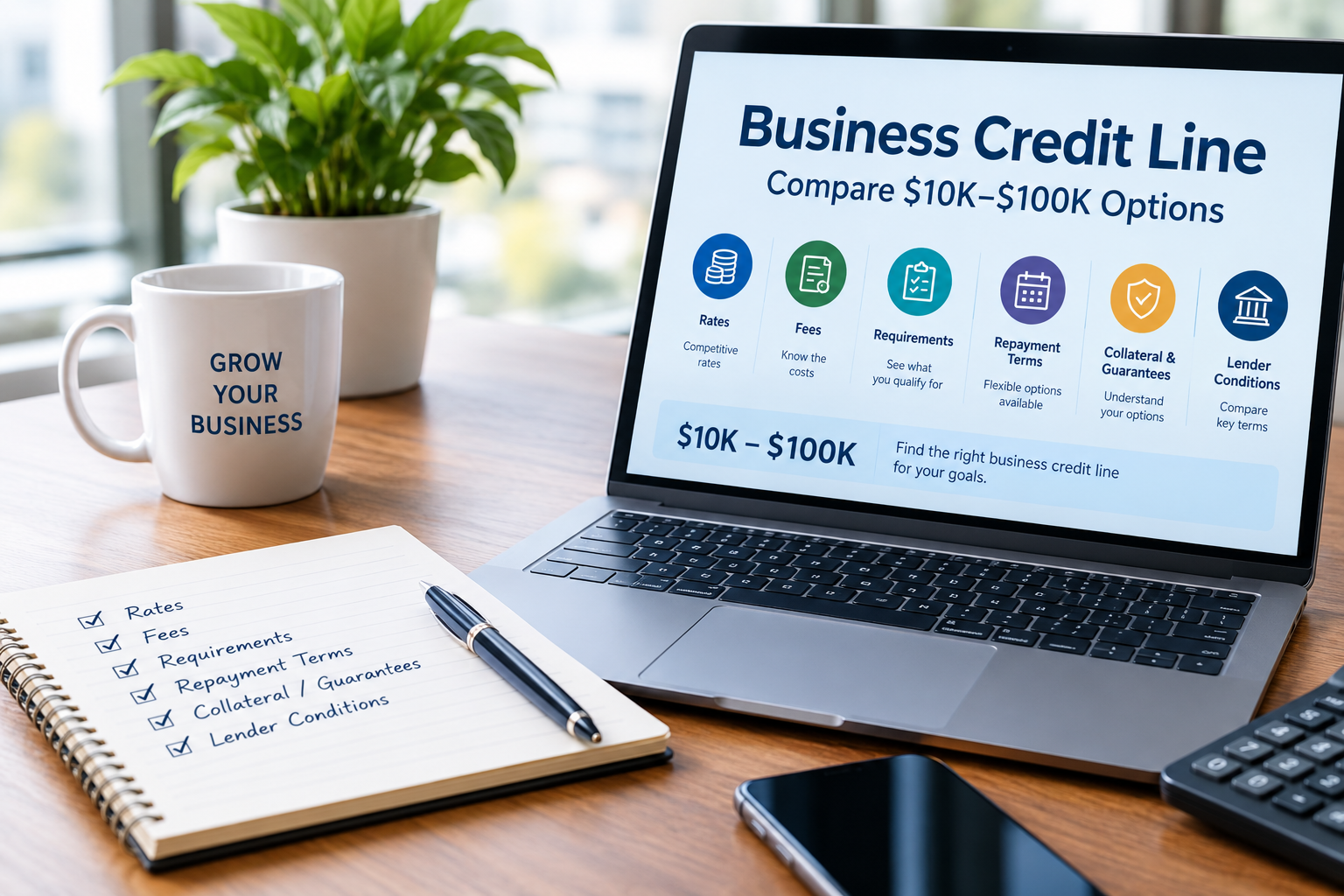
A business credit line gives a company flexible access to an approved amount of financing that can be drawn when needed rather than requiring the entire amount to be borrowed upfront. For businesses comparing roughly $10,000 to $100,000 in available credit, the real decision goes far beyond the advertised credit limit.
A strong business credit line should fit the company’s cash-flow cycle, borrowing frequency, expected utilization, repayment capacity and tolerance for guarantees or collateral. Borrowers should also compare interest calculations, annual fees, draw fees, repayment frequency, renewal conditions, lender rights to reduce or freeze the line and whether repaid principal becomes available to borrow again.
That makes a business credit line particularly relevant for recurring or unpredictable short-term needs such as inventory, supplier payments, payroll timing, repairs, receivables gaps and seasonal working capital.
The goal of this guide is to help U.S. business owners compare a business credit line as a complete financing decision—not simply chase the biggest limit, fastest approval or lowest-looking rate.
Educational note: Kevanzo provides general business-financing information and comparison guidance. It is not a lender, broker, financial adviser or approval service. Financing availability, limits, costs and requirements depend on the lender, applicant and underwriting.
What Is a Business Credit Line?
A business credit line is a financing facility that allows an eligible business to borrow up to an approved credit limit.
Unlike a traditional term loan, where the borrower generally receives a lump sum, a credit line can allow funds to be accessed as business needs arise. With a genuinely revolving structure, principal that is repaid can restore available borrowing capacity, subject to the lender agreement.
For example:
Approved credit line: $75,000
The business draws $20,000 to purchase inventory.
Available credit falls to approximately $55,000.
The business repays $10,000 of principal.
If the product is fully revolving and no other restrictions apply, available capacity may rise to approximately $65,000.
That repeat access is one of the main reasons businesses compare credit lines with ordinary loans.
However, products differ. Never assume that every facility marketed as a credit line operates identically.
Why Businesses Use Credit Lines
A business credit line can be useful when the financing need is genuine but the exact amount or timing cannot be predicted perfectly.
Common uses include:
- covering short-term working-capital gaps;
- purchasing inventory before revenue arrives;
- paying suppliers;
- managing seasonal cash-flow changes;
- bridging accounts-receivable timing;
- meeting temporary payroll obligations;
- paying for unexpected equipment repairs;
- financing materials for a contracted project;
- covering short-duration operating expenses; and
- maintaining additional liquidity for unexpected business needs.
The key word is temporary.
A credit line is generally more defensible when there is a clear source from which each draw can ultimately be repaid.
Continually using new draws simply to fund losses or ordinary expenses that normal revenue cannot support can turn flexible credit into persistent debt.
What Changes as Your Credit Needs Grow?
The funding amount should influence how you compare offers.
There is no universal rule saying every lender becomes more demanding at a particular dollar threshold. Nevertheless, different factors tend to become increasingly important as the requested credit exposure grows.
| Decision area | What deserves extra attention |
|---|---|
| Fees and borrowing mechanics | Annual fees, minimum borrowing amounts, speed, repayment frequency and whether another form of credit could cost less |
| Repayment and qualification | Interest structure, revenue expectations, personal guarantee, utilization and payment affordability |
| Underwriting and renewal | Cash-flow strength, financial documentation, annual fees, underwriting and renewal conditions |
| Security and total borrowing economics | Total borrowing economics, collateral possibilities, personal guarantees, UCC exposure, financial documentation and bank-versus-online-lender differences |
The higher limit should not automatically win.
If your business realistically needs $25,000 of temporary credit, obtaining $100,000 does not necessarily make the product better.
The objective is sufficient useful capacity at acceptable cost and risk.
The 7 Most Important Things to Compare
1. Credit Limit
Start with the amount the business realistically requires.
Ask two separate questions:
How much credit would make the financing useful?
and
How much debt could the business safely carry if most of the line were used?
Those figures are not necessarily the same.
A business may like having access to $100,000 but be financially comfortable carrying only a $30,000 balance.
That distinction matters.
2. Interest-Rate Structure
Find out exactly how interest is calculated.
A rate may be:
- fixed;
- variable;
- tied to Prime or another benchmark;
- expressed as the benchmark plus a lender margin; or
- structured differently depending on the product.
A variable rate can change as its benchmark moves.
Do not stop at the headline percentage. Determine whether the quoted rate is the complete borrowing rate and what could cause it to change.
3. Fees
A business credit line can carry costs beyond interest.
Potential charges can include:
- annual fees;
- maintenance fees;
- draw fees;
- origination fees;
- wire-transfer fees;
- cash-advance fees;
- late fees;
- unused-line fees; and
- other facility charges.
One lender can therefore have a lower headline rate and still produce a higher expected total cost for a particular borrower.
4. Repayment Frequency
Find out whether repayments are expected:
- daily;
- weekly;
- monthly; or
- according to another schedule.
This can be extremely important.
Suppose your customers normally pay invoices 30 to 60 days after delivery. A facility demanding frequent payments could place pressure on cash flow before the income generated by the financed activity arrives.
The financing should fit the business’s operating cycle—not fight against it.
5. Revolving Mechanics
Ask a simple question:
When I repay principal, can I borrow that money again?
A genuine revolving facility generally replenishes borrowing availability as principal is repaid, subject to the agreement.
Other financing structures can behave differently.
Some products may create separate repayment obligations for individual draws or limit the period during which new funds can be accessed.
Understand this before borrowing.
6. Security and Guarantees
Check whether the lender requires:
- specific business collateral;
- a blanket security interest;
- a UCC filing;
- a personal guarantee; or
- another form of security.
Importantly, unsecured does not necessarily mean no personal exposure.
An unsecured business line of credit may avoid a specific collateral requirement while still involving a personal guarantee or other lender protections.
7. Renewal and Continued Availability
A company can become dangerously dependent on credit that it assumes will always remain available.
Ask:
- Does the credit line expire?
- Is there an annual review?
- Does it renew automatically?
- Can the lender reduce the limit?
- Can future draws be suspended?
- What financial reporting is required?
- What happens to an outstanding balance if the facility is not renewed?
Unused borrowing capacity has value only while it remains available.
How to Compare Business Credit Facilities
Business credit facilities can differ materially in structure even when they serve similar working-capital needs.
For an evergreen comparison, focus on the terms that determine how the facility actually works rather than on temporary lender offers, promotional rates or changing product limits.
Compare the Credit Limit and Access Structure
Start by comparing the credit limit, minimum and maximum draw rules, whether repaid principal restores available credit, and whether the facility has a draw period, maturity date or renewal review. A larger limit is not automatically better if the business does not need the extra capacity or the terms become less suitable.
Compare Security, Guarantees and Fees
Next compare whether the facility is secured or unsecured, whether a personal guarantee or UCC filing may apply, and which annual, maintenance, draw or origination fees could increase the real cost. A secured structure may sometimes support different pricing or capacity, but it also changes the business assets potentially exposed under the agreement.
Compare Repayment and Ongoing Availability
Finally, compare payment frequency, minimum-payment rules, variable-rate provisions, renewal requirements, financial-reporting obligations and the lender’s contractual rights to freeze or reduce future access. A credit line is useful only when its repayment structure fits the business’s cash flow and the company understands that future borrowing availability may be conditional.
The goal is not to identify one universally best lender or product.
A purchase-ready borrower should compare structure against structure: useful credit capacity, total cost, repayment demands, security exposure, renewal conditions and how well the facility matches the business’s actual cash-flow cycle.
For a broader provider-selection framework, see Kevanzo’s small business loan lenders guide.
How to Calculate the True Cost of a Business Credit Line
One of the biggest mistakes borrowers make is comparing only the headline interest rate.
A more useful framework is:
Expected borrowing cost = interest on the amount actually used + facility fees + draw fees + setup costs + other applicable charges
You should then calculate the expected economics using the balance you actually expect to carry.
$100,000 Credit Line Example
Suppose a hypothetical business receives a $100,000 credit line.
For illustration only, assume:
- 12% annual interest;
- $150 annual facility fee;
- no draw fee; and
- a relatively stable average balance.
The economics could look approximately like this:
| Average utilization | Average amount borrowed | Illustrative annual interest | Facility fee | Illustrative total |
|---|---|---|---|---|
| 25% | $25,000 | $3,000 | $150 | $3,150 |
| 50% | $50,000 | $6,000 | $150 | $6,150 |
| 75% | $75,000 | $9,000 | $150 | $9,150 |
This is a simplified hypothetical example, not a lender quote.
Real balances can change throughout the year, interest may accrue differently, rates can be variable and additional charges may apply.
But the exercise shows something important:
Credit limit is not the same thing as expected borrowing cost.
A company approved for $100,000 but normally using $25,000 should analyze the economics primarily around its expected $25,000 usage—not pretend the full $100,000 will always be outstanding.
Can Your Business Qualify?
There is no universal qualification standard for a business credit line.
Lenders can evaluate a combination of factors.
Personal Credit
For many small businesses, particularly closely held companies, the owner’s personal credit can influence underwriting.
A stronger credit history may broaden available options, but a particular score never guarantees approval.
Businesses facing more difficult credit circumstances can review Kevanzo’s guide to business loans for bad credit rather than assuming every credit-line application will use the same underwriting standard.
Business Credit
An established business may also have a commercial credit profile.
Payment history, existing borrowing, liens and other credit information can influence how a lender evaluates risk.
Revenue
Revenue indicates business scale, but sales alone do not prove repayment capacity.
A company can generate substantial revenue while having poor margins or severe cash-flow pressure.
Cash Flow
Cash flow can be especially important because a lender needs evidence that repayments can be supported by the business.
Questions include:
- How stable are deposits?
- How variable are monthly sales?
- How quickly do customers pay?
- What existing debt payments already leave the account?
- How much operating cash remains after expenses?
Time in Business
Longer operating history gives the lender more historical information to evaluate.
Newer businesses may encounter different lender options, documentation requirements or underwriting standards.
Existing Debt
The business credit line will not exist in isolation.
Existing loans, cards, leases and other obligations can affect repayment capacity.
Calculate the company’s obligations after adding the proposed credit-line payment.
Industry and Business Risk
Some lenders restrict certain industries or apply different underwriting depending on the business model.
Ownership and Guarantees
Owners with significant control may be required to guarantee the obligation depending on the lender and product.
For businesses already preparing to approach lenders, Kevanzo’s business line of credit guide explains what pre approval means and why it is not final funding approval.
Documents You May Need
Requirements vary, but businesses may be asked for documents such as:
- business identification;
- Employer Identification Number;
- ownership information;
- formation documents;
- business bank statements;
- profit-and-loss statements;
- balance sheets;
- tax returns;
- debt schedules;
- accounts-receivable aging;
- accounts-payable aging;
- information about collateral;
- identification for guarantors; and
- details about the intended funding use.
Preparing these before submitting an application can make comparison easier and reduce the risk of inconsistent information being supplied to different lenders.
Secured vs. Unsecured Business Credit Lines
The important question is not simply whether one product is secured.
It is what the complete structure means for your business.
| Factor | Secured credit line | Unsecured credit line |
|---|---|---|
| Collateral | Specific business assets may secure the facility | Specific collateral may not be required |
| Credit limit | Larger limits may be available in some programs | Limits may be lower depending on lender |
| Rate | Security can sometimes support more favorable pricing | Pricing may reflect greater lender risk |
| Personal guarantee | May still apply | May also apply |
| UCC filing | Common when business assets secure credit | May still arise depending on agreement |
| Underwriting | Collateral and lien position can matter | Creditworthiness and cash flow can receive greater emphasis |
| Asset risk | Pledged assets can be exposed after default | Lack of specific collateral does not eliminate contractual risk |
Do not interpret unsecured financing as automatically safer.
The complete contract matters.
Hidden Contract Terms Worth Checking
Purchase-ready borrowers should pay close attention to contract language that receives less attention than the advertised rate.
Variable-Rate Benchmark and Margin
If the rate is variable, identify:
- the benchmark;
- lender margin;
- any rate floor;
- adjustment timing; and
- circumstances in which pricing can change.
Personal Guarantee
Understand exactly who is guaranteeing repayment and under what circumstances the guarantee can be enforced.
UCC Filing
A UCC filing can affect the lender’s security interest and potentially influence the business’s ability to pledge assets elsewhere.
Minimum Draw
A minimum borrowing amount may reduce flexibility if the business only needs a small amount.
Draw Fees
Repeated fees can make frequent small draws more expensive than expected.
Annual Fee
Determine whether the annual charge applies regardless of how much credit is used.
Unused-Line Fee
Some commercial facilities can charge for unused committed capacity.
Renewal
Find out whether continued access requires periodic underwriting or documentation.
Freeze and Reduction Rights
Read the circumstances under which additional borrowing can be suspended.
Default
Know which events constitute default and what remedies become available to the lender.
Cross-Default
Some agreements can be affected by defaults involving other obligations.
These provisions can materially change the value and risk of a credit facility.
Business Credit Line vs. Business Loan
A business credit line and a traditional term loan solve different financing problems.
| Decision factor | Business credit line | Business loan |
|---|---|---|
| Funding method | Draw funds as required up to available limit | Receive agreed loan amount |
| Repeat borrowing | Designed for repeated access when revolving | New borrowing generally requires another loan |
| Interest | Often applies to funds drawn | Applies to outstanding loan balance |
| Payment amount | Can vary as utilization changes | Often more predictable |
| Ideal comparison | Recurring or unpredictable short-term needs | Defined one-time financing requirement |
| Continued availability | Can depend on facility terms and renewal | Funds are advanced upfront |
A line can therefore make sense for inventory or recurring working-capital timing.
A loan can make more sense for a known, one-time expenditure.
Businesses comparing the broader financing market should also review small business loans.
Using a Credit Line for Working Capital
Working capital is one of the clearest applications for revolving business credit.
Consider a wholesaler that must pay suppliers before retailers pay outstanding invoices.
If:
- the underlying sales are profitable;
- customer payments are reasonably predictable; and
- the financing period is temporary,
a credit line can bridge the timing difference.
Another example is a seasonal company that needs additional inventory several weeks before peak sales begin.
The company can potentially draw funds before the selling season, then repay the balance as revenue arrives.
Readers specifically evaluating operating-capital financing can continue to Kevanzo’s guide to working capital loans for small business.
When an SBA Working-Capital Credit Line May Be Relevant
The U.S. Small Business Administration offers working-capital financing pathways through participating lenders that may be relevant when a business needs flexible funding for operating needs.
SBA-backed working-capital financing can be used for needs such as receivables, inventory, contracts and projects, subject to the applicable program rules and participating-lender underwriting. Businesses should verify current eligibility and program terms directly with the SBA before applying.
That does not mean SBA financing is automatically preferable.
Eligibility, lender underwriting, documentation and program rules still apply.
Its relevance here is to remind borrowers that conventional bank and online credit facilities are not the only structures worth understanding.
Business Credit Line Decision Tree
Use this before approaching lenders.
Do You Need Financing Once or Repeatedly?
Repeatedly: a revolving credit line deserves consideration.
Once: compare a term loan as well.
Is the Need Short-Term?
Yes: continue comparing credit lines.
No: long-term financing could be structurally more appropriate.
Can You Identify the Repayment Source?
Yes: estimate when the cash should arrive.
No: reconsider whether debt is solving the underlying problem.
Are Fees and Minimum Draw Rules Important?
Give particularly close attention to fees and whether the facility’s fixed costs are proportionate to the relatively small amount borrowed.
Does the Repayment Structure Fit Your Cash Flow?
Compare credit requirements, payment frequency, expected utilization and guarantees.
Can You Meet the Underwriting Requirements?
Pay increasing attention to documentation, cash-flow capacity and renewal exposure.
Are You Comfortable With Guarantees or Collateral?
Compare the complete economics of bank, secured, unsecured and online alternatives rather than making the decision around approval speed alone.
Do You Need Funding Quickly?
An online application can be convenient, but convenience should not override total cost and contract review.
Kevanzo’s guide to how to apply for business financing online explains the digital application route in more detail.
The Business Credit Line Stress Test
Before accepting an offer, test the financing against a weaker scenario.
Suppose your business expects to borrow $40,000 and repay it from customer collections over the following three months.
Now ask:
What happens if customer payments arrive 30 days late?
Then test:
What happens if monthly sales fall 20%?
Then:
Could the business still meet payroll, tax obligations, supplier payments, existing debt and the credit-line payment?
If the answer becomes uncomfortable after a modest downside scenario, the business may be considering too much debt, the wrong repayment schedule or the wrong financing structure.
Approval capacity and safe borrowing capacity are not necessarily the same.
Questions to Ask Before Accepting an Offer
Do not sign until you can answer these clearly:
- What is the total approved limit?
- What determines the interest rate?
- Is the rate fixed or variable?
- If variable, which benchmark and margin apply?
- Is there a rate floor?
- Is there an annual fee?
- Is there a maintenance fee?
- Are draw fees charged?
- Is there an origination fee?
- How frequently are payments required?
- How is the minimum payment calculated?
- Does each draw create its own repayment schedule?
- Does repaid principal restore available credit?
- Is there a minimum draw amount?
- Is collateral required?
- Is a personal guarantee required?
- Will a UCC financing statement be filed?
- How long is the draw period?
- Does the facility require annual renewal?
- Can the lender reduce the limit?
- Can additional draws be frozen?
- What constitutes default?
- What happens at maturity?
- Are there prepayment restrictions?
- What financial information must be supplied after approval?
If an important answer has only been provided verbally, locate the corresponding provision in the written agreement.
Before You Apply
Prepare a one-page borrowing plan containing:
Target credit limit:
How much capacity is genuinely required?
Expected normal balance:
How much will usually be outstanding?
Maximum expected balance:
What is the realistic worst-case utilization?
Funding purpose:
Exactly what will each draw finance?
Repayment source:
Which future cash flow is expected to reduce the balance?
Repayment timing:
When should that cash arrive?
Existing obligations:
What other payments must still be met?
Downside scenario:
What happens if revenue falls or receivables arrive late?
Guarantee tolerance:
Are owners comfortable with the requested guarantee?
Collateral tolerance:
Which assets, if any, could reasonably secure financing?
Maximum acceptable cost:
At what point does borrowing stop creating sufficient economic value?
This framework makes lender comparison much more disciplined.
Common Business Credit Line Mistakes
Choosing the Largest Limit
More available credit is not automatically better financing.
Comparing Only Rates
A low-looking rate can be offset by fees or unfavorable repayment requirements.
Ignoring Utilization
Compare costs at the amount you actually expect to borrow.
Ignoring Payment Frequency
A financing product can look affordable annually but create damaging weekly cash pressure.
Assuming Unsecured Means No Guarantee
Always read the actual security and guarantee provisions.
Treating the Credit Limit as Permanent
Future availability may depend on the agreement, renewal and continuing financial condition.
Using Credit to Finance Permanent Losses
A revolving balance that never declines can signal a structural business problem.
Applying Everywhere at Once
First narrow the realistic options and understand each lender’s application and credit-inquiry process.
Ignoring the Contract
Marketing pages help with screening. The signed agreement determines the obligation.
Frequently Asked Questions
How Does a Business Credit Line Work?
A lender approves a maximum credit amount. The business can generally draw funds up to the available limit under the agreement. Interest and fees depend on the product. With revolving credit, repaying principal can restore borrowing capacity.
Is a Business Credit Line the Same as a Business Line of Credit?
The phrases are commonly used to describe the same broad type of revolving business-financing product. Specific lenders may favor one term over the other, so the contract—not the wording alone—determines how the facility actually operates.
How Much Business Credit Can I Get?
There is no universal amount. Limits depend on lender policy, creditworthiness, revenue, cash flow, operating history, existing obligations, requested security and other underwriting factors.
What Credit Score Is Needed?
There is no market-wide minimum. Individual lenders can publish their own criteria and may consider personal and business credit together with other financial information.
Do Business Credit Lines Require Collateral?
Some do and some do not. Even facilities marketed as unsecured can include a personal guarantee or other lender protections.
Do You Pay Interest on the Whole Credit Limit?
Many revolving facilities calculate interest based primarily on the amount drawn rather than the entire approved limit, but annual, maintenance, draw or other fees may still apply. Check the agreement.
Is a $100,000 Credit Line Better Than a $50,000 Credit Line?
Only if the additional capacity is useful and the associated cost and obligations are acceptable. The right amount is the amount that fits the actual financing need and repayment capacity.
Can You Use a Credit Line for Payroll?
Businesses can use some facilities for ordinary working-capital purposes such as payroll, subject to the lender’s permitted-use provisions. The more important question is whether the draw will be repaid from predictable incoming cash.
Is a Credit Line Better Than a Business Loan?
Neither is universally better. Credit lines generally deserve consideration for repeated and uncertain short-term borrowing. Term loans generally deserve comparison when financing one defined expenditure.
Can a Lender Cancel or Reduce a Credit Line?
Depending on the agreement and circumstances, access may be reduced, frozen or not renewed. Review the relevant contractual provisions before becoming dependent on the facility.
Why Lender Type Matters
Federal Reserve Small Business Credit Survey research illustrates that small businesses use loans, lines of credit and other financing products to meet funding needs. The report also shows that financing applicants continue to use large banks, online lenders and small banks, reinforcing why lender type and financing structure matter during comparison.
The survey covers a nationwide convenience sample rather than a random sample, so its results should be treated as evidence about small-business financing conditions rather than a precise measurement of every U.S. business.
How Kevanzo Compares Business Credit Lines
When named lenders are discussed, Kevanzo’s objective is to compare commercially relevant factors rather than simply rank providers.
Important comparison fields include:
- available credit limit;
- rate structure;
- published fees;
- repayment frequency;
- revolving mechanics;
- time-in-business requirements;
- revenue requirements;
- published credit indications;
- security requirements;
- personal guarantees;
- UCC exposure;
- draw structure;
- renewal conditions;
- funding access;
- application requirements; and
- date the information was verified.
Lender-specific information can change.
For that reason, current lender details should remain isolated from the durable educational sections of this guide and should be rechecked against first-party sources before materially relying on them.
Helpful Resources
For additional independent information, business owners can consult:
Federal Reserve Small Business Credit Survey
Provides research on financing demand, applications, approval experiences and small-business credit conditions.
U.S. Small Business Administration
Provides official information on SBA lending programs, including the 7(a) Working Capital Pilot.
These official sources are useful for validating broader market and government-program information independently of lender advertising.
Final Takeaway
A business credit line should be judged by far more than its maximum limit.
For a business comparing $10,000 to $100,000 of revolving credit, the strongest decision considers:
- how much credit is genuinely needed;
- how much will normally be used;
- the expected total borrowing cost;
- repayment frequency;
- cash-flow timing;
- whether repaid principal can be reused;
- fees;
- qualification requirements;
- personal guarantees;
- collateral;
- UCC exposure;
- renewal provisions;
- lender rights to restrict further borrowing; and
- the source from which each draw will ultimately be repaid.
The best-looking approval is not necessarily the best financing.
A useful business credit line provides enough flexibility to solve short-term funding needs without placing the company under unnecessary cost or repayment pressure.
Compare the written terms. Stress-test the payments. Understand the guarantees. Know the repayment source.
Then choose the financing structure that fits the business—not simply the biggest credit limit available.
Author Bio
Kevanzo Editorial Team
The Kevanzo Editorial Team creates plain-English educational resources for U.S. business owners comparing business financing, credit lines, small business loans, borrowing costs, lender requirements, repayment structures and funding decisions.
Copyright Notice
© 2026 Kevanzo. All rights reserved.
This article is protected by copyright and may not be copied, scraped, spun, republished or commercially reproduced without prior written permission from Kevanzo. Brief quotations may be used with appropriate attribution and a link to the original article.
Disclaimer
Kevanzo.com provides general educational information about business financing. Kevanzo is not a lender, loan broker, financial adviser, attorney, accountant or approval service.
Nothing in this article constitutes financial, legal, tax, accounting, lending or personalized business advice. Rates, fees, limits, repayment terms, qualification standards, collateral requirements, personal guarantees, product availability and underwriting decisions vary by lender and applicant and can change.
Review current lender information and the complete financing agreement before accepting business credit.
7 thoughts on “Business Credit Line: Compare Costs, Terms & Requirements”